Page 36 of 502
NOTE:
• After setting the Child-Protection Door Lock system,
always test the door from the inside to make certain it
is in the desired position.
• For emergency exit with the system engaged, move
the door lock switch to the UNLOCK position, roll
down the window and open the door with the outside
door handle. WINDOWS
Power Windows – If Equipped
Power Window Switches1 – Left Front 3 – Right Rear
2 – Right Front 4 – Left Rear34 THINGS TO KNOW BEFORE STARTING YOUR VEHICLE
Page 40 of 502

normal occurrence and can be minimized. If the rear
windows are open and buffeting occurs, open the front
and rear windows together to minimize the buffeting.
OCCUPANT RESTRAINTS
Some of the most important safety features in your
vehicle are the restraint systems:
• Three-point lap and shoulder belts for the driver and
all passengers
• Advanced Front Air Bags for driver and front passen-
ger — if equipped
• An energy-absorbing steering column and steering
wheel
• Knee bolsters/blockers for front seat occupants • All seat belt systems (except driver ’s regular/Crew
Cab � , first and second row center position for Crew
Cab � only) include Automatic Locking Retractors
(ALR)
If you will be carrying children too small for adult-sized
seat belts, the seat belts or the Lower Anchors and Tether
for CHildren (LATCH) feature also can be used to hold
infant and child restraint systems. For further informa-
tion, refer to “Lower Anchors and Tether for CHildren
(LATCH)”.
NOTE: The Advanced Front Air Bags have a multistage
inflator design. This allows the air bag to have different
rates of inflation based on several factors, including the
severity and type of collision.
Please pay close attention to the information in this
section. It tells you how to use your restraint system
properly, to keep you and your passengers as safe as
possible.38 THINGS TO KNOW BEFORE STARTING YOUR VEHICLE
Page 51 of 502

WARNING!• A lap belt worn too loose or too high is dangerous.
• A belt worn too loose can allow you to slip down
and under the belt in a collision.
• A belt that is too loose or too high will apply crash
forces to the abdomen, not to the stronger hip
bones. In either case, the risk of internal injuries is
greater. Wear a lap belt low and snug.
Seat Belts In Passenger Seating Positions
The seat belts in the passenger seating positions are
equipped with an Automatic Locking Retractor (ALR) or
a cinching latch plate which are used to secure a child
restraint system. For additional information refer to
“Installing Child Restraints Using the Vehicle Seat Belt”
under the “Child Restraint” section. The chart below
defines the type of feature for each seating position. Regular Cab
Left Center Right
First Row N/A ALR ALR
• N/A — Not Applicable
• ALR — Automatic Locking Retractor
Crew Cab �
Left Center Right
First Row N/A N/A ALR
Second Row ALR Cinch ALR
• N/A — Not Applicable
• ALR — Automatic Locking Retractor
If the passenger seating position is equipped with an
ALR and is being used for normal usage:
Only pull the belt webbing out far enough to comfortably
wrap around the occupants mid-section so as to not 2 THINGS TO KNOW BEFORE STARTING YOUR VEHICLE 49
Page 52 of 502

activate the ALR. If the ALR is activated you will hear a
ratcheting sound as the belt retracts. Allow the webbing
to retract completely in this case and then carefully pull
out only the amount of webbing necessary to comfort-
ably wrap around the occupants mid-section. Slide the
latch plate into the buckle until you hear a � click. �
Automatic Locking Retractor Mode (ALR) — If
Equipped
In this mode, the shoulder belt is automatically pre-
locked. However, the belt will still retract to remove slack
in the shoulder belt. Use the Automatic Locking Mode
any time a child safety seat is installed in a seating
position that has a seat belt with this feature. Children
12 years old and younger should be properly restrained
in the rear seat whenever possible.
How To Engage The Automatic Locking Mode
1. Buckle the combination lap and shoulder belt. 2. Grasp the shoulder portion and pull downward until
the entire belt is extracted.
3. Allow the belt to retract. As the belt retracts, you will
hear a ratcheting sound. This indicates the safety belt is
now in the Automatic Locking mode.
How To Disengage The Automatic Locking Mode
Unbuckle the combination lap and shoulder belt and
allow it to retract completely to disengage the Automatic
Locking mode and activate the vehicle sensitive (emer-
gency) locking mode.
Center Lap Belts — Crew Cab � Only
The front center seating position has a lap belt only. To
fasten the lap belt, slide the latch plate into the buckle
until you hear a “click.” To lengthen the lap belt, tilt the
latch plate and pull. To remove slack, pull the loose end
of the webbing. Wear the lap belt snug against the hips.
Sit back and erect in the seat, then adjust the belt as
tightly as is comfortable.50 THINGS TO KNOW BEFORE STARTING YOUR VEHICLE
Page 73 of 502

We urge you to carefully follow the directions of the
manufacturer when installing your child restraint. Many,
but not all, restraint systems will be equipped with
separate straps on each side, with each having a hook or
connector, and a means for adjusting the tension in the
strap. Forward-facing toddler restraints and some
rearward-facing infant restraints will also be equipped
with a tether strap, a hook and means for adjusting the
tension in the strap.
In general, you will first loosen the child seat adjusters on
the lower straps and tether straps so that you can more
easily attach the hook or connector to the lower anchor-
ages and tether anchorages. Then tighten all three straps
as you push the child restraint rearward and downward
into the seat.
Not all child restraint systems will be installed as we
have described here. Again, carefully follow the instruc-
tions that come with the child restraint system. WARNING!Improper installation of a child restraint to the
LATCH anchorages can lead to failure of an infant or
child restraint. The child could be badly injured or
killed. Follow the manufacturer’s directions exactly
when installing an infant or child restraint.
Installing Child Restraints Using The Vehicle Seat
Belt
The seat belts in the passenger seating positions are
equipped with either an Automatic Locking Retractor
(ALR) or a cinching latch plate or both. Both types of seat
belts are designed to keep the lap portion of the seat belt
tight around the child restraint so that it is not necessary
to use a locking clip. The ALR will make a ratcheting
noise if you extract the entire belt from the retractor and
then allow the belt to retract into the retractor. For
additional information on ALR, refer to “Automatic
Locking Mode”. 2 THINGS TO KNOW BEFORE STARTING YOUR VEHICLE 71
Page 74 of 502
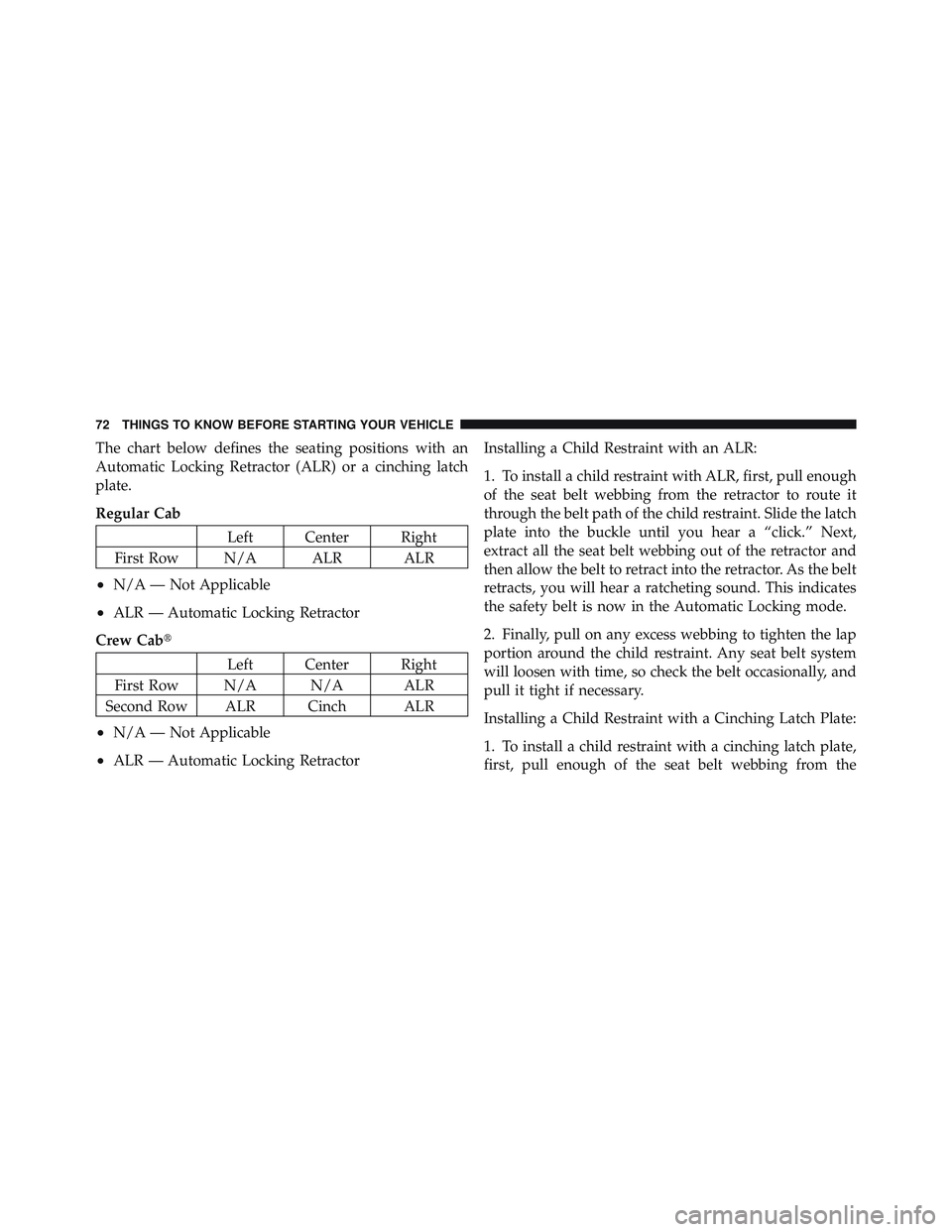
The chart below defines the seating positions with an
Automatic Locking Retractor (ALR) or a cinching latch
plate.
Regular Cab
Left Center Right
First Row N/A ALR ALR
• N/A — Not Applicable
• ALR — Automatic Locking Retractor
Crew Cab �
Left Center Right
First Row N/A N/A ALR
Second Row ALR Cinch ALR
• N/A — Not Applicable
• ALR — Automatic Locking Retractor Installing a Child Restraint with an ALR:
1. To install a child restraint with ALR, first, pull enough
of the seat belt webbing from the retractor to route it
through the belt path of the child restraint. Slide the latch
plate into the buckle until you hear a “click.” Next,
extract all the seat belt webbing out of the retractor and
then allow the belt to retract into the retractor. As the belt
retracts, you will hear a ratcheting sound. This indicates
the safety belt is now in the Automatic Locking mode.
2. Finally, pull on any excess webbing to tighten the lap
portion around the child restraint. Any seat belt system
will loosen with time, so check the belt occasionally, and
pull it tight if necessary.
Installing a Child Restraint with a Cinching Latch Plate:
1. To install a child restraint with a cinching latch plate,
first, pull enough of the seat belt webbing from the72 THINGS TO KNOW BEFORE STARTING YOUR VEHICLE
Page 275 of 502

STARTING PROCEDURES
Before starting your vehicle, adjust your seat, adjust both
inside and outside mirrors, and fasten your seat belt.
The starter should not be operated for more than 15-
second intervals. Waiting a few seconds between such
intervals will protect the starter from overheating.
WARNING!Never leave children alone in a vehicle. Leaving
children in a vehicle unattended is dangerous for a
number of reasons. A child or others could be seri-
ously or fatally injured. Children should be warned
not to touch the parking brake, brake pedal or the
shift lever. Do not leave the key fob in the vehicle. A
child could operate power windows, other controls,
or move the vehicle. Normal Starting
Normal starting of either a warm or cold engine is
obtained without pumping or pressing the accelerator
pedal. Turn the key fob to the START position and release
when the engine starts. If the engine fails to start within
10 seconds, turn the key fob to the OFF position, wait five
seconds, then repeat the “Normal Starting” procedure.
Automatic Transmission
Start the engine with the shift lever in the NEUTRAL or
PARK position. Apply the brake before shifting into any
driving range.
NOTE: This vehicle is equipped with a transmission
shift interlocking system. The brake pedal must be
pressed to shift out of PARK.
5 STARTING AND OPERATING 273
Page 279 of 502

WARNING!• Unintended movement of a vehicle could injure
those in or near the vehicle. As with all vehicles,
you should never exit a vehicle while the engine is
running. Before exiting a vehicle, always apply the
parking brake, shift the transmission into PARK,
and remove the key fob. Once the key fob is
removed, the shift lever is locked in the PARK
position, securing the vehicle against unwanted
movement. Furthermore, you should never leave
unattended children inside a vehicle.
(Continued) WARNING! (Continued)• Leaving children in a vehicle unattended is dan-
gerous for a number of reasons. A child or others
could be seriously or fatally injured. Children
should be warned not to touch the parking brake,
brake pedal or the shift lever. Do not leave the key
fob in the vehicle. A child could operate power
windows, other controls, or move the vehicle.
• It is dangerous to move the shift lever out of PARK
or NEUTRAL if the engine speed is higher than
idle speed. If your foot is not firmly pressing the
brake pedal, the vehicle could accelerate quickly
forward or in reverse. You could lose control of the
vehicle and hit someone or something. Only shift
into gear when the engine is idling normally and
when your foot is firmly pressing the brake pedal.
5 STARTING AND OPERATING 277
