Page 94 of 173

JUMP STARTING
WARNING!
•To prevent personal injury or damage to clothing,
do not allow battery fluid to contact eyes, skin or
fabrics. Do not lean over a battery when connect-
ing jumper cables or allow cable clamps to touch
each other. Keep open flames or sparks away from
battery vent holes. Always wear eye protection
when working with batteries.
•Do not use a booster battery or any other booster
source that has a greater than 12 Volt system, i.e.,
do not use a 24 Volt power source.
NOTE: Replacement batteries should both be of equal
size to prevent damage to the vehicle’s charging system.
Your vehicle is equipped with two 12 Volt batteries. If it
becomes necessary to use a booster battery with jumper cables to start a vehicle’s engine because its batteries are
discharged, the following procedure should be used:
Set the parking brake and place an automatic transmis-
sion in PARK (or NEUTRAL for a manual transmission).
Turn off lights, heater and other electrical loads. Observe
charge indicator (if equipped) in both batteries. If the
indicator (if equipped) is light or yellow on either battery,
replace that battery.
CAUTION!
Use the jump start procedure only when the charge
indicator (if equipped) in both batteries is dark in the
center. Do not attempt jump starting when either
battery charge indicator (if equipped) is bright or
yellow. If the charge indicator (if equipped) has a
green dot in the center, failure to start is not due to a
discharged battery and cranking system should be
checked.
92 WHAT TO DO IN EMERGENCIES
Page 99 of 173
MAINTAINING YOUR VEHICLE
CONTENTS
�Engine Compartment — 6.7L Diesel ......... 99
� Maintenance Procedures ................. 100
▫ Engine Oil ......................... 100
▫ Engine Air Cleaner Filter ............... 104
▫ Draining Fuel/Water Separator Filter ...... 106
▫ Fuel Filter Replacement ................ 108
▫ Priming If The Engine Has Run Out Of
Fuel .............................. 110
▫ Intervention Regeneration Strategy – EVIC
Message Process Flow ..................111 ▫
Diesel Exhaust Fluid – Chassis Cab Only . . . 114
▫ Maintenance-Free Batteries ............. 114
▫ Cooling System ..................... 115
▫ Charge Air Cooler – Inter-Cooler ......... 121
▫ Brake System ....................... 121
▫ Clutch Hydraulic System ............... 123
▫ Transfer Case – If Equipped ............. 123
▫ Manual Transmission – If Equipped ....... 124
▫ Automatic Transmission – If Equipped ..... 124
6
Page 101 of 173
ENGINE COMPARTMENT — 6.7L DIESEL
1 — Battery6 — Washer Fluid Reservoir
2 — Engine Coolant Reservoir 7 — Integrated Power Module
3 — Automatic Transmission Dipstick (If Equipped) 8 — Engine Oil Fill
4 — Engine Oil Dipstick 9 — Coolant Pressure Cap
5 — Brake Fluid Reservoir 10 — Air Cleaner Filter
6
MAINTAINING YOUR VEHICLE 99
Page 126 of 173

Fluid Level Check
This fluid level can be checked by removing the filler
plug. The fluid level should be to the bottom edge of the
filler plug hole with the vehicle in a level position.
Manual Transmission – If Equipped
Lubricant Selection
Refer to “Fluids, Lubricants, and Genuine Parts” in
“Maintaining Your Vehicle” for further information.
Fluid Level Check
The fluid level can be checked by removing the filler
plug. If the level of the lubricant is more than 1/2 in
(12 mm) below the bottom of the filler hole while the
vehicle is on level ground, enough lubricant should be
added to bring the level to 1/4 in (6 mm) below the
bottom of the filler hole.
Automatic Transmission – If Equipped
Lubricant Selection
Refer to “Fluids, Lubricants, and Genuine Parts” in
“Maintaining Your Vehicle” for further information.
Fluid Level Check – Ram Truck Only
The fluid level should be checked when the engine is
fully warmed up and the fluid in the transmission is at
normal operating temperature. At normal operating tem-
perature, the fluid cannot be held comfortably between
the fingertips. Operation of the transmission with an
improper fluid level will greatly reduce the life of the
transmission and of the fluid. Check the fluid level
whenever the vehicle is serviced.
To properly check the automatic transmission fluid level,
the following procedure must be used:
1. Operate the engine at idle speed and normal operating
temperature.
124 MAINTAINING YOUR VEHICLE
Page 129 of 173

7. Remove the dipstick again and note the fluid level on
both sides. The fluid level should be between the HOT
(upper) reference holes on the dipstick at normal operat-
ing temperature. Verify that a solid coating of oil is seen
on both sides of the dipstick. If the fluid is low, add
MOPAR�AS68RC Automatic Transmission Fluid or
equivalent as required into the dipstick tube. Do not
overfill. Never use any ATF other than MOPAR�
AS68RC Automatic Transmission Fluid or equivalent.
After adding any quantity of oil through the dipstick
tube, wait a minimum of two minutes for the oil to fully
drain into the transmission before rechecking the fluid
level.
NOTE: If it is necessary to check the transmission below
the operating temperature, the fluid level should be
between the two COLD (lower) holes on the dipstick
with the fluid at approximately 70°F to 85°F (20°C to
30°C). If the fluid level is correctly established at room temperature, it should be between the HOT (upper)
reference holes when the transmission reaches 160°F to
175°F (70°C to 82°C).
CAUTION!
Be aware that if the fluid level is below 50°F (10°C),
it may not register on the dipstick. Do not add fluid
until the temperature is elevated enough to produce
a accurate reading.
8. Check for leaks. Release the parking brake.
NOTE: To prevent dirt and water from entering the
transmission after checking or adding fluid, make sure
that the dipstick cap is properly reseated. It is normal for
the dipstick cap to spring back slightly from its fully
seated position, as long as the seal remains engaged in
the dipstick tube.
6
MAINTAINING YOUR VEHICLE 127
Page 138 of 173
Chassis
ComponentFluid, Lubricant, or Genuine Part
Automatic Transmission – If
Equipped (Six-Speed 68RFE) – Ram
Truck Only MOPAR�
ATF+4�Automatic Transmission Fluid or equivalent licensed
ATF+4� product.
Automatic Transmission – If
Equipped (Six-Speed AS68RC) –
Chassis Cab Only MOPAR�
AS68RC Automatic Transmission Fluid or equivalent.
Clutch Linkage MOPAR�Multi-Purpose Grease, NLGI Grade 2 E.P. or equivalent.
Manual Transmission (G-56) – If
Equipped MOPAR�
ATF+4�Automatic Transmission Fluid or equivalent licensed
ATF+4� product.
136 MAINTAINING YOUR VEHICLE
Page 140 of 173

MAINTENANCE SCHEDULE
CAUTION!
Failure to perform the required maintenance items
may result in damage to the vehicle.
At Each Stop For Fuel
•Check the engine oil level at least 30 minutes after a
fully warmed engine is shut off. Checking the oil level
while the vehicle is on level ground will improve the
accuracy of the oil level reading. Add oil only when
the level is at or below the ADD or MIN mark.
Once A Month
•Inspect the batteries, and clean and tighten the termi-
nals as required.
•Check the fluid levels of the coolant reservoir, brake
master cylinder, and transmission and transfer case (if
equipped), add as needed.
At Each Oil Change
•Change the engine oil filter.
•Inspect the exhaust system.
•Check the automatic transmission fluid level (if
equipped).
•Check the manual transmission fluid level (if
equipped).
•Check the coolant level, hoses, and clamps.
•Lubricate outer tie rod ends.
Inspection and service should also be performed anytime
a malfunction is observed or suspected. Retain all re-
ceipts.
138 MAINTENANCE SCHEDULES
Page 146 of 173
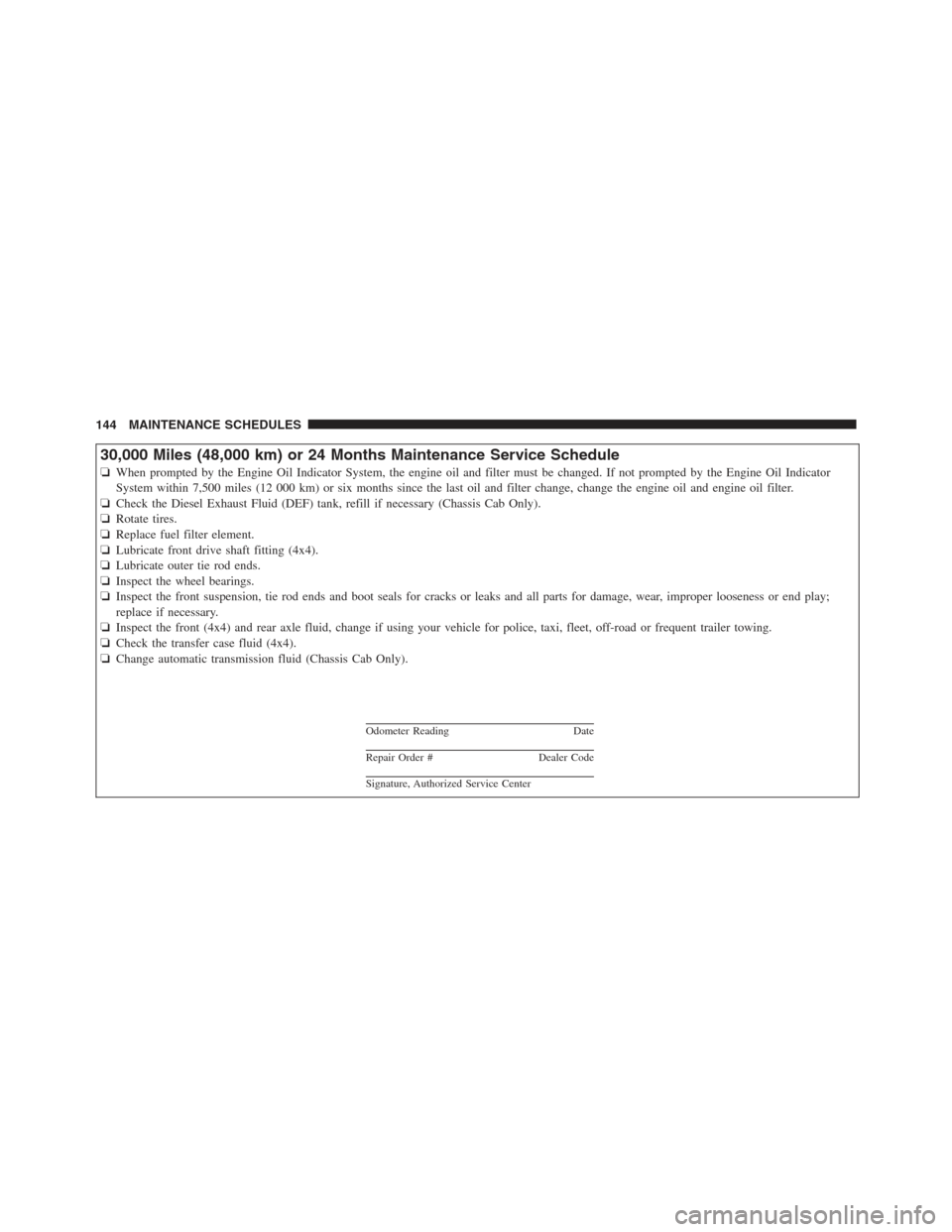
30,000 Miles (48,000 km) or 24 Months Maintenance Service Schedule
❏When prompted by the Engine Oil Indicator System, the engine oil and filter must be changed. If not prompted by the Engine Oil Indicator
System within 7,500 miles (12 000 km) or six months since the last oil and filter change, change the engine oil and engine oil filter.
❏ Check the Diesel Exhaust Fluid (DEF) tank, refill if necessary (Chassis Cab Only).
❏ Rotate tires.
❏ Replace fuel filter element.
❏ Lubricate front drive shaft fitting (4x4).
❏ Lubricate outer tie rod ends.
❏ Inspect the wheel bearings.
❏ Inspect the front suspension, tie rod ends and boot seals for cracks or leaks and all parts for damage, wear, improper looseness or end play;
replace if necessary.
❏ Inspect the front (4x4) and rear axle fluid, change if using your vehicle for police, taxi, fleet, off-road or frequent trailer towing.
❏ Check the transfer case fluid (4x4).
❏ Change automatic transmission fluid (Chassis Cab Only).
Odometer Reading Date
Repair Order #Dealer Code
Signature, Authorized Service Center
144 MAINTENANCE SCHEDULES


