2012 PEUGEOT 4007 tow
[x] Cancel search: towPage 104 of 236

6
SAFETY
DIRECTION INDICATORS
HAZARD WARNING LAMPS
A visual warning by means of the direction
indicators to alert other road users to a
vehicle breakdown, towing or accident.
HORN
)
Press one of the spokes of the
steering wheel.
)
Left: lower the lighting stalk passing
the point of resistance.
)
Right: raise the lighting stalk passing
the point of resistance.
"Motorway" function
)
Press briefl y upwards or down-
wards, without going beyond the
point of resistance; the direction
indicators will fl ash 3 times.
Audible warning to alert other road users
to an imminent danger.
The audible signal can be con-
fi gured via the colour screen
"Equipment" menu.
)
Press this button, the direction indi-
cators fl ash.
They can operate with the ignition off.
Automatic operation of hazard
warning lamps
When braking in an emergency, de-
pending on the deceleration, the hazard
warning lamps come on automatically.
They switch off automatically the fi rst
time you accelerate.
)
You can also switch them off by
pressing the button.
Page 109 of 236
6
SAFETY
The driver must ensure that passen-
gers use the seat belts correctly and
that they are all restrained securely
before setting off.
Wherever you are seated in the ve-
hicle, always fasten your seat belt,
even for short journeys.
Do not interchange the seat belt
buckles as they will not fulfi l their
role fully.
The seat belts are fi tted with an in-
ertia reel permitting automatic ad-
justment of the length of the strap
to your size. The seat belt is stowed
automatically when not in use.
Before and after use, ensure that the
seat belt is reeled in correctly.
The lower part of the strap must be
positioned as low as possible on the
pelvis.
The upper part must be positioned
in the hollow of the shoulder.
The inertia reels are fi tted with an
automatic locking device which
comes into operation in the event
of a collision, emergency braking or
if the vehicle rolls over. You can re-
lease the device by pulling fi rmly on
the strap and releasing it so that it
reels in slightly.
Recommendations for children
Use a suitable child seat if the pas-
senger is less than 12 years old or
shorter than one and a half metres.
Never use the same seat belt to se-
cure more than one person.
Never allow a child to travel on your
lap. In order to be effective, a seat belt
must:
- be tightened as close to the body
as possible,
- be pulled in front of you with a
smooth movement, checking that
it does not twist,
-
be used to restrain only one person,
- not bear any trace of cuts or fraying,
- not be converted or modifi ed to
avoid affecting its performance.
In accordance with current safety
regulations, for all repairs on your
vehicle, go to a qualifi ed workshop
with the skills and equipment needed,
which a PEUGEOT dealer is able to
provide.
Have your seat belts checked regu-
larly by a PEUGEOT dealer or a
qualifi ed workshop, particularly if the
straps show signs of damage.
Clean the seat belt straps with soapy
water or a textile cleaning product,
sold by PEUGEOT dealers.
After folding or moving a seat or rear
bench seat, ensure that the seat belt
is positioned and reeled in correctly.
In the event of an impact
Depending on the nature and se-
riousness of the impact
, the pre-
tensioning device may be deployed
before and independently of the
airbags. Deployment of the preten-
sioners is accompanied by a slight
discharge of harmless smoke and
a noise, due to the activation of the
pyrotechnic cartridge incorporated in
the system.
In all cases, the airbag warning lamp
comes on.
Following an impact, have the seat
belts system checked, and if neces-
sary replaced, by a PEUGEOT dealer
or a qualifi ed workshop.
Page 112 of 236
6
SAFETY
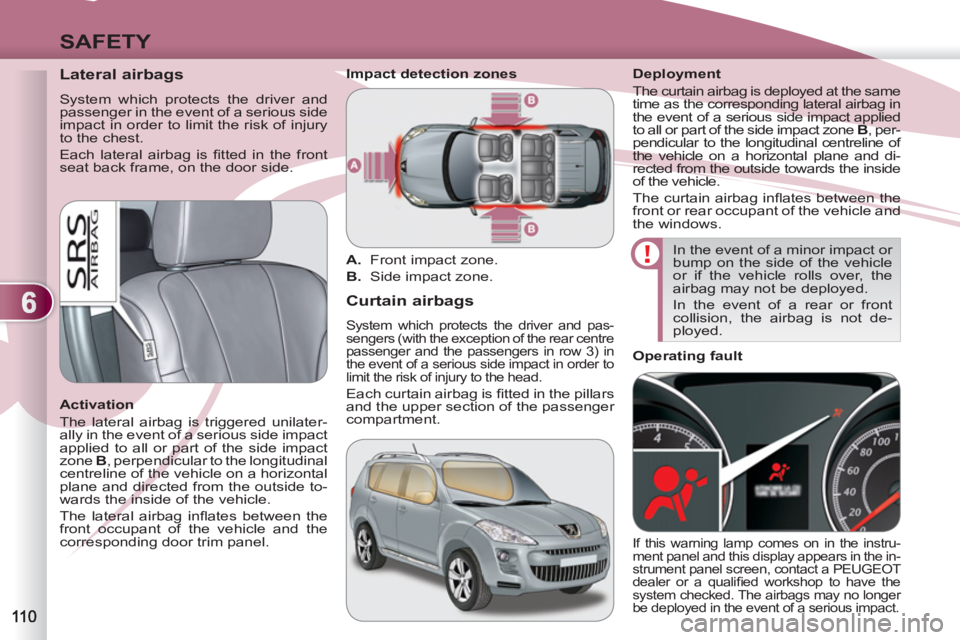
Lateral airbags
System which protects the driver and
passenger in the event of a serious side
impact in order to limit the risk of injury
to the chest.
Each lateral airbag is fi tted in the front
seat back frame, on the door side.
Activation
The lateral airbag is triggered unilater-
ally in the event of a serious side impact
applied to all or part of the side impact
zone B
, perpendicular to the longitudinal
centreline of the vehicle on a horizontal
plane and directed from the outside to-
wards the inside of the vehicle.
The lateral airbag infl ates between the
front occupant of the vehicle and the
corresponding door trim panel.
Curtain airbags
System which protects the driver and pas-
sengers (with the exception of the rear centre
passenger and the passengers in row 3) in
the event of a serious side impact in order to
limit the risk of injury to the head.
Each curtain airbag is fi tted in the pillars
and the upper section of the passenger
compartment.
Deployment
The curtain airbag is deployed at the same
time as the corresponding lateral airbag in
the event of a serious side impact applied
to all or part of the side impact zone B
, per-
pendicular to the longitudinal centreline of
the vehicle on a horizontal plane and di-
rected from the outside towards the inside
of the vehicle.
The curtain airbag infl ates between the
front or rear occupant of the vehicle and
the windows.
In the event of a minor impact or
bump on the side of the vehicle
or if the vehicle rolls over, the
airbag may not be deployed.
In the event of a rear or front
collision, the airbag is not de-
ployed.
Impact detection zones
A.
Front impact zone.
B.
Side impact zone.
Operating fault
If this warning lamp comes on in the instru-
ment panel and this display appears in the in-
strument panel screen, contact a PEUGEOT
dealer or a qualifi ed workshop to have the
system checked. The airbags may no longer
be deployed in the event of a serious impact.
Page 114 of 236
7
DRIVING
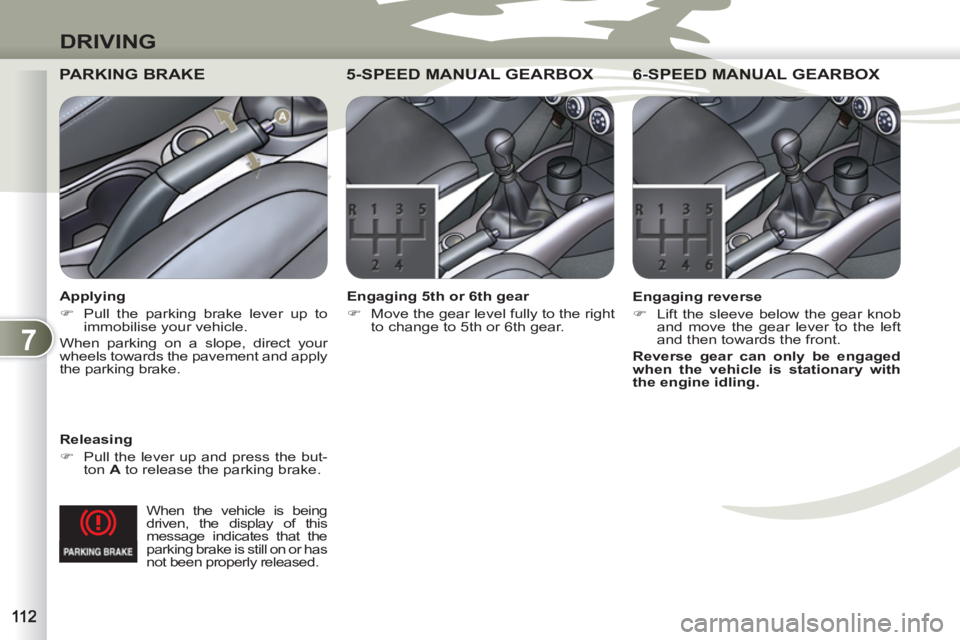
When the vehicle is being
driven, the display of this
message indicates that the
parking brake is still on or has
not been properly released.
PARKING BRAKE
Releasing
)
Pull the lever up and press the but-
ton A
to release the parking brake.
NUAL GEARBOX
5-SPEED MANUAL GEARBOX
Engaging 5 th or 6 th gear
)
Move the gear level fully to the right
to change to 5 th or 6 th gear.
Applying
)
Pull the parking brake lever up to
immobilise your vehicle.
When parking on a slope, direct your
wheels towards the pavement and apply
the parking brake.
6-SPEED MANUAL GEARBOX6-SPEED MANUA
Engaging reverse
)
Lift the sleeve below the gear knob
and move the gear lever to the left
and then towards the front.
Reverse gear can only be engaged
when the vehicle is stationary with
the engine idling.
Page 122 of 236

7
DRIVING
Operating faults
If the selected transmission mode display
fl ashes, the vehicle switches automati-
cally to front "2WD"
transmission mode.
It is then no longer possible to select the
transmission mode using the control A
. Do not subject the vehicle to ex-
cessive conditions while driving.
As the engine torque is applied
to all four wheels, the condition
of the tyres has a considerable
impact on the performance of
the vehicle.
Ensure that all four tyres are in
good condition.
Avoid driving the vehicle in
sandy or muddy areas or in
other areas in which the wheels
could spin.
Spinning the wheels places the
transmission components under
pressure and could cause a seri-
ous malfunction.
Do not drive the vehicle through
deep water.
Avoid driving over excessively
uneven terrain (risk of scraping
under the body or of grounding
on crossing a bridge).
Have your vehicle towed on a
fl atbed.
The vehicle must not be towed
with the front or rear wheels on
the ground even if it is in front
"2WD" (2 wheel drive) mode.
If the message "SLOW DOWN" is dis-
played on the instrument panel, let the
transmission cool down then wait for the
display to clear before setting off again.
If "4WD" and "LOCK" are displayed
alternately and if "MAINTENANCE
REQUIRED" is displayed in the instru-
ment panel, the system has failed and
the safety system has been activated.
Contact a PEUGEOT dealer or a quali-
fi ed workshop without delay.
Page 125 of 236

7
DRIVING
AUDIBLE REAR PARKINGAUDIBLE
SENSORS NSO
It detects obstacles (person, vehicle,
tree, gate,...) located behind the vehicle,
but it cannot detect obstacles located
immediately below the bumper.
Activation
The parking sensors are activated by
engaging reverse gear.
The proximity information is indicated by
an audible signal which becomes more
frequent as the vehicle approaches the
obstacle.
When a certain distance between the
rear of the vehicle and the obstacle is
reached, the audible signal becomes
continuous:
An object such as a stake, a
road works cone or any other
similar object may be detected
at the beginning of the manoeu-
vre but may no longer be de-
tected when the vehicle moves
closer to it.
Location of the sensors
The vehicle is fi tted with four sensors:
- two side sensors A
- two central sensors B
.
Vehicle only
Vehicle fi tted with a towbar
Detection zones
The detection zones differ depending
on whether the vehicle is fi tted with a
towbar.
If you select towbar mode, the towbar
zone C
is excluded from the detection
zones.
The parking sensor system can-
not, in any circumstances, take
the place of the need for vigi-
lance and responsibility on the
part of the driver.
Sensors
Distance between
vehicle and
obstacle less than:
Side A
Approximately
25 cm
Central B
without
towbar
Approximately
40 cm
Central B
with
towbar
Approximately
60 cm
System consisting of proximity sensors
installed in the rear bumper.
Page 126 of 236

7
DRIVING
REVERSING CAMERA REVERSING CAM
Linked with the navigation option, a re-
versing camera is activated automatically
when reverse gear is engaged.
The colour image is provided on the
navigation screen with indication of the
limit of the rear bumper and of the gen-
eral direction of the vehicle.
Operating fault
If an operating fault occurs, the indicator
lamp in button A
fl ashes when reverse
gear is engaged.
Contact a PEUGEOT dealer or a quali-
fi ed workshop.
In bad weather or in winter, check
that the sensors are not covered
with mud, ice or snow.
Deactivation
)
With reverse gear engaged, press
button A
, the indicator lamp goes
off, the system is fully deactivated.
Reactivation
)
With reverse gear engaged, press
button A
again, the indicator lamp
comes on, the system is reactivated.
Modifi cation of the detection zones
)
Press button A
to deactivate the
system.
)
Press button A
again for a few seconds
and release it.
The detection zone modifi cation infor-
mation is indicated by an audible signal:
- double
signal on vehicles fi tted with
a towbar,
- single
signal on vehicles which are
not fi tted with a towbar.
The red line indicates the dis-
tance required to open the lower
tailgate.
Page 133 of 236
8
CHECKS
Manual gearbox
Refer to the servicing booklet
for details of gearbox mainte-
nance.
Brake pads
Brake wear depends on the
style of driving, particularly in
the case of vehicles used in
town, over short distances. It
may be necessary to have the
condition of the brakes checked, even
between vehicle services.
Unless there is a leak on the circuit, a
drop in the brake fl uid level indicates
that the brake pads are worn.
Brake disc wear
For information on checking
brake disc wear, contact a
PEUGEOT dealer or a quali-
fi ed workshop.
Parking brake
If the parking brake travel is
too long or if you notice a loss
of effectiveness of this sys-
tem, the parking brake must
be adjusted, even between
two services.
This system must be checked by a
PEUGEOT dealer or a qualifi ed work-
shop.
Only use products recommended by
PEUGEOT or products of equivalent
quality and specifi cations. In order to optimise the opera-
tion of units as important as
the braking system, PEUGEOT
selects and offers very specifi c
products.
To avoid damaging the electrical
units, the use of a high pressure
washer in the engine compart-
ment is strictly prohibited.
Transfer box and rear
differential
Refer to the servicing booklet
for details of the service inter-
val for these components.