2012 PEUGEOT 107 wheel
[x] Cancel search: wheelPage 51 of 140

7
49 Safety
Emergency braking
assistance
In an emergency, this system enables you to
reach the optimum braking pressure morequickly and therefore reduce the stoppingdistance.
It is triggered by the speed at which the brake pedal is pressed. This is felt by a reduction in
the resistance of the pedal and an increase in
the effectiveness of the braking.
*
The CSC system is linked with the EBFD on
vehicles which are not fitted with ASR/ESP
systems.
Anti-lock braking system (ABS) and
braking systems (EBFD and CSC * )
The ABS, in conjunction with the EBFD and
CSC *
braking systems, increases the stability and manoeuvrability of your vehicle on brakingand provides improved control, in particular on poor or slippery road surfaces.
The ABS prevents wheel lock in the event of
emergency braking.
The EBFD and CSC * systems provide fullcontrol of the braking pressure wheel by wheel.A distribution between:
- the front and the rear in the case of the
EBFD (Electronic Brake Force Distribution),
- the left and the right in the case of theCSC * (Cornering Stability Control).
When changing wheels (tyres), make
sure that these are approved.
The anti-lock braking system comesinto operation automatically when thereis a risk of wheel lock.
When this warning lamp comes on,
it indicates that there is a fault with
the ABS, which could cause a loss of control of the vehicle when braking.
Contact a PEUGEOT dealer or a qualified
workshop.
When these warning lampscome on simultaneously, it
indicates that there is a fault
with the braking system or that the parking
brake has not been released fully, which cancause a loss of control of the vehicle when
braking. You must stop as soon as it is safe to do so. Contact a PEUGEOT dealer or a qualified
workshop.
Normal operation of the ABS may make itself felt by slight vibrations of the brake pedal.
In emergency braking, pressvery firmly without releasing thepressure.
Page 52 of 140

VSC
50Safety
Anti-slip regulation (ASR) and electronic
stability programme (ESP)
Operating check
Operation of the ASR and
ESP systems
When one of these two systems
is operating, this warning lamp
comes on.
If a fault occurs with the s
ystems, this
warning lamp comes on.
Contact a PEUGEOT dealer or
a qualified workshop to have thesystems checked.
These systems are linked and supplement
the AB
S.
The ASR system optimises drive to prevent the
wheels skidding, by acting on the brakes of
the driving wheelsand on the engine. It also allows the directional stability of the vehicle to
be improved on acceleration.
If there is a variation between the trajectory followed by the vehicle and that required by
the driver, the ESP system automatically acts on the brake of one or more wheels and on theengine to put the vehicle back on course, within
the limits of the laws of physics.
The ASR/ESP systems offer exceptional safety during normal driving, but this should not encourage the driver to take extra risks or drive athigh speed. Correct operation of these systemsdepends on obser vation of thema-nufacturer's recommendations regar-ding the wheels (tyres andrims), the braking components and the electronic components as well as therepair procedures use by a PEUGEOT dealer or qualified workshop.
After an impact, have these systemschecked by a PEUGEOT dealer or a qualified workshop.
Page 56 of 140

54Safety
Airbags Front airbags
Front airbag fault
Immediately after the impact, the airbags
deflate rapidly so that they do not hinder
the visibility of the occupants nor their exit if
necessary from the vehicle. The airbags are
not deployed in the case of minor impacts, rear impacts or in cer tain roll-over conditions. The seat belt is sufficient to ensure maximumprotection in these situations. The seriousness
of a collision depends on the nature of the
obstacle and the speed of the vehicle at the
m
oment of the collision.
Airbags only operate when the ignition is switched on. When they are deployed, a noise
is heard during inflation.
The airbags have been designed to maximise
the safety of the occupants in the event of serious collisions. They work in conjunction
with the force-limiting seat belts. The electronic detectors register and analyse any abrupt deceleration of the vehicle in the
impact detection zones (see diagram): if the
deployment threshold is reached, the airbags
in
flate instantly and protect the occupants of
the vehicle.
These are
fitted in the centre of the steering wheel for the driver and in the dashboard for the frontpassenger. They are deployed simultaneously,except in cases where the passenger's airbag is
deactivated, in the event of a serious front impact
applied in the impact zone A in the longitudinalAcentreline of the vehicle, on a horizontal plane and
from the front of the vehicle towards the rear. T he
airbag inflates between the front occupant of the
v
ehicle and the dashboard to cushion his forward movement. The airbags therefore limit the risk of injury to the head and chest.
A.
Front impact zone.B.Side impact zone.
Note:
the gas escaping from the airbags can be a minor irritant.
Flashin
g indicates an airbag fault,contact a PEUGEOT dealer or a qualified workshop to have the system checked. The airbags may no longer be
deplo
yed in the event of a serious impact.
Impact detection zones
Page 58 of 140

56Safety
Front airbags
Do not drive holding the steering wheel by its
spokes or resting your hands on the centre part
of the wheel.
Passengers must not place their feet on the
dashboard.
Smoke as little as possible; deployment of the
airbags can cause burns or the risk of injuryfrom a cigarette or pipe.
Never remove or pierce the steering wheel or hit it violently.
Curtain airbags
Do not fix or attach anything to the pillars or the
roof. This could cause injury to the head when
the cur tain airbag inflates.
The deployment of an airbag or airbags is
accompanied b
y a slight emission of harmlesssmoke and a noise due to the activation of
the pyrotechnic cartridge incorporated in the system. This smoke is not harmful but sensitiveindividuals may experience some irritation.
The detonation noise may result in a slight loss
of hearing for a shor t time.
Even if all of the precautions mentioned are
observed, injury or slight burns to the head,chest or arms when the air bag is deployed cannot be ruled out. Indeed, the bag inflates
almost instantly (approximately 30 milliseconds)
then deflates within the same time discharginghot gas via the openings provided for thispurpose.
This equipment will only operate once. If a second impact occurs (during the same or asubsequent accident), the airbag will not inflate.
Lateral airbags
Only put approved covers on the seats, these
will not hamper the inflation of the lateral
airbags. Contact a PEUGEOT dealer or a qualified workshop.
Do not fix or attach anything to the front seatbacks. This could cause injury to the chest or
arms when the lateral airba
g inflates.
Do not sit with the upper par t of the body any
nearer to the door than necessary.
For the front, lateral and cur tain airbags to be fully effective, obser ve the following safety rules:Wear a correctly adjusted seat belt. Sit in a normal upright position. Do not leave anything between the occupants and the airbags (child, animal, object...). This could hamper the operation of the airbags or injure the occupants. All work on the airbag systems is strictly prohibited unless it is carried out by qualified personnel of the PEUGEOTdealer network or a qualified workshop.
After an accident or if the vehicle has been stolen or broken into, have theairbag systems checked.
Page 67 of 140
9
65 Practical information
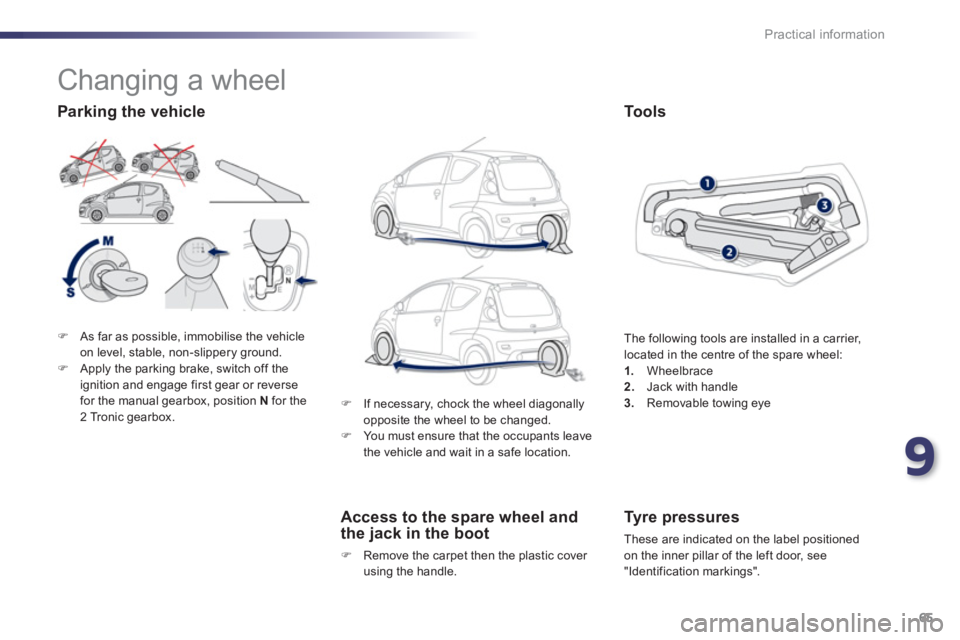
)As far as possible, immobilise the vehicle
on level, stable, non-slippery ground. )Apply the parking brake, switch off the
ignition and engage first gear or reverse
for the manual gearbox, position Nfor the2 Tronic gearbox. The followin
g tools are installed in a carrier,
located in the centre of the spare wheel:
1
. Wheelbrace 2.Jack with handle 3.Removable towing eye
Access to the spare wheel and
the jack in the boot
) Remove the carpet then the plastic cover using the handle.
Tyre pressures
These are indicated on the label positioned on the inner pillar of the left door, see
"Identification markings".
Changing a wheel
)
If necessary, chock the wheel diagonally
opposite the wheel to be changed.) You must ensure that the occupants leave
the vehicle and wait in a safe location.
Parking the vehicle
To o l s
Page 68 of 140
66Practical information
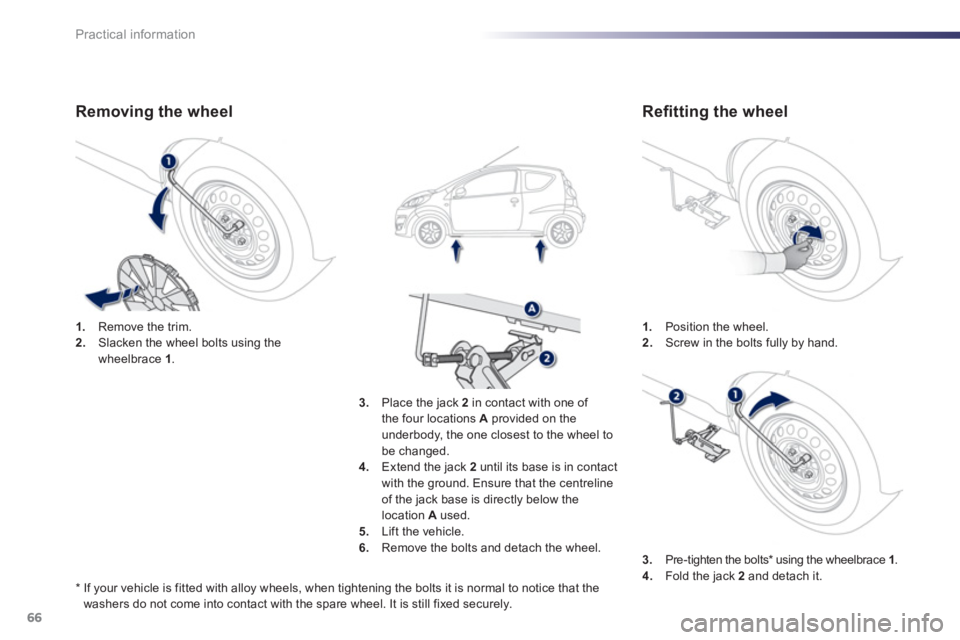
1. Position the wheel.2.Screw in the bolts fully by hand.1.
Remove the trim. 2.
Slacken the wheel bolts using the
wheelbrace 1.
3. Place the jack 2in contact with one of
the four locations A provided on the
underbody, the one closest to the wheel to
be changed.
4.Extend the jack 2 until its base is in contact
with the ground. Ensure that the centrelineof the jack base is directly below thelocation A
used.
5.Lift the vehicle.
6. Remove the bolts and detach the wheel.3.Pre-tighten the bolts * using the wheelbrace 1.4.
Fold the jack 2
and detach it. *
If your vehicle is fitted with alloy wheels, when tightening the bolts it is normal to notice that the
washers do not come into contact with the spare wheel. It is still fixed securely.
Removing the wheel
Refi tting the wheel
Page 69 of 140
9
67 Practical information
Changing a bulb
)
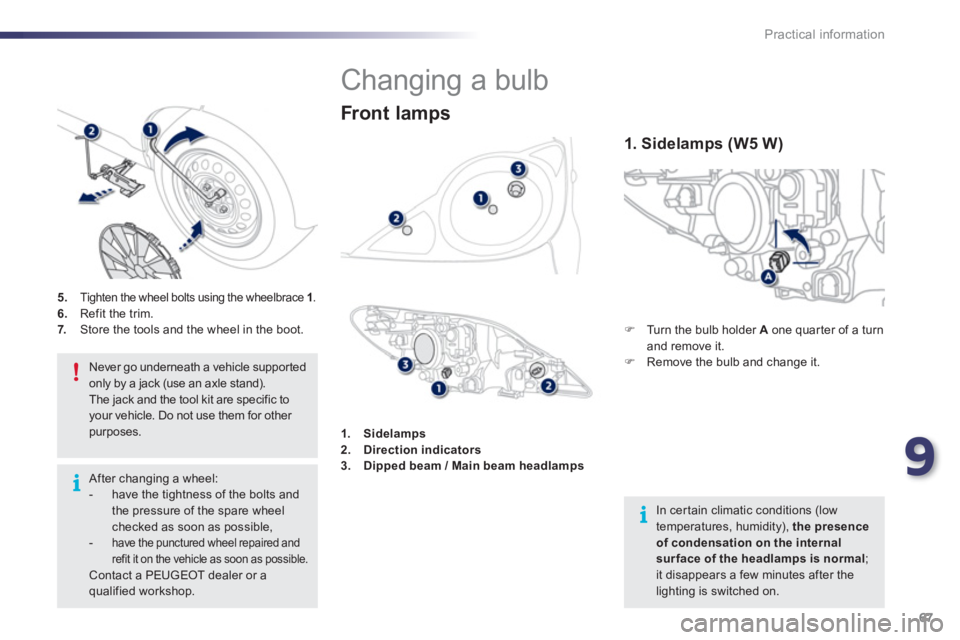
Turn the bulb holder A
one quar ter of a turn and remove it. )
Remove the bulb and change it.
5
.Tighten the wheel bolts using the wheelbrace 1.6.Refit the trim. 7. Store the tools and the wheel in the boot.
1
.Sidelamps2.Direction indicators3.Dipped beam / Main beam headlamps
Never go underneath a vehicle suppor tedonly by a jack (use an axle stand). The jack and the tool kit are specific to your vehicle. Do not use them for other
purposes.
In cer tain climatic conditions (low temperatures, humidity), the presence
of condensation on the internalsur face of the headlamps is normal ; it disappears a few minutes after the lighting is switched on.
Front lamps
1. Sidelamps (W5 W)
After changing a wheel:- have the tightness of the bolts and the pressure of the spare wheel checked as soon as possible,
-have the punctured wheel repaired andrefit it on the vehicle as soon as possible. Contact a PEUGEOT dealer or aqualified workshop.
Page 73 of 140
9
71 Practical information
Changing a fuse
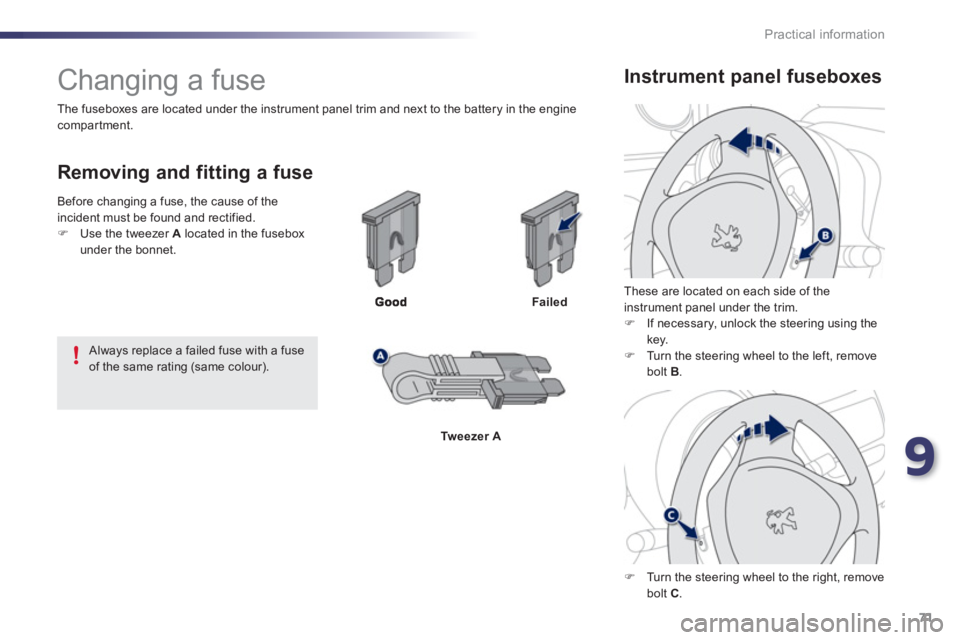
Removing and fitting a fuse
Failed
Tweezer A
Th
ese are located on each side of the
instrument panel under the trim.
) If necessary, unlock the steering using the
key. ) Turn the steering wheel to the left, remove bolt B.
)
Turn the steering wheel to the right, removebolt C.
Always replace a failed fuse with a fuse of the same rating (same colour).
Instrument panel fuseboxes
The fuseboxes are located under the instrument panel trim and next to the battery in the engine compartment.
Before chan
ging a fuse, the cause of the
incident must be found and rectified. )Use the tweezer A located in the fusebox under the bonnet.