2012 NISSAN NOTE trans
[x] Cancel search: transPage 169 of 235
RECOMMENDED TOWING
CAUTION
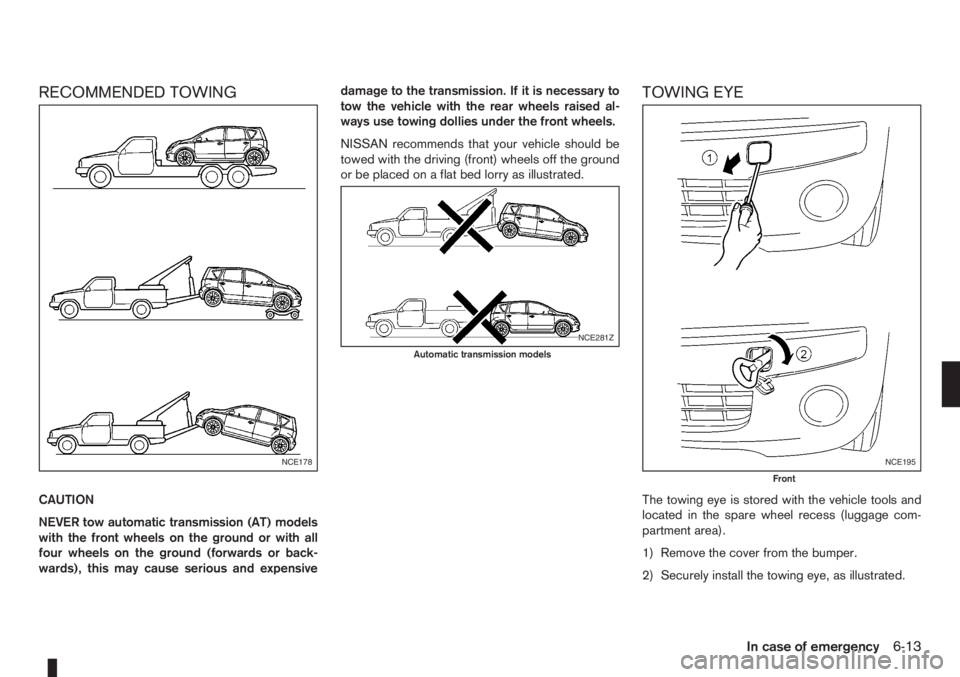
NEVER tow automatic transmission (AT) models
with the front wheels on the ground or with all
four wheels on the ground (forwards or back-
wards), this may cause serious and expensivedamage to the transmission. If it is necessary to
tow the vehicle with the rear wheels raised al-
ways use towing dollies under the front wheels.
NISSAN recommends that your vehicle should be
towed with the driving (front) wheels off the ground
or be placed on a flat bed lorry as illustrated.
TOWING EYE
The towing eye is stored with the vehicle tools and
located in the spare wheel recess (luggage com-
partment area).
1) Remove the cover from the bumper.
2) Securely install the towing eye, as illustrated.
NCE178
NCE281Z
Automatic transmission models
NCE195
Front
In case of emergency6-13
Page 176 of 235

8Maintenance and do-it-yourselfMaintenance and do-it-yourself
Maintenance requirements ....................................... 8-2
Scheduled maintenance...................................... 8-2
General maintenance .......................................... 8-2
Where to go for service ...................................... 8-2
General maintenance ............................................... 8-2
Explanation of general maintenance items ........... 8-2
Maintenance precautions ......................................... 8-4
Engine compartment ................................................ 8-5
Engine cooling system ............................................. 8-6
Checking engine coolant level............................. 8-6
Changing engine coolant .................................... 8-6
Engine oil................................................................. 8-8
Checking engine oil level .................................... 8-9
Changing engine oil ............................................ 8-9
Changing engine oil filter .................................... 8-11
Protect the environment ...................................... 8-12
Fuel filter (Diesel engine models) ............................. 8-12
Bleeding the fuel system ..................................... 8-12
Automatic transmission fluid (ATF) ........................... 8-13
Brakes ..................................................................... 8-13
Checking brake pedal......................................... 8-13
Checking handbrake........................................... 8-13
Brake and clutch fluid .............................................. 8-13
Window washer fluid/headlight cleaner fluid
(where fitted) ........................................................... 8-14
Battery..................................................................... 8-15
Vehicle battery .................................................... 8-15
Reinitialisation procedure after battery
reconnection....................................................... 8-16
Jump-starting ...................................................... 8-16Integrated Keyfob/Intelligent Key battery
replacement........................................................ 8-17
Drive belts ............................................................... 8-18
Spark plugs (Petrol engine models).......................... 8-18
Air cleaner filter........................................................ 8-19
Viscous paper type ............................................. 8-19
Dry paper type (where fitted) .............................. 8-19
Wiper blades ........................................................... 8-19
Cleaning ............................................................. 8-19
Front window wiper replacement ........................ 8-20
Back door window wiper replacement ................ 8-20
Windscreen washer nozzle ................................. 8-20
Fuses ...................................................................... 8-21
Passenger compartment ..................................... 8-21
Engine compartment ........................................... 8-22
Lights ...................................................................... 8-23
Headlights .......................................................... 8-23
Exterior lights ...................................................... 8-24
Interior lights....................................................... 8-24
Light locations .................................................... 8-25
Wheels and tyres ..................................................... 8-29
Tyre inflation pressure......................................... 8-29
Types of tyres ..................................................... 8-29
Snow chains....................................................... 8-30
Tyre rotation ....................................................... 8-30
Tyre wear and damage ....................................... 8-30
Tyre age ............................................................. 8-31
Changing tyres and wheels ................................. 8-31
Wheel balance.................................................... 8-31
Spare tyre .......................................................... 8-31
Page 180 of 235

Handbrake*:
Confirm that your vehicle is held securely on a fairly
steep hill with only the handbrake applied.
Seats:
Check seat position controls such as seat adjust-
ers, seatback recliner, etc. to ensure they operate
smoothly and all latches lock securely in every posi-
tion. Check that the head restraints move up and
down smoothly and the locks hold securely in all
latched positions.
Seat belts:
Check that all parts of the seat belt system (e.g.
buckles, anchors, adjusters and retractors) operate
properly and smoothly, and are installed securely.
Check the belt webbing for cuts, fraying, wear or
damage. See “Seat belt maintenance” in the
“1. Safety — seats, seat belts and supplemental
restraint system” section for further details.
Steering wheel:
Check for any change in the steering conditions,
such as excessive free play, hard steering or strange
noises.
Warning lights and audible reminders:
Make sure that all warning/indicator lights and au-
dible reminders are operating properly.
Windscreen defogger:
Check that the air comes out of the defogger outlets
properly when operating the heater or air condi-
tioner.Windscreen wiper and washer*:
Check that the wipers and washer operate properly
and that the wipers do not streak.When performing any inspection or maintenance
work on your vehicle, always take care to prevent
serious accidental injury to yourself or damage to
the vehicle. The following are general precautions
which should be closely observed.
•Park the vehicle on a level surface, apply the
handbrake securely and block the wheels to
prevent the vehicle from moving. For a manual
transmission models, move the gear lever to
N (Neutral) position. [For automatic transmis-
sion models, move the selector lever to P
(Park) position.]
•Do not work under the engine bonnet while
the engine is hot. Turn off the engine and wait
until it cools down.
•Be sure to turn the ignition switch to the “OFF”
or LOCK position.
When the ignition switch is in the ON or Acc
position, the cooling fan may start to operate
suddenly even when the engine is not run-
ning. To avoid injury, always disconnect the
negative battery cable before working near
the engine.
•If you must work with the engine running,
keep your hands, clothing, hair and tools away
from moving fans, belts and any other moving
parts.
•It is advisable to remove ties and any jewel-
lery, such as rings, watches, etc. before work-
ing on your vehicle.
MAINTENANCE PRECAUTIONS
8-4Maintenance and do-it-yourself
Page 181 of 235
•If you must run the engine in an enclosed
space such as a garage, be sure there is
proper ventilation for exhaust gases.
•Never get under the vehicle while it is sup-
ported only by a jack. If it is necessary to work
under the vehicle, support it with safety
stands.
•Keep smoking materials, flame and sparks
away from fuel and battery.
•Never connect or disconnect either the bat-
tery or any transistorised component connec-
tor while the ignition switch is in the ON posi-
tion.
•Never leave the engine or transmission re-
lated component harness connector discon-
nected while the ignition switch is in the ON
position.
•On petrol engine models with the multiport
fuel injection (MFI) system, the fuel filter or
fuel lines should be serviced by a NISSAN
dealer or qualified workshop because the fuel
lines are under high pressure even when the
engine is off.
•Always wear eye protection whenever you
work on your vehicle.
•Failure to follow these or other common sense
guidelines may lead to serious injury or ve-
hicle damage.
NISSAN GREEN PROGRAM
Improperly disposed engine oil and/or other
vehicle fluids can pollute the environment. Al-
ways conform to local regulations for disposal
of vehicle fluid.
This section gives instructions regarding only those
items which are relatively easy for an owner to per-
form.
You should be aware that incomplete or improper
servicing may result in operating difficulties or ex-
cessive emissions, and could affect your warranty
coverage.If in doubt about any servicing, have it
done by your NISSAN dealer or qualified work-
shop.For an overview of the engine compartment, see
“Engine compartment” in the “0. Illustrated table
of contents” section.
ENGINE COMPARTMENT
Maintenance and do-it-yourself8-5
Page 189 of 235

When checking or replacement is required, NISSAN
recommends contacting a NISSAN dealer or quali-
fied workshop for servicing.
CAUTION
•Use only Genuine NISSAN Matic D ATF. Do
not mix with other fluids.
•Using automatic transmission fluid other than
Genuine NISSAN Matic D ATF will cause dete-
rioration in driveability and automatic trans-
mission durability, and may damage the auto-
matic transmission, which is not covered by
the warranty.
CHECKING BRAKE PEDAL
If the brake pedal suddenly goes down further than
normal, the pedal feels “spongy” or the vehicle
seems to take longer to stop, see a NISSAN dealer
or qualified workshop.
CHECKING HANDBRAKE
Periodically check the holding ability of the hand-
brake by parking on a steep hill and restraining the
vehicle by using only the handbrake. If it does not
hold satisfactorily, see a NISSAN dealer or qualified
workshop.
WARNING
•Use only new fluid. Old, inferior, or contami-
nated fluid may damage the brake and clutch
systems. The use of improper fluids can dam-
age the brake system and affect the vehicle’s
stopping ability.
•Clean the filler cap before removing.
NDI1011Z
LHD models
NDI735Z
RHD models
AUTOMATIC TRANSMISSION
FLUID (ATF)BRAKES BRAKE AND CLUTCH FLUID
Maintenance and do-it-yourself8-13
Page 207 of 235
TYRE AGE
Remember tyre age. Never use a tyre over six years
old, regardless of whether they have been used or
not.
Tyres degrade with age as well as the use they are
subjected to. Have the tyres checked and balanced
frequently by a NISSAN dealer or qualified work-
shop. Report all accidents where the tyre is knocked
even if it is minor.
CHANGING TYRES AND WHEELS
WARNING
Do not install a deformed wheel or tyre even if it
has been repaired. Such wheels or tyres could
have structural damage and could fail without
warning.
When replacing a tyre, use the same size, speed
rating and load carrying capacity as originally
equipped. Recommended types and sizes are men-
tioned in “Wheels and tyres” in the “9. Technical
information” section.
The use of tyres other than those recommended or
the mixed use of tyres of different brands, construc-
tion (bias, bias-belted or radial), or tread patterns
can adversely affect the ride, braking, handling,
ground clearance, body-to-tyre clearance, snow
chain clearance, speedometer calibration, headlight
aim and bumper height.
WARNING
Some of these effects may lead to accidents and
could result in serious personal injury.
If the wheels are changed for any reason, always
replace with wheels which have the same offset
dimension. Wheels of a different offset could cause
early tyre wear, possibly degraded vehicle handling
characteristics and/or interference with the brake
discs/drums. Such interference can lead to
decreased braking efficiency and/or early brake
pad/shoe wear.
WHEEL BALANCE
Unbalanced wheels may affect vehicle handling and
tyre life. Even with regular use, wheels can get out
of balance. Therefore, they should be balanced as
required.
Wheel balance service should be performed with
the wheels off the vehicle. Spin balancing the front
wheels on the vehicle could lead to transmission
damage.
SPARE TYRE
The temporary-use spare wheel/tyre can be identi-
fied by the temporary-use spare tyre label which
contrasts to the standard road wheels. If in doubt,
contact a NISSAN dealer, qualified workshop or
see “Spare tyre” in the “6. In case of emergency”
section.
CARE OF WHEELS
For details, see “Care of wheels” in the “7. Appear-
ance and care” section.
Maintenance and do-it-yourself8-31
Page 209 of 235

9Technical informationTechnical information
Capacities and recommended fuel/lubricants ........... 9-2
Fuel recommendation ......................................... 9-4
Recommended SAE viscosity number ................. 9-4
Air conditioning system refrigerant and
lubricant recommendations (where fitted) ............ 9-4
Engine ..................................................................... 9-5
Wheels and tyres ..................................................... 9-5
Dimensions .............................................................. 9-6
When travelling or transferring your registration to
another country........................................................ 9-6Vehicle identification ................................................ 9-6
Vehicle identification plate ................................... 9-6
Vehicle identification number (VIN) (chassis
number).............................................................. 9-6
Engine serial number .......................................... 9-7
Tyre placard ....................................................... 9-7
Air conditioner specification label (where
fitted).................................................................. 9-7
NATS immobilizer radio approval number ................. 9-8
Approval numbers.................................................... 9-8
Page 210 of 235
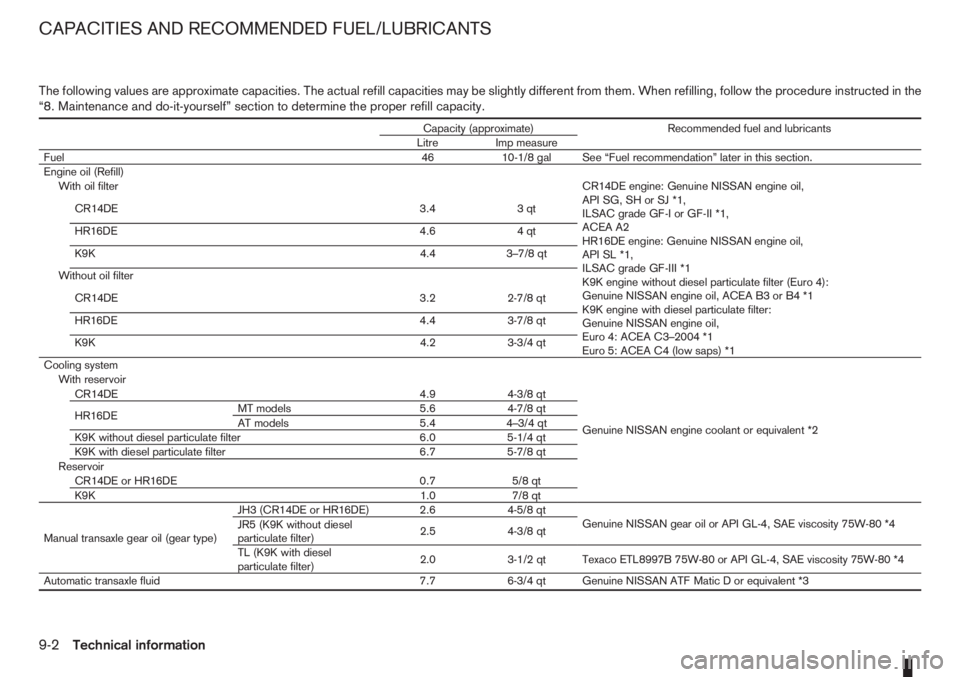
The following values are approximate capacities. The actual refill capacities may be slightly different from them. When refilling, follow the procedure instructed in the
“8. Maintenance and do-it-yourself” section to determine the proper refill capacity.
Capacity (approximate) Recommended fuel and lubricants
Litre Imp measure
Fuel 46 10-1/8 gal See “Fuel recommendation” later in this section
.Engine oil (Refill)
With oil filterCR14DE engine: Genuine NISSAN engine oil,
API SG, SH or SJ *1,
ILSAC grade GF-I or GF-II *1,
ACEA A2
HR16DE engine: Genuine NISSAN engine oil,
API SL *1,
ILSAC grade GF-III *1
K9K engine without diesel particulate filter (Euro 4):
Genuine NISSAN engine oil, ACEA B3 or B4 *1
K9K engine with diesel particulate filter:
Genuine NISSAN engine oil,
Euro 4: ACEA C3–2004 *1
Euro 5: ACEA C4 (low saps) *1 CR14DE 3.4 3 qt
HR16DE 4.6 4 qt
K9K 4.4 3–7/8 qt
Without oil filter
CR14DE 3.2 2-7/8 qt
HR16DE 4.4 3-7/8 qt
K9K 4.2 3-3/4 qt
Cooling system
Genuine NISSAN engine coolant or equivalent *2 With reservoir
CR14DE 4.9 4-3/8 qt
HR16DEMT models 5.6 4-7/8 qt
AT models 5.4 4–3/4 qt
K9K without diesel particulate filter 6.0 5-1/4 qt
K9K with diesel particulate filter 6.7 5-7/8 qt
Reservoir
CR14DE or HR16DE 0.7 5/8 qt
K9K 1.0 7/8 qt
Manual transaxle gear oil (gear type)JH3 (CR14DE or HR16DE) 2.6 4-5/8 qt
Genuine NISSAN gear oil or API GL-4, SAE viscosity 75W-80 *4
JR5 (K9K without diesel
particulate filter)2.5 4-3/8 qt
TL (K9K with diesel
particulate filter)2.0 3-1/2 qt Texaco ETL8997B 75W-80 or API GL-4, SAE viscosity 75W-80 *4
Automatic transaxle fluid 7.7 6-3/4 qt Genuine NISSAN ATF Matic D or equivalent *3
CAPACITIES AND RECOMMENDED FUEL/LUBRICANTS
9-2Technical information