Page 356 of 453
CAUTION
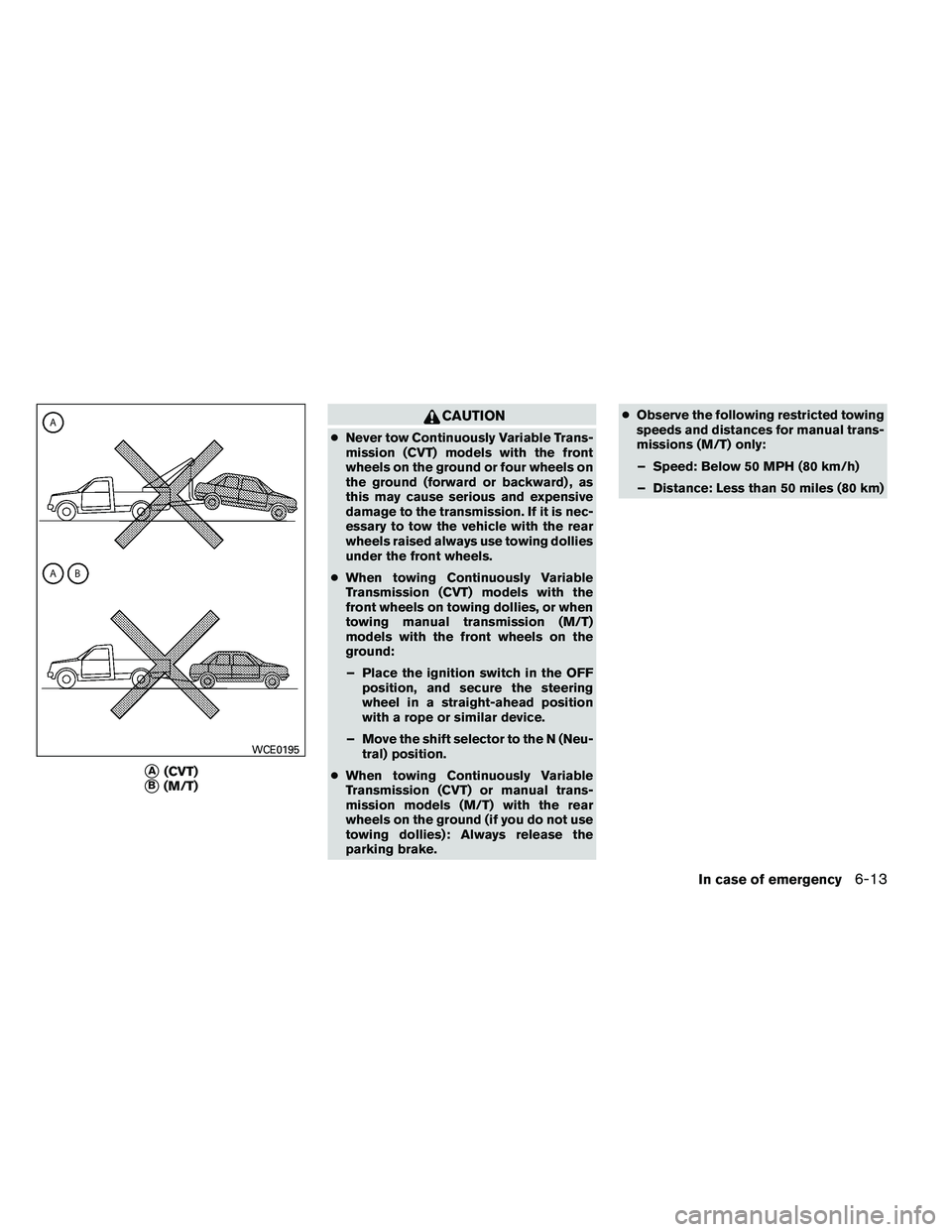
●Never tow Continuously Variable Trans-
mission (CVT) models with the front
wheels on the ground or four wheels on
the ground (forward or backward) , as
this may cause serious and expensive
damage to the transmission. If it is nec-
essary to tow the vehicle with the rear
wheels raised always use towing dollies
under the front wheels.
● When towing Continuously Variable
Transmission (CVT) models with the
front wheels on towing dollies, or when
towing manual transmission (M/T)
models with the front wheels on the
ground:
– Place the ignition switch in the OFF position, and secure the steering
wheel in a straight-ahead position
with a rope or similar device.
– Move the shift selector to the N (Neu- tral) position.
● When towing Continuously Variable
Transmission (CVT) or manual trans-
mission models (M/T) with the rear
wheels on the ground (if you do not use
towing dollies): Always release the
parking brake. ●
Observe the following restricted towing
speeds and distances for manual trans-
missions (M/T) only:
– Speed: Below 50 MPH (80 km/h)
– Distance: Less than 50 miles (80 km)
Page 385 of 453
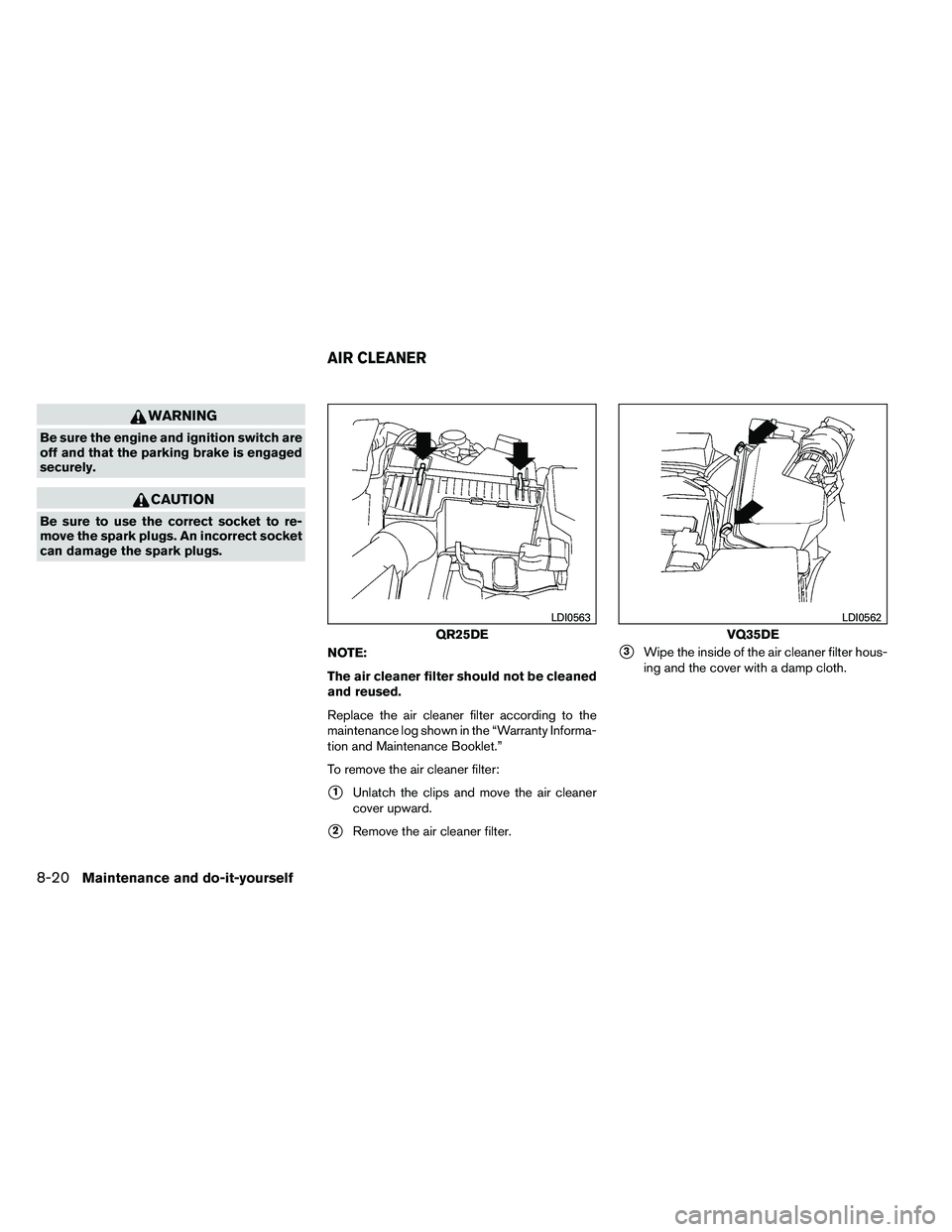
WARNING
Be sure the engine and ignition switch are
off and that the parking brake is engaged
securely.
Page 392 of 453
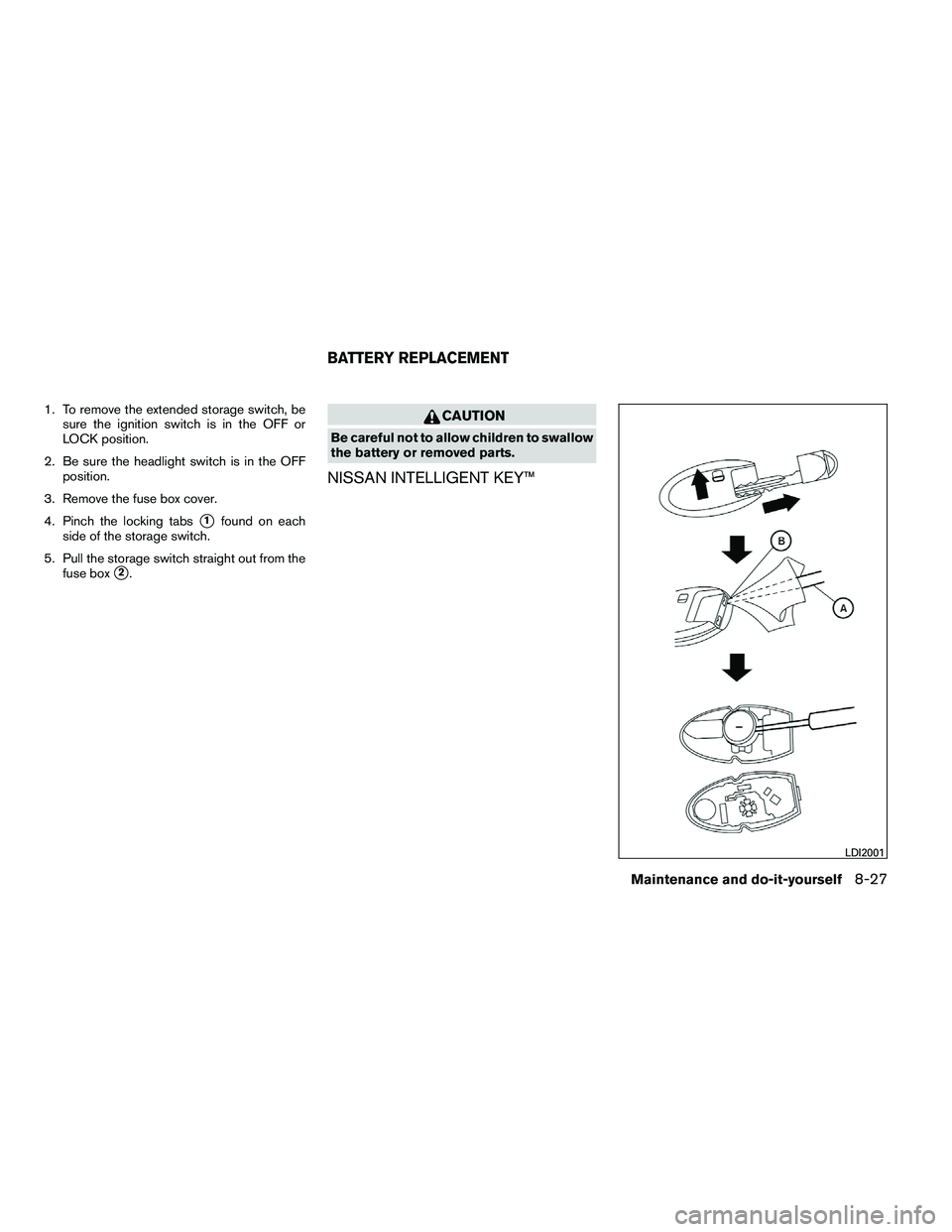
1. To remove the extended storage switch, besure the ignition switch is in the OFF or
LOCK position.
2. Be sure the headlight switch is in the OFF position.
3. Remove the fuse box cover.
4. Pinch the locking tabs
�1found on each
side of the storage switch.
5. Pull the storage switch straight out from the fuse box
�2.
Page 419 of 453
E–85 fuel
E-85 fuel is a mixture of approximately 85% fuel
ethanol and 15% unleaded gasoline. E-85 can
only be used in a Flexible Fuel Vehicle (FFV) . Do
not use E-85 in your vehicle. U.S. government
regulations require fuel ethanol dispensing
pumps to be identified by a small, square, orange
and black label with the common abbreviation or
the appropriate percentage for that region.
Aftermarket fuel additives
NISSAN does not recommend the use of any
aftermarket fuel additives (for example, fuel injec-
tor cleaner, octane booster, intake valve deposit
removers, etc.) which are sold commercially.
Many of these additives intended for gum, varnish
or deposit removal may contain active solvents or
similar ingredients that can be harmful to the fuel
system and engine.
Octane rating tips
Using unleaded gasoline with an octane
rating lower than recommended can cause
persistent, heavy “spark knock.” (“Spark
knock” is a metallic rapping noise.) If se-
vere, this can lead to engine damage. If you
detect a persistent heavy spark knock even
when using gasoline of the stated octane
rating, or if you hear steady spark knock
while holding a steady speed on levelroads, have a NISSAN dealer correct the
condition. Failure to correct the condition
is misuse of the vehicle, for which NISSAN
is not responsible.
Incorrect ignition timing may result in spark
knock, after-run and/or overheating, which may
cause excessive fuel consumption or engine
damage. If any of the above symptoms are en-
countered, have your vehicle checked at a
NISSAN dealer.
However, now and then you may notice
light spark knock for a short time while
accelerating or driving up hills. This is not a
cause for concern, because you get the
greatest fuel benefit when there is light
spark knock for a short time under heavy
engine load.
Page 441 of 453
Additional information concerning motor
vehicle safety may be obtained from
Transport Canada’s Road Safety Informa-
tion Centre at 1-800-333-0371 or online
at www.tc.gc.ca/roadsafety (English
speakers) or
www.tc.gc.ca/securiteroutiere (French
speakers) .
To notify NISSAN of any safety concerns
please contact our Consumer Information
Centre toll free at 1-800-387-0122.Due to legal requirements in some states and
Canadian Provinces, your vehicle may be re-
quired to be in what is called the “ready condi-
tion” for an Inspection/Maintenance (I/M) test of
the emission control system.
The vehicle is set to the “ready condition” when it
is driven through certain driving patterns. Usually,
the ready condition can be obtained by ordinary
usage of the vehicle.
If a powertrain system component is repaired or
the battery is disconnected, the vehicle may be
reset to a “not ready” condition. Before taking the
I/M test, check the vehicle’s
inspection/maintenance test readiness condi-
tion. Place the ignition switch in the ON position
without starting the engine. If the Malfunction
Indicator Light (MIL) comes on steady for 20
seconds and then blinks for 10 seconds , the I/M
test condition is “not ready”. If the MIL does not
blink after 20 seconds, the I/M test condition is
“ready”. Contact a NISSAN dealer to set the
“ready condition” or to prepare the vehicle for
testing.This vehicle is equipped with an Event Data Re-
corder (EDR) . The main purpose of an EDR is to
record, in certain crash or near crash-like situa-
tions, such as an air bag deployment or hitting a
road obstacle, data that will assist in understand-
ing how a vehicle’s systems performed. The EDR
is designed to record data related to vehicle
dynamics and safety systems for a short period of
time, typically 30 seconds or less. The EDR in this
vehicle is designed to record such data as:
● How various systems in your vehicle were
operating;
● Whether or not the driver and passenger
safety belts were buckled/fastened;
● How far (if at all) the driver was depressing
the accelerator and/or brake pedal; and,
● How fast the vehicle was traveling.
● Sounds are not recorded.
These data can help provide a better understand-
ing of the circumstances in which crashes and
injuries occur. NOTE: EDR data are recorded by
your vehicle only if a nontrivial crash situation
occurs; no data are recorded by the EDR under
normal driving conditions and no personal data
(e.g. name, gender, age and crash location) are
recorded. However, other parties, such as law
enforcement, could combine the EDR data with
READINESS FOR INSPECTION/
MAINTENANCE (I/M) TEST EVENT DATA RECORDERS (EDR)
9-26Technical and consumer information
Page 446 of 453
Continuously Variable Transmission
(CVT) fluid..................8-13
Engine coolant .................8-8
Engine oil ...................8-10
Power steering fluid .............8-14
F.M.V.S.S. certification label ...........9-10
Fog light switch .................2-34
Front air bag system
(See supplemental restraint system) ......1-50
Front seats .....................1-2
Fuel Capacities and recommended
fuel/lubricants .................9-2
Fuel economy ................5-22
Fuel-filler door and cap ...........3-25
Fuel-filler door lock opener lever ......3-25
Fuel gauge ...................2-6
Fuel octane rating ...............9-4
Fuel recommendation .............9-3
Loose fuel cap warning ........2-25, 3-25
Fuses .......................8-23
Fusible links ...................8-25
G
Garage door opener, HomeLink� Universal
Transceiver ....................2-51
Gascap .....................3-25
Gauge Engine coolant temperature gauge .....2-5
Fuel gauge ...................2-6
Odometer ...................2-4
Speedometer .................2-4
Tachometer ..................2-5
Trip odometer .................2-4 General maintenance
...............8-2
Glove box .....................2-41
Glove box lock ..................2-41
Grocery hooks ..................2-42
H
Hands-free phone system, Bluetooth� . . . .4-92,
4-106
Hazard warning flasher switch .........2-34
Headlight
and turn signal switch ........2-29
Headlight control switch ............2-31
Headlights ....................8-29
Heated seats ...................2-35
Heater Heater and air conditioner
controls ................4-19, 4-26
Heater operation ...........4-20, 4-27
HomeLink� Universal Transceiver ........2-51
Hood release ...................3-23
Horn .......................2-35
I
Ignition Switch Push-Button Ignition Switch .........5-7
Immobilizer system .........2-27, 3-3, 5-10
Important vehicle information label .......9-10
In-cabin microfilter ................8-21
Increasing fuel economy .............5-22
Indicator lights and audible reminders
(See warning/indicator lights and audible
reminders) ....................2-10
Inside automatic anti-glare mirror ........3-30Inside mirror
...................3-29
Instrument brightness control ..........2-33
Instrument panel ...............0-8, 2-2
Instrument panel dimmer switch ........2-33
Intelligent Key system Key operating range ..........3-8, 3-18
Key operation .................3-9
Mechanical key ................3-3
Remote keyless entry operation . . .3-12, 3-18
Troubleshooting guide ........3-16, 3-22
Warning signals ............3-16, 3-22
Interior light ....................2-48
Interior trunk lid release .............3-24
iPod� Player................4-72, 4-74
ISOFIX child restraints .............1-24
J
Jump starting .................. .6-8
K
K
eyfob battery replacement ...........8-27
Keyless entry With Intelligent Key system
(See Intelligent Key system) .....3-12, 3-18
Keys, For Intelligent Key system .........3-2
L
Labels Air conditioner specification label .....9-12
C.M.V.S.S. certification label ........9-10
10-3