2012 NISSAN 370Z COUPE wheel
[x] Cancel search: wheelPage 395 of 427
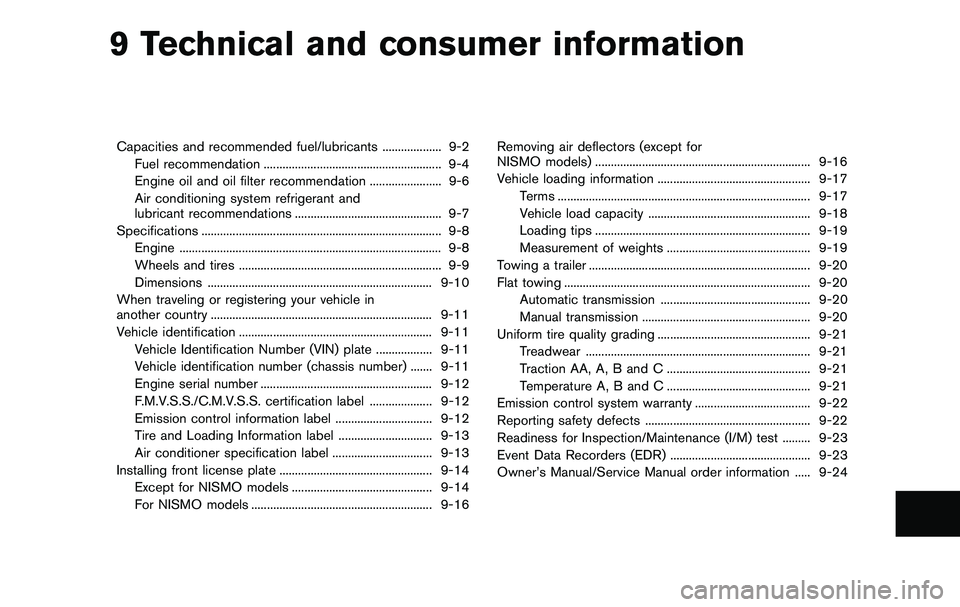
9 Technical and consumer information
Capacities and recommended fuel/lubricants ................... 9-2Fuel recommendation ......................................................... 9-4
Engine oil and oil filter recommendation ....................... 9-6
Air conditioning system refrigerant and
lubricant recommendations ............................................... 9-7
Specifications ........................................................................\
..... 9-8
Engine ........................................................................\
............ 9-8
Wheels and tires ................................................................. 9-9
Dimensions ........................................................................\
9-10
When traveling or registering your vehicle in
another country ....................................................................... 9-11
Vehicle identification .............................................................. 9-11 Vehicle Identification Number (VIN) plate .................. 9-11
Vehicle identification number (chassis number) ....... 9-11
Engine serial number ....................................................... 9-12
F.M.V.S.S./C.M.V.S.S. certification label .................... 9-12
Emission control information label ............................... 9-12
Tire and Loading Information label .............................. 9-13
Air conditioner specification label ................................ 9-13
Installing front license plate ................................................. 9-14
Except for NISMO models ............................................. 9-14
For NISMO models .......................................................... 9-16 Removing air deflectors (except for
NISMO models) ..................................................................... 9-16
Vehicle loading information ................................................. 9-17
Terms ........................................................................\
......... 9-17
Vehicle load capacity .................................................... 9-18
Loading tips ..................................................................... 9-19
Measurement of weights .............................................. 9-19
Towing a trailer ....................................................................... 9-20
Flat towing ........................................................................\
....... 9-20 Automatic transmission ................................................ 9-20
Manual transmission ...................................................... 9-20
Uniform tire quality grading ................................................. 9-21 Treadwear ........................................................................\
9-21
Traction AA, A, B and C .............................................. 9-21
Temperature A, B and C .............................................. 9-21
Emission control system warranty ..................................... 9-22
Reporting safety defects ..................................................... 9-22
Readiness for Inspection/Maintenance (I/M) test ......... 9-23
Event Data Recorders (EDR) ............................................. 9-23
Owner’s Manual/Service Manual order information ..... 9-24
Page 403 of 427
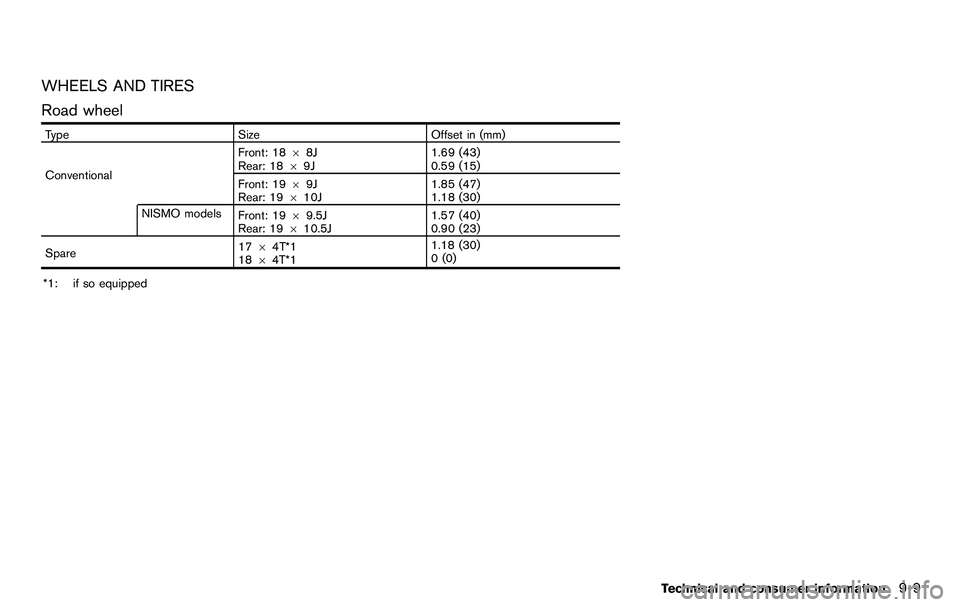
WHEELS AND TIRES
Road wheel
TypeSize Offset in (mm)
Conventional Front: 18
68J
Rear: 18 69J 1.69 (43)
0.59 (15)
Front: 19 69J
Rear: 19 610J 1.85 (47)
1.18 (30)
NISMO models Front: 1969.5J
Rear: 19 610.5J 1.57 (40)
0.90 (23)
Spare 17
64T*1
18 64T*1 1.18 (30)
0 (0)
*1: if so equipped
Technical and consumer information9-9
Page 404 of 427
![NISSAN 370Z COUPE 2012 Owners Manual 9-10Technical and consumer information
Tire
TypeSize Pressure PSI (kPa) [Cold]
Conventional Front: 225/50R18 95W
Rear: 245/45R18 96W
35 (240)*2
38 (260)*3
Front: 245/40R19 94W
Rear: 275/35R19 96W 35 (](/manual-img/5/58159/w960_58159-403.png "NISSAN 370Z COUPE 2012 Owners Manual 9-10Technical and consumer information
Tire
TypeSize Pressure PSI (kPa) [Cold]
Conventional Front: 225/50R18 95W
Rear: 245/45R18 96W
35 (240)*2
38 (260)*3
Front: 245/40R19 94W
Rear: 275/35R19 96W 35 (")
9-10Technical and consumer information
Tire
TypeSize Pressure PSI (kPa) [Cold]
Conventional Front: 225/50R18 95W
Rear: 245/45R18 96W
35 (240)*2
38 (260)*3
Front: 245/40R19 94W
Rear: 275/35R19 96W 35 (240)
NISMO models Front: 245/40R19
Rear: 285/35R19 35 (240)
Spare (T-type) T145/80D17 107M*1
T145/70R18 107M*1
60 (420)
—*3, *4
*1: if so equipped
*2: Coupe models
*3: Roadster models
*4: The emergency tire puncture repair kit is supplied.
DIMENSIONS
in (mm)
Overall length 167.2 (4,246)*1 167.4 (4,253)*2
173.4 (4,405)*1, *3
173.5 (4,407)*2, *3
Overall width 72.6 (1,845)
Overall height 51.8 (1,315) 52.2 (1,325)*4
Front tread 61.0 (1,550)*5
60.6 (1,540)*6
61.2 (1,555)*6, *3
Rear tread 62.8 (1,595)*5
61.6 (1,565)*6
62.2 (1,580)*6, *3
Wheelbase 100.4 (2,550)
*1: Without front license plate bracket
*2: With front license plate bracket
*3: NISMO models
*4: Roadster models
*5: 18-inch wheel models
*6: 19-inch wheel models
Page 410 of 427
9-16Technical and consumer information
FOR NISMO MODELS
Use the following steps to mount the license
plate:
Before mounting the license plate, confirm that
the following parts are enclosed in the vinyl bag.
.License plate bracket
. J-nut 62
. Screw 64
. Screw grommet 64
1. Park the vehicle on flat, level ground.
2. Temporarily place the license plate bracket while aligning points
*Aof the front bumper
fascia with holes
*Bin the license plate
bracket.
3. Confirm that points
*Aand*Bare aligned.
Hold the license plate bracket and mark the
points
*Con the bumper facia through the
center of the holes
*Dwith a felt-tip pen.
4. Remove the license plate bracket.
5. Carefully drill two shallow pilot holes
*A
and*Cusing a 0.39 in (10 mm) drill bit at
the marked locations. (Be sure that the
drill only goes through the fascia.)
6. Insert grommets into the hole on the fascia.
7. Insert a flat-blade screwdriver into the grommet hole to add a 908 turn onto the
part
*E. 8. Insert a J-nut into the license plate bracket
before placing the license plate bracket on
the fascia.
9. Install the license plate bracket with the screws.
10. Install the license plate with bolts that are not longer than 0.55 in (14 mm).
When the recovery hook is used, you need to
temporarily remove the front license plate and
bracket from the vehicle. (See “Vehicle recovery
(freeing a stuck vehicle)” (P.6-21) for further
details.)
STI0623
Left side
This vehicle is equipped with air deflectors in
front of the front wheels. The deflectors will
change the air flow to help improve aerodynamic
performance.
When transporting your vehicle on a trailer, the
air deflectors may interfere with a steep slope to
a trailer bed. In this case, remove the deflectors
from the undercover of the vehicle.
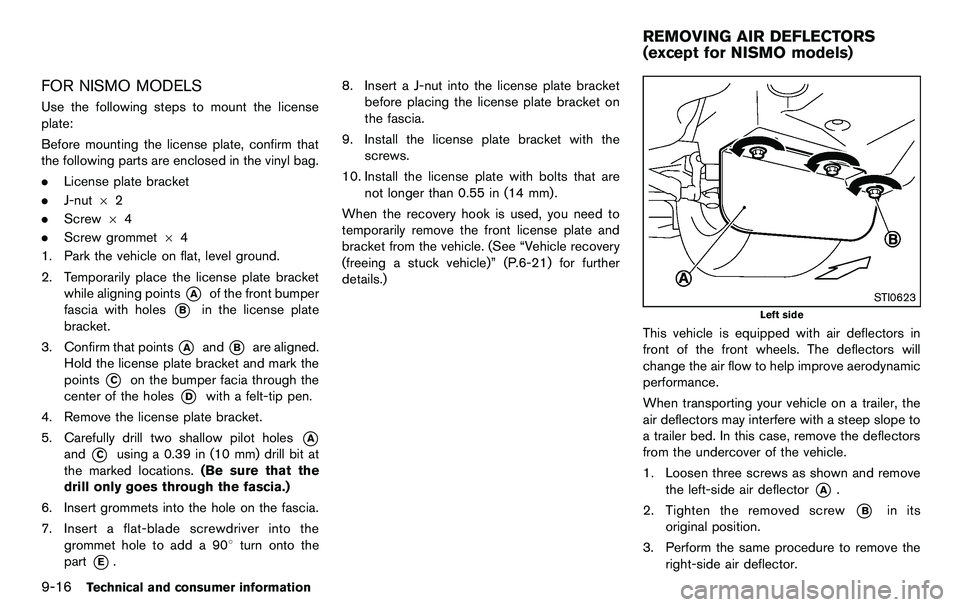
1. Loosen three screws as shown and remove the left-side air deflector
*A.
2. Tighten the removed screw
*Bin its
original position.
3. Perform the same procedure to remove the right-side air deflector.
REMOVING AIR DEFLECTORS
(except for NISMO models)
Page 413 of 427
capacity. For example, if the XXX
amount equals 1400 lbs. and there will
be five 150 lb. passengers in your
vehicle, the amount of available cargo
and luggage load capacity is 650 lbs.
(1400−750 (5 x 150) = 650 lbs or
640 −340 (5 x 70) = 300 kg.)
5. Determine the combined weight of luggage and cargo being loaded on
the vehicle. That weight may not safely
exceed the available cargo and luggage
load capacity calculated in Step 4.
6. If your vehicle will be towing a trailer, load from your trailer will be transferred
to your vehicle. Consult this manual to
determine how this reduces the avail-
able cargo and luggage load capacity
of your vehicle.
Before driving a loaded vehicle, confirm
that you do not exceed the Gross Vehicle
Weight Rating (GVWR) or the Gross Axle
Weight Rating (GAWR) for your vehicle.
(See “Measurement of weights” (P.9-19) .)
Also check tires for proper inflation pres-
sures. See the Tire and Loading Information
label.LOADING TIPS
. The GVW must not exceed GVWR or
GAWR as specified on the F.M.V.S.S./
C.M.V.S.S. certification label.
. Do not load the front and rear axle to
the GAWR. Doing so will exceed the
GVWR.
WARNING
.Properly secure all cargo to help
prevent it from sliding or shift-
ing. Do not place cargo higher
than the seatbacks. In a sudden
stop or collision, unsecured car-
go could cause personal injury.
. Do not load your vehicle any
heavier than the GVWR or the
maximum front and rear
GAWRs. If you do, parts of your
vehicle can break, tire damage
could occur, or it can change the
way your vehicle handles. This
could result in loss of control
and cause personal injury. .
Overloading could not only
shorten the life of your vehicle
and the tires, but also could lead
to hazardous vehicle handling
and long braking distance. This
may cause a premature tire
malfunction, which could result
in a serious accident and perso-
nal injury. Failures caused by
overloading are not covered by
the vehicle’s warranty.
MEASUREMENT OF WEIGHTS
Secure loose items to prevent weight shifts
that could affect the balance of your
vehicle. When the vehicle is loaded, drive
to a scale and weigh the front and the rear
wheels separately to determine axle loads.
Individual axle loads should not exceed
either of the gross axle weight ratings
(GAWR). The total of the axle loads should
not exceed the gross vehicle weight rating
(GVWR) . These ratings are given on the
vehicle certification label. If weight ratings
are exceeded, move or remove items to
bring all weights below the ratings.
Technical and consumer information9-19
Page 414 of 427
9-20Technical and consumer information
Do not tow a trailer with your vehicle.Towing your vehicle with all four wheels on the
ground is sometimes called flat towing. This
method is sometimes used when towing a
vehicle behind a recreational vehicle, such as a
motor home.
CAUTION
.Failure to follow these guidelines
can result in severe transmission
damage.
. Whenever flat towing your vehicle,
always tow forward, never back-
ward.
. DO NOT tow any automatic trans-
mission vehicle with all four wheels
on the ground (flat towing) . Doing
so WILL DAMAGE internal transmis-
sion parts due to lack of transmis-
sion lubrication.
. For emergency towing procedures
refer to “Towing recommended by
NISSAN (except for NISMO mod-
els)” (P.6-19) of this manual.
AUTOMATIC TRANSMISSION
To tow a vehicle equipped with an automatic
transmission, an appropriate vehicle dolly MUST
be placed under the towed vehicle’s drive
wheels. Always follow the dolly manufacturer’s
recommendations when using their product.
MANUAL TRANSMISSION
. Always tow with the manual transmission in
Neutral.
. Your vehicle speed should never exceed 70
MPH (112 km/h) when flat towing your
vehicle.
. After towing 500 miles, start and idle the
engine with the transmission in Neutral for
two minutes. Failure to idle the engine after
every 500 miles of towing may cause
damage to the transmission’s internal parts.
TOWING A TRAILER FLAT TOWING
Page 415 of 427

DOT (Department Of Transportation) Quality
Grades: All passenger car tires must conform to
federal safety requirements in addition to these
grades.
Quality grades can be found where applicable
on the tire sidewall between tread shoulder and
maximum section width. For example:
Treadwear 200 Traction AA Temperature A
TREADWEAR
The treadwear grade is a comparative rating
based on the wear rate of the tire when tested
under controlled conditions on a specified
government test course. For example, a tire
graded 150 would wear one and one-half (1
1/2) times as well on the government course as
a tire graded 100. The relative performance of
tires depends upon actual conditions of their
use, however, and may depart significantly from
the norm due to variations in driving habits,
service practices and differences in road char-
acteristics and climate.
TRACTION AA, A, B AND C
The traction grades, from highest to lowest, are
AA, A, B and C. Those grades represent the
tire’s ability to stop on wet pavement as
measured under controlled conditions on spe-
cified government test surfaces of asphalt and
concrete. A tire marked C may have poor
traction performance.
WARNING
The traction grade assigned to this tire
is based on straight-ahead braking
traction tests, and does not include
acceleration, cornering, hydroplaning,
or peak traction characteristics.
TEMPERATURE A, B AND C
The temperature grades A (the highest), B, and
C, representing the tire’s resistance to the
generation of heat and its ability to dissipate
heat when tested under controlled conditions on
a specified indoor laboratory test wheel. Sus-
tained high temperature can cause the material
of the tire to degenerate and reduce tire life, and
excessive temperature can lead to sudden tire
failure. The grade C corresponds to a level of
performance which all passenger car tires must
meet under the Federal Motor Vehicle Safety
Standard No. 109. Grades B and A represent
higher levels of performance on the laboratory
test wheel than the minimum required by law.
WARNING
The temperature grade for this tire is
established for a tire that is properly
inflated and not overloaded. Excessive
speed, under-inflation, or excessive
loading, either separately or in combi-
nation, can cause heat build-up and
possible tire failure.
Technical and consumer information9-21
UNIFORM TIRE QUALITY GRADING
Page 419 of 427
10 Index
A
ABS (Anti-lock Braking System) ............................ 5-26
Advanced air bag system ......................................... 1-33
Air bag systemAdvanced air bag system .................................. 1-33
Front passenger air bag and status light....... 1-35
Front-seat mounted side-impact
supplemental air bag system ............................ 1-38
Roof-mounted curtain side-impact
supplemental air bag system ............................ 1-38
Air bag warning labels............................................... 1-40
Air bag warning light...................................... 1-41, 2-13
Air cleaner housing filter ........................................... 8-19
Air conditioner Air conditioner operation.................................... 4-24
Air conditioner service ........................................ 4-30
Air conditioner specification label.................... 9-13
Air conditioning system refrigerant and
lubricant recommendations....................... 4-30, 9-7
In-cabin microfilter ............................................... 4-30
Air deflectors................................................................ 9-16
Alarm, How to stop alarm (see vehicle
security system)........................................................... 2-28
Alcohol, drugs and driving.......................................... 5-7
Antenna.......................................................................... 4-79
Anti-lock Braking System (ABS) ............................ 5-26
Anti-lock braking system (ABS) warning light..... 2-10
Appearance care Exterior appearance care ...................................... 7-2
Interior appearance care ....................................... 7-5
Audible reminders....................................................... 2-16
Audio operation precautions.................................... 4-31
Audio system................................................................ 4-31 Steering wheel audio controls.......................... 4-77 Autochanger
Compact Disc (CD) ............................................ 4-49
Autolight system.......................................................... 2-32
Automatic Air conditioner (Type A) ..................................... 4-25
Air conditioner (Type B) ..................................... 4-28
Automatic adjusting function
(front windows)..................................................... 2-46
Automatic transmission fluid (ATF).................. 8-13
Door locks................................................................. 3-5
Driving with automatic transmission................ 5-12
AUX (Auxiliary) button.................................... 4-46, 4-51
Auxiliary input jacks .................................................... 4-75
Avoiding collision and rollover ................................... 5-6
B
Battery............................................................................ 8-16 Battery saver system........................................... 2-34
Intelligent Key........................................................ 8-25
Variable voltage control system........................ 8-18
Before starting the engine........................................ 5-11
Belts (See drive belts)............................................... 8-18
Bluetooth
®hands-free phone system
(models with navigation system)............................. 4-81
Bluetooth
®hands-free phone system
(models without navigation system) ....................... 4-91
Bluetooth
®streaming audio ..................................... 4-63
Booster seats............................................................... 1-24
Brake Anti-lock Braking System (ABS) ..................... 5-26
Brake and clutch fluid......................................... 8-14
Brake fluid.............................................................. 8-14
Brake system......................................................... 5-25
Parking brake operation ..................................... 5-20
Warning light......................................................... 2-10 Break-in schedule ....................................................... 5-23
Brightness control......................................................... 4-7 Display ON/OFF button ........................................ 4-7
Instrument panel................................................... 2-34
Bulb check/instrument panel ................................... 2-10
Bulb replacement........................................................ 8-27
C
Cabin air filter............................................................... 4-30
Capacities and recommended fuel/lubricants ....... 9-2
Car phone or CB radio ............................................. 4-80
Cargo cover.................................................................. 2-43
Catalytic converter, Three way catalyst................... 5-3
CD/CF/USB memory care and cleaning .............. 4-76
Center multi-function control panel
(models with navigation system)............................... 4-3
Child restraints............................................................. 1-18 Booster seats........................................................ 1-24
Precautions on child restraints......................... 1-18
Top tether strap.................................................... 1-19
Child safety................................................................... 1-15
Chimes Audible reminders................................................ 2-16
Seat belt warning light and chime................... 2-13
Circuit breaker, Fusible link...................................... 8-23
Cleaning exterior and interior............................ 7-2, 7-5
Clock..................................................................... 2-8, 2-25
Clutch fluid.................................................................... 8-14
Cockpit ............................................................................ 2-3
Cold weather driving.................................................. 5-31
Compact Disc (CD) changer (See
audio system)............................................................... 4-49
Compact Disc (CD) player (See
audio system)................................................... 4-45, 4-54
Compact spare tire..................................................... 8-40