Page 189 of 610

3-92 Features and controls
3
Driving through water
N00537800098
If the electrical circuits become wet, further operation of the
vehicle will be impossible; therefore, avoid driving through
water unless absolutely necessary. If driving through water is
unavoidable, use the following procedure:
Check the depth of the water and the terrain before attempting
to drive through it. Drive slowly to avoid creating excessive
water splashing.
Inspection and maintenance following
rough road operation
N00530700098
After operating the vehicle in rough road conditions, be sure to
perform the following inspection and maintenance procedures:
�Check that the vehicle has not been damaged by rocks,
gravel, etc.
�Carefully wash the vehicle with water.
Drive the vehicle slowly while lightly depressing the
brake pedal in order to dry out the brakes. If the brakes
still do not function properly, contact an authorized Mit-
subishi Motors dealer or a repair facility of your choice as
soon as possible to have the brakes checked.
�Remove the insects, dried grass, etc. clogging the radiator
core.
�After driving through water, check the engine, transaxle
and differential oil. If the oil or grease is milky or cloudy
because of water contamination, it must be replaced with
new oil.
�Check the inside of the vehicle. If water entry is found,
dry the carpet etc.
�Inspect the headlights. If water is in the headlight housing,
have it drained at an authorized Mitsubishi Motors dealer
or a repair facility of your choice.
�Have an authorized Mitsubishi Motors dealer replace
grease in the wheel bearings.
CAUTION
!�Never drive through water that is deep enough to
cover wheel hubs, axles or exhaust pipe. Do not
change the gearshift lever position (M/T) or the
selector lever position (CVT) while driving through
water.
Frequent driving through water can adversely affect
the life span of the vehicle; consult an authorized
Mitsubishi Motors dealer or a repair facility of your
choice and take the necessary measures to prepare,
inspect, and repair the vehicle.�After driving through water, apply the brakes to be
sure they are functioning properly. If the brakes are
wet and not functioning properly, dry them out by
driving slowly while lightly depressing the brake
pedal. Inspect each part of the vehicle carefully.
BK0140300US.book 92 ページ 2011年6月28日 火曜日 午後5時18分
Page 190 of 610
Features and controls
3-93
3 Cautions on the handling of 4-wheel drive
vehicles
N00530800187
Tires and wheelsSince the driving torque can be applied to the four wheels, the
driving performance of the vehicle when operating in 4-wheel
drive is greatly affected by the condition of the tires.
Pay close attention to the tires.
�Install only the specified tires on all wheels. Refer to
“Tires and wheels” on page 9-8.
�Be sure all four tires and wheels are the same size and
type.
When it is necessary to replace any of the tires or wheels,
replace all four.
�All tires should be rotated before the wear difference
between the front and rear tires is recognizable.
Good vehicle performance cannot be expected if there is a dif-
ference in wear between tires. Refer to “Tire rotation” on page
7-30.
�Check the tire inflation pressure regularly.
CAUTION
!�Always use tires of the same size, type, and brand
that have no wear differences. Using tires of differ-
ent size, type, brands or degree of wear, will increase
the differential oil temperature and result in possi-
ble damage to the driving system. Further, the drive
train will be subject to excessive loading, possibly
leading to oil leakage, component seizure, or other
serious failures.
BK0140300US.book 93 ページ 2011年6月28日 火曜日 午後5時18分
Page 191 of 610
3-94 Features and controls
3
To w i n g
Jacking up a 4-wheel drive vehicle
CAUTION
!�Do not tow 4-wheel drive vehicles with the front or
rear wheels on the ground (Type A or Type B) as
illustrated. This could result in damage to the driv-
etrain, or unstable towing.
If you tow 4-wheel drive vehicles, use Type C or
Type D equipment.
�Even in “2WD” mode, the vehicle cannot be towed
with the front or the rear wheels on the ground.
WA R N I N G
!�Do not crank the engine while jacking up the vehi-
cle.
The tire on the ground may turn and the vehicle
may roll off the jack.
CAUTION
!
BK0140300US.book 94 ページ 2011年6月28日 火曜日 午後5時18分
Page 196 of 610
Features and controls
3-99
3
NOTE�Once the brake assist system is operational, it maintains
great braking force even if the brake pedal is lightly
released.
To stop its operation, completely remove your foot from
the brake pedal.
�The brake assist system may become operational when the
brake pedal is fully depressed even if it has not been
depressed suddenly.
�When the brake assist system is in use while driving, you
may feel as if the depressed brake pedal is soft, the pedal
moves in small motions in conjunction with the operation
noise, or the vehicle body and the steering wheel vibrate.
This occurs when the brake assist system is operating nor-
mally and does not indicate faulty operation. Continue to
depress the brake pedal.
�You may hear an operation noise when the brake pedal is
depressed suddenly while stationary. This does not indi-
cate a malfunction and the brake assist system is operating
normally.
Anti-lock braking system
N00517900240
The anti-lock braking system helps prevent the wheels from
locking up when braking. This helps maintain vehicle drivabil-
ity and steering wheel handling.Driving hints�When using the anti-lock brakes (sudden braking), steer-
ing is slightly different from normal driving conditions.
Use the steering wheel carefully.
�Always keep a safe distance from the vehicle in front of
you. Even if your vehicle is equipped with the anti-lock
braking system, leave a greater braking distance when:
• Driving on gravel or snow-covered roads.
• Driving on uneven road surfaces.
�Operation of anti-lock braking system is not restricted sit-
uations where brakes are applied suddenly. This system
may also prevent the wheels from locking when you drive
over manholes, steel roadwork plates, road markings, or
any uneven road surface.
�When the anti-lock braking system is in use, you may feel
the brake pedal vibrating and hear a unique sound. It may
also feel as if the pedal resists being pressed.
In this situation, simply hold the brake pedal down
firmly. Do not pump the brake, which will result in
reduced braking performance.
BK0140300US.book 99 ページ 2011年6月28日 火曜日 午後5時18分
Page 197 of 610
3-100 Features and controls
3
NOTE�A whining sound is emitted from the engine compartment
when driving immediately after starting the engine. These
are the normal sounds the anti-lock braking system makes
when performing a self-check. It does not indicate a mal-
function.
�The anti-lock braking system can be used after the vehicle
has reached a speed over approximately 6 mph (10 km/h).
It stops working when the vehicle slows below 3 mph (5
km/h).
Anti-lock braking system warning light/display
N00531600645
Warning light
Warning display type 1
Warning display type 2
If there is a malfunction in the system, the anti-lock braking
system warning light will come on and the warning display
will appear on the information screen in the multi-information
display.
Under normal conditions, the ABS warning light only comes
on when the ignition switch is turned to the “ON” position or
the operation mode is put in ON and goes off a few seconds
later.
CAUTION
!�The anti-lock braking system cannot prevent acci-
dents. It is your responsibility to take safety precau-
tions and to drive carefully.�To prevent failure of the anti-lock braking system,
be sure all 4 wheels and tires are the same size and
the same type.
BK0140300US.book 100 ページ 2011年6月28日 火曜日 午後5時18分
Page 199 of 610
3-102 Features and controls
3
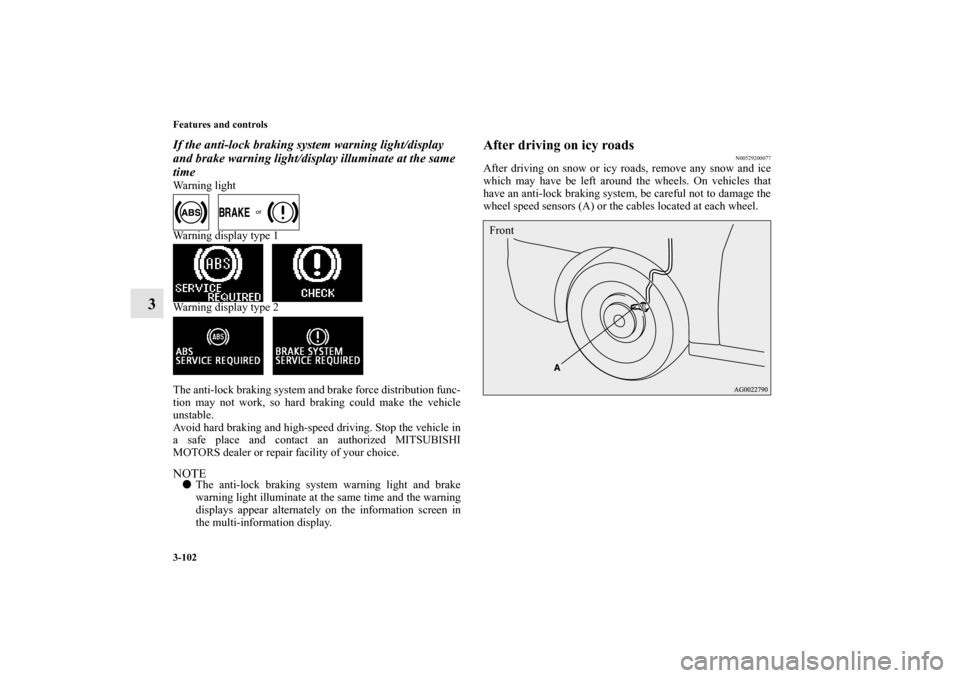
If the anti-lock braking system warning light/display
and brake warning light/display illuminate at the same
timeWarning light
Warning display type 1
Warning display type 2
The anti-lock braking system and brake force distribution func-
tion may not work, so hard braking could make the vehicle
unstable.
Avoid hard braking and high-speed driving. Stop the vehicle in
a safe place and contact an authorized MITSUBISHI
MOTORS dealer or repair facility of your choice.NOTE�The anti-lock braking system warning light and brake
warning light illuminate at the same time and the warning
displays appear alternately on the information screen in
the multi-information display.
After driving on icy roads
N00529200077
After driving on snow or icy roads, remove any snow and ice
which may have be left around the wheels. On vehicles that
have an anti-lock braking system, be careful not to damage the
wheel speed sensors (A) or the cables located at each wheel.Front
BK0140300US.book 102 ページ 2011年6月28日 火曜日 午後5時18分
Page 200 of 610
Features and controls
3-103
3 Electric power steering system (EPS)
N00568400029
The electric power steering system (EPS) operates while the
engine is running. It helps reduce the effort needed to turn the
steering wheel.
The EPS has mechanical steering capability in case the power
assist is lost. If the power assist is lost for some reason, you
will still be able to steer your vehicle. If the power assist is lost,
you will notice it takes much more effort to steer and that there
is much more “free play” in the steering wheel. If this happens,
take your vehicle to an authorized Mitsubishi Motors dealer or
a repair facility of your choice.NOTE�During repeated full-lock turning of the steering wheel
(for example, while you are manoeuvring the vehicle into
a parking space), a protection function may be activated to
prevent overheating of the power steering system. This
function will make the steering wheel gradually harder to
turn. In this event, limit your turning of the steering wheel
for a while. When the system has cooled down, the steer-
ing action will return to normal.
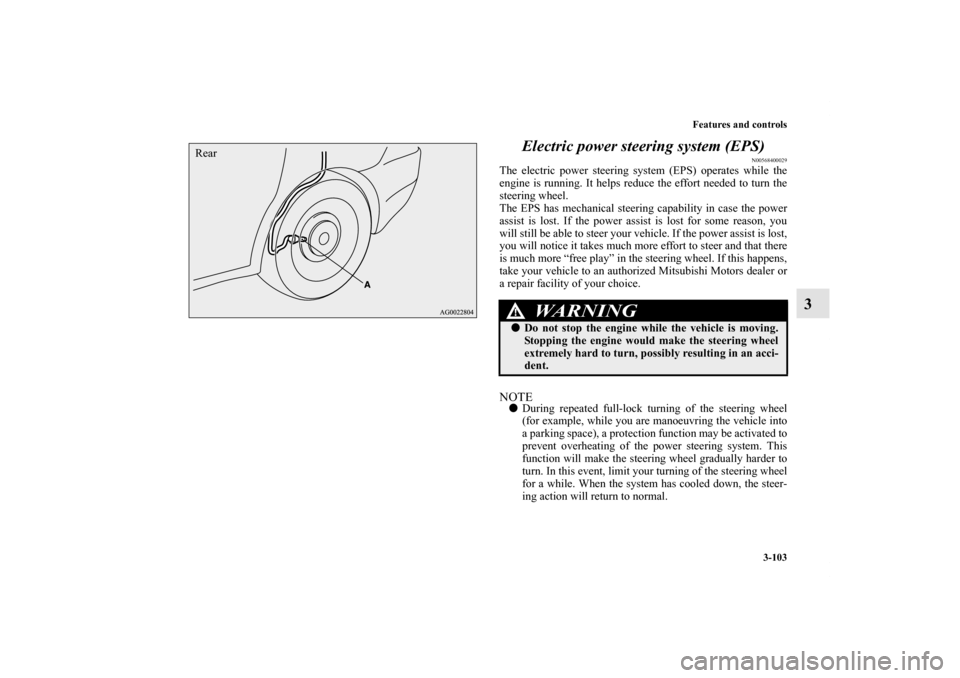
Rear
WA R N I N G
!�Do not stop the engine while the vehicle is moving.
Stopping the engine would make the steering wheel
extremely hard to turn, possibly resulting in an acci-
dent.
BK0140300US.book 103 ページ 2011年6月28日 火曜日 午後5時18分
Page 201 of 610
3-104 Features and controls
3
�If you turn the steering wheel while the vehicle is station-
ary with the headlights on, the headlights may become
dim. This behaviour is not abnormal. The headlights will
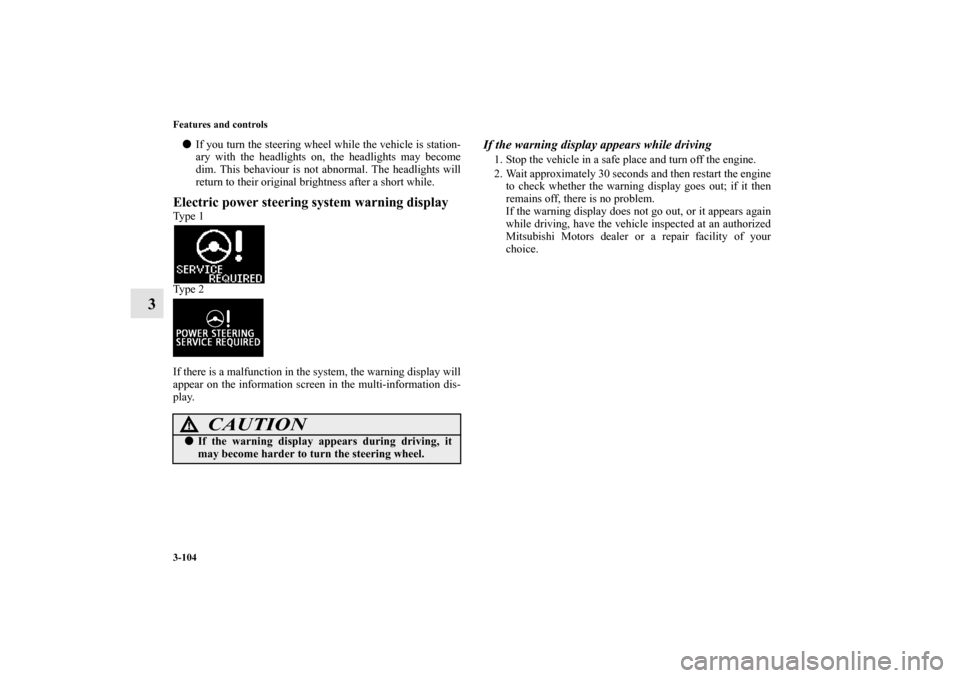
return to their original brightness after a short while.Electric power steering system warning displayTy p e 1
Ty p e 2
If there is a malfunction in the system, the warning display will
appear on the information screen in the multi-information dis-
play.
If the warning display appears while driving 1. Stop the vehicle in a safe place and turn off the engine.
2. Wait approximately 30 seconds and then restart the engine
to check whether the warning display goes out; if it then
remains off, there is no problem.
If the warning display does not go out, or it appears again
while driving, have the vehicle inspected at an authorized
Mitsubishi Motors dealer or a repair facility of your
choice.
CAUTION
!�If the warning display appears during driving, it
may become harder to turn the steering wheel.
BK0140300US.book 104 ページ 2011年6月28日 火曜日 午後5時18分