Page 31 of 610
2-4 Seat and restraint systems
2
WA R N I N G
!�Do not attempt to adjust the seat while driving. This
can cause loss of vehicle control and result in an
accident.�After adjusting the seat, make sure that it is securely
locked into position.�To reduce the risk to the driver of serious injury or
death during deployment of the driver’s airbag,
always properly wear the seat belt and adjust the
driver’s seat as far back as possible while maintain-
ing a position that still enables you to fully apply the
pedals, easily control the steering wheel, and safely
operate the vehicle.�To reduce the risk to the front passenger of serious
injury or death during deployment of the passen-
ger’s airbag, always properly wear the seat belt and
adjust the front passenger’s seat as far back as pos-
sible.�Always place children 12 years old and under in the
rear seat and use appropriate child restraint sys-
tems.
CAUTION
!�Make sure that the seat is adjusted by an adult. If it
is adjusted by a child, an unexpected accident might
occur.�Do not place a cushion or the like between your back
and the seatback while driving. The effectiveness of
the head restraints will be reduced in the event of an
accident.�When sliding the seats, be careful not to catch your
hand or leg.�When sliding or reclining the seat rearward, pay
careful attention to the rear seat passengers.
BK0140300US.book 4 ページ 2011年6月28日 火曜日 午後5時18分
Page 33 of 610
2-6 Seat and restraint systems
2
To adjust the seatbacks
N00402000268
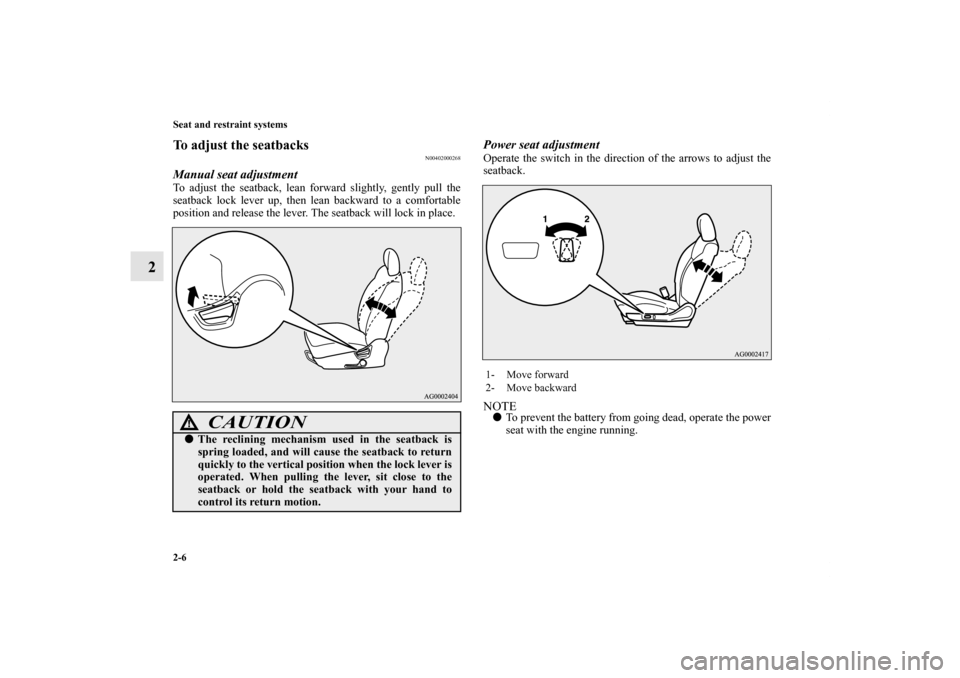
Manual seat adjustmentTo adjust the seatback, lean forward slightly, gently pull the
seatback lock lever up, then lean backward to a comfortable
position and release the lever. The seatback will lock in place.
Power seat adjustmentOperate the switch in the direction of the arrows to adjust the
seatback.NOTE�To prevent the battery from going dead, operate the power
seat with the engine running.
CAUTION
!�The reclining mechanism used in the seatback is
spring loaded, and will cause the seatback to return
quickly to the vertical position when the lock lever is
operated. When pulling the lever, sit close to the
seatback or hold the seatback with your hand to
control its return motion.
1- Move forward
2- Move backward
BK0140300US.book 6 ページ 2011年6月28日 火曜日 午後5時18分
Page 45 of 610
2-18 Seat and restraint systems
2
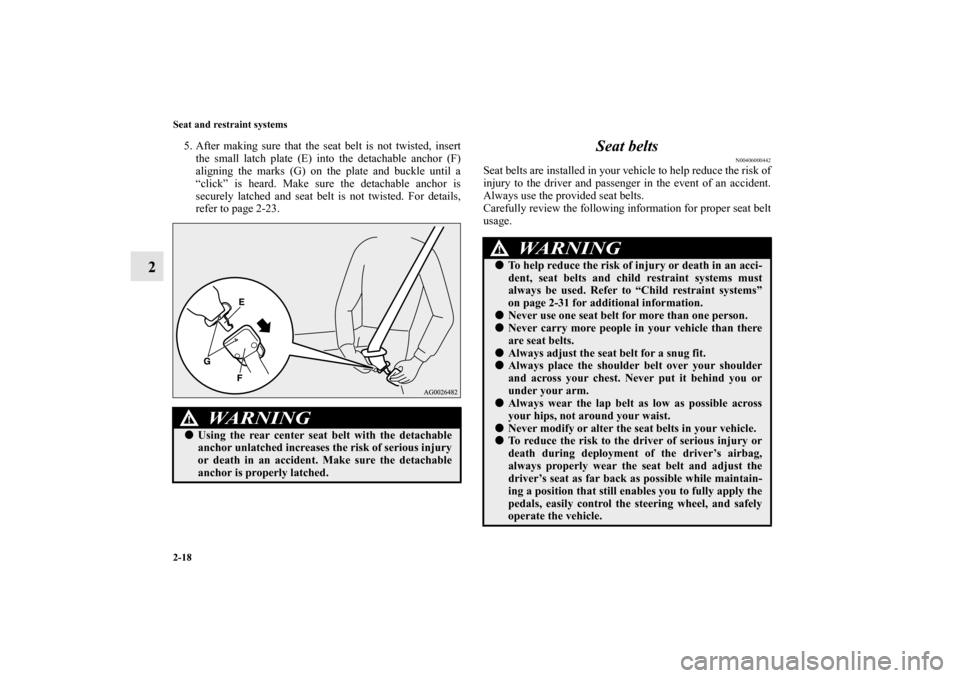
5. After making sure that the seat belt is not twisted, insert
the small latch plate (E) into the detachable anchor (F)
aligning the marks (G) on the plate and buckle until a
“click” is heard. Make sure the detachable anchor is
securely latched and seat belt is not twisted. For details,
refer to page 2-23.
Seat belts
N00406000442
Seat belts are installed in your vehicle to help reduce the risk of
injury to the driver and passenger in the event of an accident.
Always use the provided seat belts.
Carefully review the following information for proper seat belt
usage.
WA R N I N G
!�Using the rear center seat belt with the detachable
anchor unlatched increases the risk of serious injury
or death in an accident. Make sure the detachable
anchor is properly latched.
WA R N I N G
!�To help reduce the risk of injury or death in an acci-
dent, seat belts and child restraint systems must
always be used. Refer to “Child restraint systems”
on page 2-31 for additional information.�Never use one seat belt for more than one person. �Never carry more people in your vehicle than there
are seat belts. �Always adjust the seat belt for a snug fit.�Always place the shoulder belt over your shoulder
and across your chest. Never put it behind you or
under your arm. �Always wear the lap belt as low as possible across
your hips, not around your waist.�Never modify or alter the seat belts in your vehicle.�To reduce the risk to the driver of serious injury or
death during deployment of the driver’s airbag,
always properly wear the seat belt and adjust the
driver’s seat as far back as possible while maintain-
ing a position that still enables you to fully apply the
pedals, easily control the steering wheel, and safely
operate the vehicle.
BK0140300US.book 18 ページ 2011年6月28日 火曜日 午後5時18分
Page 47 of 610
2-20 Seat and restraint systems
2
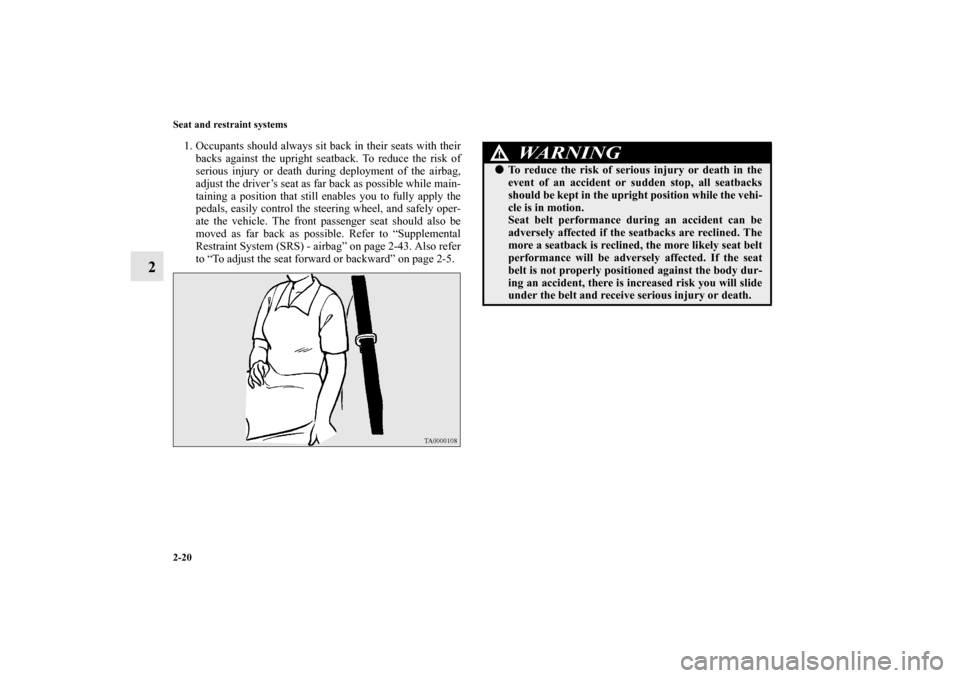
1. Occupants should always sit back in their seats with their
backs against the upright seatback. To reduce the risk of
serious injury or death during deployment of the airbag,
adjust the driver’s seat as far back as possible while main-
taining a position that still enables you to fully apply the
pedals, easily control the steering wheel, and safely oper-
ate the vehicle. The front passenger seat should also be
moved as far back as possible. Refer to “Supplemental
Restraint System (SRS) - airbag” on page 2-43. Also refer
to “To adjust the seat forward or backward” on page 2-5.
WA R N I N G
!�To reduce the risk of serious injury or death in the
event of an accident or sudden stop, all seatbacks
should be kept in the upright position while the vehi-
cle is in motion.
Seat belt performance during an accident can be
adversely affected if the seatbacks are reclined. The
more a seatback is reclined, the more likely seat belt
performance will be adversely affected. If the seat
belt is not properly positioned against the body dur-
ing an accident, there is increased risk you will slide
under the belt and receive serious injury or death.
BK0140300US.book 20 ページ 2011年6月28日 火曜日 午後5時18分
Page 57 of 610
2-30 Seat and restraint systems
2
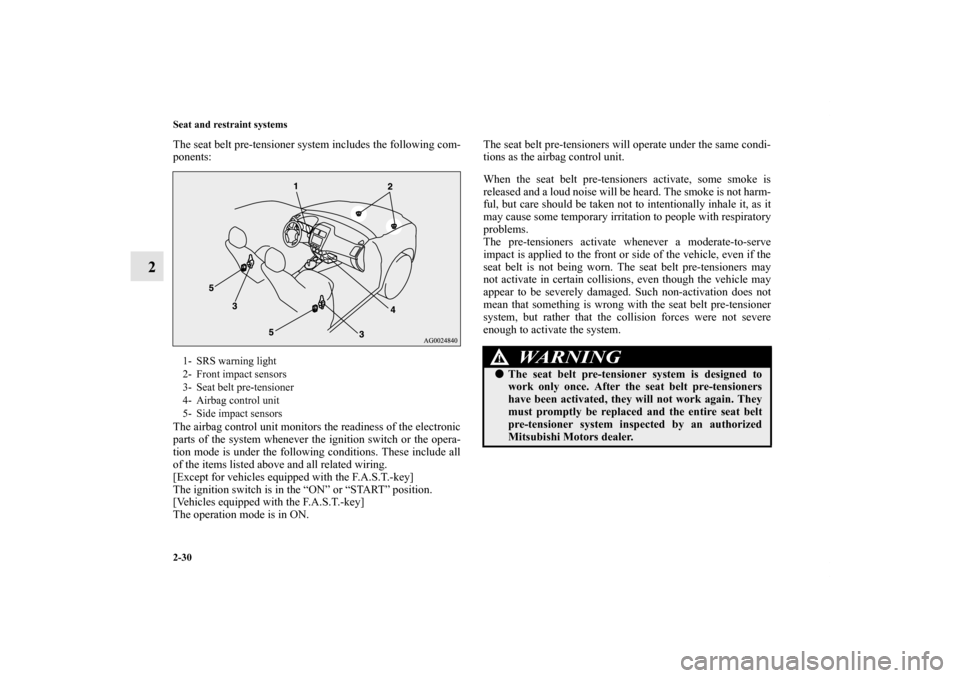
The seat belt pre-tensioner system includes the following com-
ponents:
The airbag control unit monitors the readiness of the electronic
parts of the system whenever the ignition switch or the opera-
tion mode is under the following conditions. These include all
of the items listed above and all related wiring.
[Except for vehicles equipped with the F.A.S.T.-key]
The ignition switch is in the “ON” or “START” position.
[Vehicles equipped with the F.A.S.T.-key]
The operation mode is in ON.The seat belt pre-tensioners will operate under the same condi-
tions as the airbag control unit.
When the seat belt pre-tensioners activate, some smoke is
released and a loud noise will be heard. The smoke is not harm-
ful, but care should be taken not to intentionally inhale it, as it
may cause some temporary irritation to people with respiratory
problems.
The pre-tensioners activate whenever a moderate-to-serve
impact is applied to the front or side of the vehicle, even if the
seat belt is not being worn. The seat belt pre-tensioners may
not activate in certain collisions, even though the vehicle may
appear to be severely damaged. Such non-activation does not
mean that something is wrong with the seat belt pre-tensioner
system, but rather that the collision forces were not severe
enough to activate the system.1- SRS warning light
2- Front impact sensors
3- Seat belt pre-tensioner
4- Airbag control unit
5- Side impact sensors
WA R N I N G
!�The seat belt pre-tensioner system is designed to
work only once. After the seat belt pre-tensioners
have been activated, they will not work again. They
must promptly be replaced and the entire seat belt
pre-tensioner system inspected by an authorized
Mitsubishi Motors dealer.
BK0140300US.book 30 ページ 2011年6月28日 火曜日 午後5時18分
Page 71 of 610
2-44 Seat and restraint systems
2
WA R N I N G
!�IT IS VERY IMPORTANT TO BE PROPERLY
SEATED.
• A driver or front passenger sitting too close to the
steering wheel or instrument panel during airbag
deployment can be seriously injured or killed.
• Airbags inflate very quickly and with great force.
If the driver and front passenger are not properly
seated and restrained, the airbag may not provide
the proper protection, and can cause serious inju-
ries or death when it inflates.
• To reduce the risk to the driver of serious injury or
death due to a deploying driver’s airbag, always
properly wear your seat belt and adjust the
driver’s seat as far back as possible, maintaining a
position that still allows the driver to have good
control of the steering wheel, brake, accelerator,
and other vehicle controls.
• To reduce the risk to the front passenger of serious
injury or death from a deploying passenger’s air-
bag, make sure the passenger always wears the
seat belt properly, remains seated upright and all
the way back in the seat, and positions the seat as
far back as possible.
• Seat all infants and children in the rear seat, prop-
erly restrained in an appropriate child restraint
system.
WA R N I N G
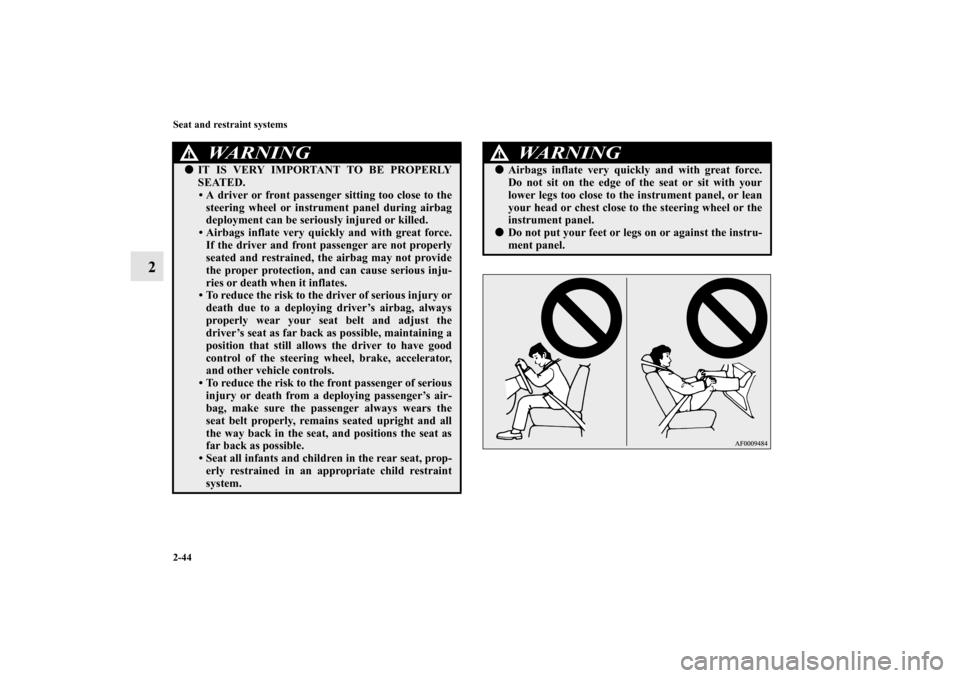
!�Airbags inflate very quickly and with great force.
Do not sit on the edge of the seat or sit with your
lower legs too close to the instrument panel, or lean
your head or chest close to the steering wheel or the
instrument panel.�Do not put your feet or legs on or against the instru-
ment panel.
BK0140300US.book 44 ページ 2011年6月28日 火曜日 午後5時18分
Page 74 of 610
Seat and restraint systems
2-47
2
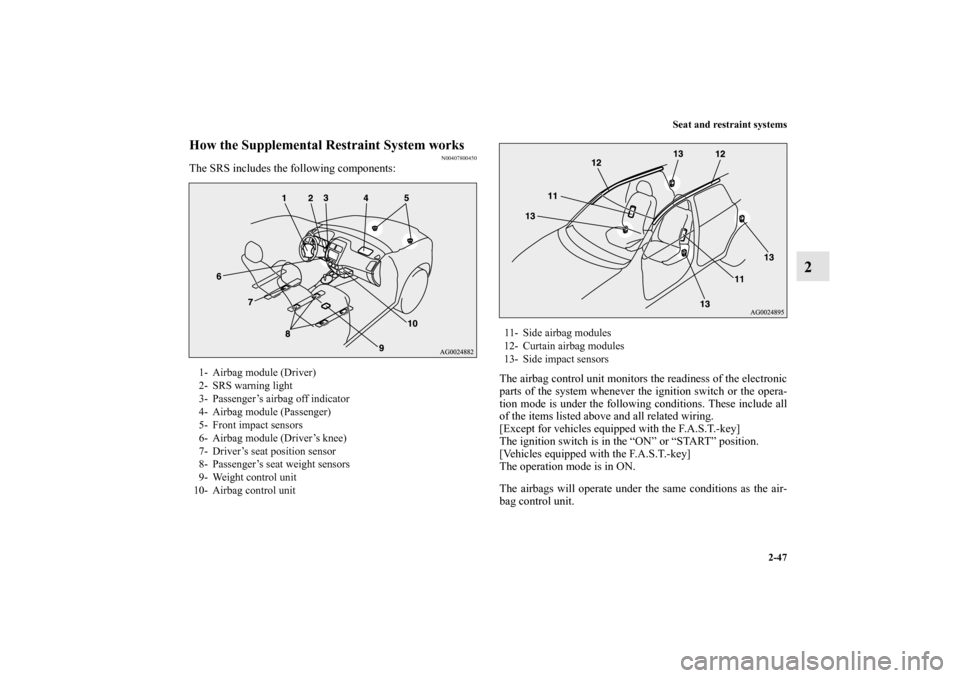
How the Supplemental Restraint System works
N00407800450
The SRS includes the following components:
The airbag control unit monitors the readiness of the electronic
parts of the system whenever the ignition switch or the opera-
tion mode is under the following conditions. These include all
of the items listed above and all related wiring.
[Except for vehicles equipped with the F.A.S.T.-key]
The ignition switch is in the “ON” or “START” position.
[Vehicles equipped with the F.A.S.T.-key]
The operation mode is in ON.
The airbags will operate under the same conditions as the air-
bag control unit.1- Airbag module (Driver)
2- SRS warning light
3- Passenger’s airbag off indicator
4- Airbag module (Passenger)
5- Front impact sensors
6- Airbag module (Driver’s knee)
7- Driver’s seat position sensor
8- Passenger’s seat weight sensors
9- Weight control unit
10- Airbag control unit
11- Side airbag modules
12- Curtain airbag modules
13- Side impact sensors
BK0140300US.book 47 ページ 2011年6月28日 火曜日 午後5時18分
Page 75 of 610
2-48 Seat and restraint systems
2
When the impact sensors detect a sufficient front or side impact
to deploy the airbag(s), the appropriate airbag(s) will be
deployed.
When the airbag control unit detects rollover of the vehicle,
curtain airbags will be deployed.
When airbags deploy, some smoke is released accompanied by
a loud noise. The smoke is not harmful, but do not intentionally
inhale the smoke as it may cause temporary irritation to people
with respiratory problems.
An inflated airbag will deflate quickly, so you may not even
notice that the airbag was inflated.
Airbag inflation does not prevent the driver from seeing or
being able to steer the vehicle, and does not prevent people
from leaving the vehicle.
Event Data Recording
N00418600197
Your vehicle is equipped with an “EDR” - Event Data
Recorder which is capable of collecting and storing data in the
event of an airbag deployment.
The EDR may record the following information:
�Condition of specific vehicle systems;
�Diagnostic code(s)
CAUTION
!�Airbags inflate very quickly and with great force. In
certain situations, contact with an inflating airbag
may cause small cuts, abrasions, and bruises.
BK0140300US.book 48 ページ 2011年6月28日 火曜日 午後5時18分