Page 404 of 714
Features and controls
3-289
3
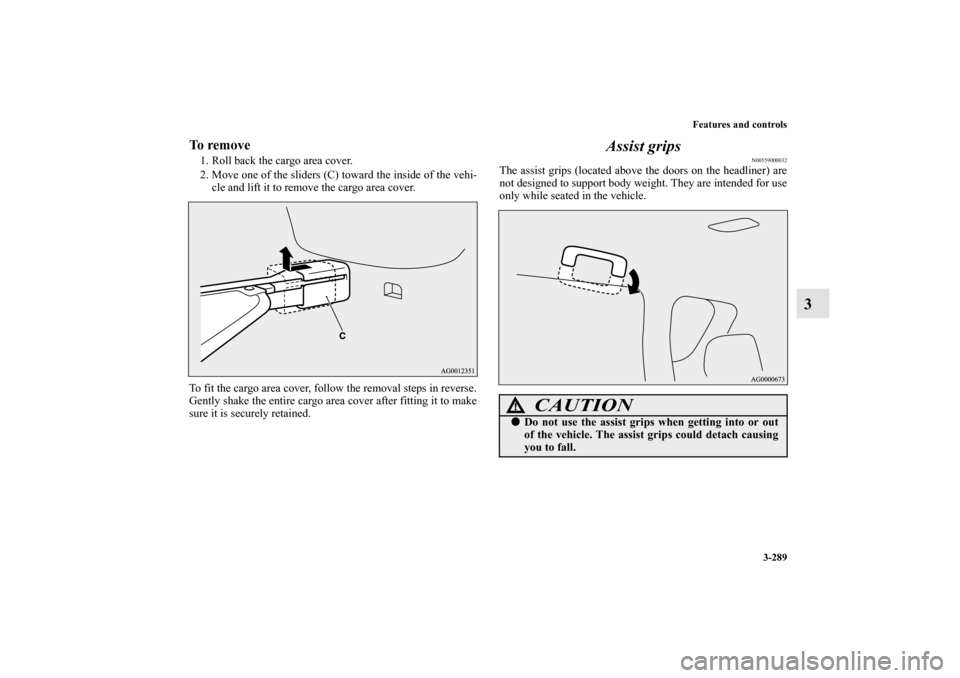
To remove1. Roll back the cargo area cover.
2. Move one of the sliders (C) toward the inside of the vehi-
cle and lift it to remove the cargo area cover.
To fit the cargo area cover, follow the removal steps in reverse.
Gently shake the entire cargo area cover after fitting it to make
sure it is securely retained.
Assist grips
N00559000032
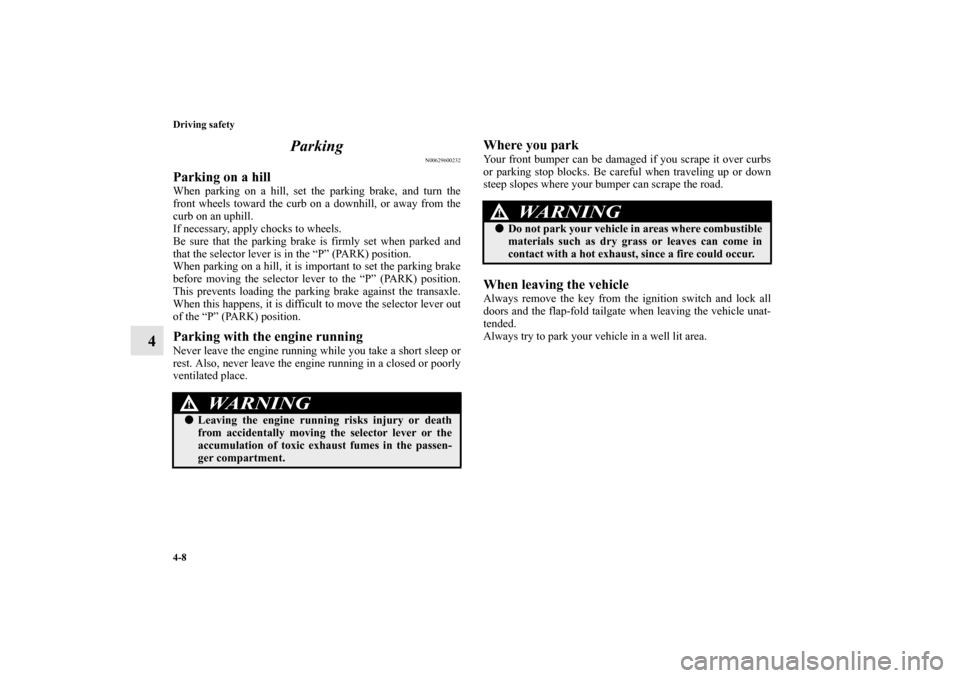
The assist grips (located above the doors on the headliner) are
not designed to support body weight. They are intended for use
only while seated in the vehicle.
CAUTION
!�Do not use the assist grips when getting into or out
of the vehicle. The assist grips could detach causing
you to fall.
BK0138000US.book 289 ページ 2011年4月13日 水曜日 午前11時17分
Page 408 of 714
4
Driving safety
Driving precaution . . . . . . . . . . . . . . . . . . . . . . . . .4- 2
Fuel economy . . . . . . . . . . . . . . . . . . . . . . . . . . . . .4- 2
Driving, alcohol and drugs. . . . . . . . . . . . . . . . . . .4- 3
Floor mat . . . . . . . . . . . . . . . . . . . . . . . . . . . . . . . .4- 3
Vehicle preparation before driving. . . . . . . . . . . . .4- 5
Safe driving techniques . . . . . . . . . . . . . . . . . . . . .4- 6
Driving during cold weather . . . . . . . . . . . . . . . . .4- 6
Braking. . . . . . . . . . . . . . . . . . . . . . . . . . . . . . . . . .4- 7
Parking . . . . . . . . . . . . . . . . . . . . . . . . . . . . . . . . . .4- 8
Loading information . . . . . . . . . . . . . . . . . . . . . . .4- 9
Cargo loads . . . . . . . . . . . . . . . . . . . . . . . . . . . . . .4- 13
Trailer towing. . . . . . . . . . . . . . . . . . . . . . . . . . . . .4- 17
BK0138000US.book 1 ページ 2011年4月13日 水曜日 午前11時17分
Page 415 of 714
4-8 Driving safety
4Parking
N00629600232
Parking on a hillWhen parking on a hill, set the parking brake, and turn the
front wheels toward the curb on a downhill, or away from the
curb on an uphill.
If necessary, apply chocks to wheels.
Be sure that the parking brake is firmly set when parked and
that the selector lever is in the “P” (PARK) position.
When parking on a hill, it is important to set the parking brake
before moving the selector lever to the “P” (PARK) position.
This prevents loading the parking brake against the transaxle.
When this happens, it is difficult to move the selector lever out
of the “P” (PARK) position.Parking with the engine runningNever leave the engine running while you take a short sleep or
rest. Also, never leave the engine running in a closed or poorly
ventilated place.
Where you parkYour front bumper can be damaged if you scrape it over curbs
or parking stop blocks. Be careful when traveling up or down
steep slopes where your bumper can scrape the road.When leaving the vehicleAlways remove the key from the ignition switch and lock all
doors and the flap-fold tailgate when leaving the vehicle unat-
tended.
Always try to park your vehicle in a well lit area.
WA R N I N G
!�Leaving the engine running risks injury or death
from accidentally moving the selector lever or the
accumulation of toxic exhaust fumes in the passen-
ger compartment.
WA R N I N G
!�Do not park your vehicle in areas where combustible
materials such as dry grass or leaves can come in
contact with a hot exhaust, since a fire could occur.
BK0138000US.book 8 ページ 2011年4月13日 水曜日 午前11時17分
Page 416 of 714
Driving safety
4-9
4 Loading information
N00629900352
It is very important to know how much weight your vehicle can
carry. This weight is called the vehicle capacity weight and
includes the weight of all occupants, cargo (including the roof
load), non-factory-installed options, and the tongue weight of
the trailer, if any, being towed. The tire and loading informa-
tion placard located on the driver’s door sill of your vehicle
will show how much weight it may properly carry.
It is important to familiarize yourself with the following terms
before loading your vehicle:
�Vehicle maximum load on the tire: load on an individual
tire that is determined by distributing to each axle its share
of the maximum loaded vehicle weight and dividing by
two.
�Vehicle normal load on the tire: load on an individual tire
that is determined by distributing to each axle its share of
the curb weight, accessory weight, and normal occupant
weight and dividing by two.
�Maximum loaded vehicle weight: the sum of -
(a) Curb weight;
(b) Accessory weight;
(c) Vehicle capacity weight; and
(d) Production options weight.�Curb weight: the weight of a motor vehicle with standard
equipment including the maximum capacity of fuel, oil,
and coolant.
�Accessory weight: the combined weight (in excess of
those standard items which may be replaced) of automatic
transmission, power steering, power brakes, power win-
dows, power seats, radio, and heater, to the extent that
these items are available as factory- installed equipment
(whether installed or not).
�Vehicle capacity weight: the rated cargo and luggage load
plus 150 lbs (68 kg) * times the vehicle’s designated seat-
ing capacity.
�Production options weight: the combined weight of those
installed regular production options weighing over 5 lbs
(2.3 kg) in excess of those standard items which they
replace, not previously considered in curb weight or
accessory weight, including heavy duty brakes, ride level-
ers, roof rack, heavy duty battery, and special trim.
�Normal occupant weight: 150 lbs (68 kg) * times the num-
ber of specified occupants (3 in the case of your vehicle)
�Occupant distribution: Occupant distribution within the
passenger compartment (In your vehicle the distribution is
2 in front, 1 in second row seat)
WA R N I N G
!�Never overload your vehicle. Overloading can dam-
age your vehicle, adversely affect vehicle perfor-
mance, including handling and braking, cause tire
failure, and result in an accident.
*: 150 lbs (68 kg) is the weight of one person as defined by
U.S.A. and Canadian regulations.
BK0138000US.book 9 ページ 2011年4月13日 水曜日 午前11時17分
Page 417 of 714
4-10 Driving safety
4
Tire and loading information placard
N00630100325
The tire and loading information placard is located on the
inside sill of the driver’s door.This placard shows the maximum number of occupants permit-
ted to ride in your vehicle as well as “the combined weight of
occupants and cargo” (A), which is called the vehicle capacity
weight. The weight of any non-factory installed options, as
well as the tongue weight of a trailer being towed and roof load
is included in the definition of “cargo” when determining the
vehicle capacity weight. This placard also tells you the size and
recommended inflation pressure for the original equipment
tires on your vehicle. For more information, refer to “Tires” on
page 7-24.
Ty p e 1
BK0138000US.book 10 ページ 2011年4月13日 水曜日 午前11時17分
Page 418 of 714

Driving safety
4-11
4
Ty p e 2
Steps for Determining Correct Load Limit
N00630200094
1. Locate the statement “The combined weight of occu-
pants and cargo should never exceed XXX kg or XXX
lbs.” on your vehicle’s placard.
2. Determine the combined weight of the driver and pas-
sengers that will be riding in your vehicle.
3. Subtract the combined weight of the driver and passen-
gers from XXX kg or XXX lbs.
4. The resulting figure equals the available amount of
cargo and luggage load capacity. For example, if the
“XXX” amount equals 1400 lbs. and there will be five
150 lbs. passengers in your vehicle, the amount of
available cargo and luggage load capacity is 650 lbs.
(1400 - 750 (5 x 150) = 650 lbs.)
5. Determine the combined weight of luggage and cargo
being loaded on the vehicle. That weight may not
safely exceed the available cargo and luggage load
capacity calculated in Step 4.
6. If your vehicle will be towing a trailer, load from your
trailer will be transferred to your vehicle. Consult this
manual to determine how this reduces the available
cargo and luggage load capacity of your vehicle.
BK0138000US.book 11 ページ 2011年4月13日 水曜日 午前11時17分
Page 419 of 714
4-12 Driving safety
4
NOTE�The following table shows examples on how to calculate total load, cargo/luggage and towing capacities of your vehicle
with varying seating configurations and number and size of occupants. This table is for illustration purposes only and
may not be accurate for the seating and load carry capacity of your vehicle.
�For the following example the combined weight of occupants and cargo should never exceed 865 lbs (392 kg).
�Under a maximum loaded vehicle condition, gross axle weight ratings (GAWR’s) for the front and rear axles must not be
exceeded. For further information on GAWR’s, vehicle loading and trailer towing, see the “Specifications” section of
this manual.
BK0138000US.book 12 ページ 2011年4月13日 水曜日 午前11時17分
Page 423 of 714
4-16 Driving safety
4
Attaching the roof carrierSlide each cover (B) toward the front of the vehicle to remove
it.
Refitting the covers1. With each cover, put the tabs (C) on the cover in the holes
(D) in the roof.
2. Slide the cover (B) toward the rear of the vehicle to install
it.
BK0138000US.book 16 ページ 2011年4月13日 水曜日 午前11時17分