Page 307 of 334
X
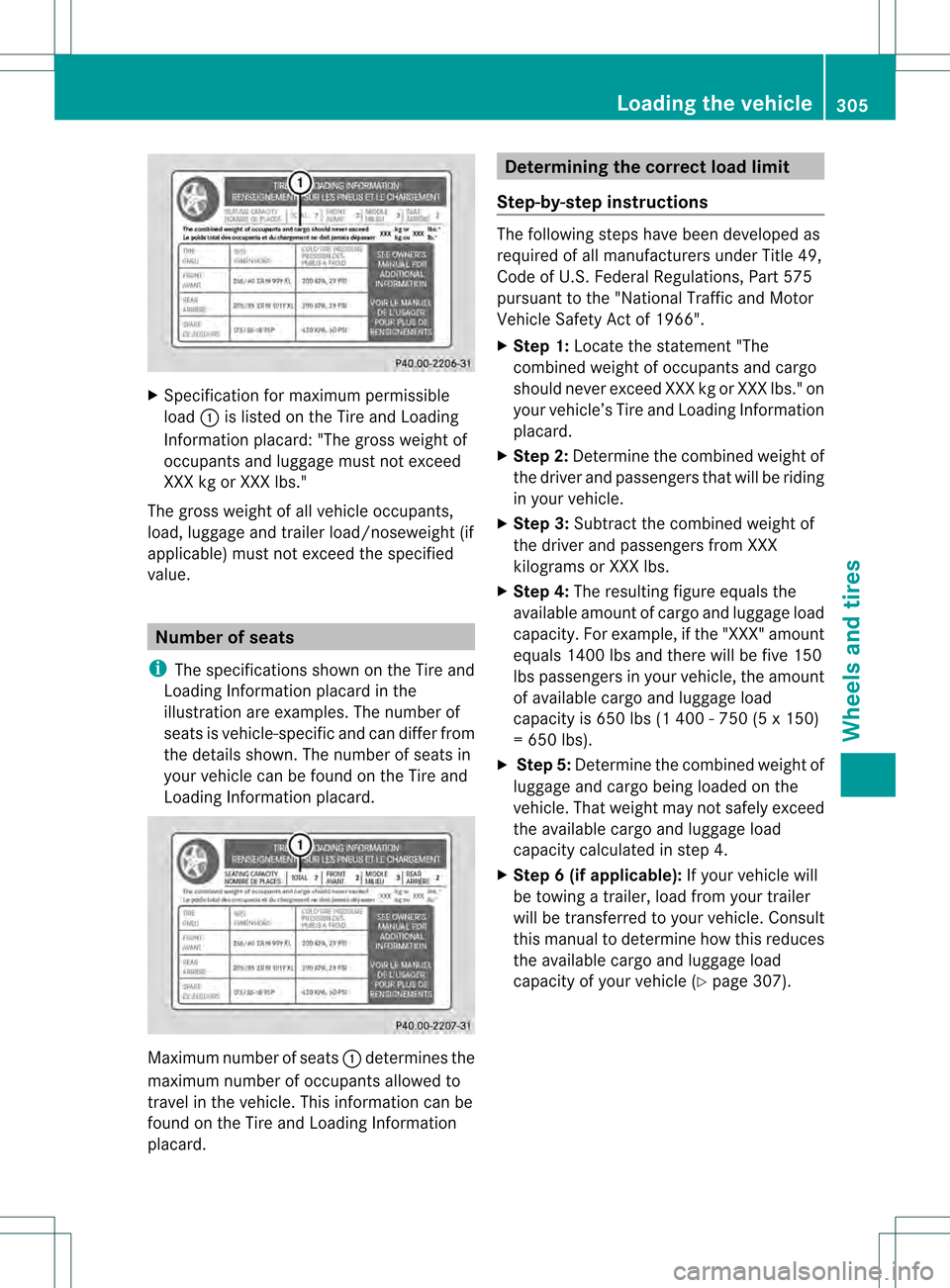
Specification for maximum permissible
load 0002is listed on the Tire and Loading
Information placard: "The gross weight of
occupants and luggage mus tnot exceed
XXX kg or XXX lbs."
The gross weight of all vehicle occupants,
load, luggage and trailer load/noseweight (if
applicable) must not exceed the specified
value. Number of seats
i The specifications shown on the Tire and
Loading Information placard in the
illustration are examples. The number of
seats is vehicle-specific and can differ from
the details shown. The number of seats in
your vehicle can be found on the Tire and
Loading Information placard. Maximum number of seats
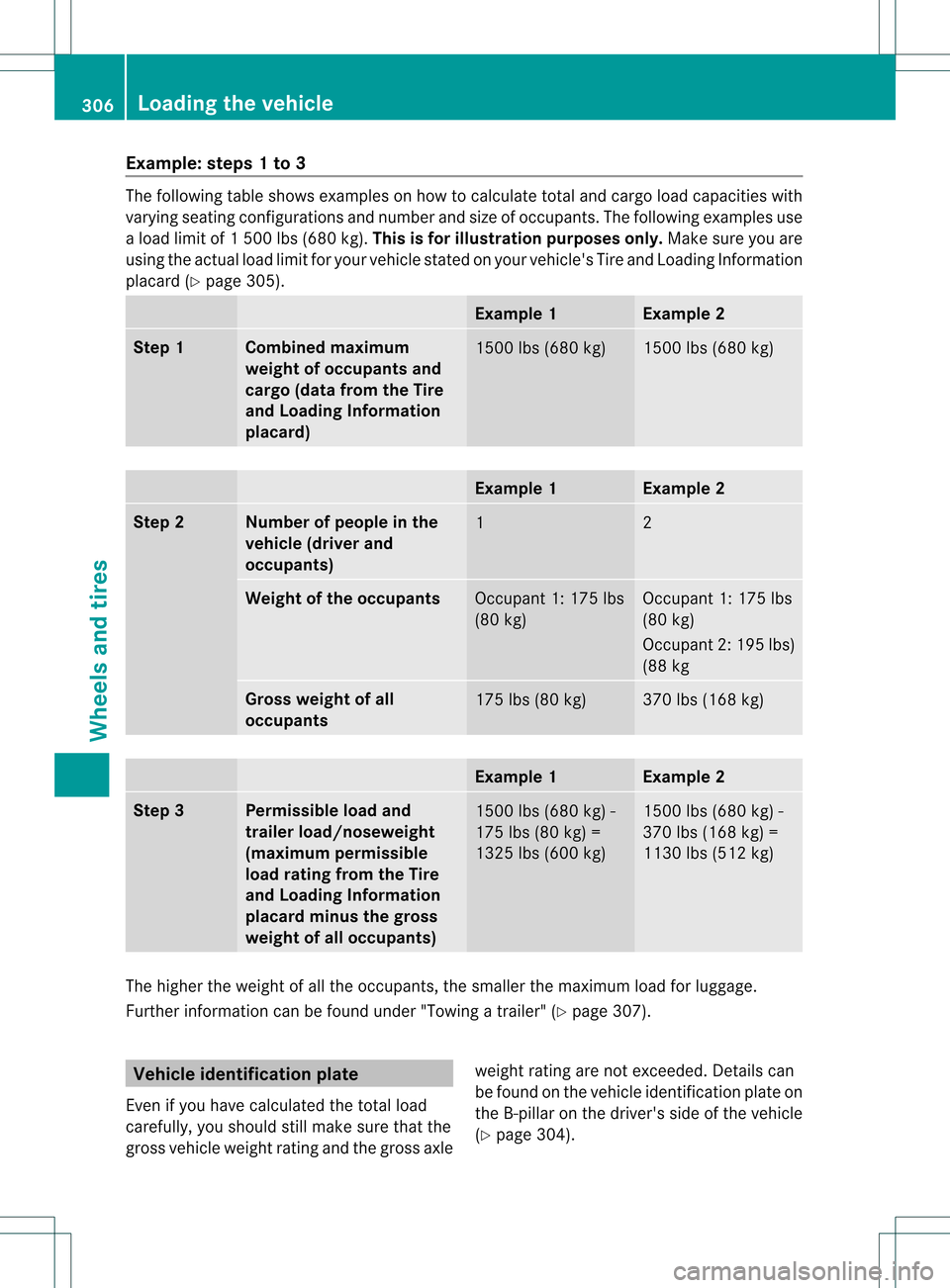
0002determines the
maximum number of occupants allowed to
travel in the vehicle. This information can be
found on the Tire and Loading Information
placard. Determining the correct load limit
Step-by-step instructions The following steps have been developed as
required of all manufacturers under Title 49,
Code of U.S. Federal Regulations, Part 575
pursuant to the "National Traffic and Motor
Vehicle Safety Act of 1966".
X
Step 1: Locate the statement "The
combined weight of occupant sand cargo
should neve rexceed XXX kg or XXX lbs." on
your vehicle’s Tire and Loading Information
placard.
X Ste p2:Determine the combined weight of
the driver and passengers tha twill be riding
in your vehicle.
X Step 3: Subtract the combined weight of
the drive rand passengers from XXX
kilograms or XXX lbs.
X Ste p4:The resulting figure equals the
available amount of cargo and luggage load
capacity. For example, if the "XXX" amount
equals 1400 lbs and there will be five 150
lbs passengers in your vehicle, the amount
of available cargo and luggage load
capacity is 650 lbs (1 400 - 750 (5 x 150)
= 650 lbs).
X Step 5: Determine the combined weight of
luggage and cargo being loaded on the
vehicle. That weight may not safely exceed
the available cargo and luggage load
capacity calculated in step 4.
X Step 6 (if applicable): If your vehicle will
be towing a trailer, load from your trailer
will be transferred to your vehicle. Consult
this manual to determine how this reduces
the available cargo and luggage load
capacity of your vehicle ( Ypage 307). Loading the vehicle
305Wheels and tires Z
Page 308 of 334
Example: steps 1 to 3
The following table shows examples on how to calculate total and cargo load capacities with
varying seating configurations and number and size of occupants. The following examples use
a load limit of 1500 lbs (680 kg). This is for illustration purposes only. Make sure you are
using the actual load limit for you rvehicle stated on your vehicle's Tire and Loading Information
placard (Y page 305). Example 1 Example 2
Step 1 Combined maximum
weight of occupants and
cargo (data from the Tire
and Loading Information
placard)
1500 lbs (680 kg) 1500 lbs (680 kg)
Example 1 Example 2
Step 2 Number of people in the
vehicle (driver and
occupants)
1 2
Weight of the occupants
Occupant 1: 175 lbs
(80 kg) Occupant 1: 175 lbs
(80 kg)
Occupant 2: 195 lbs)
(88 kg
Gross weight of all
occupants
175 lbs (80 kg) 370 lbs (168 kg)
Example 1 Example 2
Step 3 Permissible load and
trailer load/noseweight
(maximum permissible
load rating from the Tire
and Loading Information
placard minus the gross
weight of all occupants)
1500 lbs (680 kg) -
175 lbs (80 kg) =
1325 lbs (600 kg) 1500 lbs (680 kg) -
370 lbs (168 kg) =
1130 lbs (512 kg)
The higher the weight of all the occupants, the smaller the maximum load for luggage.
Further information can be found under "Towing atrailer" (Y page 307). Vehicle identification plate
Even if you have calculated the total load
carefully, you should still make sure that the
gross vehicle weight rating and the gross axle weight rating are not exceeded. Details can
be found on the vehicle identification plate on
the B-pillar on the driver's side of the vehicle
(Y page 304). 306
Loading the vehicleWheels and tires
Page 309 of 334
Permissible gross vehicle weight:
the
gross weight of the vehicle, all passengers,
load and trailer load/noseweight (if
applicable) must not exceed the permissible
gross vehicle weight.
Gross axle weight rating: the maximum
permissible weight that can be carried by one
axle (front or rear axle).
To ensure that your vehicle does not exceed
the maximum permissible values (gross
vehicle weight and maximum gross axle
weight rating), have your loaded vehicle
(including driver, occupants, cargo, and full
trailer load if applicable) weighed on a
suitable vehicle weighbridge. Trailer load/noseweight
The trailer load/noseweight affects the gross
weight of the vehicle. If a trailer is attached,
the trailer load/noseweight is included in the
load along with occupants and luggage. The
trailer load/noseweight is usually
approximately 10% of the gross weight of the
trailer and its load.
Your Mercedes-Benz has been designed
primarily to carry passengers and their
luggage. Mercedes-Benz does not
recommend towing a trailer with your vehicle. Maximum load rating
Do not overload the tires by exceeding the
specified load limit. The maximum
permissible load can be found on the
vehicle's Tire and Loading Information
placard on the B-pillar on the driver's side
(Y page 304). i
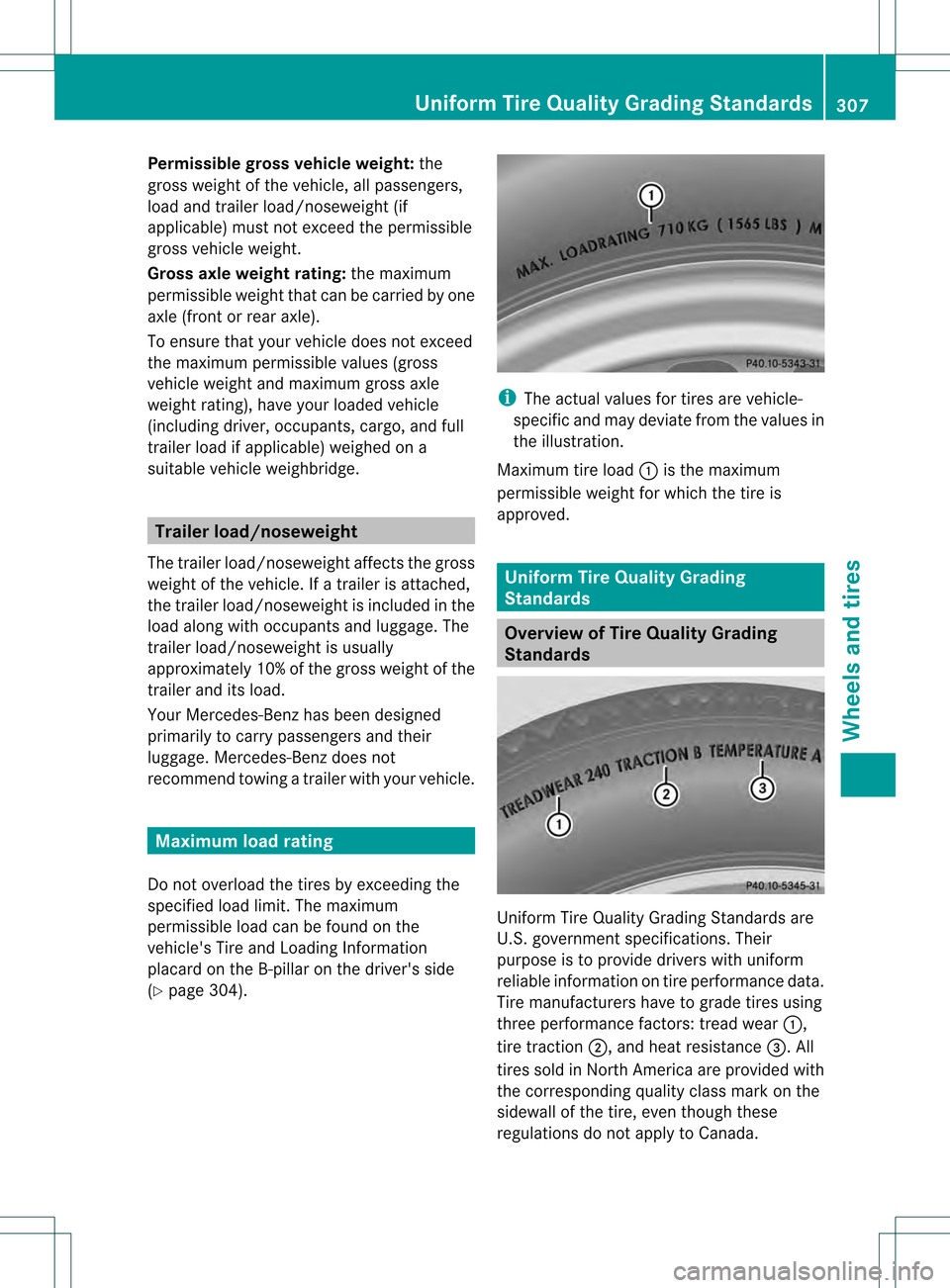
The actual values for tires are vehicle-
specific and may deviate from the values in
the illustration.
Maximum tire load 0002is the maximum
permissible weight for which the tire is
approved. Uniform Tire Quality Grading
Standards
Overview of Tire Quality Grading
Standards
Uniform Tire Quality Grading Standards are
U.S. government specifications. Their
purpose is to provide drivers with uniform
reliable information on tire performance data.
Tire manufacturers have to grade tires using
three performance factors: tread wear
0002,
tire traction 0003, and heat resistance 0023. All
tires sold in North America are provided with
the corresponding quality class mark on the
sidewall of the tire, even though these
regulations do not apply to Canada. Uniform Tire Quality Grading Standards
307Wheels and tires Z