2012 MERCEDES-BENZ R-Class belt
[x] Cancel search: beltPage 61 of 368

seat belt lies properly across their bodies
without the need for a booster seat.
Install the child restraint system according to
the manufacturer's instructions.
The child restraint system must be installed
firmly on both brackets.
An incorrectly installed child restraint system
can come loose in the event of an accident,
causing the child to be severely or fatally
injured.
Child restraint systems/child restraint
retaining brackets that are damaged or have
suffered damage due to an impact must be
replaced.
LATCH-type (ISOFIX) is a standardized
securing system for specially designed child
restraint systems on the rear seats.
Securing rings for two LATCH-type (ISOFIX)
child restraint systems are installed on the
left and right:
R on the seat cushions of the outer seats in
the second row
R on the backrests of the seats in the third
row of seats
Secure non LATCH-type (ISOFIX) child
restraint systems using the vehicle's seat belt
system. Always install child restraint systems
according to the manufacturer's instructions.XMove the rear seat backrests in the second
row to an upright position ( Y page 101).
The securing rings on the outer seats in the
second row of seats are covered by an
upholstered lining.
:Securing rings for outer seats in the
second row;Installation instructions for the securing
ringXSlide the upholstered lining to the side.XInstall the LATCH-type (ISOFIX) child
restraint system. Comply with the
manufacturer's instructions when doing
so.
The securing rings on the seats in the third
row are covered by protective caps.
XRemove protective caps = in the third row
of seats.Children in the vehicle59SafetyZ
Page 62 of 368
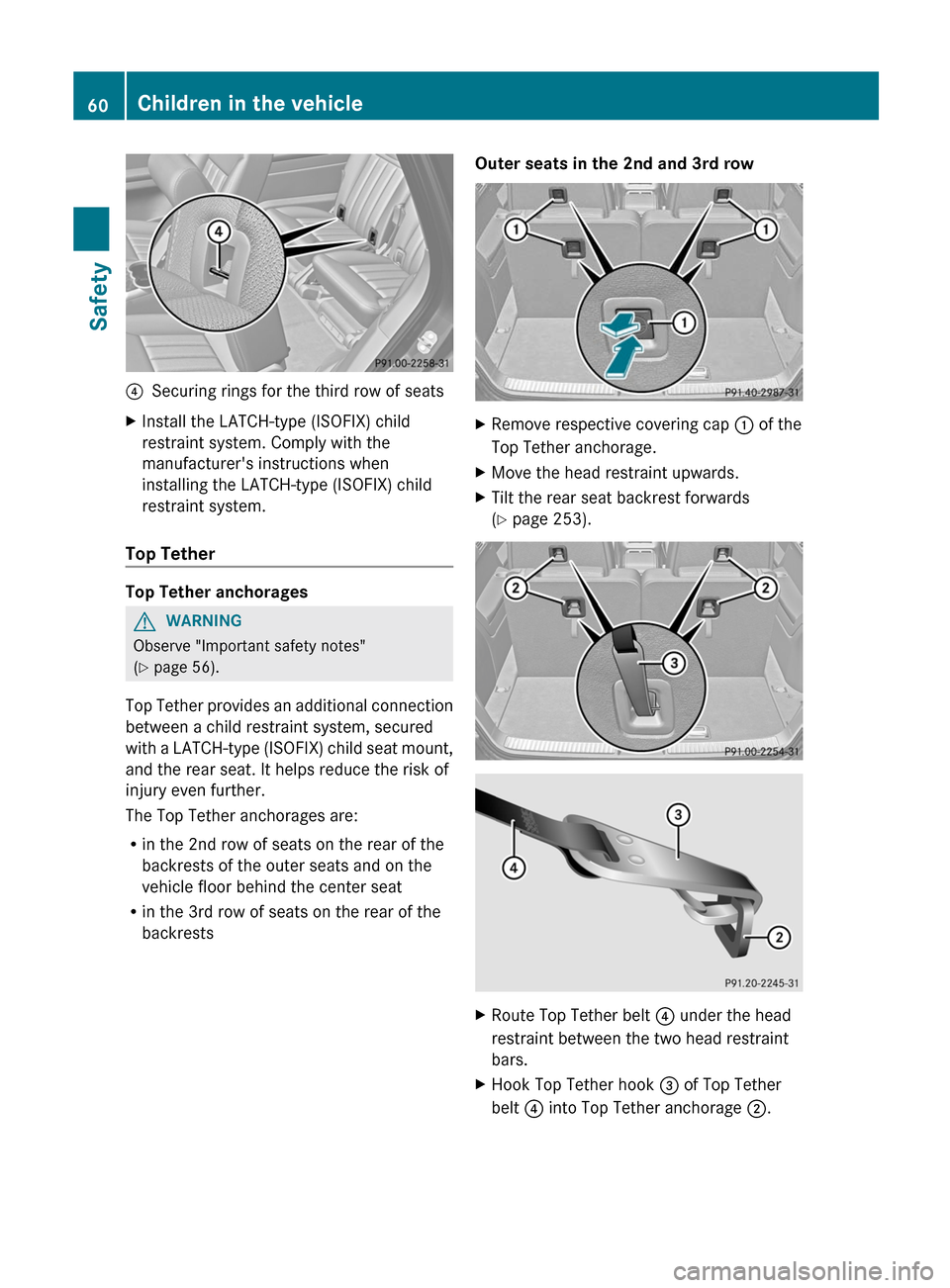
?Securing rings for the third row of seatsXInstall the LATCH-type (ISOFIX) child
restraint system. Comply with the
manufacturer's instructions when
installing the LATCH-type (ISOFIX) child
restraint system.
Top Tether
Top Tether anchorages
GWARNING
Observe "Important safety notes"
( Y page 56).
Top Tether provides an additional connection
between a child restraint system, secured
with a LATCH-type (ISOFIX) child seat mount,
and the rear seat. It helps reduce the risk of
injury even further.
The Top Tether anchorages are:
R in the 2nd row of seats on the rear of the
backrests of the outer seats and on the
vehicle floor behind the center seat
R in the 3rd row of seats on the rear of the
backrests
Outer seats in the 2nd and 3rd rowXRemove respective covering cap : of the
Top Tether anchorage.XMove the head restraint upwards.XTilt the rear seat backrest forwards
( Y page 253).XRoute Top Tether belt ? under the head
restraint between the two head restraint
bars.XHook Top Tether hook = of Top Tether
belt ? into Top Tether anchorage ;.60Children in the vehicleSafety
Page 63 of 368

Ensure that:
R Top Tether hook = is hooked into Top
Tether anchorage ; as shown
R Top Tether belt ? is not twisted
R Top Tether belt ? is routed between the
seat backrest and the cargo
compartment cover if the cargo
compartment cover is installed.
R Top Tether belt ? is routed between the
seat backrest and the cargo net if the
cargo net is installed.GWARNING
Do not secure the Top Tether hook to the loop
underneath the Top Tether anchorage if you
are securing a child restraint system in the
third row of seats. The child restraint system
is not secured if you do so. An incorrectly
fitted child restraint system cannot perform
its intended protective function in the event
of an accident, and could lead to injuries.
XSwing back the seat backrest until it
engages ( Y page 253).
The outer seats in the second row are only
locked if the lock verification indicator is
folded in and the indicator area is barely
visible ( Y page 253).GWARNING
Make sure that the seats are locked and that
the backrests are locked in a vertical position
after fitting the Top Tether belt.
The outer seats in the second row are only
locked if the lock verification indicator is
folded in and the indicator area is barely
visible.
If the backrests are not locked, they could fold
forwards in the event of an accident, sudden
braking or a sudden change of direction.
Instead of restraining an occupant, they could
cause additional serious or even fatal injury.
XMove the head restraint back down again
slightly if necessary ( Y page 100). Makesure that you do not interfere with the
correct routing of Top Tether belt ?.XInstall the LATCH-type (ISOFIX) child
restraint system with Top TetherComply
with the manufacturer's installation
instructions when doing so. Make sure that
Top Tether belt ? is tight.
Center seat in the 2nd row
GWARNING
Only secure a child restraint system on the
center seat in the second row when the belt
buckles of the outer seats are not obstructed
or overlapped by the child restraint system.
Not all child restraint systems, including some
Mercedes-Benz approved child restraint
systems, can be used in this seat position. For
further information contact an authorized
Mercedes-Benz Center.
Do not use the LATCH-type anchors (ISOFIX)
or seat belt buckles for the outer seats in
conjunction with a child seat in the second-
row center seat. Child seats in the center
seating position must only be secured by the
center seat position seat belt inserted into the
seat belt buckle for the second-row center
seat.
GWARNING
Please be aware that installation of a child
seat in the second-row center seat position
can prevent the folding forward of the outer
second-row seats which can obstruct access
to and exit from the third-row seats. This
could affect the occupants' on the third-row
seats ability to exit the vehicle. In case of an
accident it will be difficult for occupants of the
third-row seats to leave the vehicle. Serious
injuries could be the result.
Install a child seat in one of the outer seating
positions according to the installation
instructions if access to the third-row seats is
required.
XMove the head restraint upwards.Children in the vehicle61SafetyZ
Page 64 of 368

XPull release loop : in the direction of the
arrow.XFold seat backrest ; forward in the
direction of seat cushion = until Top
Tether anchorage ? is accessible.XRoute Top Tether belt B under the head
restraint between the two head restraint
bars.XHook Top Tether hook A of Top Tether belt
B into Top Tether anchorage ?.Ensure that:
R Top Tether hook A is hooked into Top
Tether anchorage ? as shown
R Top Tether belt B is not twisted
R Top Tether belt B is routed between the
seat backrest and the cargo
compartment cover if the cargo
compartment cover is installed.
R Top Tether belt B is routed between the
seat backrest and the cargo net if the
cargo net is installed.XSwing back the seat backrest until it
engages audibly ( Y page 253).GWARNING
Always lock the rear seat backrests in their
upright position when the rear seats are
occupied by passengers. Lock the rear seat
backrests in their upright position after
installing the TopTether straps or when the
extended cargo compartment is not in use.
Make sure that rear seat backrests are
secured properly by pushing and pulling on
the seat backrests. If the seat backrest is not
locked properly, the seat backrest could fold.
The child restraint system is no longer
supported properly or held in position and can
no longer fulfill its function. That could cause
serious or even fatal injuries.
XMove the head restraint back down again
slightly if necessary ( Y page 100). Make
sure that you do not interfere with the
correct routing of Top Tether belt B.XInstall the LATCH-type (ISOFIX) child
restraint system with Top Tether. Comply
with the manufacturer's installation
instructions when doing so. Make sure that
Top Tether belt B sits taut.62Children in the vehicleSafety
Page 92 of 368

The opening/closing procedure of the sliding
sunroof can be immediately halted by
releasing the sliding sunroof switch or, if the
sliding sunroof switch was moved past the
resistance point and released, by moving the
sliding sunroof switch in any direction.GWARNING
The sliding sunroof is made out of glass. In the
event of an accident, the glass may shatter.
This may result in an opening in the roof.
In a vehicle rollover, occupants not wearing
their seat belts or not wearing them properly
may be thrown out of the opening. Such an
opening also presents a potential for injury for
occupants wearing their seat belts properly,
as entire body parts or portions of them may
protrude from the passenger compartment.
! Only open the sliding sunroof if it is free
of snow and ice. Otherwise, malfunctions
may occur.
Do not allow anything to protrude from the
sliding sunroof. Otherwise, the seals could
be damaged.
! The weather can change abruptly. It could
start to rain or snow. Make sure that the
sliding sunroof is closed when you leave the
vehicle. The vehicle electronics can be
damaged if water enters the vehicle
interior.
i Resonance noises can occur in addition
to the usual airflow noises when the sliding
sunroof is open. They are caused by minor
pressure fluctuations in the vehicle interior.
Change the position of the sliding sunroof
or open a side window slightly to reduce or
eliminate these noises.
Operating the sliding sunroof
Opening and closing
i You can continue to operate the sliding
sunroof after switching off the engine or
removing the SmartKey from the ignition
lock. This function is available for up to five
minutes or until the driver's or front-
passenger door is opened.
Overhead control panel
:To raise;To open=To close/lowerXTurn the SmartKey to position 1 or 2 in the
ignition lock.XPress or pull the 2 switch in the
corresponding direction.
i If you press the 2 switch beyond the
point of resistance, an automatic opening/
closing process is started in the
corresponding direction. You can stop
automatic operation by operating the
switch again.
The sun protection cover automatically opens
along with the sliding sunroof. You can open
or close the sun protection cover manually
when the sliding sunroof is raised or closed.
Resetting
Reset the sliding sunroof if it does not move
smoothly, or if the battery has been
disconnected or has become discharged.
XRemove the SmartKey from the ignition
lock or select position 0 (KEYLESS-GO).XRemove the fuse for the sliding sunroof
from the fuse box. To find out where the
fuse is located, refer to the fuse allocation
chart in the vehicle tool kit ( Y page 296).XReinsert the fuse.90Sliding sunroofOpening/closing
Page 98 of 368

Useful information
i This Operator's Manual describes all
models and all standard and optional
equipment of your vehicle available at the
time of publication of the Operator's
Manual. Country-specific differences are
possible. Please note that your vehicle may
not be equipped with all features
described. This also applies to safety-
related systems and functions.
i Please read the information on qualified
specialist workshops ( Y page 24).
Correct driver's seat position
Observe the safety guidelines on seat
adjustment ( Y page 97).
XCheck whether you have adjusted seat =
properly.
Electrical seat adjustment ( Y page 98)
When adjusting the seat, make sure:
R you are as far away from the driver's air
bag as possible.
R you are sitting in a normal upright
position.R you can fasten the seat belt properly.
R you have moved the backrest to an
almost vertical position.
R you have set the seat cushion angle so
that your thighs are gently supported.
R you can depress the pedals properly.XCheck whether the head restraint is
adjusted properly ( Y page 99).
When doing so, make sure that you have
adjusted the head restraint so that the back
of your head is supported at eye level by
the center of the head restraint.
Observe the safety guidelines on steering
wheel adjustment ( Y page 107).
XCheck whether steering wheel : is
adjusted properly.
Adjusting the steering wheel
manually( Y page 107)
Adjusting the steering wheel electrically
( Y page 108)
When adjusting the steering wheel, make
sure:
R you can hold the steering wheel with your
arms slightly bent.
R you can move your legs freely.
R you can see all the displays in the
instrument cluster clearly.
Observe the safety guidelines for seat belts
( Y page 51).
XCheck whether you have fastened seat
belt ; properly ( Y page 53).
The seat belt should:
R fit snugly across your body
R be routed across the middle of your
shoulder
R be routed in your pelvic area across the
hip jointsXBefore starting off, adjust the rear-view
mirror and the exterior mirrors96Correct driver's seat positionSeats, steering wheel and mirrors
Page 99 of 368

(Y page 110) in such a way that you have
a good view of road and traffic conditions.XVehicles with a memory function: save
the seat, steering wheel and exterior mirror
settings ( Y page 112).
Seats
Important safety notes
GWARNING
In order to avoid possible loss of vehicle
control, all seat, head restraint, steering
wheel and rear view mirror adjustments, as
well as fastening of seat belts, must be done
before setting the vehicle in motion.
GWARNING
Do not adjust the driver's seat while driving.
Adjusting the seat while driving could cause
the driver to lose control of the vehicle.
Never travel in a moving vehicle with the seat
backrest in an excessively reclined position as
this can be dangerous. You could slide under
the seat belt in a collision. If you slide under
it, the seat belt would apply force at the
abdomen or neck. This could cause serious or
fatal injuries. The seat backrest and seat belts
provide the best restraint when the wearer is
in a position that is as upright as possible and
seat belts are properly positioned on the
body.
GWARNING
Your seat belt must be adjusted so that you
can correctly fasten your seat belt.
Observe the following points:
R adjust the seat backrest until your arms are
slightly angled when holding the steering
wheel.
R adjust the seat to a comfortable seating
position that still allows you to reach the
accelerator/brake pedal safely. The
position should be as far back as possible
with the driver still able to operate the
controls properly.
R adjust the head restraint so that it is as
close to the head as possible and the center
of the head restraint supports the back of
the head at eye level.
R never place hands under the seat or near
any moving parts while a seat is being
adjusted.
Failure to do so could result in an accident
and/or serious personal injury.GWARNING
The electrically adjustable seats can be
operated at any time. Therefore, do not leave
children unattended in the vehicle, or with
access to an unlocked vehicle. A child's
unsupervised access to a vehicle could result
in an accident and/or serious personal injury.
GWARNING
According to accident statistics, children are
safer when properly restrained in the rear
seating positions than in the front seating
position. Thus, we strongly recommend that
children be placed in the rear seats whenever
possible. Regardless of seating position,
children 12 years old and under must be
seated and properly secured in an
appropriately sized infant restraint, toddler
restraint, or booster seat recommended for
the size and weight of the child. For additional
information, see "Children in the vehicle".
A child's risk of serious or fatal injuries is
significantly increased if the child restraints
are not properly secured in the vehicle and/
or the child is not properly secured in the child
restraint.
GWARNING
For your protection, drive only with properly
positioned head restraints.
Adjust the head restraint so that it is as close
to the head as possible and the center of the
head restraint supports the back of the head
at eye level. This will reduce the potential for
Seats97Seats, steering wheel and mirrorsZ
Page 103 of 368

you must move the respective seat as far
back as possible (Y page 101). Then, fold the
seat backrest forwards.
You can remove the head restraints in the
second row of seats (center seat and outer
seats) and the head restraints in the third row
of seats in the same way.
Removing the head restraints from the outer seats
in the second row of seats
XTo remove: pull the head restraint up to
the stop.XPress release catch : and pull the head
restraint out of the guides.XTo re-install: place the head restraint in
the guides of the backrest.
i For the outer seat head restraints in the
second row of seats, the notches on the
guide rod must be on the left-hand side
when viewed in the direction of travel.
XPush the head restraint down until you hear
it engage in position.
Adjusting the seats in the 2nd and 3rd
rows
Important safety notes
GWARNING
Never travel in a moving vehicle with the seat
backrest in an excessively reclined position as
this can be dangerous. You could slide under
the seat belt in a collision. If you slide under
it, the seat belt would apply force at the
abdomen or neck. This could cause serious or
fatal injuries. The seat backrest and seat belt
provide the best restraint when the wearer is
in a position that is as upright as possible and
the seat belt is properly positioned on the
body.
Your seat belt must be adjusted so that you
can correctly fasten your seat belt.
Never place hands under the seat or near any
moving parts while a seat is being adjusted.
After adjusting the seat, always ensure that
the seat and the backrest are correctly
engaged. The backrest must be in an upright
position.
An outer seat in the second row is only locked
correctly if lock verification indicator : is
folded in and red marking ; is just visible.
If the seat and backrest are not correctly
latched, the seat could move forward and the
backrest could fold down. While braking,
changing direction, or in an accident, you
could slide under the seat belt. The child seat
would no longer be correctly supported or
correctly positioned and would no longer
carry out its intended function. This could
cause serious or fatal injuries.
Seat locking display
Seat locked
When the seat is locked, lock verification
indicator : is folded in and indicator
area ; is barely visible.
Seats101Seats, steering wheel and mirrorsZ