2012 MERCEDES-BENZ M-Class warning
[x] Cancel search: warningPage 43 of 396

Since
theairb ag inflate swithcon siderable
speed andforce, aproper seatingposit ion
and correctposit ioningof the hands onthe
ste erin gwheel willhelp tokeep youatasafe
dist ancefro mt heair bag. Occupants whoare
not wearing theirseatbelt, arenot seated
properly orare too close tothe airbag canbe
seriously injuredorkilled byan air bag asit
inflates withgreat forceinstant aneously :
R Sit with theseat beltproperly fastened ina
position thatisas upright aspossible with
your back against theseat backrest.
R Move thedriver's seatasfar back as
possible, stillpermittin gproper operation
of vehicle controls. Thedistance fromthe
cent erofthe driver's chesttothe cent erof
the airbag cover onthe steering wheel
must beatleast 10inches (25cm) ormore.
You should beable toaccomplish thisby
adjusting theseat andsteering wheel.If
you have anydifficulties, pleasecontactan
authorized Mercedes-Ben zCent er.
R Do not lean your head orchest closetothe
steerin gwheel ordashboard.
R Only holdthesteerin gwheel bythe rim.
Placing handsandarms inside therim can
incr ease therisk and poten tialseverit yof
hand/arm injurywhenthedriver frontair
bag inflates .
R Adj ust the fron t-passenger seatasfar back
as possible fromthedashboard whenthe
seat isoccupied.
R Occ upants, especially children,should
never placetheirbodies orlean their heads
in the area ofthe door where theside
impact airbag inflates .This could result in
serious injuries ordeath should theside
impact airbag bedeploy ed.Always sitas
upright aspossible, weartheseat belt
properly anduseanappropriately sized
child restraint ,infant restraint orbooster
seat recommen dedforthe size andweight
of the child.
Failure tofollow theseinstruct ionscanresult
in severe injuries toyou orother occupants. If
you sellyour vehicle, itis important thatyou
make thebuyer aware ofthis safety
information. Besure togive thebuyer this
Operator's Manual. G
WARNING Acc
ident research showsthatthesafest place
for children inan automobile isin arear seat.
As ide impact airbag relat edinjury may occur
if occ upant s,espec iallychildr en,are not
proper lyseate dor rest raine dwhen next toa
side impact airbag which needs todeploy
rapidly inaside impact inorder todo itsjob.
To help avoid thepossibili tyof injury, please
follow theseguidelines:
(1) Always sitasupright aspossible
and usetheseat belts properly.
Make surethatchildren 12years
old and under useanappropriately
sized childrestraint ,infant
restraint ,or booster seat
recommen dedforthe size and
weight ofthe child.
(2) Always wearseatbelts properly.
The airbags areonly deploy edifthe airbag
cont rolunit detects theneed fordeploy ment.
Only inthe event ofsuch asituation willthey
provide theirsupplemental protection.
The driver andpassenger shouldalwayswear
their seatbelts. Otherwise, itis not possible
for the airbags toprovide theirsupplemental
protect ion.
In the event ofother types ofimpacts and
impacts belowairbag deploy ment
thresholds, theairbags willnotdeploy .The
driver andpassengers willthen beprotect ed
to the exten tpossible byaproperly fastened
seat belt. Aproperl yfastened seatbeltisalso
needed toprovide thebest possible
protect ioninarollover.
Air bags provide additional protection;they
are not, however, asubstitute forseat belts.
All vehicle occupants mustfasten theirseat
belts regardless ofwhether yourvehicle is
equip pedwith airbags ornot. Occ
upant safety
41Safety Z
Page 45 of 396
Dri
ver 'sknee bag: provide sad ditio nal
pro tecti onfor the driver against:
R knee injuries
R thi gh inju ries
R lowe rleg injuries
Driv er's knee bag :deploys belowthe
steer ingwheel. Duringafron talimpact, ifthe
system determinesthatairbag deployment
can offer additional protectiontothat
provided bythe seat belt, driver's knee
bag :isdeployed alongwiththedriver's air
bag. Thedriver's knee bag :operates best
in con junc tion with aproperly positionedand
fasten edseat belt.
Side impactairbags G
WARN
ING The
pressure sensorsfor side impact airbag
con trol arelocated inthe doors. Donot
modify anycompon entsof the doors ordoor
trim panels including, forexample, the
addition ofdoor speakers.
Improper repairworkonthe doors orthe
modificat ionoraddition ofcompon entsto the
doors createarisk ofrender ingthe side
impact airbags inoperat iveorcausing
unint ended airbag deployment .Work onthe
doors musttherefor eonly beperformed by
quali fiedtechn icians. Contact anauthorized
Mercedes-B enzCenter. G
WARNING Only
useseat covers whichhavebeen tested
and approved byMercedes-B enzforyour
vehicle model.Usingotherseatcovers may
interf erewith orprevent thedeployment of
the side impact airbags. Contact an
authorized Mercedes-B enzCenter for
availa bility. When
deployed, theside impact airbags offer
additional protectionforthe thorax andpelvis
of the vehicle occupant son the side ofthe
vehicle onwhich theimpact occurs. However,
they donot protect the:
R head
R neck
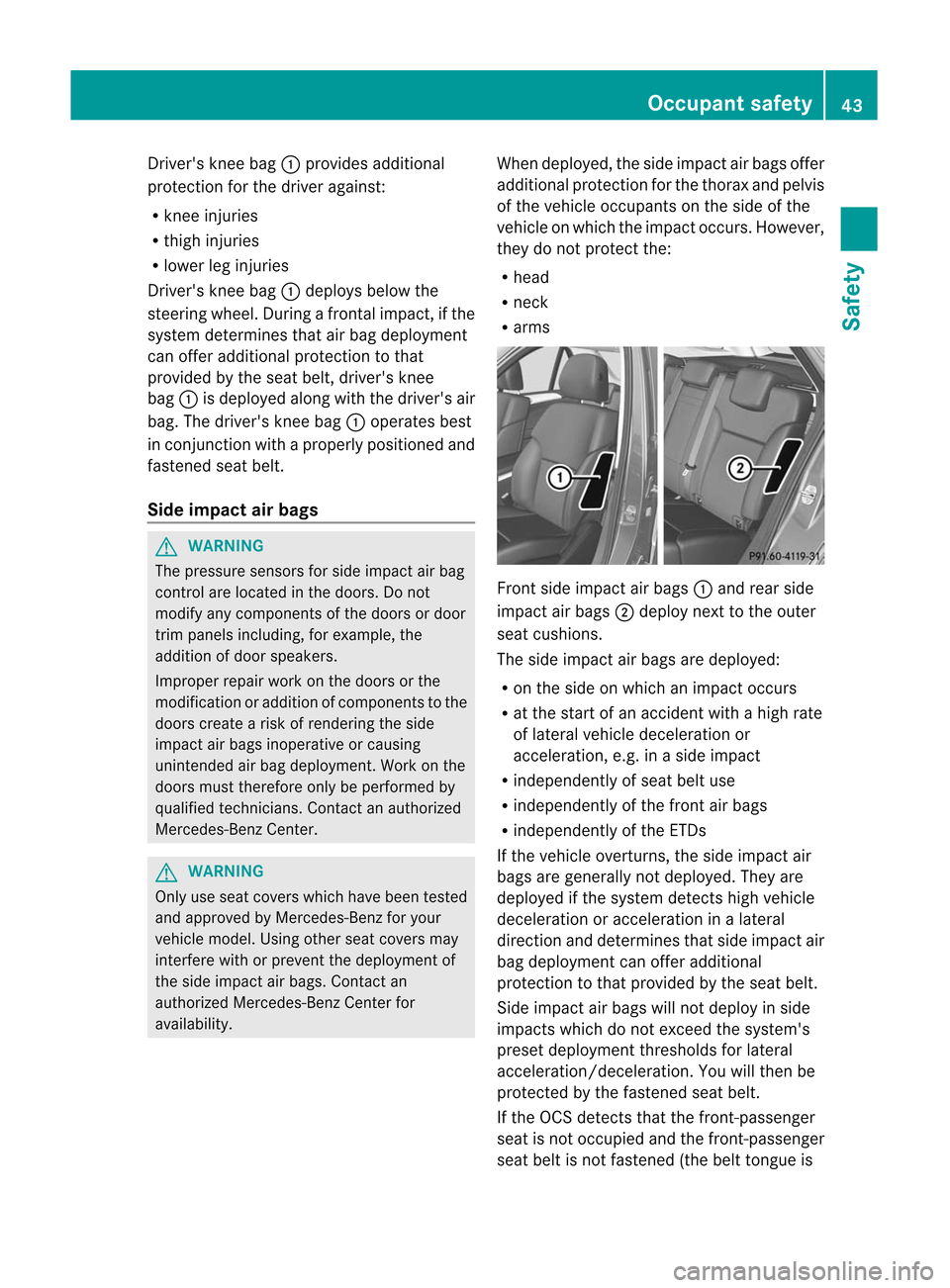
R arms Fron
tside impac tairbags :and rear side
impac tairbags ;deploy nexttothe outer
seat cushions.
The side impact airbags aredeployed:
R on the side onwhich animpact occurs
R at the start ofan accident withahigh rate
of lateral vehicle deceleration or
acceleration, e.g.inas ide impac t
R indep endently of seat beltuse
R indep endently of the frontair bags
R indep endently of the ETD s
If the vehic leover turns, the side impac tair
bags aregenerally notdeployed. Theyare
deployed ifthe syst emdete ctshigh vehic le
decele ration oracc elerat ioninalater al
direc tionanddete rmin esthat side impac tair
bag deploymen tcan offeraddit ional
pro tection tothat pro vide dbyth eseat belt.
Si de imp act airbags willnotd eploy inside
impacts whichdonot exceed thesystem' s
preset deployment thresholds forlateral
accelerat ion/deceleration .You will then be
protec tedbythe fastened seatbelt.
If the OCS detect sthat thefront -passenger
seat isnot occupied andthefront -passenger
seat beltisnot fastened (thebelttongue is Occupant
safety
43Safety Z
Page 47 of 396

G
WARNING If
the 45 indicatorlamp illumina tes
when anadu ltor someone largerthan asmal l
indivi dualis in the front passenger seat,have
the front passenger repositionhimse lfor
hersel fint he seat until the45
indicator lampgoesout.
In the event ofacollision, theairbag cont rol
unit willnotallow frontpassenger frontairbag
deploy mentwhen theOCS hasclassified the
front passenger seatoccupant asweighing as
much asorless than atypical 12-month-old
child inastandard childrestraint orifthe front
passenger seatisclassified asbeing empty.
When theOCS senses thatthefront
passenger seatoccupant isclassified as
being uptoor less than theweight ofatypical
12-m onth-oldchild inastandard child
restraint ,the 45 indicatorlampwill
illu minate whentheengine isstarted and
remain illuminated. Thisindicates thatthe
front passenger frontairbag isdeactivated.
When theOCS senses thatthefront
passenger seatisclassified asbeing empty,
the 45 indicatorlampwillilluminate
when theengine isstarted andremain
illu minated. Thisindicates thatthefront
passenger frontairbag isdeactivated.
When theOCS senses thatthefront
passenger seatoccupant isclassified as
being heavier thantheweight ofatypical 12-
mont h-old childseated inas tand ardchi ld
res traint oras being asma llind ividu al(such
as ayo ung teenag eror as mall adult),the
45 indicatorlamp willill umina tefor
app roximatel y6s econ dswhen theengine is
start ed.Depen dingonoccupant weight
sensor readings fromtheseat, itwill then
remain illuminated orgo out. With the
45 indicatorlamp illuminated, the
fron tpassen gerfron ta irbag isdeact ivated.
With the45 indicatorlamp out,the
fro ntpassen gerfrontair bag isact ivate d.
When theOCS senses that thefront
passen gerseat occupant isclassif iedasan
adult orsomeo nelarger thanasmall indiv
idual, the45 indicatorlamp will
illuminat efor approx imatelysix seco nds
when theengin eis star ted and thengoout.
This indicates thatthefront passenger front
air bag isactivated.
If the 45 indicatorlampisilluminated,
the front passenger frontairbag is
deactivated andwillnotbedeployed.
If the 45 indicatorlampisnot
illuminated, thefront passenger frontairbag
is activated andwillbedeployed
R in the event ofcert ainfront alimpacts
R ifthe impact exceeds apredetermin ed
triggering threshold
R independent ofthe side impact airbag or
pelvis airbag
If the front passenger frontairbag is
deployed, therate ofinflation willbe
influenced by
R the rate ofvehicle deceleration asassessed
by the airbag cont rolunit
R the front passenger's weightcategory as
identified bythe OCS
For further informat ion,see"Air bag display
messages" (Ypage 249). G
WARNING Acc
ording toaccident statistics,children are
safer when properly restrained onthe rear
seats thanonthe front -passenger seat.Thus,
we stron glyrecommen dthat children be
placed inthe rear seats whenever possible.
Regardless ofseating position, children12
years oldand under mustbeseated and
properly securedinan appropriate infant
restraint ,toddler restraint ,or booster seat
recommen dedforthe size andweight ofthe
child.
The infant orchild restraint mustbeproperly
secured withthevehicle's seatbelt, theseat
belt andTopTether strap,orlower anchors
and TopTether strap,fullyinaccordanc ewith
the child seatmanufacturer' sinstr uctions. Occupant
safety
45Safety
Z
Page 49 of 396

If
the SmartKey hasbeen removed fromthe
ignition lockorisin positio n0, indicator lamp
45: doesnotlightup. G
WARN
ING If
the red 6 SRSwarning lampinthe
inst rument clusterandthe45
indicat orlamp lightupsimultan eously,the
OCS ismalfunc tioning. Thefrontpassen ger
fr on ta irbag willbedeact ivatedin this case.
Have thesyst emchec kedbyqualified
tec hnic ians assoon aspossible .Contac tan
auth orizedMer cedes-Ben zCent er.
Only have theseat repaired orreplaced atan
authorized Mercedes-BenzCenter .
In order toensure properoperation ofthe air
bag system andOCS:
R Sit with theseat beltproperly fastenedina
position thatisas upright aspossible with
your back against theseat backr est.
R When seated, apassenger shouldnot
position him/herselfinsuch away asto
cause thepassenger' sweight tobe lifted
from theseat cushion asthis may result in
the OCS being unable tocorr ectly
approximat ethe passenger' sweight
categor y.
R Read andobserve allwarnings inthis
chapter .
System self-test If
an adult occupant isproperly sitting onthe
passenger seatandtheOCS classifies the
occupant asan adult, the45 indicator
lamp illuminates andgoes outagain after
approximat ely6secon ds.
If the seat isnot occupied andtheOCS
classifies thefron tpasse nger seat asbein g
uno ccupied, the45 indicat orlamp
will illumin ateand notg oout. G
WARNIN
G If
the 45indic atorlamp doesnot
illuminat e,the syst emisnot func tioning. You
must contactan author izedMerc edes- Benz Cent
erbefor eseatin gany child onthe front
passen gerseat.
For more informat ion,see"Problem swith the
Occ upant Classific ationSystem"
(Y page 48). G
WARN
ING Never
placeanything betwee nseat cushion
and child seat(e.g. apillow), sinceitreduces
the effec tivenessofthe OCS. Theunderside
and rear side child restraintsystem mustbe
placed entirely onthe seat cushion andthe
backr estofthe fron t-passenger seat
backr est.
If neces sary,adjust thetiltofthe passenger
seat backr est.
An incor rectlymount edchild seatcould cause
injuries tothe child incase ofan acciden t,
inst ead ofincr easing protectionforthe child.
Follow themanufact urer'sinstruct ions for
inst allation ofchild restraintsystems. Occupant
safety
47Safety Z
Page 50 of 396

Problems
withtheoccupant classific ationsystem Problem Possible
causes/co nsequences andM Solutions
The
45
indicator lamp
illu minates and
remains illuminated.
The person onthe
front -passenger seat:
R has theweight ofa
typical adult
R has been determined
by the system notto
be achild. The
OCS ismalfunction ing.
X Have theOCS check edassoon aspossible atan authorized
Mercedes-B enzCenter.
X Observe theadditional displaymessages inthe multifunct ion
display (Ypage 249). G
WARNING If
the 45 indicatorlampilluminates andremains illuminated whentheweight ofatypical
adult orsomeone largerthanasmall individual hasbeen detect edon the passenger seat,donot
allow anyoccupant touse thepassenger seatuntil thesystem hasbeen repaired. Problem Possible
causes/co nsequences andM Solutions
The
45
indicator lampdoesnot
illu minate and/or does
not remain illuminated.
The front -passenger
seat is:
R unoccupied
R occupied witha
weight uptoor less
than atypical 12-
mont h-old childina
standard child
restraint system The
OCS ismalfunction ing.
X Make surethere isnothin gbetween theseat cushion andthe
child seat.
X Check theinstallation ofthe child restraint system.
X Make surethatnoobject sareapp lying add itiona lwei ght onto
the seat.
X Ifthe 45 indicatorlamp doesnotillumina te,have the
OCS checked assoon aspossi bleatan authorized Mercede s-
Benz Center. Donot transport achild onthe front-passenge r
seat aslong asthe OCS isnot functioning.
X Observe theadditiona ldisp laymessa gesinthe multi function
disp lay(Ypag e249). G
WARNING If
the 45 indicatorlamp doesnotillumina teor remai nsout with theweight ofatypi cal
12-month-old childinastandard childrestrai ntor less, orisunoccup ied,on the front-passenge r
seat, donot transport achild onthe front -passenger seatuntil thesystem hasbeen repaired. 48
Occ
upant safetySafety
Page 51 of 396

PRE-SAFE
®
(preventat iveocc upant
prot ection) G
WARNING The
PRE-SA FE®
system reduces theimpact of
an accident onvehicle occupants, aslong as
their seatbelts havebeen fastened correctly.
Although yourvehicle isequippe dwith aPRE-
SAF E®
system, thepossibility ofinjury inthe
event ofan accident cannotberuled out.You
should therefore alwaysdrive carefully and
adapt yourdriving styletothe prevailing road,
weather andtraffic condition s.
PRE-SA FE®
takes preemptive measuresto
protect occupants incertain hazardous
situations.
PRE-SA FE®
interv enes:
R in emergency brakingsituations, e.g.ifBAS
is activated or,invehicles withDISTRONIC
PLUS, BASPLUS intervenespowerfully
R ifthe radar sensor system detectsan
imminent dangerofcollision incertain
situations (onvehicles withDISTRONIC
PLUS)
R in critic aldriving situations, e.g.when
physical limitsareexceed andthevehicle
understeers oroversteers severely
PRE-SA FE®
takes thefollowing measures
depending onthe hazardous situation
detect ed:
R the front seatbelts arepre-ten sioned.
R on vehicles withmemory functionforthe
front -passenger seat:thefront -passenger
seat isadjusted ifit is in an unfavorable
position.
R ifthe vehicle skids,thesliding sunroof/
panorama roofwith power tilt/sliding
panel andtheside windows areclosed so
that only asmall gapremains.
If the sliding sunroof, panorama roofwith
power tilt/sliding paneloraside window is
obstruct edduring closing, theclosing
procedure isstopped. Theobstruct edsliding
sunroof, panorama roofwith power tilt/ sliding
panelorside window opensagain
slightly.
If the hazardous situationpasseswithout
resulting inan accident, PRE-SAFE®
slackens
the belt pretension ing.Allsettin gsmade by
PRE-SA FE®
can then bereversed.
If the seat belts arenot released:
X Move thebackrest orseat back slightly, but
only when thevehicle isstationary.
The belt pretension ingisreduced andthe
locking mechanism isreleased. G
WARNING Make
surethatnobody canbecome trapped
as you adjust theseat.
! Make surethatthere arenoobject sin the
footwell orbehind theseats when resett ing
the seats. Thereisarisk that theseats
and/or theobject scould bedamaged.
More information aboutseat-belt
adjustment ,a conv enience function
integrated intoPRE-SA FE®
,can befound in
the "Seat-belt adjustment "section
(Y page 52). Seat
belts
Import antsafety notes The
useofseat belts andinfant andchild
restraint systemsisrequired bylaw inall 50
states, theDistr ictofColumbi a,the U.S.
territ ories andallCanadia nprovinces.
Even where thisisnot thecase, allvehicl e
occupa ntsshou ldhave theirseatbelts
fastened whenthevehicl eis in motion. i
For
further informati ononinfants and
child rentraveli nginthe vehicl eand on
infant andchild restrai ntsystems ,see
"C hildren inthe vehicl e"(Y pag e54). G
WARNING Alwa
ysfasten yourseat belt before driving off.
Always makesureallofyour passengers are Occupant
safety
49Safety
Z
Page 53 of 396

ribs
orabd omen, whichcould severel y
injure internal organssuchasyou rliver or
spleen .
Adj ust the seat beltsothat theshoulder
sect ionislocat edasclos eas possible to
the middle ofthe shoulder .Its hould not
touch theneck .Never pass theshoulder
portion ofthe seat beltunder yourarm. For
this purpose, youcan adjust theheight of
the seat beltoutlet.
R Position thelapbelt aslow aspossible on
your hipsandnotacross theabdomen. If
the lapbelt isposition edacross your
abdomen, itcould cause serious injuries in
a crash.
R Never wearseatbelts overrigid or
breakable objectsinor on your clothing,
such aseyeglasses, pens,keysetc.,as
these might cause injuries.
R Make suretheseat beltisalway sfitt ed
snugly. Takespecial careofthis when
wearing looseclothing.
R Never useaseat beltformore thanone
person atatime. Donot fasten aseat belt
around aperson andanoth erperson or
other objectsat the same time.
R Seat belts should notbeworn twisted. Ina
crash, youwould nothave thefullwidth of
the seat belttodistribut eimpact forces.
The twisted seatbeltagainst yourbody
could cause injuries.
R Pregnant womenshouldalsoalway suse a
lap-shoulder belt.Thelapbelt portion
should bepositioned aslow aspossible on
the hips toavoid anypossible pressure on
the abdomen.
R Place theseat backrest inaposition thatis
as upright aspossible.
R Check yourseatbeltduring traveltomake
sure itis properly positioned.
R Never placeyourfeetonthe instr ument
panel, dashboard, oron the seat. Always keep
bothfeetonthe floor infront ofthe
seat.
R When usingaseat belttosecure infant
restraint s,toddler restraint s,or children in
booster seats,alwaysfollow thechild seat
manufacturer' sinstr uctions. G
WARNING Do
not pass seatbelts oversharp edges. They
could tear.
Do not allow theseat belttoget caught inthe
door orinthe seat adjustmen tmechanism.
This could damage theseat belt.
Never attempt tomake modifications toseat
belts. Thiscould impair theeffect iveness of
the seat belts.
Fastening seatbelts G
WARNING Acc
ording toaccident statistics,children are
safer when properly restrained onthe rear
seats thanonthe front -passenger seat.Thus,
we stron glyrecommen dthat children be
placed inthe rear seat whenever possible.
Regardless ofseating position, children12
years oldand under mustbeseated and
properly securedinan appropriately sized
child restraint systemorbooster seat
recommen dedforthe size andweight ofthe
child. Foradditional information,seethe
"Child reninthe vehicle" section.
Ac hild's riskofserious orfatal injuries is
significantly increasedifthe child restraint s
are not properly securedinthe vehicle and/
or the child isnot properly securedinthe child
restraint . Occ
upant safety
51Safety Z
Page 55 of 396

X
To rais e:slid ethe beltsa sh guideup wa rds .
The beltsa sh guide eng ages invario us
po sitio ns.
X To lowe r:pre ssand holdbe ltsa sh guide
rel ease :.
X Sli de the beltsa sh guide do wnw ards.
X Re leas ebe ltsa sh guide rel ease : and
ma kesure tha tthe belt sash guide has
engaged.
Releasing seatbelts X
Press release button?(Ypage51)and
guide belttongue ;back towards belt
sash guide :.
! Make surethattheseat beltisfully rolled
up. Otherwise, theseat beltorbelt tongue
will betrapped inthe door orinthe seat
mechanism. Thiscould damage thedoor,
the door trimpanel andtheseat belt.
Damaged seatbelts cannolonger fulfill
their protect ivefunct ionand must be
replaced. Consultanauthorized Mercedes-
Benz Center.
Belt warning forthe driver andfront
passenger Regardl
essofwhether thedriver andfront
passenger havefastened theirseatbelts
already ,the 7 seatbeltwarning lamp
lights upfor 6secon dsafter every engine
start .It then goes outifthe driver andthe
fron tpasse nger have fastened their seat
belt s.
If th edriv er'sseat beltisno tfast ened after
th een gin eis start ed, anaddit ionalwarn ing
to ne will soun d.The warn ingtone goes out
aft erappro ximatelysix sec onds oronce the
driv er'sseat beltisfast ened. If
th edriv eror fron tpasse nger have not
fast ened their seat beltafter6s econ dsand
the doors areclosed, the7 seatbelt
warning lamplights up.
R until thedriver orthe fron tpasse nger have
fast ened their seat belts
R ifaveh icle spee dof 15 mph (25km/h)is
ex cee ded once, awarn ingtone with
inc reas ingintensitysoun dsaddit ionally for
a max imum of60 sec onds orunt ilth edriv er
or fron tp asse nger have fastened their seat
belt s.
If th edriv eror fron tpasse ngerundo their seat
belt sdurin gth ejo urn ey, the7 seatbelt
warn inglamp lightsup and thewarn ingtone
soun dsagain .
The warn ingtone ceas eseve nifthe driver or
front passenger havestillnotfastened their
seat beltafter 60seconds. The7 seatbelt
warning lampstops flashing butcont inues to
be lit.
Once thevehicle isstationary, thewarning
tone isreactivated andthe7 seatbelt
warning lampstarts toflash again ifthe
vehicle speedexceeds 15mph(25 km/h)
once.
The 7 seatbeltwarning lamponlygoes
out if:
R both thedriver andthefront passenger
have fastened theirseatbelts.
or
R the vehicle isstationary andadoor isopen. i
For
more information onthe 7 seat
belt warning lamp,see"Warning and
indicator lampsinthe instrumen tcluster,
seat belt" (Ypage 269).
Emergency TensioningDevices,belt
force limiters The
front seatbelts andtheouter seatbelts
in the rear areequipp edwith ETDs andseat
belt force limiters.
The ETDs onthe driver's andfront -passenger
seat consist ofpyrotechnic beltbuckle Occ
upantsafety
53Safety Z