2012 MERCEDES-BENZ G-CLASS SUV tailgate
[x] Cancel search: tailgatePage 173 of 357
R
Chec kthat items of luggage and loads are
stowed safely and are well secured
(Y page 271).
R To avoid damaging the vehicle, make sure
there is always sufficient ground clearance.
R Always keep the engine running and in gear
when driving on a downhill gradient.
R Always keep the engine running and in gear
when driving on a slope.
R Drive slowly and evenly, if necessary at
walking pace.
R Ensure that the wheels are in contact with
the ground at all times.
R Drive with extreme care on unknown off-
road routes where visibility is poor. For
safety reasons, get out of the vehicle first
and survey the off-road route.
R Check the depth of water before fording
rivers and streams.
R When fording, do not stop and do not
switch off the engine.
R Look out for obstacles such as rocks, holes,
tree stumps and furrows.
R Always keep the doors, the rear door or
tailgate (G-Class Cabriolet), the side win-
dows and the sliding sunroof closed while
the vehicle is in motion.
R Switch off cruise control and variable
SPEEDTRONIC.
R Do not stray from marked routes or paths.
R Adapt your speed to the terrain. The
rougher, steeper or more ruts on the ter-
rain, the slower your speed should be.
R Drive slowly and at a constant speed
through the water. Ensure that a bow wave
does not form as you drive.
R On sand, drive quickly to overcome the roll-
ing resistance. Otherwise, the vehicle could
dig itself into the sand.
R Do not jump with the vehicle as this will
interrupt the vehicle's propulsion. R
Avoid high engine speeds. Drive at appro-
priate engine speeds.
R Always check the vehicle for damage after
off-road driving.
i Information about retrofitting special all-
terrain tyres is available from any qualified
specialist workshop.
i Do not use the HOLD function when driv-
ing off-road, on steep uphill or downhill gra-
dients or on slippery or loose surfaces. The
HOLD function cannot hold the vehicle on
such surfaces.
Checklist before driving off-road !
If the engine oil warning lamp lights up
during the journey, stop the vehicle in a
safe place as soon as is possible. Check the
engine oil level. The warning given by the
engine oil warning light must not be
ignored. Continuing your journey when the
symbol is shown may result in engine dam-
age.
X Engine oil level: check the engine oil and
top it up if necessary.
Only then does the engine receive enough
oil when the vehicle is standing on a steep
incline.
X G3 50 BlueTEC: have the AdBlue ®
level
checked at a qualified specialist workshop
(Y page 160).
X Tyre-change tool kit: check that the jack
is working and make sure you have the
wheelbrace, a robust tow cable and a fold-
ing spade in the vehicle.
X Wheels and tyres: check the tyre tread
depth and tyre pressure.
X Check for damage and remove any foreign
objects, e.g. small stones, from the
wheels/tyres.
X Replace any missing valve caps.
X Replace dented or damaged wheels.
X Carry a sound spare wheel. 170
Driving tipsDriving and parking
Page 252 of 357
Display messages Possible causes/consequences and
M Solutions
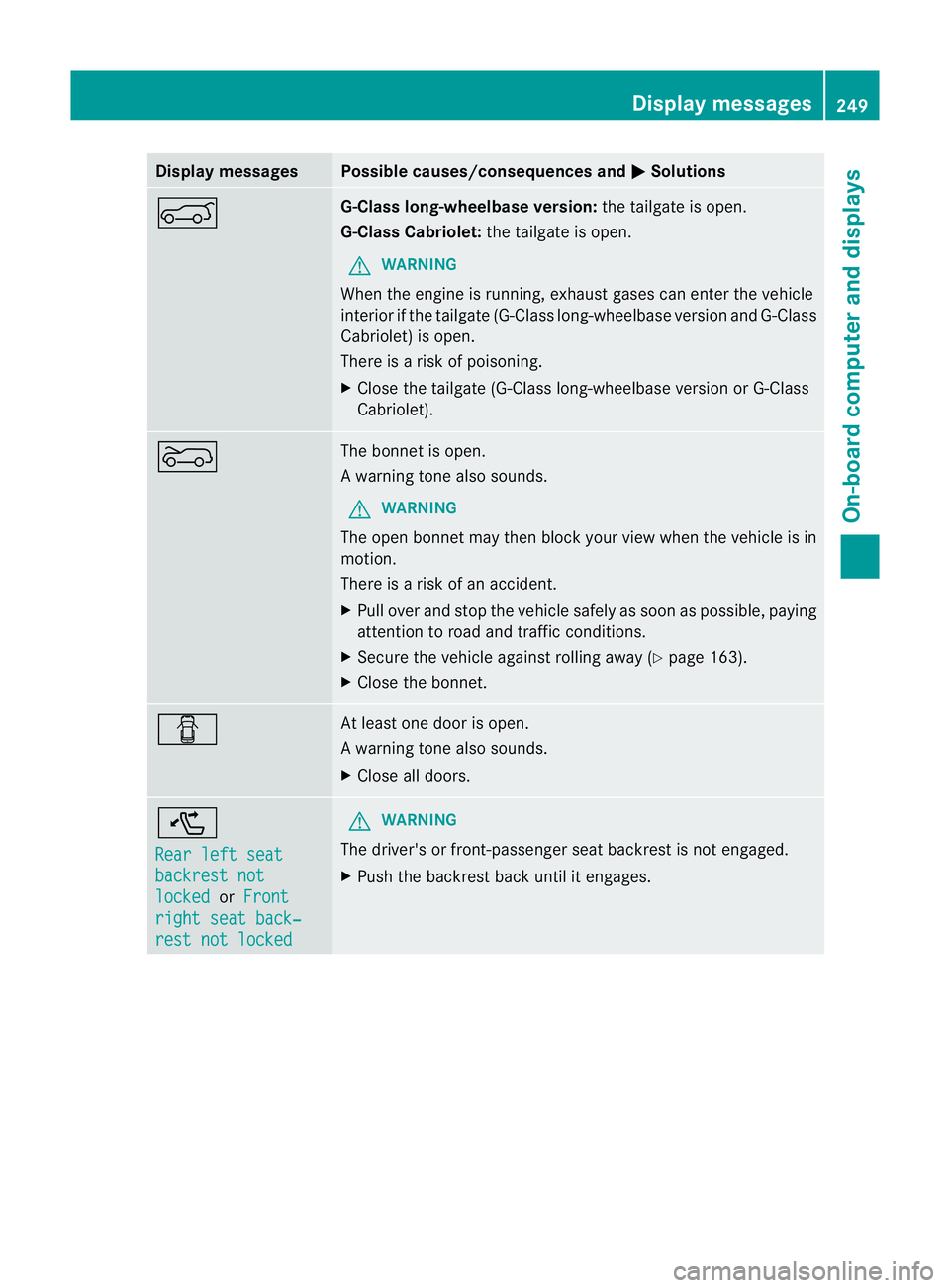
A G-Class long-wheelbase version:
the tailgate is open.
G-Class Cabriolet: the tailgate is open.
G WARNING
Whe nthe engine is running, exhaust gases can enter the vehicle
interior if the tailgate (G-Class long-wheelbase version and G-Class
Cabriolet) is open.
There is a risk of poisoning.
X Close the tailgate (G-Class long-wheelbase version or G-Class
Cabriolet). ? The bonnet is open.
Aw
arning tone also sounds.
G WARNING
The open bonne tmay then bloc kyour view when the vehicle is in
motion.
There is a risk of an accident.
X Pull over and stop the vehicle safely as soon as possible, paying
attention to road and traffic conditions.
X Secure the vehicle against rolling away (Y page 163).
X Close the bonnet. C At least one door is open.
Aw arning tone also sounds.
X Close all doors. ^
Rear left seat
backrest not
locked or
Front right seat back‐
rest not locked G
WARNING
The driver's or front-passenger seat backres tis not engaged.
X Push the backrest back until it engages. Display messages
249On-board computer and displays Z
Page 269 of 357
Useful information
i This Owner's Manual describes all mod-
els, series and optional equipment for your
vehicle that were available at the time of
going to press. Country-specific differen-
ces are possible. Note that your vehicle
may not be fitted with all features descri-
bed. This is also the case for systems and
functions relevant to safety.
i Read the information on qualified special-
ist workshops: (Y page 22). Loading guidelines
G
WARNING
Secure and position the load as described in
the loading guidelines.
Otherwise, vehicle occupants could
be injured by the load being thrown around in
the even tofsharp braking, a sudden change
in direction or an accident. This also applies
to seats which have been removed.
You will find further information in the "Secur-
ing a load" section.
Even if you follow all the loading guidelines,
the load will increase the risk of injury in the
event of an accident. G
WARNING
Keep the boot lid/tailgate closed when the
engine is running. Otherwise, you could be
poisoned by exhaust fumes entering the vehi-
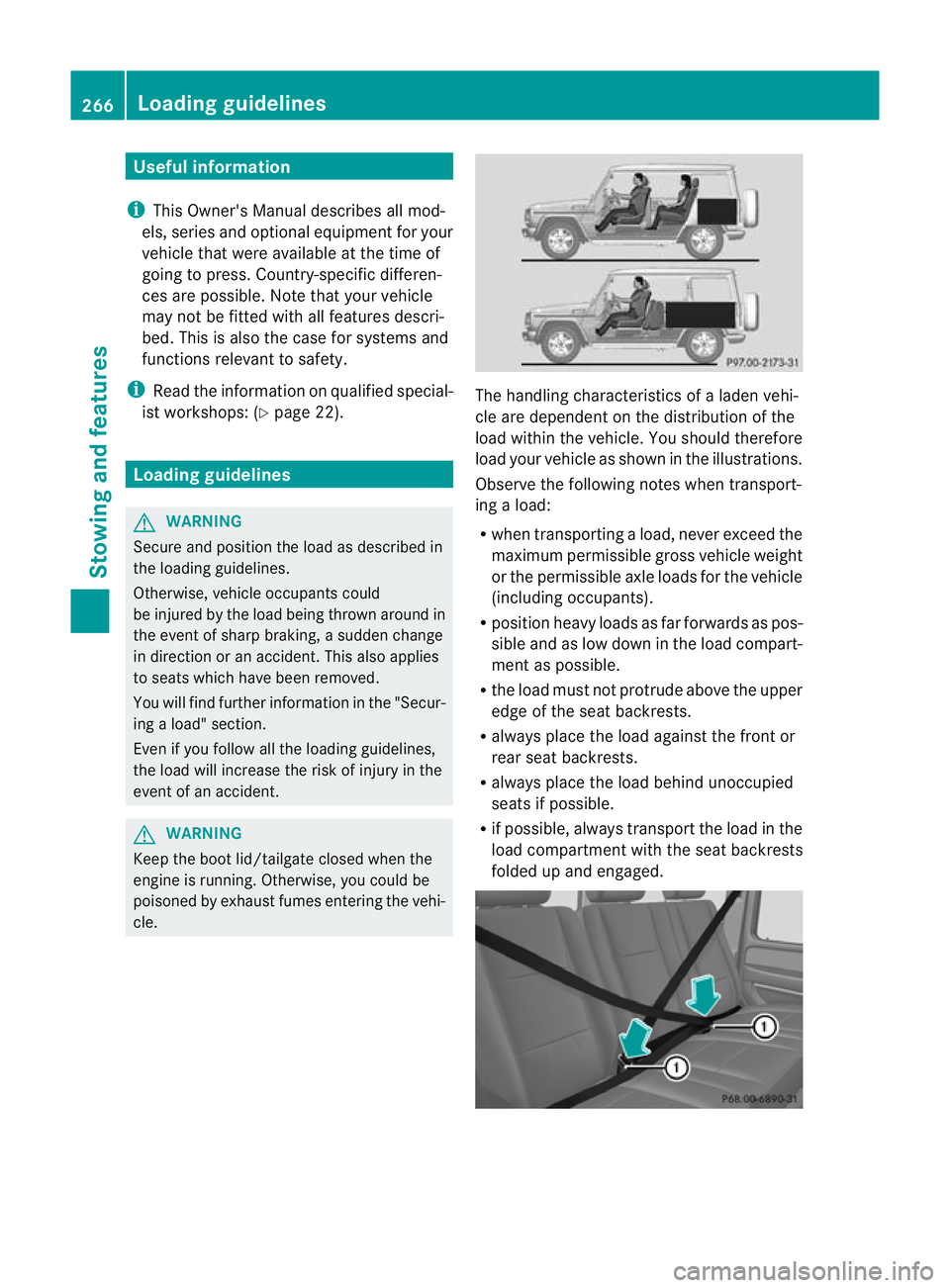
cle. The handling characteristics of a laden vehi-
cle are dependent on the distribution of the
load within the vehicle. You should therefore
load your vehicle as shown in the illustrations.
Observe the following notes when transport-
ing a load:
R when transporting a load, never exceed the
maximum permissible gross vehicle weight
or the permissible axle loads for the vehicle
(including occupants).
R position heavy loads as far forwards as pos-
sible and as low down in the load compart-
ment as possible.
R the load must not protrude above the upper
edge of the seat backrests.
R always place the load against the front or
rear seat backrests.
R always place the load behind unoccupied
seats if possible.
R if possible, always transport the load in the
load compartmentw ith the seat backrests
folded up and engaged. 266
Loading guidelinesStowing and features
Page 271 of 357
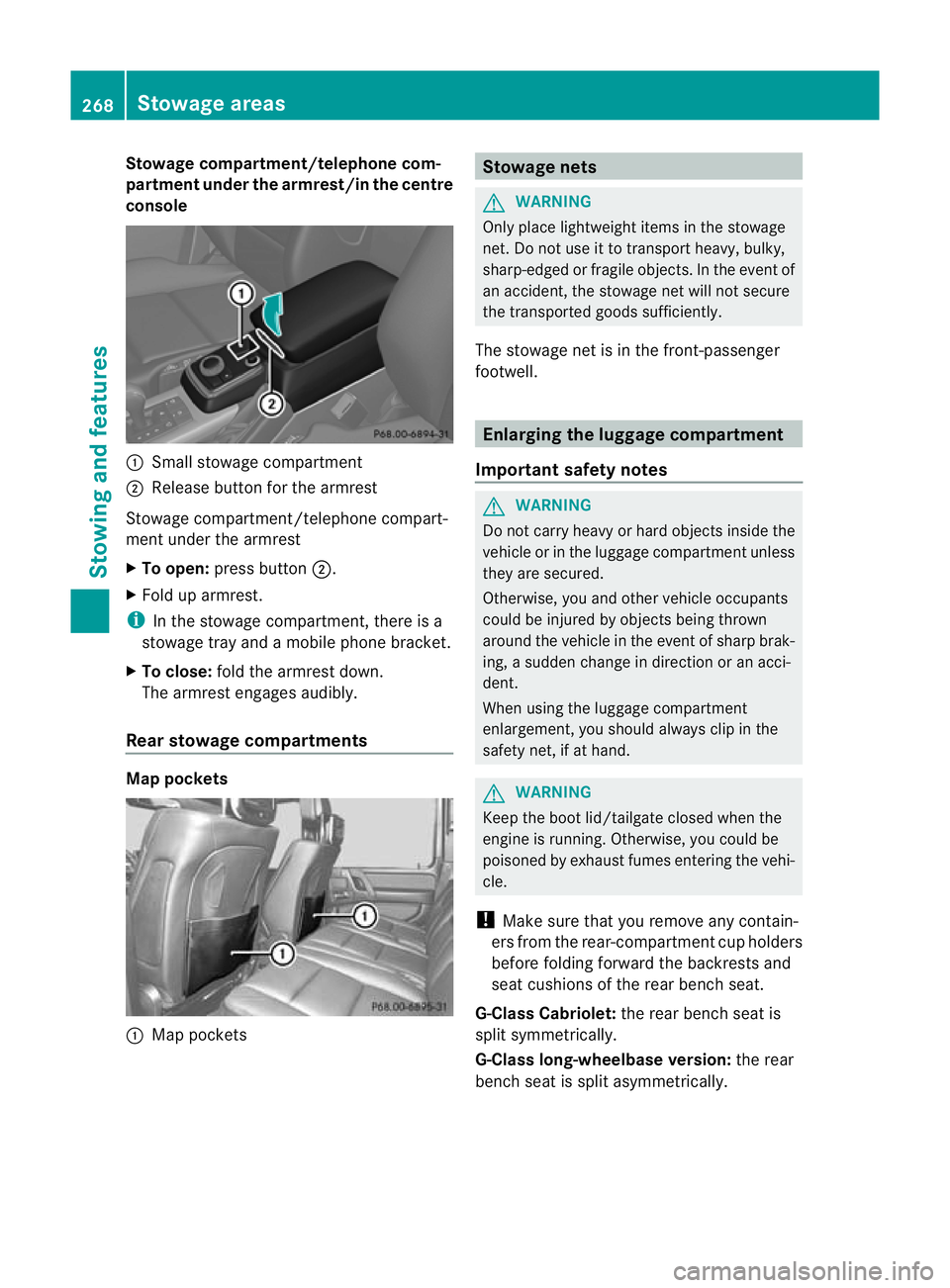
Stowage compartment/telephone com-
partment under the armrest/in the centre
console
:
Small stowage compartment
; Release button for the armrest
Stowage compartment/telephone compart-
ment under the armrest
X To open: press button ;.
X Fold up armrest.
i In the stowage compartment, there is a
stowage tray and a mobile phone bracket.
X To close: fold the armrest down.
The armrest engages audibly.
Rear stowage compartments Map pockets
:
Map pockets Stowage nets
G
WARNING
Only place lightweight items in the stowage
net. Do not use it to transport heavy, bulky,
sharp-edged or fragile objects. In the event of
an accident, the stowage net will not secure
the transported goods sufficiently.
The stowage net is in the front-passenger
footwell. Enlarging the luggage compartment
Important safety notes G
WARNING
Do not carry heavy or hard objects inside the
vehicle or in the luggage compartmen tunless
they are secured.
Otherwise, you and othe rvehicle occupants
could be injured by objects being thrown
around the vehicle in the event of sharp brak-
ing, a sudden change in direction or an acci-
dent.
When using the luggage compartment
enlargement, you should alway sclip in the
safety net, if at hand. G
WARNING
Keep the boot lid/tailgate closed when the
engine is running. Otherwise, you could be
poisoned by exhaust fumes entering the vehi-
cle.
! Make sure that you remove any contain-
ers fro mthe rear-compartment cup holders
before folding forward the backrests and
seat cushions of the rear bench seat.
G-Class Cabriolet: the rear bench seat is
split symmetrically.
G-Class long-wheelbase version: the rear
bench seat is split asymmetrically. 268
Stowage areasStowing and features
Page 307 of 357
Useful information
i This Owner's Manual describes all mod-
els, series and optional equipment for your
vehicle that were available at the time of
going to press. Country-specific differen-
ces are possible. Note that your vehicle
may not be fitted with all features descri-
bed. This is also the case for systems and
functions relevant to safety.
i Read the information on qualified special-
ist workshops: (Y page 22). Where will I find...?
Warning triangle
Removing the warning triangle G-Class long-wheelbase version
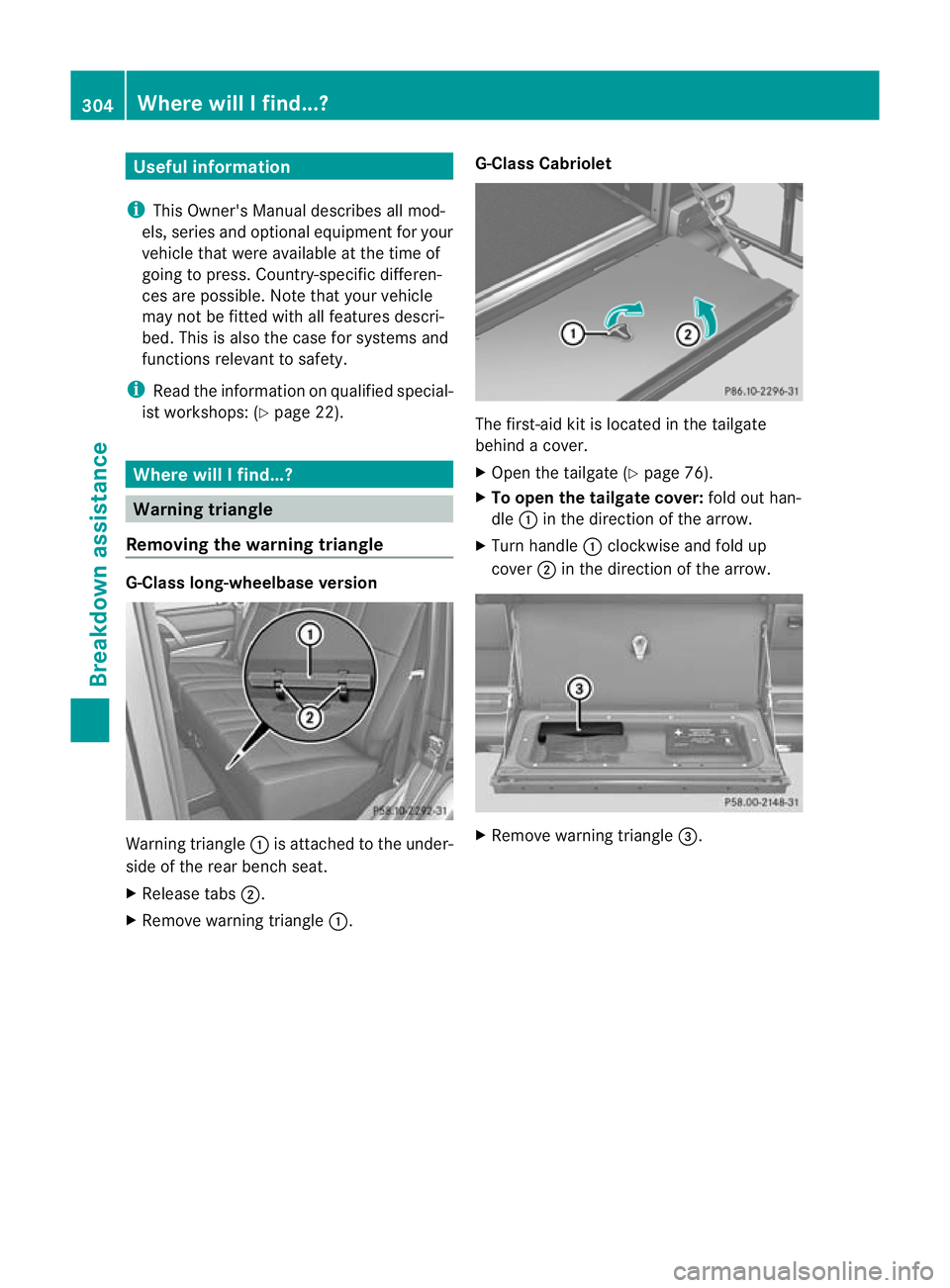
Warning triangle
:is attached to the under-
side of the rear bench seat.
X Release tabs ;.
X Remove warning triangle :.G-Class Cabriolet The first-aid kit is located in the tailgate
behind a cover.
X
Open the tailgate (Y page 76).
X To open the tailgate cover: fold out han-
dle :in the direction of the arrow.
X Turn handle :clockwise and fold up
cover ;in the direction of the arrow. X
Remove warning triangle =.304
Where will I find...?Breakdown assistance
Page 308 of 357
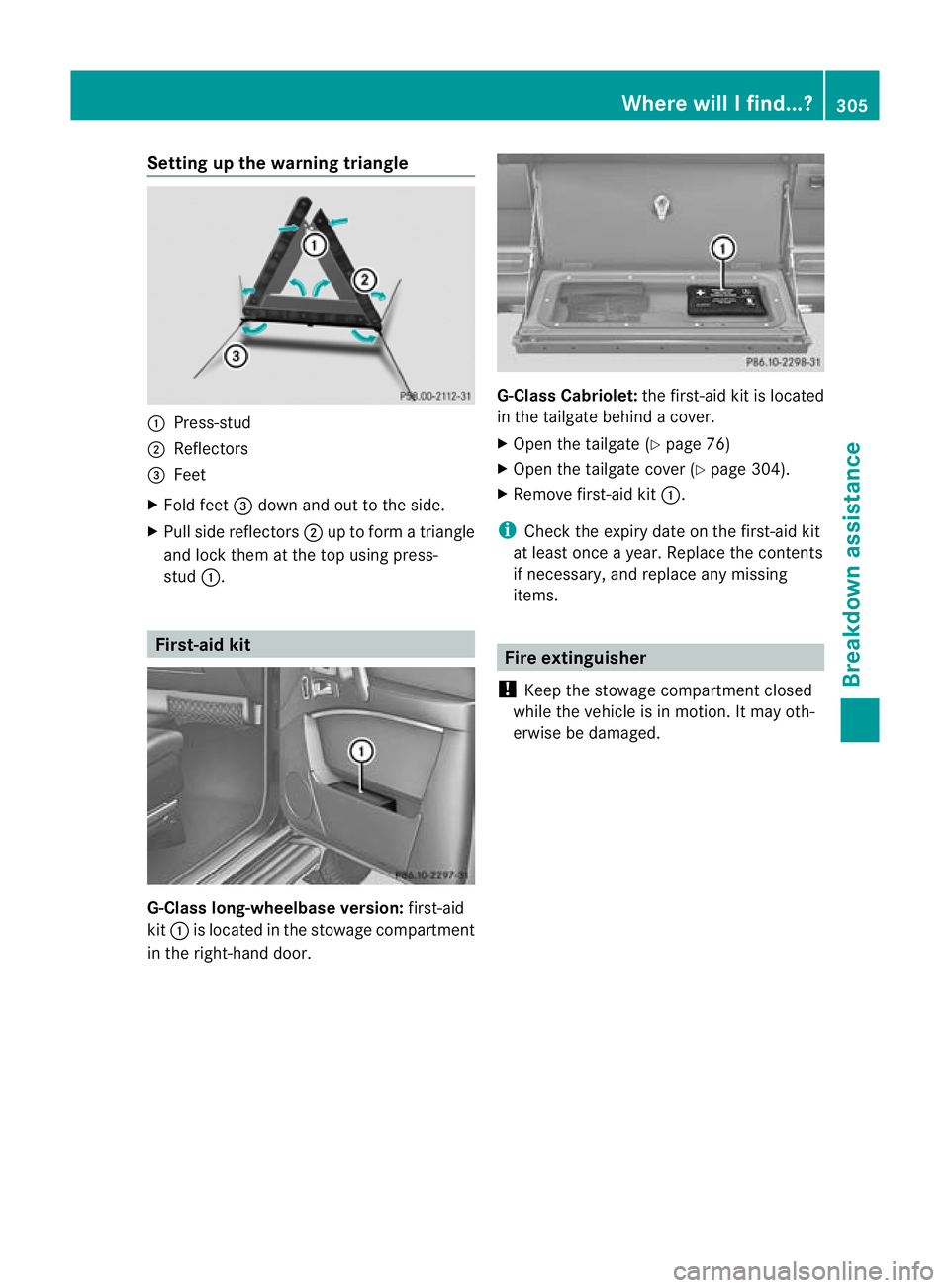
Setting up the warning triangle
:
Press-stud
; Reflectors
= Feet
X Fold feet =down and out to the side.
X Pull side reflectors ;up to form a triangle
and lock them at the top using press-
stud :. First-aid kit
G-Class long-wheelbase version:
first-aid
kit : is located in the stowage compartment
in the right-hand door. G-Class Cabriolet:
the first-aid kit is located
in the tailgate behind a cover.
X Open the tailgate (Y page 76)
X Open the tailgate cover (Y page 304).
X Remove first-aid kit :.
i Check the expiry date on the first-aid kit
at least once a year. Replace the contents
if necessary, and replace any missing
items. Fire extinguisher
! Keep the stowage compartmen tclosed
while the vehicle is in motion. It may oth-
erwise be damaged. Where will I find...?
305Breakdown assistance
Page 310 of 357
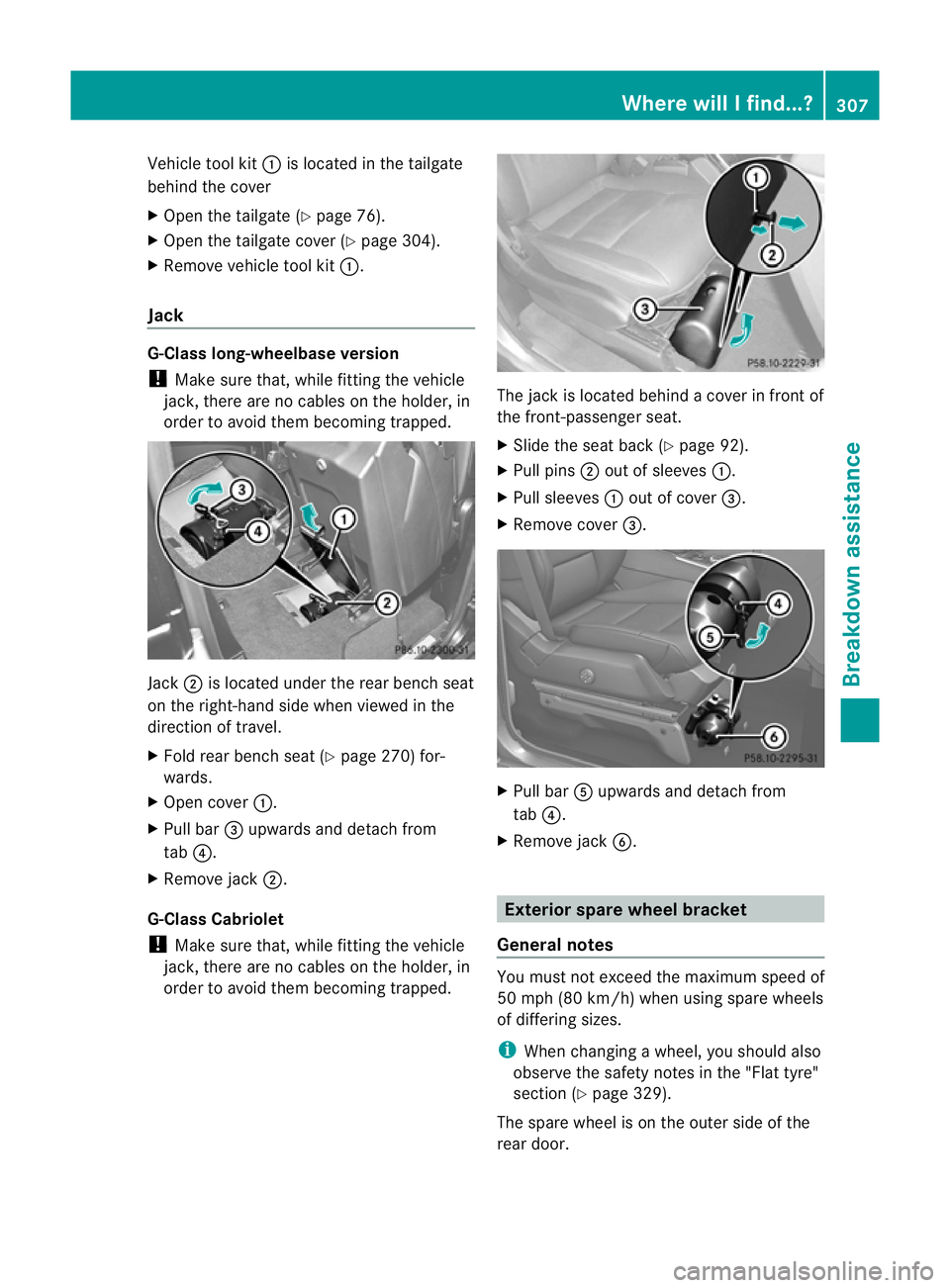
Vehicle tool kit
:is located in the tailgate
behind the cover
X Open the tailgate (Y page 76).
X Open the tailgate cover (Y page 304).
X Remove vehicle tool kit :.
Jack G-Class long-wheelbase version
!
Make sure that, while fitting the vehicle
jack, there are no cables on the holder, in
order to avoid them becoming trapped. Jack
;is located under the rear bench seat
on the right-hand side when viewed in the
direction of travel.
X Fold rear bench seat (Y page 270) for-
wards.
X Open cover :.
X Pull bar =upwards and detach from
tab ?.
X Remove jack ;.
G-Class Cabriolet
! Make sure that, while fitting the vehicle
jack, there are no cables on the holder, in
order to avoid them becoming trapped. The jack is located behind a cover in front of
the front-passenger seat.
X
Slide the seat back (Y page 92).
X Pull pins ;out of sleeves :.
X Pull sleeves :out of cover =.
X Remove cover =. X
Pull bar Aupwards and detach from
tab ?.
X Remove jack B. Exterior spare wheel bracket
General notes You must not exceed the maximum speed of
50 mph (80 km/h) when using spare wheels
of differing sizes.
i
When changing a wheel, you should also
observe the safety notes in the "Flat tyre"
section (Y page 329).
The spare wheel is on the outer side of the
rear door. Where will I find...?
307Breakdown assistance
Page 334 of 357
is being changed. It is not suited for per-
forming maintenance work under the vehi-
cle.
R avoid changing the wheel on uphill and
downhill slopes.
R before raising the vehicle, secure it from
rolling away by applying the parking brake
and inserting wheel chocks. Neve rdisen-
gage the parking brake while the vehicle is
raised.
R the jack must be placed on a firm, flat and
non-slip surface. On a loose surface, a
large, load-bearing underlay must be used.
On a slippery surface, a non-slip underlay
must be used, e.g. rubber mats.
R do not use wooden blocks or similar
objects as a jac kunderlay. Otherwise, the
jack will not be able to achieve its load-
bearing capacity due to the restricted
height.
R make sure tha tthe distance between the
underside of the tyres and the ground does
not exceed 3 cm.
R never place your hands or feet under the
raised vehicle.
R never lie under the raised vehicle.
R never start the engine when the vehicle is
raised.
R never open or close a door or the tailgate
when the vehicle is raised.
R make sure that no persons are present in
the vehicle when the vehicle is raised. X
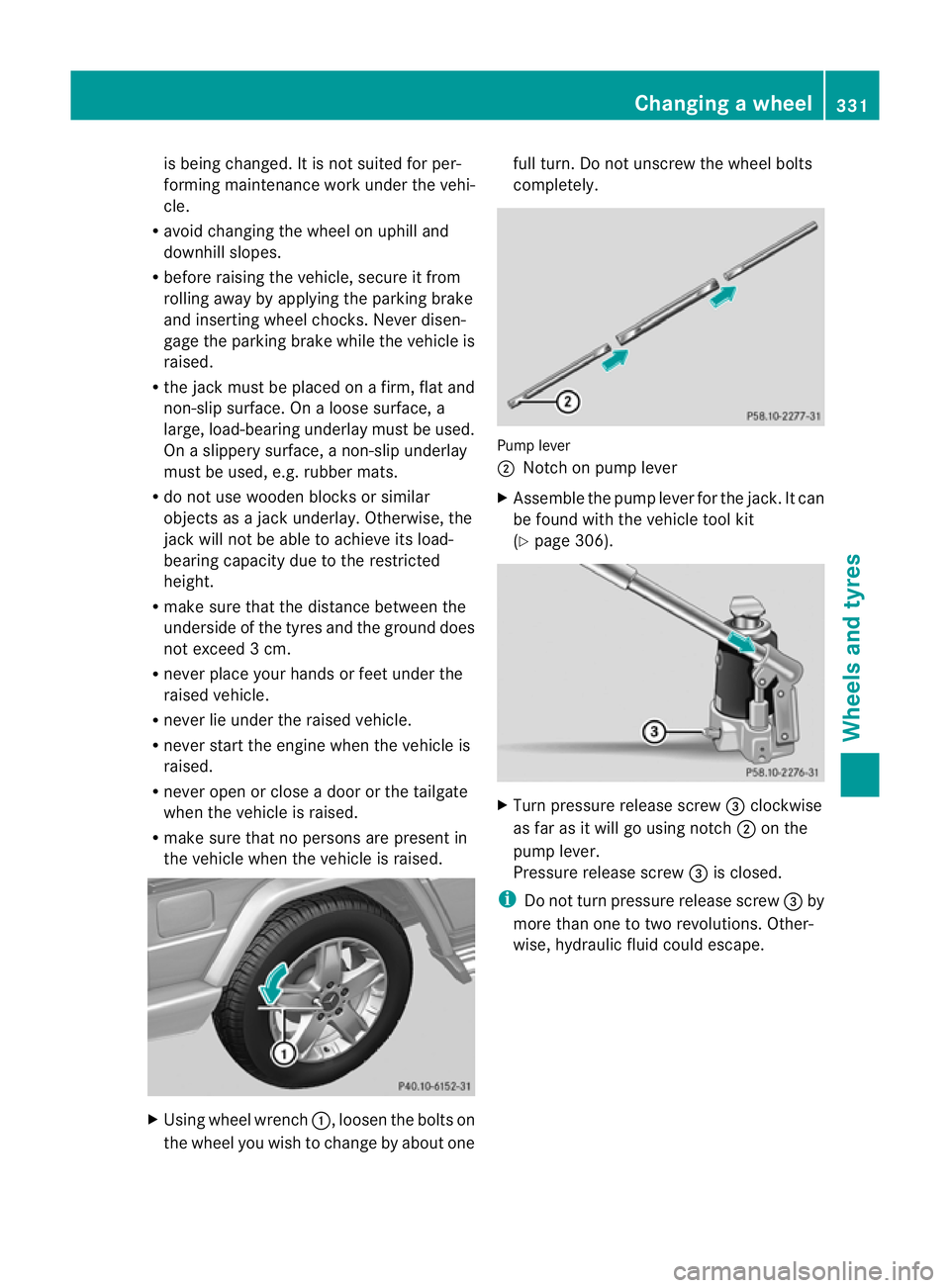
Using wheel wrench :, loosen the bolts on
the wheel you wish to change by about one full turn. Do not unscrew the wheel bolts
completely.
Pump lever
;
Notch on pump lever
X Assemble the pump lever for the jack. It can
be found with the vehicle tool kit
(Y page 306). X
Turn pressure release screw =clockwise
as far as it will go using notch ;on the
pump lever.
Pressure release screw =is closed.
i Do not turn pressure release screw =by
more than one to two revolutions. Other-
wise, hydraulic fluid could escape. Changing
awheel
331Wheels and tyres Z