2012 MERCEDES-BENZ E-CLASS ESTATE light
[x] Cancel search: lightPage 360 of 457
R
clean cloth covers with a microfibre cloth
moistened with a solution containing
1%detergen t(e.g. washing-up liquid).
Rub carefully, and always wipe entire
seat sections to avoid leaving visible
lines. Leave the seat to dry afterwards.
Cleaning results depend on the type of
dirt and how long it has been there.
R clean DINAMICA covers with a damp
cloth. Make sure that you wipe entire
seat sections to avoid leaving visible
lines.
! Do not use microfibre cloths to clean gen-
uine leather, artificial leather or DINAMICA
covers. If used often, these can damage the
cover.
i Note that regular care is essential to
make sure that the appearance and com-
fort of the covers are retained over time.
Cleaning the seat belts !
Do not clean the seat belts using chemical
cleaning agents .Do not dry the seat belts
at temperatures above 80 † or in direct
sunlight.
X Use clean, lukewarm water and soap solu-
tion.
Cleaning the roof lining and carpets X
Roof lining: if it is very dirty, use a soft
brush or dry shampoo.
X Carpets: use the carpet and textile clean-
ing agents recommended and approved by
Mercedes-Benz. Care
357Maintenance and care Z
Page 387 of 457
G
WARNING
If the tyre pressure drops repeatedly, the
wheel, valve or tyre may be damaged. Tyre
pressure that is too low may result in a tyre
blow-out. There is a risk of accident.
R Check the tyre for foreign objects.
R Check whethe rthe wheel is losing air or the
valve is leaking.
If you are unable to rectify the damage, con-
tact a qualified specialist workshop. H
Environmental note
Check the tyre pressure regularly, at least
every 14 days.
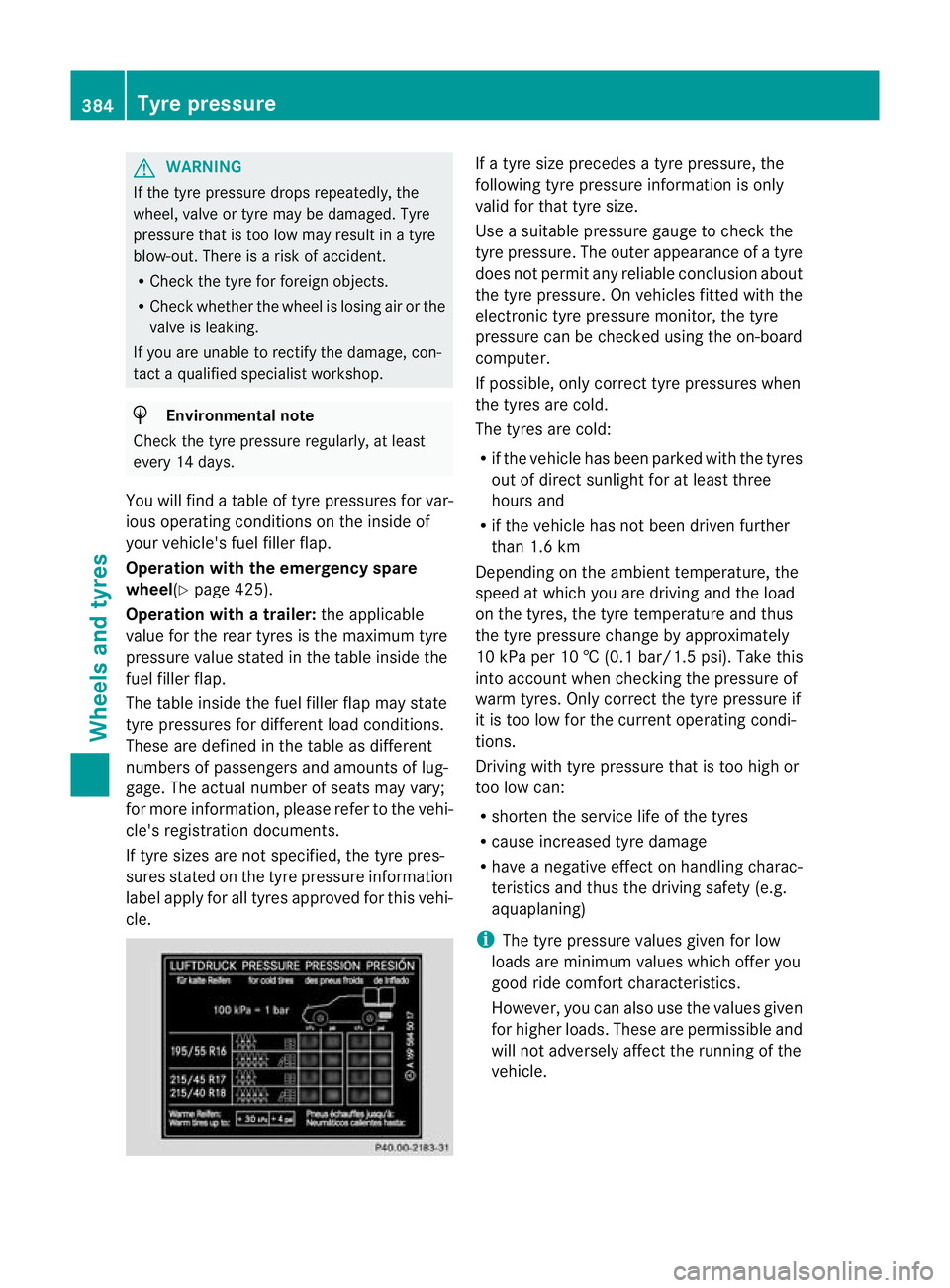
You will find a table of tyre pressures for var-
ious operating conditions on the inside of
your vehicle's fuel filler flap.
Operation with the emergency spare
wheel(Y page 425).
Operation with a trailer: the applicable
value for the rear tyres is the maximum tyre
pressure value stated in the table inside the
fuel filler flap.
The table inside the fuel filler flap may state
tyre pressures for different load conditions.
These are defined in the table as different
numbers of passengers and amounts of lug-
gage. The actual number of seats may vary;
for more information, please refer to the vehi-
cle's registration documents.
If tyre sizes are not specified, the tyre pres-
sures stated on the tyre pressure information
label apply for all tyres approved for this vehi-
cle. If a tyre size precedes a tyre pressure, the
following tyre pressure information is only
valid for that tyre size.
Use a suitable pressure gauge to check the
tyre pressure. The outer appearance of a tyre
does not permit any reliable conclusion about
the tyre pressure. On vehicles fitted with the
electronic tyre pressure monitor, the tyre
pressure can be checked using the on-board
computer.
If possible, only correct tyre pressures when
the tyres are cold.
The tyres are cold:
R
if the vehicle has been parked with the tyres
out of direct sunlight for at least three
hours and
R if the vehicle has not been driven further
than 1.6 km
Depending on the ambient temperature, the
speed at which you are driving and the load
on the tyres, the tyre temperature and thus
the tyre pressure change by approximately
10 kPa per 10 † (0.1 ba r/1.5 psi). Take this
into account whe nchecking the pressure of
warm tyres. Only correct the tyre pressure if
it is too low for the current operating condi-
tions.
Driving with tyre pressure that is too high or
too low can:
R shorten the service life of the tyres
R cause increased tyre damage
R have a negative effect on handling charac-
teristics and thus the driving safety (e.g.
aquaplaning)
i The tyre pressure values given for low
loads are minimum values which offer you
good ride comfort characteristics.
However, you can also use the values given
for higher loads. These are permissible and
will not adversely affect the running of the
vehicle. 384
Tyre pressureWheels and tyres
Page 388 of 457
Speeds up to 210 km/h(does not apply to
AMG vehicles): despite the values stated on
the tyre pressure information label (fuel filler
flap), for speeds up to 210 km/h andwith
R16 or R17 tyres, the values stated can be
reduced as follows without a reduction in
safety:
R Saloon: Ò30kPa (Ò0.3bar/Ò4psi)
R Estate: Ò20 kPa (Ò0.2 bar/Ò3p si)
This does not apply to vehicles towing a
trailer.
This improves the ride comfort of your vehi-
cle; however, the fuel consumption may
increase slightly. Tyre pressure loss warning system
Important safety notes While the vehicle is in motion, the tyre pres-
sure loss warning system monitors the set
tyre pressure using the rotational speed of
the wheels. This enables the system to detect
significant pressure loss in a tyre. If the speed
of rotation of a wheel changes as a result of
a loss of pressure, a corresponding warning
message will appearint he multifunction dis-
play.
The tyre pressure warning system does not
warn you of an incorrectly set tyre pressure.
Observe the notes on the recommended tyre
pressure (Y page 383).
The tyre pressure loss warning system does
not replace the need to regularly check your
vehicle's tyre pressures, since an even loss of
pressure on several tyres at the same time
cannot be detected by the tyre pressure loss
warning system.
The tyre pressure monitor is not able to warn
you of a sudden loss of pressure, e.g. if the
tyre is penetrated by a foreign object. In the
event of a sudden loss of pressure, bring the
vehicle to a halt by braking carefully. Avoid
abrupt steering manoeuvres. The function of the tyre pressure loss warning
system is limited or delayed if:
R snow chains are fitted to your vehicle's
tyres.
R road conditions are wintry.
R you are driving on sand or gravel.
R you adopt a very sporty driving style (cor-
nering at high speeds or driving with high
rates of acceleration).
R you are towing a very heavy or large trailer.
R you are driving with a heavy load (in the
vehicle or on the roof).
Restarting the tyre pressure loss warn-
ing system Restart the tyre pressure loss warning system
if you have:
R
changed the tyre pressure
R changed the wheels or tyres
R fitted new wheels or tyres
X Before restarting, make sure that the tyre
pressures are set properly on all four tyres
for the respective operating conditions.
The recommended tyre pressures can be
found in the table on the fuel filler flap. The
tyre pressure loss warning system can only
give reliable warnings if you have set the
correct tyre pressure. If an incorrect tyre
pressure is set, these incorrectv alues will
be monitored.
X Also observe the notes in the sectio non
tyre pressures (Y page 383).
X Make sure tha tthe key is in posi-
tion 2(Ypage 161) in the ignition lock.
X Press =or; on the steering wheel
to select the Serv.Serv. menu.
X Press the 9or: button to select
Tyre pressure .
X Press the abutton.
The message appears in the multifunction
display. Tyre pressure
385Wheels and tyres Z
Page 390 of 457
X
Press the 9or: button to select
Tyre pressure .
X Press the abutton.
The curren ttyre pressur efor each wheel
will be displayed in the multifunction dis-
play.
If the vehicle was parked for longer than
20 minutes the Tyre pressures will be displayed after a few minutes of
driving message is shown.
After a teach-in period, the tyre pressure
monitor automatically recognises new
wheels or new sensors. If a clear allocation of
the tyre pressure values to the individual
wheels is not possible, the message is shown
instead of the tyre pressure display .The tyre
pressures are already being monitored.
i If an emergency spare wheel is fitted, the
system may continue to show the tyre pres-
sure of the wheel that has been removed
for a few minutes. If this occurs, note that
the value displayed for the position where
the spare wheel is fitted is not the same as
the current tyre pressure of the emergency
spare wheel.
Warning messages of the tyre pressure
monitor If the tyre pressure monitor detects a signifi-
cant pressure loss on one or more tyres, a
warning message is shown in the multifunc-
tion display. Awarning tone also sounds and
the tyre pressure warning lamp lights up in
the instrument cluster.
Each tyre that is affected by a significant loss
of pressure is highlighted in the pressure dis-
play.
X If the Please correct tyre pressure message appears in the multifunction dis-
play, check the tyre pressure on all four
wheels and correct it if necessary.
i If the wheel positions on the vehicle are
interchanged, the tyre pressures may be
displayed for the wrong positions for a
short time. This is rectified after a few minutes of driving, and the tyre pressures
are displayed for the correct positions.
Restarting the tyre pressure monitor When you restar
tthe tyre pressure monitor,
all existing warning messages are deleted and
the warning lamps go out. The monitor uses
the currently set tyre pressures as the refer-
ence values for monitoring. In most cases, the
tyre pressure monitor will automatically
detect the new referencev alues after you
have changed the tyre pressure .However,
you can also define reference values man-
ually as described here. The tyre pressure
monitor then monitors the new tyre pressure
values.
X Use the table on the inside of the fuel filler
flap to ensure that the tyre pressure is set
correctly in all four tyres for the current
operating conditions.
Also observe the notes in the section on
tyre pressures (Y page 383).
X Make sure that the key is in position 2in
the ignition lock.
X Press the =or; button on the steer-
ing wheel to select the Serv. menu.
X Press the 9or: button to select
Tyre pressure .
X Press the abutton.
The multifunction display shows the cur-
rent tyre pressure for each tyre or the
Tyre pressures displayed after a few minutes of driving message.
X Press the :button.
The multifunction display shows the Use current pressure values as new ref‐
erence values message.
If you wish to confirm the restart:
X Press the abutton.
The Tyre press. monitor restarted message appears in the multifunction dis-
play. Tyre pressure
387Wheels and tyres Z
Page 393 of 457
If yourv
ehicle is equipped with a wheel chock,
it can be found in the tyre-change tool kit
(Y page 361).
The folding wheel choc kis an additional
securing measure to prevent the vehicle from
rolling away, for example when changing a
wheel.
X Fold both plates upwards :.
X Fold out lower plate ;.
X Guide the lugs on the lower plate fully into
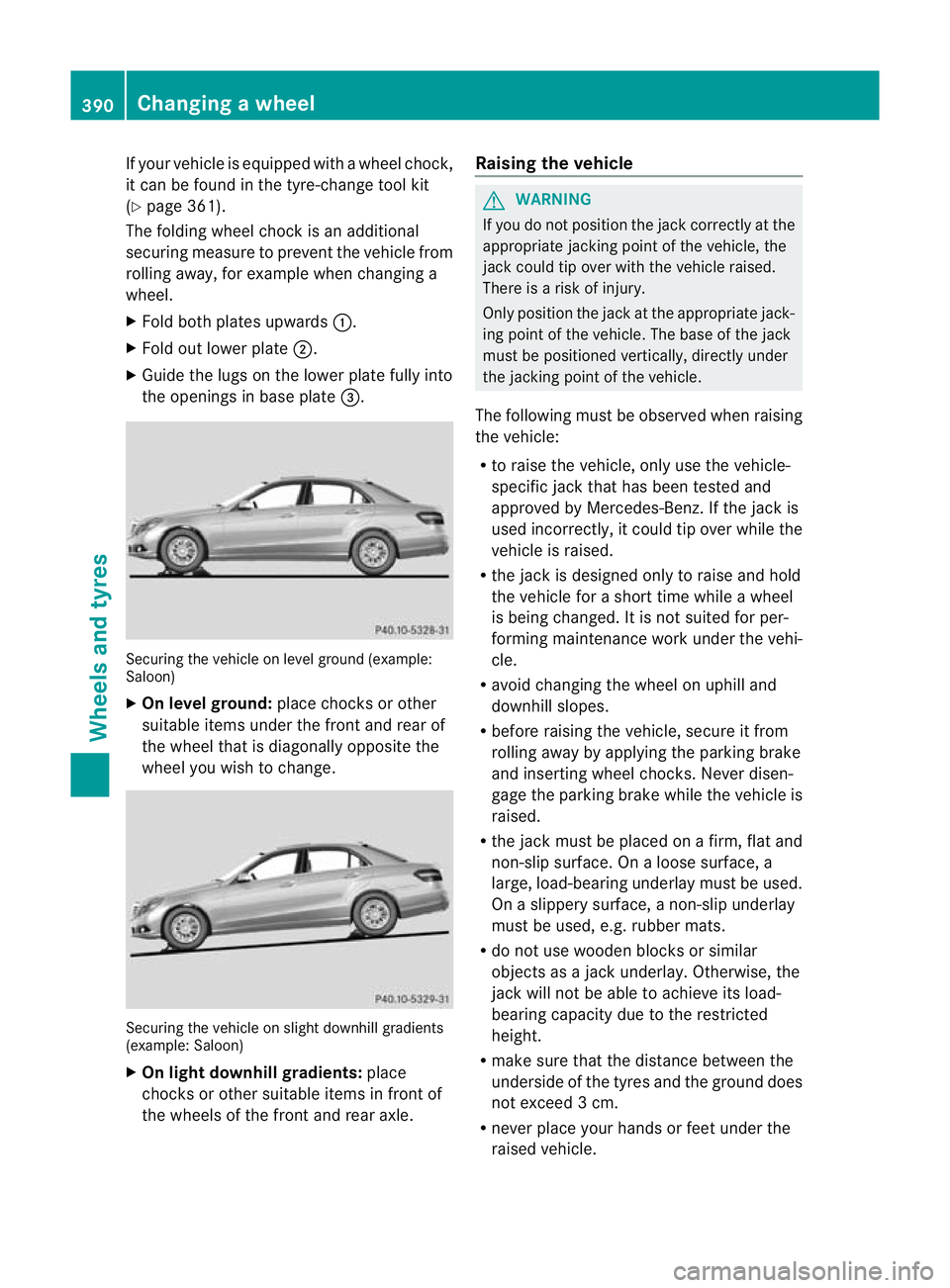
the openings in base plate =.Securing the vehicle on level ground (example:
Saloon)
X
On level ground: place chocks or other
suitable items under the front and rear of
the wheel that is diagonally opposite the
wheel you wish to change. Securing the vehicle on slight downhill gradients
(example: Saloon)
X On light downhill gradients: place
chocks or other suitable items in front of
the wheels of the front and rear axle. Raising the vehicle G
WARNING
If you do not position the jack correctly at the
appropriate jacking point of the vehicle, the
jack could tip over with the vehicle raised.
There is a risk of injury.
Only position the jack at the appropriate jack-
ing point of the vehicle. The base of the jack
must be positioned vertically, directly under
the jacking point of the vehicle.
The following must be observed when raising
the vehicle:
R to raise the vehicle, only use the vehicle-
specific jack that has been tested and
approved by Mercedes-Benz. If the jack is
used incorrectly, it could tip over while the
vehicle is raised.
R the jack is designed only to raise and hold
the vehicle for a short time while a wheel
is being changed. It is not suited for per-
forming maintenance work under the vehi-
cle.
R avoid changing the wheel on uphill and
downhill slopes.
R before raising the vehicle, secure it from
rolling away by applying the parking brake
and inserting wheel chocks. Never disen-
gage the parking brake while the vehicle is
raised.
R the jack must be placed on a firm, flat and
non-slip surface. On a loose surface, a
large, load-bearing underlay must be used.
On a slippery surface, a non-slip underlay
must be used, e.g. rubber mats.
R do not use wooden blocks or similar
objects as a jack underlay.O therwise, the
jac kw ill not be able to achieve its load-
bearing capacity due to the restricted
height.
R make sure that the distance between the
underside of the tyres and the ground does
not exceed 3 cm.
R never place your hands or feet under the
raised vehicle. 390
Changing
awheelWheels and tyres
Page 398 of 457
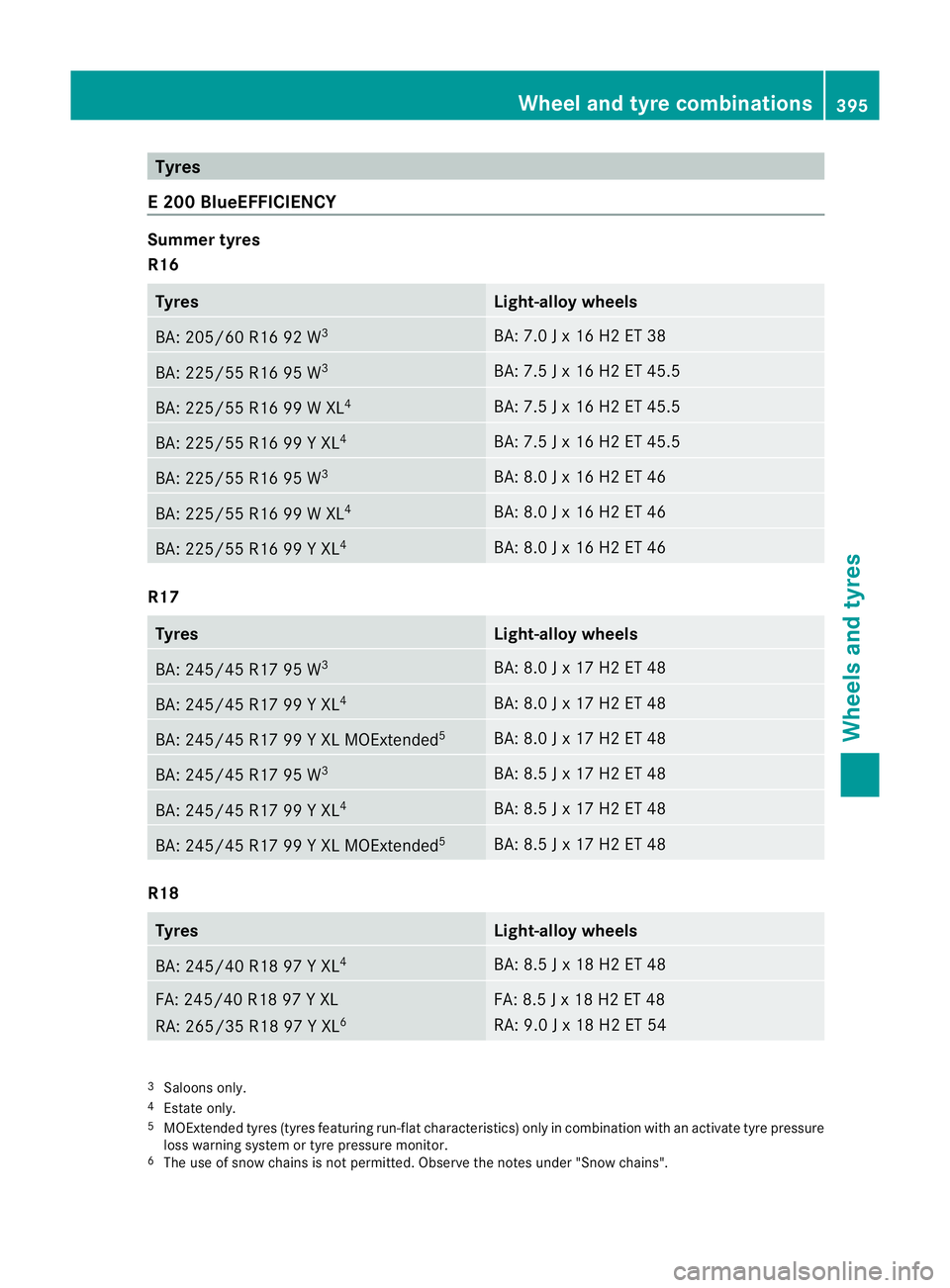
Tyres
E 200 BlueEFFICIENCY Summer tyres
R16
Tyres Light-alloy wheels
BA: 205/6
0 R16 92 W 3 BA: 7.0 J x 16 H2 ET 38
BA: 225/55 R16 95 W
3 BA: 7.5 J x 16 H2 ET 45.5
BA: 225/55 R16 99 W XL
4 BA: 7.5 J x 16 H2 ET 45.5
BA: 225/55 R16 99 Y XL
4 BA: 7.5 J x 16 H2 ET 45.5
BA: 225/55 R16 95 W
3 BA: 8.0 J x 16 H2 ET 46
BA: 225/55 R16 99 W XL
4 BA: 8.0 J x 16 H2 ET 46
BA: 225/55 R16 99 Y XL
4 BA: 8.0 J x 16 H2 ET 46
R17
Tyres Light-allo
ywheels BA: 245/45 R17 95 W
3 BA: 8.0 J x 17 H2 ET 48
BA: 245/45 R17 99 Y XL
4 BA: 8.0 J x 17 H2 ET 48
BA: 245/45 R17 99 Y XL MOExtended
5 BA: 8.0 J x 17 H2 ET 48
BA: 245/45 R17 95 W
3 BA: 8.5 J x 17 H2 ET 48
BA: 245/45 R17 99 Y XL
4 BA: 8.5 J x 17 H2 ET 48
BA: 245/45 R17 99 Y XL MOExtended
5 BA: 8.5 J x 17 H2 ET 48
R18
Tyres Light-alloy wheels
BA: 245/40 R18 97 Y XL
4 BA: 8.5 J x 18 H2 ET 48
FA: 245/40 R18 97 Y XL
RA: 265/35 R18 97 Y XL
6 FA: 8.5 J x 18 H2 ET 48
RA: 9.0 J x 18 H2 ET 54
3
Saloons only.
4 Estate only.
5 MOExtended tyres (tyre sfeaturing run-flat characteristics) only in combination with an activate tyre pressure
loss warning system or tyre pressure monitor.
6 The use of snow chains is not permitted. Observe the notes under "Snow chains". Wheel and tyre combinations
395Wheels and tyres Z
Page 399 of 457
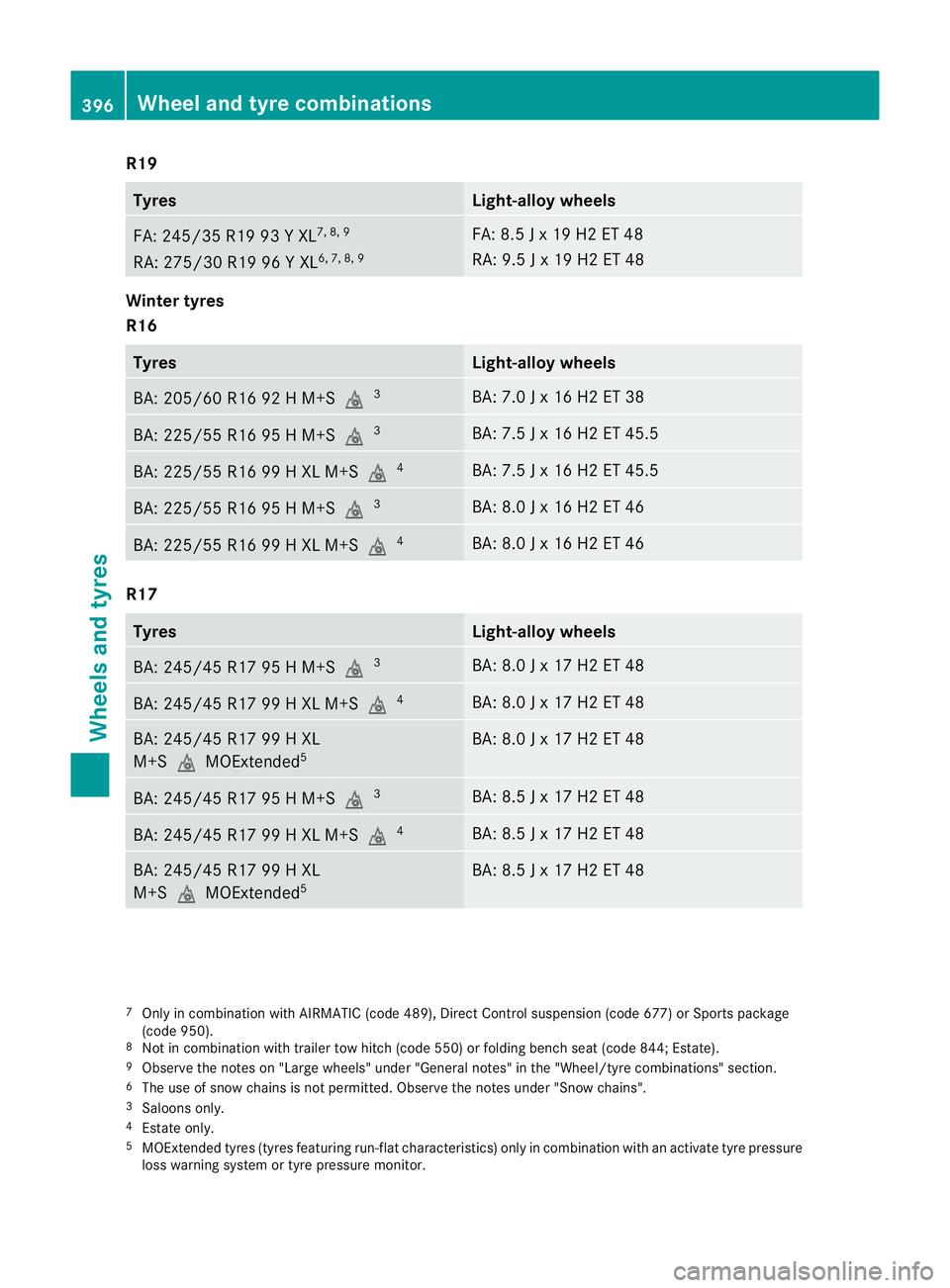
R19
Tyres Light-allo
ywheels FA: 245/35 R19 93 Y XL
7, 8, 9
RA: 275/30 R19 96 Y XL 6, 7, 8, 9 FA: 8.5 J x 19 H2 ET 48
RA: 9.5 J x 19 H2 ET 48
Winter tyres
R16
Tyres Light-alloy wheels
BA: 205/60 R16 92 H M+S
i3 BA: 7.0 J x 16 H2 ET 38
BA: 225/55 R16 95 H M+S
i3 BA: 7.5 J x 16 H2 ET 45.5
BA: 225/55 R16 99 H XL M+S
i4 BA: 7.5 J x 16 H2 ET 45.5
BA: 225/55 R16 95 H M+S
i3 BA: 8.0 J x 16 H2 ET 46
BA: 225/55 R16 99 H XL M+S
i4 BA: 8.0 J x 16 H2 ET 46
R17
Tyres Light-alloy wheels
BA: 245/45 R17 95 H M+S
i3 BA: 8.0 J x 17 H2 ET 48
BA: 245/45 R17 99 H XL M+S
i4 BA: 8.0 J x 17 H2 ET 48
BA: 245/45 R17 99 H XL
M+SiMOExtended
5 BA: 8.0 J x 17 H2 ET 48
BA: 245/45 R17 95 H M+S
i3 BA: 8.5 J x 17 H2 ET 48
BA: 245/45 R17 99 H XL M+S
i4 BA: 8.5 J x 17 H2 ET 48
BA: 245/45 R17 99 H XL
M+SiMOExtended
5 BA: 8.5 J x 17 H2 ET 48
7
Only in combination with AIRMATIC (code 489), Direct Control suspension (code 677) or Sports package
(code 950).
8 Not in combination with trailer tow hitch (code 550) or folding bench seat (code 844; Estate).
9 Observe the notes on "Large wheels" under "General notes" in the "Wheel/tyre combinations" section.
6 The use of snow chains is not permitted. Observe the notes under "Snow chains".
3 Saloons only.
4 Estate only.
5 MOExtended tyres (tyre sfeaturing run-flat characteristics) only in combination with an activate tyre pressure
loss warning system or tyre pressure monitor. 396
Wheel and tyre combinationsWheels and tyres
Page 400 of 457
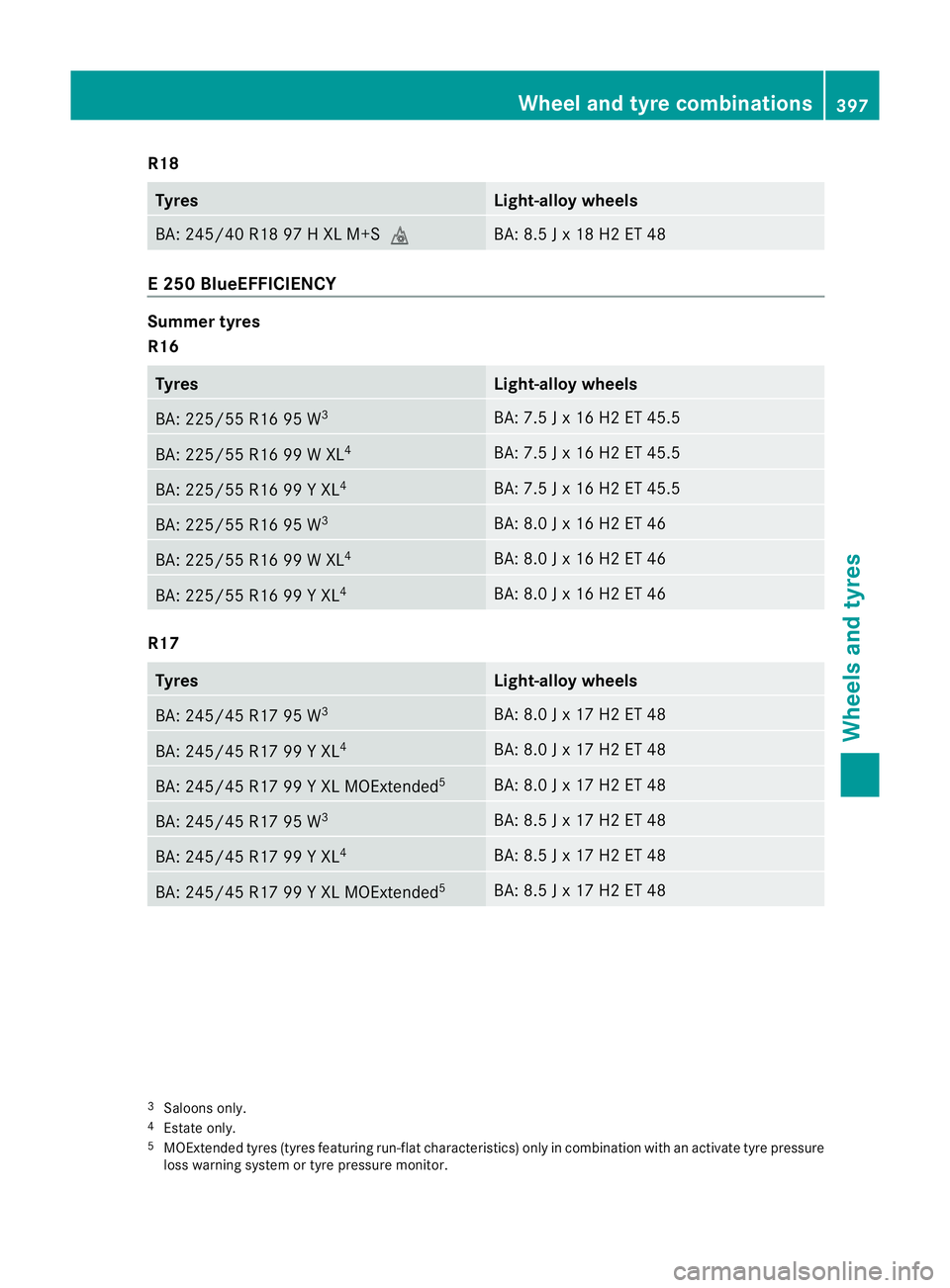
R18
Tyres Light-allo
ywheels BA: 245/40 R18 97 H XL M+S
i BA: 8.5 J x 18 H2 ET 48
E 250 BlueEFFICIENCY
Summer tyres
R16
Tyres Light-alloy wheels
BA: 225/55 R16 95 W
3 BA: 7.5 J x 16 H2 ET 45.5
BA: 225/55 R16 99 W XL
4 BA: 7.5 J x 16 H2 ET 45.5
BA: 225/55 R16 99 Y XL
4 BA: 7.5 J x 16 H2 ET 45.5
BA: 225/55 R16 95 W
3 BA: 8.0 J x 16 H2 ET 46
BA: 225/55 R16 99 W XL
4 BA: 8.0 J x 16 H2 ET 46
BA: 225/55 R16 99 Y XL
4 BA: 8.0 J x 16 H2 ET 46
R17
Tyres Light-alloy wheels
BA: 245/45 R17 95 W
3 BA: 8.0 J x 17 H2 ET 48
BA: 245/45 R17 99 Y XL
4 BA: 8.0 J x 17 H2 ET 48
BA: 245/45 R17 99 Y XL MOExtended
5 BA: 8.0 J x 17 H2 ET 48
BA: 245/45 R17 95 W
3 BA: 8.5 J x 17 H2 ET 48
BA: 245/45 R17 99 Y XL
4 BA: 8.5 J x 17 H2 ET 48
BA: 245/45 R17 99 Y XL MOExtended
5 BA: 8.5 J x 17 H2 ET 48
3
Saloons only.
4 Estate only.
5 MOExtended tyres (tyre sfeaturing run-flat characteristics) only in combination with an activate tyre pressure
loss warning system or tyre pressure monitor. Wheel and tyre combinations
397Wheels and tyres Z