2012 MERCEDES-BENZ B-CLASS winter tires
[x] Cancel search: winter tiresPage 303 of 340

safety systems such as ABS and ESP
®
to
function optimally in
winter. These tires have
been developed specifically for driving in
snow.
Use M+S tires of the same make and tread on
all wheels to maintain safe handling
characteristics.
Always observe the maximum permissible
speed specified for the M+S tires you have
mounted.
Once the winter tires are mounted:
X Check the tire pressures (Y page 305).
X Restart the tire pressure loss warning
system (Y page 305).
For more information on driving with the
emergency spare wheel, see ( Y page 325).Snow chains
G
WARNING
If snow chains are mounted on the rear
wheels, the snow
chains could cause abrasion
to the vehicle body or to chassis components.
This could cause damage to the vehicle or the
tires. There is a risk of an accident.
To avoid hazardous situations:
R never mount snow chains on the rear
wheels
R only mount snow chains in pairs on the
front wheels.
! On some tire sizes there is not enough
space for snow chains. To avoid damage to
the vehicle or tires, observe the "Wheel and
tire combinations" section under "Tires and
wheels".
For safety reasons, Mercedes-Benz
recommends that you only use snow chains
that have been specially approved for your
vehicle by Mercedes-Benz, or are of a
corresponding standard of quality. If you intend to mount snow chains, please
bear the following points in mind:
R
Snow chains may not be mounted on all
wheel/tire combinations. Permissible
wheel-tire combinations (Y page 323).
R Only use snow chains when driving on
roads completely covered by snow.
Remove the snow chains as soon as
possible when you come to a road that is
not snow-covered.
R Local regulations may restrict the use of
snow chains. Observe the appropriate
regulations if you wish to mount snow
chains.
R Do not exceed the maximum permissible
speed of 30 mph (50 km/h).
R When snow chains
are installed, never use
Active Parking Assist (Y page 172).
i You may wish to deactivate
ESP ®
(Y page 62) when pulling away with
snow chains installed. You can thereby
allow the wheels to spin in a controlled
manner, achieving an increased driving
force (cutting action).
For more information on driving with the
emergency spare wheel, see ( Y page 325). Tire pressure
Tire pressure specifications
G
WARNING
Tires with tire pressures that are too low or
too high are associated with the following
hazards:
R they can burst,
in particular if the vehicle is
heavily laden or when driven at high
speeds.
R the tires can wear excessively and/or
unevenly, which can severely impair tire
traction.
R the driving, steering and braking
characteristics may be severely impaired.
There is a risk of accident. Tire pressure
301
Wheels and tires
ZProCarManuals.com
Page 313 of 340

Uniform Tire Quality Grading
Standards
Overview of Tire Quality Grading
Standards
Uniform Tire Quality Grading Standards are
U.S. government specifications. Their
purpose is to provide drivers with uniform
reliable information
on
tire performance data.
Tire manufacturers have to grade tires using
three performance factors: tread wear :,
tire traction ;, and heat resistance =.
These regulations do not apply to Canada.
Nevertheless, all tires sold in North America
are provided with the corresponding quality
grading markings on the sidewall of the tire.
All passenger car tires must conform to the
statutory safety requirements in addition to
these grades.
Where applicable, the tire grading
information can be found on the tire sidewall
between the tread shoulder and maximum
tire width.
i The actual values for tires are vehicle-
specific and may deviate from the values in
the illustration.
For example: Treadwear Traction Temperature
200 AA A Treadwear
The treadwear grade is a comparative rating
based on the
wear rate of the tire when tested
under controlled conditions on a specified
U.S. government course. For example, a tire
graded 150 would wear one and one-half
times as well on the government course as a
tire graded 100.
The relative performance of tires depends
upon the actual conditions of their use,
however, and may depart significantly from
the norm, due to variations in driving habits,
service practices and differences in road
characteristics and climate conditions. Traction
G
WARNING
The traction grade assigned to this tire is
based on straight-ahead braking traction
tests, and does not include acceleration,
cornering, hydroplaning, or peak traction
characteristics.
The traction grades, from highest to lowest,
are AA, A, B, and C. Those grades represent
the tire's ability to stop on a wet surface as
measured under controlled conditions on
specified government test
surfaces of asphalt
and concrete. A tire marked C may have poor
traction performance.
The safe speed on a wet, snow covered or icy
road is always lower than on dry road
surfaces.
You should pay special attention to road
conditions when temperatures are around
the freezing point.
Mercedes-Benz recommends a minimum
tread depth of ã in (4 mm) for all four winter
tires ( Y page 300) to maintain normal driving
characteristics in winter. Winter tires can
reduce the braking distance on snow-covered
surfaces in comparison with summer tires.
Stopping distance, however, is still
considerably greater than when the road is Uniform Tire Quality Grading Standards
311
Wheels and tires Z
ProCarManuals.com
Page 316 of 340
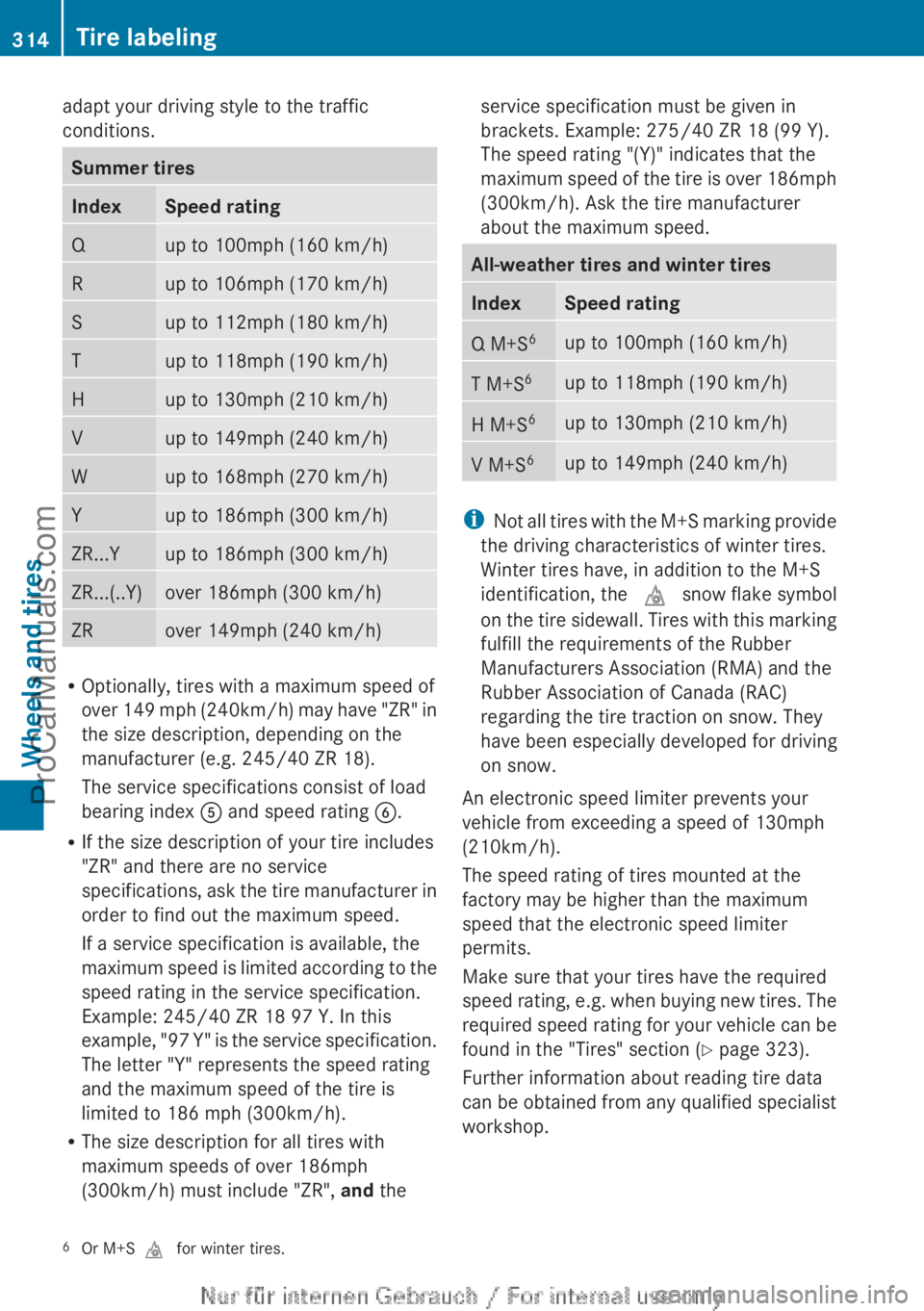
adapt your driving style to the traffic
conditions.
Summer tires
Index Speed rating
Q up to 100mph (160 km/h)
R up to 106mph (170 km/h)
S up to 112mph (180 km/h)
T up to 118mph (190 km/h)
H up to 130mph (210 km/h)
V up to 149mph (240 km/h)
W up to 168mph (270 km/h)
Y up to 186mph (300 km/h)
ZR...Y up to 186mph (300 km/h)
ZR...(..Y) over 186mph (300 km/h)
ZR over 149mph (240 km/h)
R
Optionally, tires with a maximum speed of
over 149 mph
(240km/h) may have "ZR" in
the size description, depending on the
manufacturer (e.g. 245/40 ZR 18).
The service specifications consist of load
bearing index A and speed rating B.
R If the size description of your tire includes
"ZR" and there are no service
specifications, ask the tire manufacturer in
order to find out the maximum speed.
If a service specification is available, the
maximum speed is limited according to the
speed rating in the service specification.
Example: 245/40 ZR 18 97 Y. In this
example, "97 Y" is the service specification.
The letter "Y" represents the speed rating
and the maximum speed of the tire is
limited to 186 mph (300km/h).
R The size description for all tires with
maximum speeds of over 186mph
(300km/h) must include "ZR", and theservice specification must be given in
brackets. Example:
275/40 ZR 18 (99 Y).
The speed rating "(Y)" indicates that the
maximum speed
of the tire is over 186mph
(300km/h). Ask the tire manufacturer
about the maximum speed. All-weather tires and winter tires
Index Speed rating
Q M+S
6 up to 100mph (160 km/h)
T M+S
6 up to 118mph (190 km/h)
H M+S
6 up to 130mph (210 km/h)
V M+S
6 up to 149mph (240 km/h)
i
Not all tires
with the M+S marking provide
the driving characteristics of winter tires.
Winter tires have, in addition to the M+S
identification, the i snow flake symbol
on the tire sidewall. Tires with this marking
fulfill the requirements of the Rubber
Manufacturers Association (RMA) and the
Rubber Association of Canada (RAC)
regarding the tire traction on snow. They
have been especially developed for driving
on snow.
An electronic speed limiter prevents your
vehicle from exceeding a speed of 130mph
(210km/h).
The speed rating of tires mounted at the
factory may be higher than the maximum
speed that the electronic speed limiter
permits.
Make sure that your tires have the required
speed rating, e.g. when buying new tires. The
required speed rating for your vehicle can be
found in the "Tires" section ( Y page 323).
Further information about reading tire data
can be obtained from any qualified specialist
workshop.
6 Or M+S i for winter tires.314
Tire labeling
Wheels and tires
ProCarManuals.com
Page 326 of 340
Notes on the vehicle equipment – always
equip the vehicle with:
R
tires of the
same size on a given axle (left/
right)
R the same type of tires at a given time
(summer tires, winter tires, MOExtended
tires)
Exception: it is permissible to install a
different type or make in the event of a flat
tire. Observe the "MOExtended tires (tires
with run-flat characteristics" section
(Y page 281).
Vehicles equipped with MOExtended tires are
not equipped with a TIREFIT kit at the factory.
It is therefore recommended that you
additionally equip your vehicle with a TIREFIT
kit if you mount tires that do not feature run-
flat properties, e.g. winter tires. A TIREFIT kit
may be obtained from a qualified specialist
workshop.
i The following pages contain information
on approved wheel rim and tire sizes for
equipping your vehicle with winter tires.
Winter tires are not available at the factory
as standard equipment or optional extras.
If you want to equip your vehicle with
approved winter tires, it may be necessary
to obtain wheel rims in the corresponding
size. The size of the approved winter tires
may differ from the standard tires. This is
dependent on the model and the
equipment installed at the factory.
The tires and wheel rims, as well as further
information, can be obtained at a qualified
specialist workshop.
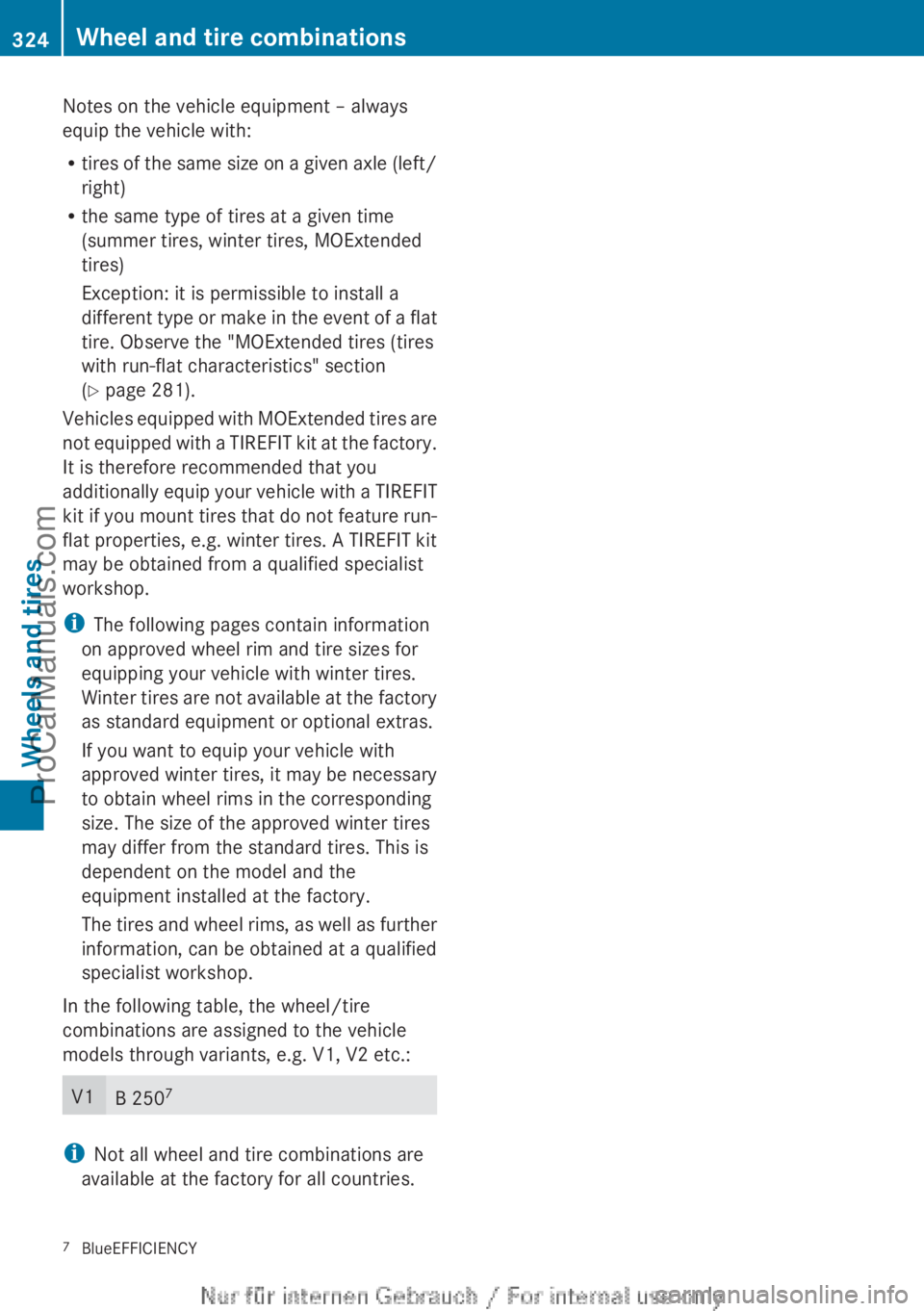
In the following table, the wheel/tire
combinations are assigned to the vehicle
models through variants, e.g. V1, V2 etc.: V1
B 250
7 i
Not all wheel and tire combinations are
available at the factory for all countries.
7 BlueEFFICIENCY324
Wheel and tire combinations
Wheels and tires
ProCarManuals.com
Page 327 of 340
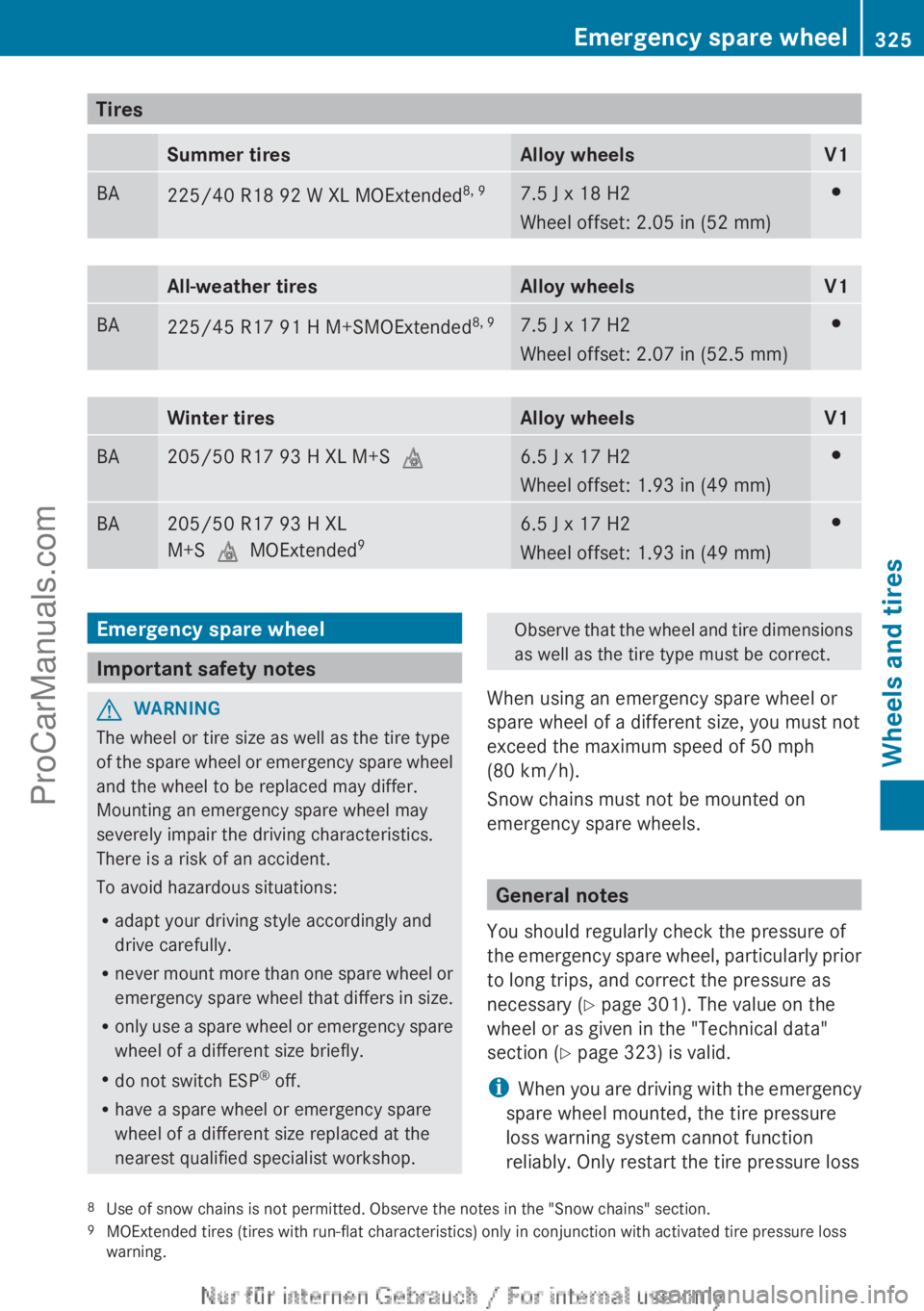
Tires
Summer tires Alloy wheels V1
BA
225/40 R18 92 W XL MOExtended
8, 9 7.5 J x 18 H2
Wheel offset: 2.05 in (52 mm) #
All-weather tires Alloy wheels V1
BA
225/45 R17 91 H M+SMOExtended
8, 9 7.5 J x 17 H2
Wheel offset: 2.07 in (52.5 mm
) #
Winter tires Alloy wheels V1
BA 205/50 R17 93 H XL M+S
i 6.5 J x 17 H2
Wheel offset: 1.93 in (49 mm) #
BA 205/50 R17 93 H XL
M+SiMOExtended
9 6.5 J x 17 H2
Wheel offset: 1.93 in (49 mm) #
Emergency spare wheel
Important safety notes
G
WARNING
The wheel or tire size as well as the tire type
of the spare
wheel or emergency spare wheel
and the wheel to be replaced may differ.
Mounting an emergency spare wheel may
severely impair the driving characteristics.
There is a risk of an accident.
To avoid hazardous situations:
R adapt your driving style accordingly and
drive carefully.
R never mount more than one spare wheel or
emergency spare wheel that differs in size.
R only use a spare wheel or emergency spare
wheel of a different size briefly.
R do not switch ESP ®
off.
R have a spare wheel or emergency spare
wheel of a different size replaced at the
nearest qualified specialist workshop. Observe that the wheel and tire dimensions
as well as the tire type must be correct.
When using an emergency spare wheel or
spare wheel of a different size, you must not
exceed the maximum speed of 50 mph
(80 km/h).
Snow chains must not be mounted on
emergency spare wheels. General notes
You should regularly check the pressure of
the emergency spare
wheel, particularly prior
to long trips, and correct the pressure as
necessary ( Y page 301). The value on the
wheel or as given in the "Technical data"
section ( Y page 323) is valid.
i When you are driving with the emergency
spare wheel mounted, the tire pressure
loss warning system cannot function
reliably. Only restart the tire pressure loss
8 Use of snow chains is not permitted. Observe the notes in the "Snow chains" section.
9 MOExtended tires (tires with run-flat characteristics) only in conjunction with activated tire pressure loss
warning. Emergency spare wheel
325
Wheels and tires Z
ProCarManuals.com