2012 MERCEDES-BENZ B-CLASS wheel
[x] Cancel search: wheelPage 20 of 340

Wear indicator (definition)
.............318
Wheel rim (definition) ....................316
see Flat tire
Top Tether ............................................ 55
Towing Important safety guidelines ...........291
Installing the towing eye ................ 292
Removing the towing eye ...............292
Towing away
With both axles on the ground ....... 293
With front axle raised ..................... 293
Tow-starting
Emergency engine starting ............ 294
Important safety notes .................. 291
Installing the towing eye ................ 292
Removing the towing eye ...............292
Traction control ................................... 62
Transmission see Automatic transmission
Transmission position display .........141
Transporting the vehicle .................. 293
Trim pieces (cleaning instructions) . 276
Trip computer (on-board computer) 189
Trip odometer Calling up ....................................... 189
Resetting (on-board computer) ...... 190
Trunk
see Tailgate
Turn signals
Changing bulbs (front) ................... 108
Changing bulbs (rear) .................... 109
Display message ............................ 209
Switching on/off ........................... 100
Type identification plate
see Vehicle identification plate U
Unlocking Emergency unlocking .......................75
From inside the vehicle (central
unlocking button) ............................. 74 V
Vanity mirror (in the sun visor) ........ 249
Vehicle Correct use ...................................... 24
Data acquisition ............................... 25
Equipment
....................................... 21
Individual settings ..........................196
Limited Warranty ............................. 25
Loading .......................................... 306
Locking (in an emergency) ............... 75
Locking (SmartKey) .......................... 68
Lowering ........................................ 322
Maintenance .................................... 22
Parking for a long period ................ 152
Pulling away ................................... 136
Raising ........................................... 320
Reporting problems .........................24
Securing from rolling away ............320
Towing away .................................. 291
Tow-starting ................................... 291
Transporting .................................. 293
Unlocking (in an emergency) ........... 75
Unlocking (SmartKey) ......................68
Vehicle data ................................... 335
Vehicle data ....................................... 335
Vehicle dimensions ...........................335
Vehicle emergency locking ................75
Vehicle identification number see VIN
Vehicle identification plate ..............328
Vehicle tool kit .................................. 280
Video (DVD) ........................................ 193
VIN ...................................................... 328 W
Warning and indicator lamps ABS ................................................ 225
Brakes
........................................... 225
Check Engine ................................. 231
Coolant .......................................... 231
Distance warning ........................... 233
DISTRONIC PLUS ........................... 233
ESP ®
.............................................. 227
ESP ®
OFF ....................................... 228
Fuel tank ........................................ 231
Overview .......................................... 3018
Index
ProCarManuals.com
Page 21 of 340

PASSENGER AIR BAG OFF ...............
53
Reserve fuel ................................... 231
Seat belt
........................................ 224
SRS ................................................ 230
Warranty ............................................ 328
Washer fluid Display message ............................ 223
Wheel bolt tightening torque ...........322
Wheel chock ...................................... 320
Wheels Changing a wheel .......................... 319
Checking ........................................ 299
Cleaning ......................................... 273
Cleaning (warning) .........................319
Emergency spare wheel ................. 325
Important safety notes .................. 298
Interchanging/changing ................319
Mounting a new wheel ................... 322
Mounting a wheel .......................... 319
Removing a wheel ..........................322
Storing ........................................... 319
Tightening torque ........................... 322
Wheel size/tire size ....................... 323
Window curtain air bag
Display message ............................ 208
Operation ......................................... 45
Windows
see Side windows
Windshield
Defrosting ...................................... 127
Windshield washer fluid
see Windshield washer system
Windshield washer system
Adding washer fluid .......................269
Notes ............................................. 334
Windshield wipers
Display message ............................ 223
Problem (malfunction) ...................115
Rear window wiper ........................112
Replacing the wiper blades ............ 112
Switching on/off ........................... 111
Winter driving
Slippery road surfaces ................... 157
Snow chains .................................. 301
Winter operation
General notes ................................ 300
Winter tires
M+S tires ....................................... 300Wiper blades
Cleaning ......................................... 274
Important safety notes
..................112
Replacing (rear window) ................113
Replacing (windshield) ................... 113
Wooden trim (cleaning instructions) 276
Workshops see Qualified specialist workshop Z
ZONE function Switching on/off ........................... 126 Index
19
ProCarManuals.com
Page 23 of 340

Have aftermarket accessories installed at
a qualified specialist workshop.
You could jeopardize the operating safety of
your vehicle if
you use parts, tires and wheels
as well as accessories relevant to safety
which have not been approved by Mercedes.
This could lead to malfunctions in safety-
relevant systems, e.g. the brake system. Use
only genuine Mercedes-Benz parts or parts of
equal quality. Only use tires, wheels and
accessories that have been specifically
approved for your vehicle.
Genuine Mercedes-Benz parts are subject to
strict quality control. Every part has been
specifically developed, manufactured or
selected for and adapted to Mercedes-Benz
vehicles. Only genuine Mercedes-Benz parts
should therefore be used.
More than 300,000 different genuine
Mercedes-Benz parts are available for
Mercedes-Benz models.
All authorized Mercedes-Benz Centers
maintain a supply of genuine Mercedes-Benz
parts for necessary service and repair work.
In addition, strategically located parts
delivery centers provide quick and reliable
parts service.
Always specify the vehicle identification
number (VIN) ( Y page 328) and the engine
number (Y page 329) when ordering genuine
Mercedes-Benz parts. Operator's Manual
General notes
Before you first
drive off, read this Operator's
Manual carefully and familiarize yourself with
your vehicle.
For your own safety and a longer vehicle life,
follow the instructions and warning notices in
this manual. Disregarding them may lead to
damage to the vehicle or personal injury.
Vehicle damage resulting from the disregard
of the instructions is not covered by the
Mercedes-Benz Limited Warranty. Vehicle equipment
This Operator's Manual describes all models
and all standard and optional equipment of
your vehicle available at the time of going to
print. Country-specific differences are
possible. Please note that your vehicle may
not be equipped with all features described.
This also applies to safety-related systems
and functions. The
equipment in your vehicle
may therefore differ from some of the
descriptions or illustrations.
The original purchase agreement lists all
systems installed in your vehicle.
Contact an authorized Mercedes-Benz Center
if you have any questions about equipment or
operation.
The Operator's Manual and Maintenance
Booklet are important documents and should
be kept in the vehicle. Service and vehicle operation
Service and literature
Your vehicle is
covered under the terms of the
warranties printed in the Service and
Warranty Information booklet. Your
authorized Mercedes-Benz Center will
exchange or repair any defective parts
originally installed in the vehicle in
accordance with the terms of the following
warranties:
R New Vehicle Limited Warranty
R Emission Systems Warranty
R Emission Performance Warranty
R California, Connecticut, Maine,
Massachusetts, New York, Pennsylvania,
Rhode Island and Vermont Emission
Control Systems Warranty
R State warranty enforcement laws (lemon
laws) Introduction
21 Z
ProCarManuals.com
Page 25 of 340
Operating safety
Important safety notes
G
WARNING
If you do not have the prescribed service/
maintenance work or any required repairs
carried out, this
can result in malfunctions or
system failures. There is a risk of an accident.
Always have the prescribed service/
maintenance work as well as any required
repairs carried out at a qualified specialist
workshop. G
WARNING
If you switch off the ignition while driving,
safety-relevant functions are only available
with limitations, or
not at all. This could affect,
for example, the power steering and the brake
boosting effect. You will require considerably
more effort to steer and brake. There is a risk
of an accident.
Do not switch off the ignition while driving. G
WARNING
Modifications to electronic components, their
software as well as wiring can impair their
function and/or the function of other
networked components. In particular,
systems relevant to safety could also be
affected. As a result, these may no longer
function as intended and/or jeopardize the
operating safety of the vehicle. There is an
increased risk of an accident and injury.
Never tamper with the wiring as well as
electronic components or
their software. You
should have all work to electrical and
electronic equipment carried out at a qualified
specialist workshop.
There is a risk of damage to the vehicle if:
R the vehicle becomes stuck, e.g. on a high
curb or an unpaved road
R you drive too fast over an obstacle, e.g. a
curb or a hole in the road
R a heavy object strikes the undercarriage or
parts of the chassis. In situations like this, the body, the
undercarriage, chassis parts, wheels or tires
could be
damaged
without the damage being
visible. Components damaged in this way can
unexpectedly fail or, in the case of an
accident, no longer withstand the strain they
are designed to.
If the underbody paneling is damaged,
combustible materials such as leaves, grass
or twigs can gather between the underbody
and the underbody paneling. If these
materials come in contact with hot parts of
the exhaust system for an extended period,
they can catch fire.
Have the vehicle checked and repaired
immediately at a qualified specialist
workshop. If on continuing your journey you
notice that driving safety is impaired, pull over
and stop the vehicle immediately, paying
attention to road and traffic conditions. In
such cases, visit a qualified specialist
workshop. Declarations of conformity
Vehicle components which receive
and/or transmit radio waves USA: "The wireless devices of this vehicle
comply with Part 15 of the FCC Rules.
Operation is subject to the following two
conditions: 1) These devices may not cause
harmful interference, and 2) These devices
must accept any interference received,
including interference that may cause
undesired operation. Changes or
modifications not expressly approved by the
party responsible for compliance could void
the user’s authority to operate the
equipment."
Canada:
"The wireless
devices of this vehicle
comply with Industry Canada license-exempt
RSS standard(s). Operation is subject to the
following two conditions: (1) These devices
may not cause interference, and (2) These
devices must accept any interference, Introduction
23 Z
ProCarManuals.com
Page 29 of 340

Dashboard ...........................................
28
Instrument cluster ..............................29
Multifunction steering wheel .............31
Center console .................................... 32
Overhead control panel ......................34
Door control panel .............................. 35 27At a glance
ProCarManuals.com
Page 30 of 340

Dashboard
Function Page
:
Steering wheel paddle
shifters
144
;
Combination switch 100
=
Instrument cluster 29
?
Horn
A
DIRECT SELECT lever 140
B
PARKTRONIC warning
display
169
C
Overhead control panel 34
D
Climate control systems
118 Function Page
E
Ignition lock 135
F
Adjusting the steering
wheel
91
G
Cruise control lever 158
H
Electric parking brake 150
I
Light switch 98
J
Diagnostics connection 24
K
Opening the hood 26628
DashboardAt a glance
ProCarManuals.com
Page 33 of 340
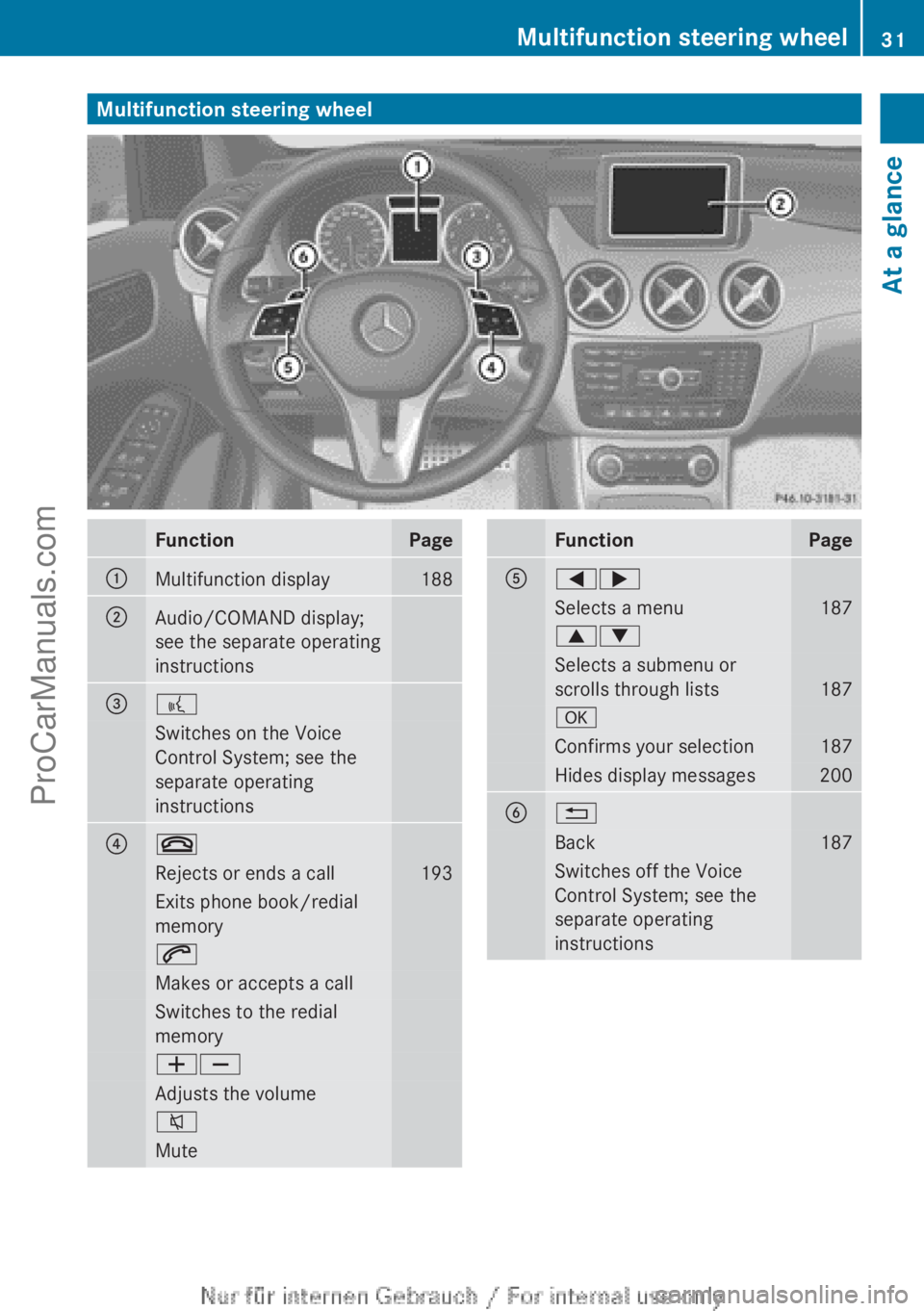
Multifunction steering wheel
Function Page
:
Multifunction display 188
;
Audio/COMAND display;
see the separate operating
instructions
=
?
Switches on the Voice
Control System; see the
separate operating
instructions
?
~
Rejects or ends a call 193
Exits phone book/redial
memory
6
Makes or accepts a call
Switches to the redial
memory
WX
Adjusts the volume
8
Mute Function Page
A
=;
Selects a menu 187
9:
Selects a submenu or
scrolls through lists
187
a
Confirms your selection 187
Hides display messages 200
B
%
Back 187
Switches off the Voice
Control System; see the
separate operating
instructionsMultifunction steering wheel
31At a glance
ProCarManuals.com
Page 42 of 340

R
the deformation characteristics of the
vehicle
R the characteristics of
the object with which
the vehicle has collided
Factors that can only be seen and measured
after a collision has occurred do not play a
decisive role in the deployment of an air bag,
nor do they provide an indication of air bag
deployment.
The vehicle may be deformed significantly,
e.g. the hood or the fender, without an air bag
being deployed. This is the case if only parts
which are relatively easily deformed are
affected and the rate of deceleration is not
high. Conversely, air bags may be deployed
even though the vehicle suffers only minor
deformation. This is the case if, for example,
very rigid vehicle parts such as longitudinal
body members are hit, and sufficient
deceleration occurs as a result.
i The front Emergency Tensioning Devices
can only be triggered if the seat belt
tongues on the front seats are correctly
engaged in the seat belt buckles.
i Not all air bags are deployed in an
accident. The different air bag systems
work independently of each other.
How the air bag system works is
determined by predicting the severity of
the accident, especially vehicle
deceleration or acceleration, and the type
of accident:
R head-on collision
R side impact
R rollover
Safety guidelines for seat belts,
Emergency Tensioning Devices (ETDs)
and air bags G
WARNING
R Damaged seat belts
or seat belts that have
been subjected to stress in an accident
must be replaced. Their anchoring points
must also be checked. Only use seat belts installed or supplied by an authorized
Mercedes-Benz Center.
R Air bags and pyrotechnic Emergency
Tensioning Devices (ETDs) contain
perchlorate material, which may require
special handling and regard for the
environment. Check your
national disposal
guidelines. In California, see
www.dtsc.ca.gov/HazardousWaste/
Perchlorate/index.cfm.
R Air bags and ETDs are designed to function
on a one-time-only basis. An air bag or ETD
that has deployed must be replaced.
R Do not pass seat belts over sharp edges.
They could tear.
R Do not make any modification that could
change the effectiveness of the seat belts.
R Do not bleach or dye seat belts, as this may
severely weaken them. In a crash, they may
not be able to provide adequate protection.
R Do not make any modifications to the SRS
wiring or components.
R Do not modify or remove any components
or parts of the SRS.
R Do not install additional trim material, seat
covers, badges, etc. to the:
-padded steering wheel boss
- knee bag covers
- front-passenger air bag cover
- outer side of front seat bolsters
- outer seat bolsters of the rear bench seat
backrest
- roof frame trim
R Do not install additional electrical/
electronic equipment on or near SRS
components and wiring.
R Keep the area between the air bags and
occupants free of objects (e.g. packages,
handbags, umbrellas etc.).
R Do not hang any objects such as coat
hangers on the coat hooks or the grab
handle above the door. These items may be
thrown around in the vehicle and cause40
Occupant safety
Safety
ProCarManuals.com