2012 MERCEDES-BENZ B-CLASS tire type
[x] Cancel search: tire typePage 317 of 340
Load index
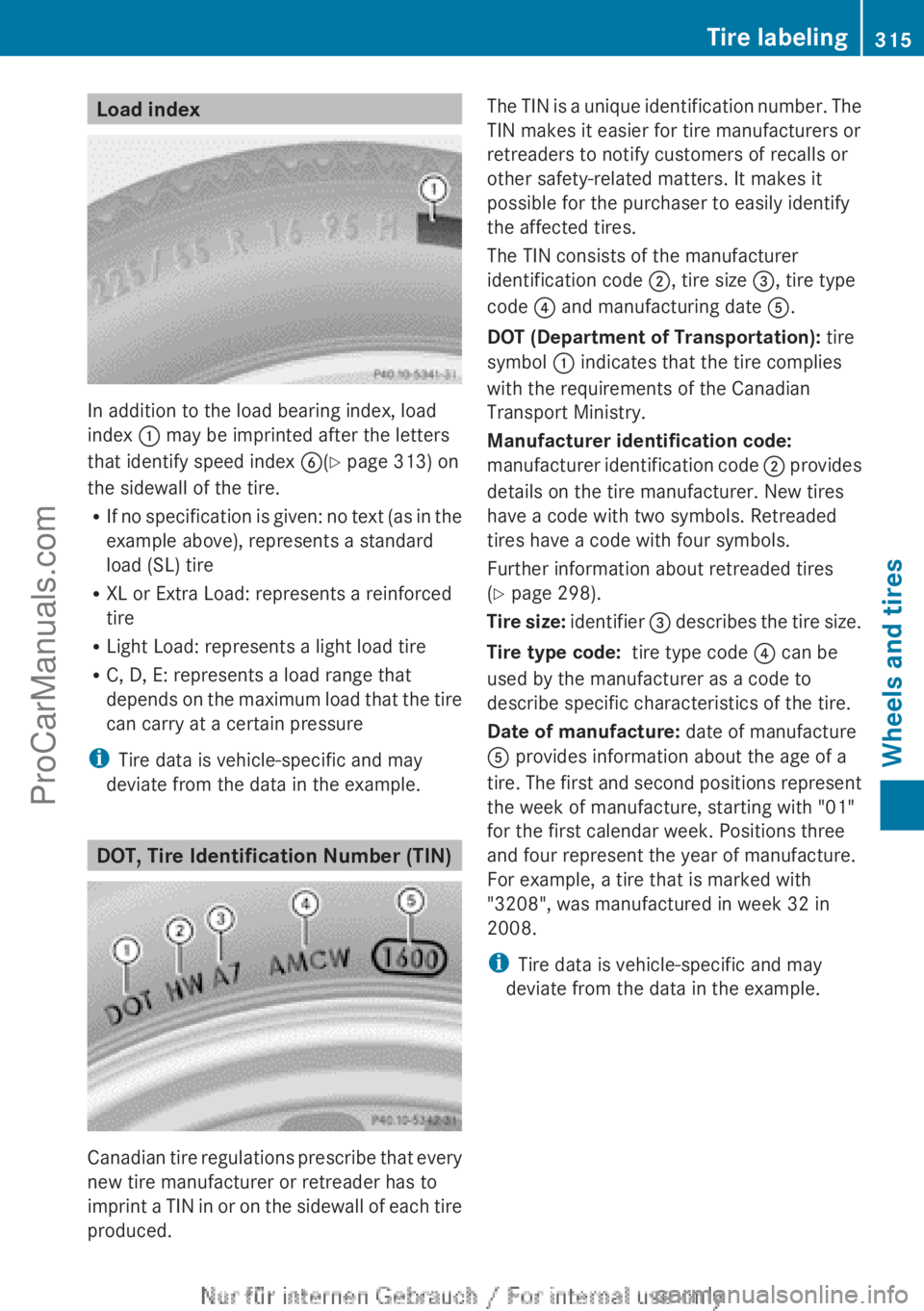
In addition to the load bearing index, load
index : may be imprinted after the letters
that identify speed index B(Y page 313) on
the sidewall of the tire.
R
If no
specification
is given: no text (as in the
example above), represents a standard
load (SL) tire
R XL or Extra Load: represents a reinforced
tire
R Light Load: represents a light load tire
R C, D, E: represents a load range that
depends on the maximum load that the tire
can carry at a certain pressure
i Tire data is vehicle-specific and may
deviate from the data in the example. DOT, Tire Identification Number (TIN)
Canadian tire regulations prescribe that every
new tire manufacturer or retreader has to
imprint a
TIN
in or on the sidewall of each tire
produced. The TIN is a unique identification number. The
TIN makes it easier for tire manufacturers or
retreaders to notify customers of recalls or
other safety-related matters. It makes it
possible for the purchaser to easily identify
the affected tires.
The TIN consists of the manufacturer
identification code ;, tire size =, tire type
code ? and manufacturing date A.
DOT (Department of Transportation):
tire
symbol : indicates that the tire complies
with the requirements of the Canadian
Transport Ministry.
Manufacturer identification code:
manufacturer identification code
;
provides
details on the tire manufacturer. New tires
have a code with two symbols. Retreaded
tires have a code with four symbols.
Further information about retreaded tires
(Y page 298).
Tire size: identifier = describes the tire size.
Tire type code: tire type code ? can be
used by the manufacturer as a code to
describe specific characteristics of the tire.
Date of manufacture: date of manufacture
A provides information about the age of a
tire. The first and second positions represent
the week of manufacture, starting with "01"
for the first calendar week. Positions three
and four represent the year of manufacture.
For example, a tire that is marked with
"3208", was manufactured in week 32 in
2008.
i Tire data is vehicle-specific and may
deviate from the data in the example. Tire labeling
315
Wheels and tires Z
ProCarManuals.com
Page 320 of 340

Aspect ratio
Relationship between tire height and tire
width in percent. Tire pressure
This is pressure inside the tire applying an
outward force to
each square inch of the tire's
surface. The tire pressure is specified in
pounds per square inch (psi), in kilopascal
(kPa) or in bar. The tire pressure should only
be corrected when the tires are cold. Tire pressure of cold tires
The tires are cold:
R if the vehicle has been parked without
direct sunlight on
the tires for at least three
hours and
R if the vehicle has not been driven further
than 1 mile (1.6 km) Tread
The part of the tire that comes into contact
with the road. Bead
The tire bead ensures that the tire sits
securely on the
wheel. There are several steel
wires in the bead to prevent the tire from
coming loose from the wheel rim. Sidewall
The part of
the tire between the tread and the
bead. Weight of optional extras
The combined weight
of those optional extras
that weigh more than the replaced standard
part and more than 2.3 kg (5 lbs). These optional extras, such as high-performance
brakes, level control, a roof rack or a high-
performance battery, are not included in the
curb weight and the weight of the
accessories.
TIN (Tire Identification Number)
This is a unique identifier which can be used
by a tire manufacturer to identify tires, for
example for a
product recall, and thus identify
the purchasers. The TIN is made up of the
manufacturer's identity code, tire size, tire
type code and the manufacturing date. Load bearing index
The load bearing index (also load index) is a
code that contains
the maximum load bearing
capacity of a tire. Traction
Traction is the result of friction between the
tires and the road surface. Treadwear indicators
Narrow bars (tread wear bars) that are
distributed over the
tire tread. If the tire tread
is level with the bars, the wear limit of á in
(1.6 mm) has been reached. Occupant distribution
The distribution of occupants in a vehicle at
their designated seating positions. Total load limit
Nominal load and luggage load plus
68 kilograms (150 lb) multiplied by the
number of seats in the vehicle. 318
Definition of terms for tires and loading
Wheels and tires
ProCarManuals.com
Page 326 of 340
Notes on the vehicle equipment – always
equip the vehicle with:
R
tires of the
same size on a given axle (left/
right)
R the same type of tires at a given time
(summer tires, winter tires, MOExtended
tires)
Exception: it is permissible to install a
different type or make in the event of a flat
tire. Observe the "MOExtended tires (tires
with run-flat characteristics" section
(Y page 281).
Vehicles equipped with MOExtended tires are
not equipped with a TIREFIT kit at the factory.
It is therefore recommended that you
additionally equip your vehicle with a TIREFIT
kit if you mount tires that do not feature run-
flat properties, e.g. winter tires. A TIREFIT kit
may be obtained from a qualified specialist
workshop.
i The following pages contain information
on approved wheel rim and tire sizes for
equipping your vehicle with winter tires.
Winter tires are not available at the factory
as standard equipment or optional extras.
If you want to equip your vehicle with
approved winter tires, it may be necessary
to obtain wheel rims in the corresponding
size. The size of the approved winter tires
may differ from the standard tires. This is
dependent on the model and the
equipment installed at the factory.
The tires and wheel rims, as well as further
information, can be obtained at a qualified
specialist workshop.
In the following table, the wheel/tire
combinations are assigned to the vehicle
models through variants, e.g. V1, V2 etc.: V1
B 250
7 i
Not all wheel and tire combinations are
available at the factory for all countries.
7 BlueEFFICIENCY324
Wheel and tire combinations
Wheels and tires
ProCarManuals.com
Page 327 of 340
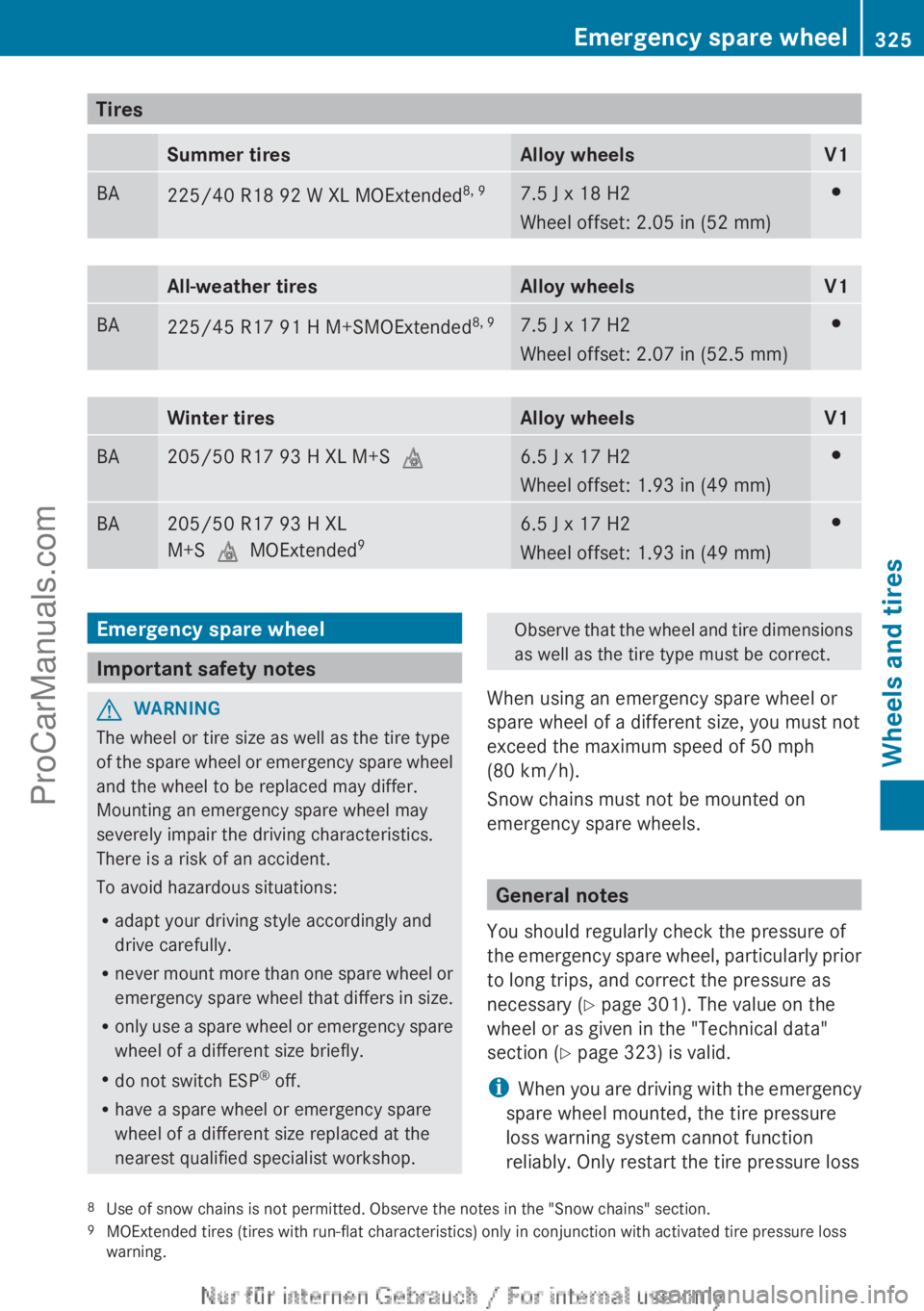
Tires
Summer tires Alloy wheels V1
BA
225/40 R18 92 W XL MOExtended
8, 9 7.5 J x 18 H2
Wheel offset: 2.05 in (52 mm) #
All-weather tires Alloy wheels V1
BA
225/45 R17 91 H M+SMOExtended
8, 9 7.5 J x 17 H2
Wheel offset: 2.07 in (52.5 mm
) #
Winter tires Alloy wheels V1
BA 205/50 R17 93 H XL M+S
i 6.5 J x 17 H2
Wheel offset: 1.93 in (49 mm) #
BA 205/50 R17 93 H XL
M+SiMOExtended
9 6.5 J x 17 H2
Wheel offset: 1.93 in (49 mm) #
Emergency spare wheel
Important safety notes
G
WARNING
The wheel or tire size as well as the tire type
of the spare
wheel or emergency spare wheel
and the wheel to be replaced may differ.
Mounting an emergency spare wheel may
severely impair the driving characteristics.
There is a risk of an accident.
To avoid hazardous situations:
R adapt your driving style accordingly and
drive carefully.
R never mount more than one spare wheel or
emergency spare wheel that differs in size.
R only use a spare wheel or emergency spare
wheel of a different size briefly.
R do not switch ESP ®
off.
R have a spare wheel or emergency spare
wheel of a different size replaced at the
nearest qualified specialist workshop. Observe that the wheel and tire dimensions
as well as the tire type must be correct.
When using an emergency spare wheel or
spare wheel of a different size, you must not
exceed the maximum speed of 50 mph
(80 km/h).
Snow chains must not be mounted on
emergency spare wheels. General notes
You should regularly check the pressure of
the emergency spare
wheel, particularly prior
to long trips, and correct the pressure as
necessary ( Y page 301). The value on the
wheel or as given in the "Technical data"
section ( Y page 323) is valid.
i When you are driving with the emergency
spare wheel mounted, the tire pressure
loss warning system cannot function
reliably. Only restart the tire pressure loss
8 Use of snow chains is not permitted. Observe the notes in the "Snow chains" section.
9 MOExtended tires (tires with run-flat characteristics) only in conjunction with activated tire pressure loss
warning. Emergency spare wheel
325
Wheels and tires Z
ProCarManuals.com
Page 337 of 340

Refrigerant instruction label
Example: refrigerant instruction label
:
Warning symbol
; Refrigerant filling capacity
= Applicable SAE standards
? PAG oil part number
A Type of refrigerant
Warning symbols : indicate:
R possible dangers
R that it is necessary to have maintenance
work carried out at a qualified specialist
workshop
Filling capacities All models Capacity
Refrigerant
650 ± 10 g
(22.9 ± 0.4 oz) PAG oil
120 g
(4.2 oz) Vehicle data
General notes
Please note that for the specified vehicle
data:
R the heights specified may vary as a result
of:
-tires
- load
- condition of the suspension
- optional equipment
Dimensions and weights Model :
Maximum
headroom ;
Opening height B 250
BlueEFFICIEN
CY
73.8 in
(1874 mm) 78.0 in
(1981 mm) B 250 BlueEFFICIENCY
Vehicle length
171.6 in
(4359 mm) Vehicle width
including exterior
mirrors
79.1 in
(2010 mm) Vehicle height
61.3 in
(1558 mm) Wheelbase
106.3 in
(2699 mm) Vehicle data
335Technical data Z
ProCarManuals.com