2012 MERCEDES-BENZ A CLASS ignition
[x] Cancel search: ignitionPage 13 of 356

Refuelling
....................................... 159
Tank content/reserve fuel ............. 339
Fuel filler flap
Opening/closing ............................ 160
Fuel filter (white display message) . 245
Fuel level Calling up the range (on-board
computer) ...................................... 212
Gauge .............................................. 30
Fuel reserve
see Fuel
Fuel tank
Capacity ........................................ 339
Problem (malfunction) ...................161
Fuses
Allocation chart ............................. 315
Before changing ............................. 314
Fuse box in the engine compart-
ment .............................................. 315
Fuse box in the front-passenger
footwell .......................................... 315
Important safety notes .................. 314G
Gear indicator (on-board computer)
226
Gear or selector lever (cleaning
instructions) ...................................... 295
Gearshift program SETUP (on-board computer) .......... 226
Genuine Mercedes-Benz parts ........... 21
Glove compartment ..........................269H
Handbrake see Parking brake
Hazard warning lamps ......................108
Display message ............................ 256
Headlamp
Cleaning system (function) ............ 108
Cleaning system (notes) ................345
Headlamps
Misting up ...................................... 111
Topping up the cleaning system .... 289
see Automatic headlamp mode Head restraints
Adjusting ......................................... 94
Adjusting (electrically) .....................95
Adjusting (manually)
........................ 95
Adjusting (rear) ................................ 96
Fitting/removing (rear) ....................96
Heating
see Climate control
High-pressure cleaners .................... 291
Hill start assist .................................. 145
HOLD function Deactivating ................................... 180
Display message ............................ 246
Function/notes ............................. 180 I
Ignition lock see Key positions
Immobiliser .......................................... 69
Indicator and warning lamps Coolant .......................................... 264
DISTRONIC PLUS ........................... 266
Engine diagnostics .........................264
SPORT handling mode ................... 261
Indicator lamps
Display message ............................ 240
see Warning and indicator lamps
Inspection
see ASSYST PLUS
Instrument cluster
Overview .......................................... 30
Settings ......................................... 220
Warning and indicator lamps ...........32
Instrument cluster lighting .............. 208
Intelligent Light System Activating/deactivating ................. 221
Display message ............................ 242
Overview ........................................ 108
Setting the dipped-beam head-
lamps for driving on the right/left . 221
Interior lighting ................................. 111
Automatic control system .............. 111
Delayed switch-off (on-board
computer) ...................................... 223
Emergency lighting ........................ 112
Manual control ............................... 112
Overview ........................................ 111 Index
11
Page 14 of 356

Reading lamp
................................. 111
Setting the ambient lighting
brightness (on-board computer) .... 222
Interior motion sensor ........................70
ISOFIX child seat securing system ....53 J
Jack Storage location ............................ 299
Using ............................................. 326
Jump starting (engine) ...................... 308K
Key Changing the battery ....................... 76
Checking the battery ....................... 76
Convenience closing feature ............ 85
Convenience opening feature .......... 85
Display message
............................ 256
Door central locking/unlocking ....... 75
Emergency key element ................... 75
Important safety notes .................... 74
Loss ................................................. 78
Modifying the programming .............75
Positions (ignition lock) ................. 143
Problem (malfunction) .....................78
Starting the engine ........................ 144
Key positions (ignition lock) ............143
Kickdown Driving tips .................................... 154
Manual drive program ....................158
Kneebag ............................................... 44L
Lamps see Warning and indicator lamps
Lane Keeping Assist
Activating/deactivating ................. 219
Display message ............................ 247
Function/information .................... 199
Lane package ..................................... 197
Lap time (RACETIMER) ......................226
Lashing eyelets ................................. 273
Licence plate lamp (display mes-
sage) ................................................... 241Lighting
see Lights
Lights
Activating/deactivating the Intel-
ligent Light System ........................ 221
Activating/deactivating the inte-
rior lighting delayed switch-off ....... 223
Active light function .......................109
Automatic headlamp mode ............ 105
Cornering light function .................109
Dipped-beam headlamps ............... 105
Display message ............................ 239
Driving abroad ............................... 104
Foglamps ....................................... 106
Foglamps (extended range) ...........109
Hazard warning lamps ................... 108
Headlamp flasher ........................... 108
Headlamp range ............................ 107
Light switch ................................... 105
Main-beam headlamps ................... 107
Motorway mode ............................. 109
Parking lamps ................................ 106
Rear foglamp ................................. 106
Setting the ambient lighting
brightness (on-board computer) .... 222
Side lamps ..................................... 106
Switching Adaptive Highbeam
Assist on/off ................................. 222
Switching the daytime driving
lights on/off (on-board computer) . 221
Switching the daytime driving
lights on/off (switch) ..................... 105
Switching the exterior lighting
delayed switch-off on/off (on-
board computer) ............................ 222
Switching the surround lighting
on/off (on-board computer) ..........222
Turn signals ................................... 107
see Interior lighting
see Replacing bulbs
Light sensor (display message) .......242
LIM indicator lamp Cruise control ................................ 169
DISTRONIC PLUS ........................... 174
Variable SPEEDTRONIC .................171
Limiting the speed
see SPEEDTRONIC
Loading guidelines ............................26812
Index
Page 25 of 356

G
WARNING
If you switch off the ignition while driving,
safety-relevant functions are only available
with
limitations, or not at all. This could affect,
for example, the power steering and the brake
boosting effect. You will require considerably
more effort to steer and brake. There is a risk
of an accident.
Do not switch off the ignition while driving. G
WARNING
Modifications to electronic components, their
software as well as wiring could effect their
function and/or the operation of other net-
worked components. This could in particular
also be the case for systems relevant to
safety. They might not function properly any
more and/or jeopardise the operational
safety of the vehicle. There is an increased
risk of an accident and injury.
Do
not attempt to modify the wiring as well as
electronic components or their software.
Always have work on electrical and electronic
components carried out at a qualified special-
ist workshop.
There is a risk of damage to the vehicle if:
R the vehicle becomes stuck, e.g. on a high
kerb or an unpaved road
R you drive too fast over an obstacle, e.g. a
kerb or a hole in the road
R a heavy object strikes the undercarriage or
parts of the chassis.
In situations like this, the body, the undercar-
riage, chassis parts, wheels or tyres could be
damaged without the damage being visible.
Components damaged in this way can unex-
pectedly fail or, in the case of an accident, no
longer withstand the strain they are designed
to.
If the underbody panelling is damaged, com-
bustible materials such as leaves, grass or
twigs can gather between the underbody and
the underbody panelling. If these materials
come in contact with hot parts of the exhaust system for an extended period, they can
catch fire.
Have
the vehicle checked and repaired imme-
diately at a qualified specialist workshop. If
on continuing your journey you notice that
driving safety is impaired, pull over and stop
the vehicle immediately, paying attention to
road and traffic conditions. In such cases,
visit a qualified specialist workshop. Declarations of conformity
Wireless vehicle components The following information applies to all com-
ponents
of the vehicle and the COMAND sys-
tem which receive and/or transmit radio
waves:
The components of this vehicle which receive
and/or transmit radio waves are compliant
with the basic requirements and other rele-
vant provisions of Directive 1999/5/EC. You
can obtain further information from any
Mercedes-Benz Service Centre.
Electromagnetic compatibility The electromagnetic compatibility of the vehi-
cle
components has been checked and certi-
fied according to the currently valid version
of Directive 72/245/EEC or the equivalent
ECE Regulation ECE-R 10. Diagnostics connection
The diagnostics connection is only intended
for
the connection of diagnostic equipment at
a qualified specialist workshop. G
WARNING
If you connect equipment to a diagnostics
connection in the vehicle, it can affect the
operation of the vehicle systems. This may
affect the operating safety of the vehicle.
There is a risk of an accident.
Do not connect any equipment to a diagnos-
tics connection in the vehicle. Introduction
23 Z
Page 30 of 356

Cockpit
Function Page
:
Steering wheel gearshift
paddles
156
;
Combination switch 107
=
Instrument cluster 30
?
Horn
A
DIRECT SELECT lever 151
B
PARKTRONIC warning dis-
play
182
C
Overhead control panel 36
D
Climate control systems
122 Function Page
E
Ignition lock 143
F
Adjusting the steering
wheel
98
G
Cruise control lever 169
H
Electric parking brake 163
I
Light switch 105
J
Diagnostics connection 23
K
Opening the bonnet 28528
CockpitAt a glance
Page 31 of 356
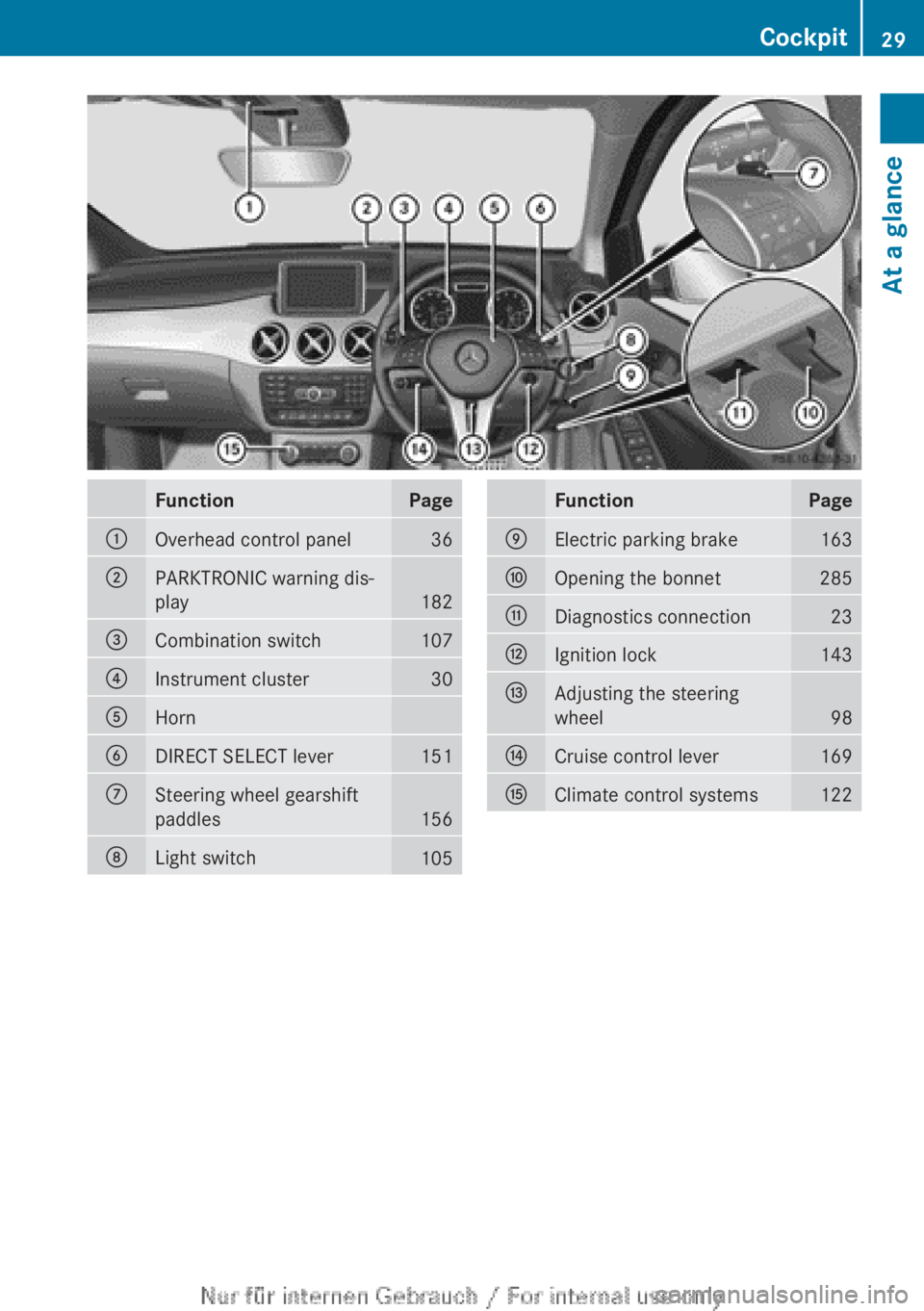
Function Page
:
Overhead control panel 36
;
PARKTRONIC warning dis-
play
182
=
Combination switch 107
?
Instrument cluster 30
A
Horn
B
DIRECT SELECT lever 151
C
Steering wheel gearshift
paddles
156
D
Light switch
105 Function Page
E
Electric parking brake 163
F
Opening the bonnet 285
G
Diagnostics connection 23
H
Ignition lock 143
I
Adjusting the steering
wheel
98
J
Cruise control lever 169
K
Climate control systems 122Cockpit
29At a glance
Page 43 of 356

SRS (Supplemental Restraint System)
Introduction Supplemental Restraint System (SRS) with:
R
The 6 SRS warning lamp
R Airbags
R Airbag control unit (with crash sensors)
R Belt
tensioners for the front seat belts and
the outer seat belts in the rear
R Seat belt force limiters for the front seat
belts and the outer seat belts in the rear
SRS reduces the risk of occupants coming
into contact with parts of the vehicle's interior
in the event of an accident. It can also reduce
the forces to which occupants are subjected
during an accident.
SRS warning lamp G
WARNING
If SRS is malfunctioning, individual systems
may
be triggered unintentionally or might not
be triggered in the event of an accident with
a high rate of vehicle deceleration.
A malfunction has occurred if:
R the 6 SRS warning lamp does not light
up when the ignition is switched on.
R the engine is running and the 6 SRS
warning lamp does not go out after a few
seconds.
R the engine is running and the 6 SRS
warning lamp lights up again.
In this case, have SRS checked immediately
at a qualified specialist workshop.
The 6 SRS warning lamp in the instrument
cluster lights up when the ignition is switched
on. It goes out no later than a few seconds
after the engine is started.
SRS functions are checked regularly when the
ignition is switched on or the engine is run-
ning. Therefore, malfunctions can be detec-
ted in good time. Triggering of belt tensioners and air-
bags During the first stage of a collision, the airbag
control unit evaluates important physical
data
relating to vehicle deceleration or accel-
eration, such as:
R duration
R direction
R magnitude
Based on the evaluation of this data, the air-
bag control unit pre-emptively triggers the
belt tensioners in the first stage.
If there is an even higher rate of vehicle decel-
eration or acceleration in a longitudinal direc-
tion, the front airbags are also deployed.
Your vehicle has adaptive, two-stage front air-
bags. The airbag control unit evaluates vehi-
cle deceleration or acceleration in the event
of a collision. In the first deployment stage,
the front airbag is filled with enough propel-
lant gas to reduce the risk of injuries. The
front airbag is fully deployed if a second
deployment threshold is reached within a few
milliseconds.
The belt tensioner and airbag triggering
thresholds are variable and are adapted to the
detected rate of deceleration or acceleration
of the vehicle. This process is pre-emptive in
nature. The triggering process must take
place in good time at the start of the collision.
The rate of vehicle deceleration or accelera-
tion and the direction of the force are essen-
tially determined by:
R the distribution of forces during the colli-
sion
R the collision angle
R the deformation characteristics of the vehi-
cle
R the characteristics of the object with which
the vehicle has collided
Factors which can only be seen and measured
after a collision has occurred do not play a
decisive role in the deployment of an airbag, Occupant safety
41
Safety Z
Page 50 of 356

The belt strap is tightened slightly when:
R
you engage the belt tongue in the belt
buckle
and you then turn the key to position
2 in the ignition lock.
R the key is in position 2 in the ignition lock
and you then engage the belt tongue in the
buckle.
The seat-belt adjustment will apply a certain
tightening force if any slack is detected
between the occupant and the seat belt. Do
not hold on to the seat belt tightly while it is
adjusting. You can switch the seat-belt
adjustment on and off in the on-board com-
puter ( Y page 225).
The seat-belt adjustment is an integral part of
the PRE-SAFE ®
convenience function. More
information about PRE-SAFE ®
can be found
in the "PRE-SAFE ®
(preventative occupant
protection)" section (Y page 45).
Belt height adjustment You can adjust the belt height for the front
seats. Adjust the belt to a height that allows
the upper part of the seat belt to be routed
across the centre of your shoulder.
X
To raise:
slide the belt sash guide upwards.
The belt sash guide engages in various posi-
tions.
X To lower: press and hold belt sash guide
release :.
X Slide the belt sash guide downwards.
X Let go of belt sash guide release : and
make sure that the belt sash guide has
engaged. Releasing the seat belts !
Make
sure that the seat belt is fully rolled
up. Otherwise, the seat belt or belt tongue
will be trapped in the door or in the seat
mechanism. This could damage the door,
the door trim panel and the seat belt. Dam-
aged seat belts can no longer fulfil their
protective function and must be replaced.
Visit a qualified specialist workshop. X
Press release button ?
on belt buckle =.
X Guide belt tongue ; back to belt sash
guide :.
Belt warning for the driver and front
passenger The
7
seat belt warning lamp in the instru-
ment cluster is a reminder for all occupants
to fasten their seat belts. It may light up con-
tinuously or flash. In addition, a warning tone
may sound.
The 7 seat belt warning lamp goes out and
the warning tone ceases when the driver and
the front passenger have fastened their seat
belt.
For certain countries only: regardless of
whether the driver and the front passenger
have fastened their seat belts, the 7 seat
belt warning lamp lights up for six seconds
after the engine is started. It then goes out if 48
Occupant safety
Safety
Page 51 of 356

the driver and the front passenger have fas-
tened their seat belts.
i
For more information on the 7 seat
belt warning lamp, see "Warning and indi-
cator
lamps in the instrument cluster, seat
belt" ( Y page 257).
Rear seat belt status indicator Example: rear seat belt status indicator
The rear-compartment seat belt status indi-
cator
indicates the rear seat on which the belt
is fastened. In the example, the occupant on
the right rear seat, when viewed in the direc-
tion of travel, is secured. The ü symbol in
the display indicates a fastened seat belt. If a
seat belt is not fastened or if a seat is not
occupied, the ý symbol is displayed.
The rear-compartment seat belt status indi-
cator appears in the multifunction display for
around 30 seconds if:
R you drive off and reach a speed of approx-
imately 10 km/h.
R the rear passengers fasten or unfasten
their seat belts while the vehicle is in
motion.
R someone gets in or out of the vehicle and
the vehicle drives off again.
You can also cancel the rear seat belt status
indicator immediately ( Y page 229).
i The status indicator for the rear-compart-
ment seat belts is only available for certain
countries.
Belt tensioners, belt force limiters G
WARNING
If the seat belt tensioners have been trig-
gered, they provide no additional protection in the event of another accident. Therefore,
have belt tensioners which have been trig-
gered replaced at a qualified specialist work-
shop.
Comply with safety regulations when dispos-
ing of belt tensioners. Any Mercedes-Benz
Service Centre can provide details of these
regulations.
! If the front-passenger seat is not occu-
pied,
do not engage the seat belt tongue in
the buckle on the front-passenger seat.
Otherwise, the belt tensioner could be trig-
gered in the event of an accident.
The front seat belts and the outer seat belts
in the rear are equipped with belt tensioners
and belt force limiters.
The belt tensioners tighten the seat belts in
an accident, pulling them close against the
body.
Belt tensioners do not correct incorrect seat
positions or incorrectly fastened seat belts.
Belt tensioners do not pull vehicle occupants
back towards the backrest.
The belt tensioners can only be activated
when:
R the ignition is switched on.
R the restraint systems are operational; see
"6 SRS warning lamp" (Y page 41).
R the belt tongue is engaged in the buckle on
each of the front seat belts.
The belt tensioners on the outside seats in the
rear compartment are triggered independ-
ently of the lock status of the seat belts.
The belt tensioners are triggered depending
on the type and severity of an accident:
R if, in the event of a head-on or rear-end col-
lision the vehicle decelerates or acceler-
ates rapidly in a longitudinal direction dur-
ing the initial stages of the impact
R if, in the event of a side impact, on the side
opposite the impact the vehicle deceler- Occupant safety
49
Safety Z