Page 287 of 437
N (Neutral)
With the gearshift lever in N (Neutral), the vehicle can be started and is
free to roll. Hold the brake pedal down while in this position.
D (Drive) with Overdrive
The normal driving position for the best fuel economy. Transmission
operates in gears one through six.
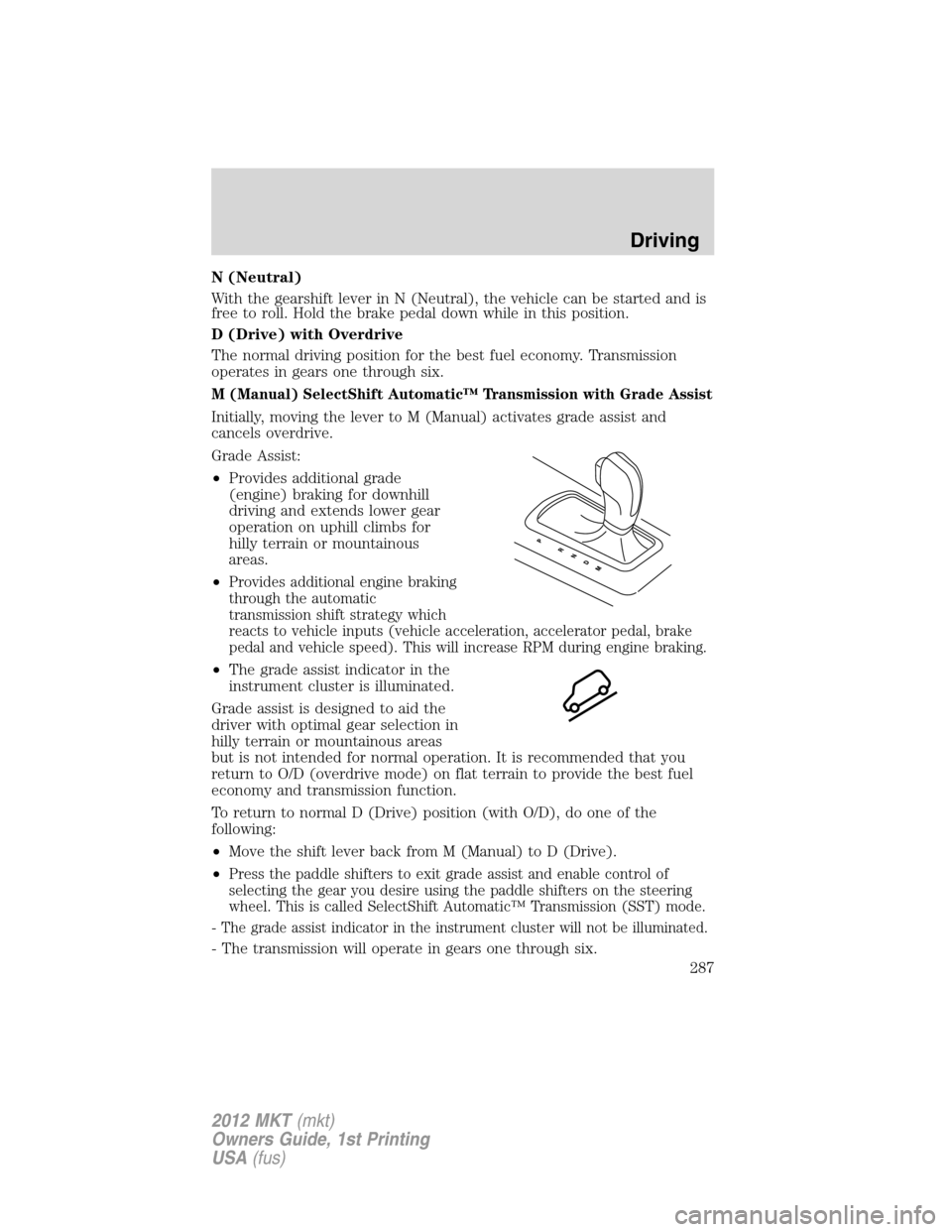
M (Manual) SelectShift Automatic™ Transmission with Grade Assist
Initially, moving the lever to M (Manual) activates grade assist and
cancels overdrive.
Grade Assist:
•Provides additional grade
(engine) braking for downhill
driving and extends lower gear
operation on uphill climbs for
hilly terrain or mountainous
areas.
•
Provides additional engine braking
through the automatic
transmission shift strategy which
reacts to vehicle inputs (vehicle acceleration, accelerator pedal, brake
pedal and vehicle speed). This will increase RPM during engine braking.
•The grade assist indicator in the
instrument cluster is illuminated.
Grade assist is designed to aid the
driver with optimal gear selection in
hilly terrain or mountainous areas
but is not intended for normal operation. It is recommended that you
return to O/D (overdrive mode) on flat terrain to provide the best fuel
economy and transmission function.
To return to normal D (Drive) position (with O/D), do one of the
following:
•Move the shift lever back from M (Manual) to D (Drive).
•
Press the paddle shifters to exit grade assist and enable control of
selecting the gear you desire using the paddle shifters on the steering
wheel. This is called SelectShift Automatic™ Transmission (SST) mode.
- The grade assist indicator in the instrument cluster will not be illuminated.
- The transmission will operate in gears one through six.
Driving
287
2012 MKT(mkt)
Owners Guide, 1st Printing
USA(fus)
Page 288 of 437

Understanding your SelectShift Automatic™ Transmission (SST)
This vehicle is equipped with a
SelectShift Automatic™
transmission (SST) gearshift lever.
SST is an automatic transmission
with the ability for the driver to
change gears up or down (without a
clutch) as desired. By moving the
gearshift lever from drive position D
(Drive) to M (Manual) you now
have control of selecting the gear
you desire using the paddle shifters
on the steering wheel.
Press the paddle shifters to enable control of selecting the gear you
desire using the paddle shifters on the steering wheel. The current
transmission gear will be displayed in the cluster.
Paddle shifters
The paddle shifters allow you to shift gears quickly, without taking your
hands off the steering wheel.
1. To manually downshift the
transmission with the gearshift lever
in M (Manual), press the paddle
shifters forward.
2. To manually upshift the
transmission with the gearshift lever
in M (Manual), pull the paddle
shifters rearward.
Recommended shift speeds
Upshift according to the following chart:
Upshifts when accelerating (recommended for best fuel economy)
Shift from:
1 - 2 15 mph (24 km/h)
2 - 3 25 mph (40 km/h)
3 - 4 40 mph (64 km/h)
4 - 5 45 mph (72 km/h)
5 - 6 50 mph (80 km/h)
Driving
288
2012 MKT(mkt)
Owners Guide, 1st Printing
USA(fus)
Page 315 of 437

ROADSIDE ASSISTANCE
Vehicles sold in the U.S. : Getting roadside assistance
To fully assist you should you have a vehicle concern, Ford Motor
Company offers a complimentary roadside assistance program. This
program is separate from the New Vehicle Limited Warranty. The service
is available:
•24-hours, seven days a week
•for the coverage period listed on the Roadside Assistance Card
included in your Owner Guide portfolio.
Roadside assistance will cover:
•a flat tire change with a good spare (except vehicles that have been
supplied with a tire inflation kit)
•battery jump start
•lock-out assistance (key replacement cost is the customer’s
responsibility)
•fuel delivery – Independent Service Contractors, if not prohibited by
state, local or municipal law shall deliver up to 2.0 gallons (7.5L) of
gasoline or 5.0 gallons (18.9L) of diesel fuel to a disabled vehicle. Fuel
delivery service is limited to two no-charge occurrences within a
12-month period.
•winch out – available within 100 feet (30.5 meters) of a paved or
county maintained road, no recoveries.
•towing – Ford and Lincoln eligible vehicles towed to an authorized
dealer within 35 miles (56 km) of the disablement location or to the
nearest authorized dealer. If a member requests to be towed to an
authorized dealer more than 35 miles (56 km) from the disablement
location, the member shall be responsible for any mileage costs in
excess of 35 miles (56 km).
Trailers shall be covered up to $200 if the disabled eligible vehicle
requires service at the nearest authorized dealer. If the trailer is disabled,
but the towing vehicle is operational, the trailer does not qualify for any
roadside services.
Roadside Emergencies
315
2012 MKT(mkt)
Owners Guide, 1st Printing
USA(fus)
Page 317 of 437

FUEL PUMP SHUT-OFF
In the event of a moderate to severe collision, this vehicle is equipped
with a fuel pump shut-off feature that stops the flow of fuel to the
engine. Not every impact will cause a shut-off.
Should your vehicle shut off after a collision due to this feature, you may
restart your vehicle by doing the following:
1. Turn the ignition switch to the off position.
2. Turn the ignition switch to the on position.
In some instances the vehicle may not restart the first time you try to
restart and may take one additional attempt.
WARNING:Failure to inspect and if necessary repair fuel leaks
after a collision may increase the risk of fire and serious injury.
Ford Motor Company recommends that the fuel system be inspected
by an authorized dealer after any collision.
FUSES AND RELAYS
Fuses
If electrical components in the
vehicle are not working, a fuse may
have blown. Blown fuses are
identified by a broken wire within
the fuse. Check the appropriate
fuses before replacing any electrical
components.
Note:Always replace a fuse with one that has the specified amperage
rating. Using a fuse with a higher amperage rating can cause severe wire
damage and could start a fire.
15
Roadside Emergencies
317
2012 MKT(mkt)
Owners Guide, 1st Printing
USA(fus)
Page 321 of 437
Fuse/Relay
LocationFuse Amp
RatingProtected Circuits
27 20A Ignition Switch, IA
28 5A Radio mute
29 5A Instrument panel cluster
30 5A Transmission shifter
31 10A Steering angle sensor, Heads-up
display
32 10A Restraint control module
33 10A Adaptive lighting module
34 5A Front body run/start feeds
35 10A Body module run/start feeds
36 5A Not used (spare)
37 10A Powertrain control module
run/start, Fuel relay
38 20A Trailer tow park lamps
39 20A Audio control module
40 20A Cigarette lighter
41 15A Delayed accessory feeds
42 10A Not used (spare)
43 10A Auxiliary blower, Rear wiper, Rain
sensor
44 10A Trailer tow backup lamps
45 5A Front wiper, Front blower, Wiper
relay
46 7.5A Occupant classification sensor
(OCS), Passenger airbag
deactivation indicator (PADI),
Front control interface module
47 30A Circuit
BreakerNot used
48 Full ISO relay Delayed accessory relay
Roadside Emergencies
321
2012 MKT(mkt)
Owners Guide, 1st Printing
USA(fus)
Page 323 of 437

Fuse/Relay
LocationFuse Amp
RatingProtected Circuits
6 30A* 110V AC inverter
7 30A* Rear climate control seat module
8 30A* Front climate control seat module
9 40A* Anti-lock brake system (ABS)
pump
10 30A* Starter
11 30A* Powertrain control module (PCM)
vehicle power
12 20A* ABS valve
13 20A** Right high intensity discharge
(HID) headlamp
14 10A** Brake on/off (BOO) switch,
Adaptive cruise relay
15 15A** Automatic high beams, Adaptive
cruise control
16 20A** Left HID headlamp
17 10A** Alternator sensor
18 30A* 3rd row power seats
19 20A* Front console power point
20 40A* Rear defroster, Heated mirrors
21 20A* Rear console power point
22 40A* Trailer tow battery charge, Trailer
tow stop/turn lamps fuse 45
power
23 10A** PCM keep alive power, Canister
vent, Relay coil
24 10A** A/C clutch
25 20A** Rear power point
26 15A** Backup lamps
27 15A** Fuel relay (Fuel pump driver
module, Fuel pump)
28 80A* Cooling fan
Roadside Emergencies
323
2012 MKT(mkt)
Owners Guide, 1st Printing
USA(fus)
Page 324 of 437

Fuse/Relay
LocationFuse Amp
RatingProtected Circuits
29 30A* Left rear smart window,
Panoramic roof module, Power
sunshade module
30 30A* Left front smart window
31 40A* Auxiliary blower motor
32 30A* Driver seat motor, Memory motor
power
33 30A* Run/start relay
34 30A* Power liftgate
35 40A* Front A/C blower
36 25A** Rear wiper module (secondary
fuse)
37 15A** Washer pump
38 10A** Trailer tow backup lamps
39 Diode Fuel pump motor diode
40 Diode One touch integrated start diode
41 G8VA relay Trailer tow park lamp
42 G8VA relay Trailer tow stop/turn lamp (left)
43 G8VA relay Trailer tow stop/turn lamp (right)
44 G8VA relay Backup lamps relay
45 20A** Trailer tow stop/turn lamps
(secondary fuse)
46 15A** PCM vehicle power 2, Vehicle
power 3
47 20A** PCM vehicle power 1
48 15A** PCM vehicle power 4 (coil on
plugs)
49 10A** Heated mirrors (secondary fuse)
50 HC micro relay Blower motor
51 HC micro relay Fog lamp deactivation
52 HC micro relay Starter
53 HC micro relay Adaptive cruise control
Roadside Emergencies
324
2012 MKT(mkt)
Owners Guide, 1st Printing
USA(fus)
Page 325 of 437

Fuse/Relay
LocationFuse Amp
RatingProtected Circuits
54 HC micro relay 3rd row power seats
55 HC micro relay Wipers (front)
56 HC micro relay Rear window defroster, Heated
mirrors
57 — Not used
58 — Not used
59 HC micro relay Auxiliary blower motor
60 HC micro relay Trailer tow battery charge
61 G8VA relay Refrigerator
62 G8VA relay Automatic high beams
63 HC micro relay Run/start
64 HC micro relay PCM
65 G8VA relay A/C clutch
66 G8VA relay Fuel pump
* Cartridge Fuses ** Mini Fuses
CHANGING THE TIRES
If you get a flat tire while driving, do not apply the brake heavily.
Instead, gradually decrease your speed. Hold the steering wheel firmly
and slowly move to a safe place on the side of the road.
Note:The tire pressure monitoring system (TPMS) indicator light will
illuminate when the spare tire is in use. To restore the full functionality
of the monitoring system, all road wheels equipped with tire pressure
monitoring sensors must be mounted on the vehicle.
Have a flat serviced by an authorized dealer in order to prevent damage to
the TPMS sensors, refer toTire pressure monitoring system (TPMS)in
theTires, Wheels and Loadingchapter. Replace the spare tire with a road
tire as soon as possible. During repairing or replacing of the flat tire, have
the authorized dealer inspect the TPMS sensor for damage.
WARNING:The use of tire sealants may damage your tire
pressure monitoring system (TPMS) and should not be used.
However, if you must use a sealant, the TPMS sensor and valve stem
on the wheel must be replaced by an authorized Ford dealer.
Roadside Emergencies
325
2012 MKT(mkt)
Owners Guide, 1st Printing
USA(fus)
