Page 31 of 420
29
1
1-2. Opening, closing and locking the doors
Before driving
Rear hatch
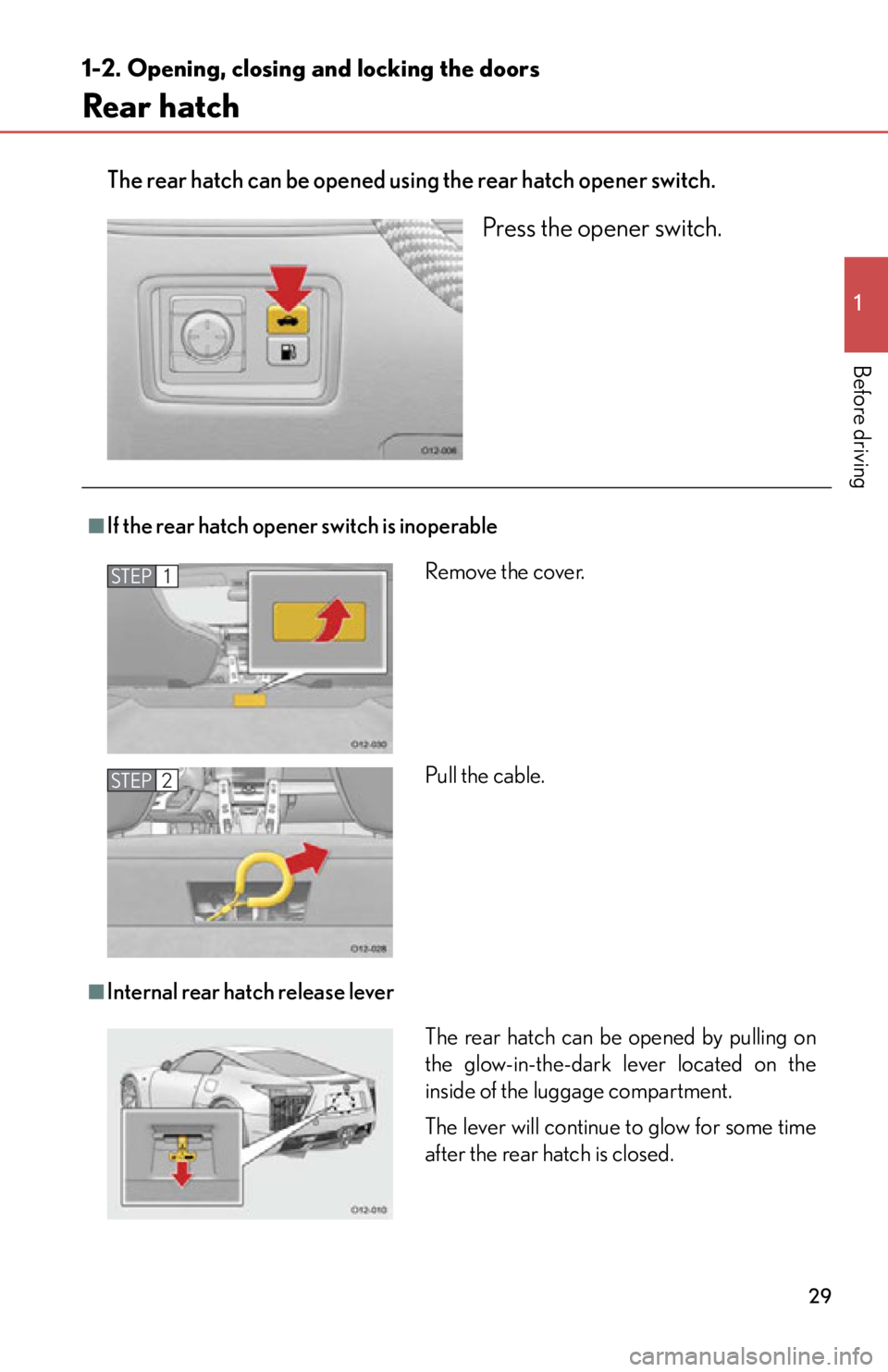
The rear hatch can be opened using the rear hatch opener switch.
Press the opener switch.
■If the rear hatch opener switch is inoperable
■Internal rear hatch release lever
Remove the cover.
Pull the cable.STEP1
STEP2
The rear hatch can be opened by pulling on
the glow-in-the-dark lever located on the
inside of the luggage compartment.
The lever will continue to glow for some time
after the rear hatch is closed.
Page 32 of 420
30
1-2. Opening, closing and locking the doors
CAUTION
■Caution while driving
●Keep the rear hatch closed while driving.
If the rear hatch is left open, it may hit near-by objects while driving or luggage
may be unexpectedly thrown out, causing an accident.
In addition, exhaust gases may enter the vehicle, causing death or a serious
health hazard. Make sure to close the rear hatch before driving.
●Before driving the vehicle, make sure that the rear hatch is fully closed. If the rear
hatch is not fully closed, it may open unexpectedly while driving, causing an acci-
dent.
●Never let anyone sit in the luggage compartment. In the event of sudden braking
or a collision, they are suscepti ble to death or serious injury.
■When children are in the vehicle
Observe the following precautions.
Failure to do so may result in death or serious injury.
●Do not leave children alone in the luggage compartment.
If a child is accidentally locked in the luggage compartment, they could have heat
exhaustion.
●Do not allow a child to open or close the rear hatch.
Doing so may cause the rear hatch to operate unexpectedly, or cause the child’s
hands, head, or neck to be caught by the closing rear hatch.
Page 33 of 420
31
1-2. Opening, closing and locking the doors
1
Before driving
CAUTION
■Using the luggage compartment
Observe the following precautions.
Failure to do so may cause parts of the body to be caught, resulting in serious injury.
●Remove any heavy loads, such as snow and ice, from the rear hatch before open-
ing it. Failure to do so may cause the rear hatch to fall closed again after it is
opened.
●When opening or closing the rear hatch, thoroughly check to make sure the sur-
rounding area is safe.
●If anyone is in the vicinity, make sure they are safe and let them know that the rear
hatch is about to open or close.
●Use caution when opening or closing the rear hatch in windy weather as it may
move abruptly in strong wind.
●Do not attach any accessories to the rear hatch. Such additional weight on the
rear hatch may cause the rear hatch to fall closed again after it is opened.
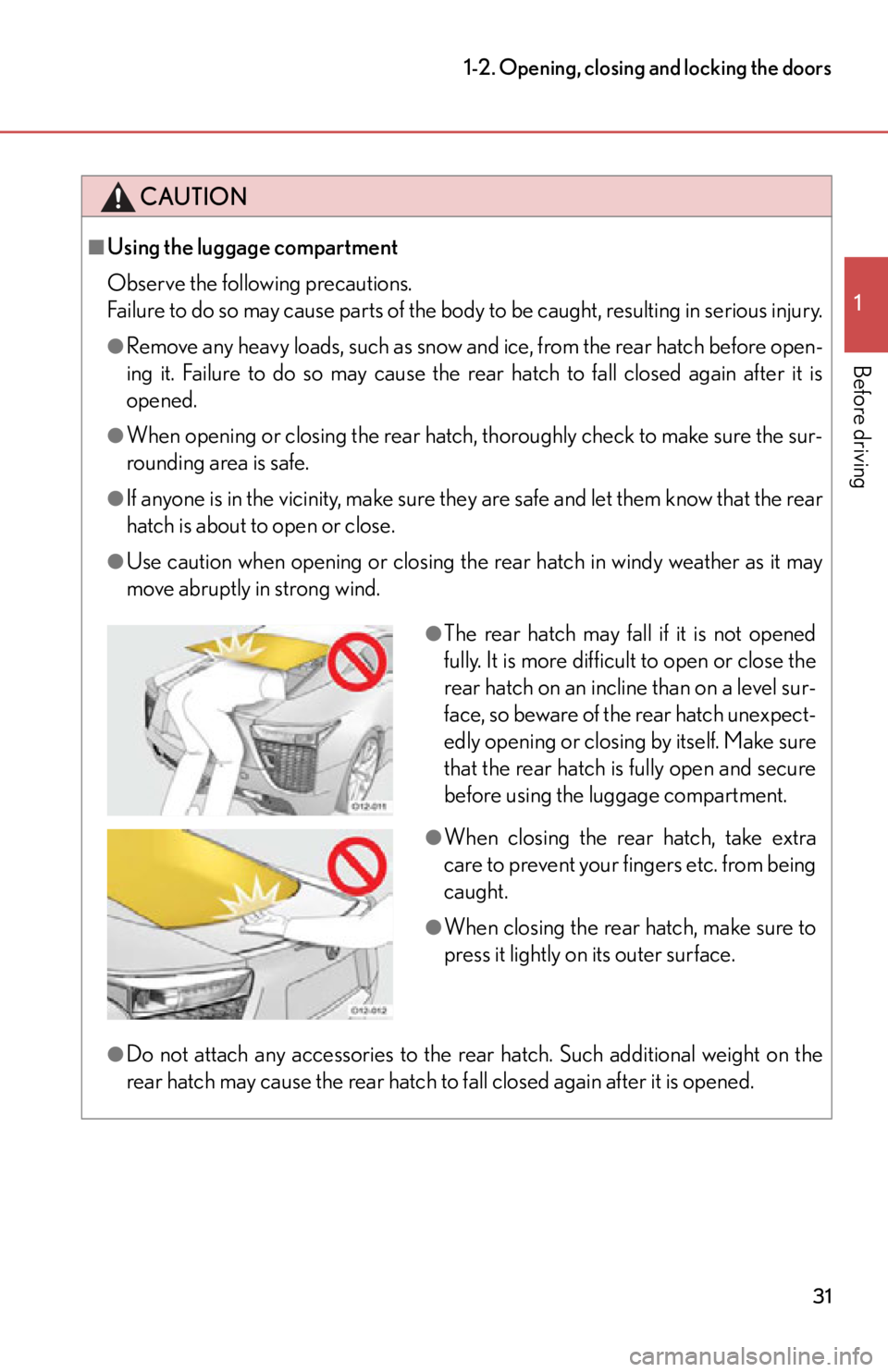
●The rear hatch may fall if it is not opened
fully. It is more difficult to open or close the
rear hatch on an incline than on a level sur-
face, so beware of the rear hatch unexpect-
edly opening or closing by itself. Make sure
that the rear hatch is fully open and secure
before using the luggage compartment.
●When closing the rear hatch, take extra
care to prevent your fingers etc. from being
caught.
●When closing the rear hatch, make sure to
press it lightly on its outer surface.
Page 39 of 420
37
1-3. Adjustable components (seats, mirrors, steering wheel)
1
Before driving
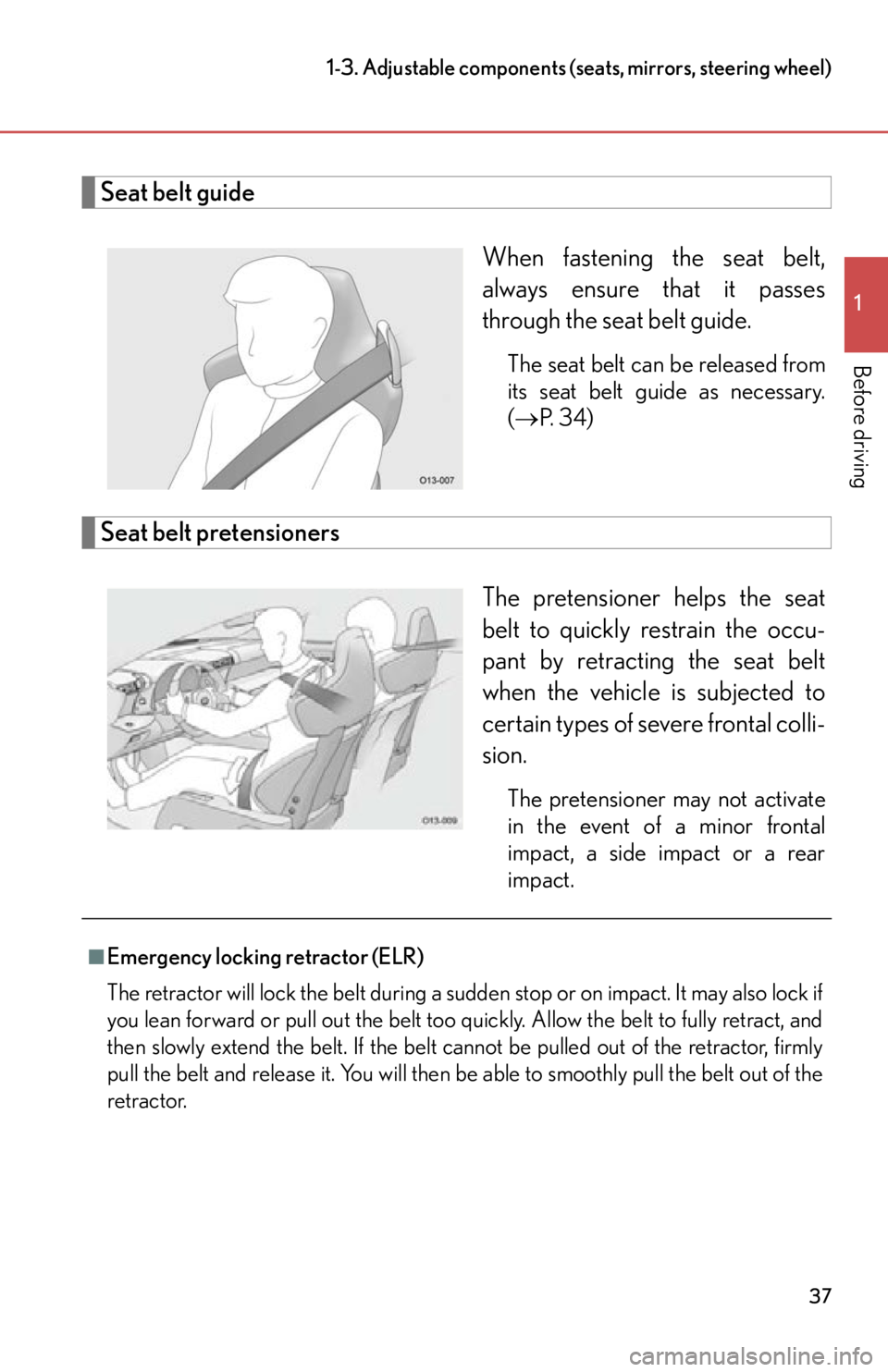
Seat belt guideWhen fastening the seat belt,
always ensure that it passes
through the seat belt guide.
The seat belt can be released from
its seat belt guide as necessary.
( P. 3 4 )
Seat belt pretensioners
The pretensioner helps the seat
belt to quickly restrain the occu-
pant by retracting the seat belt
when the vehicle is subjected to
certain types of severe frontal colli-
sion.
The pretensioner may not activate
in the event of a minor frontal
impact, a side impact or a rear
impact.
■Emergency locking retractor (ELR)
The retractor will lock the belt during a sudd en stop or on impact. It may also lock if
you lean forward or pull out the belt too quickly. Allow the belt to fully retract, and
then slowly extend the belt. If the belt cannot be pulled out of the retractor, firmly
pull the belt and release it. You will then be able to smoothly pull the belt out of the
retractor.
Page 40 of 420
38
1-3. Adjustable components (seats, mirrors, steering wheel)
■Automatic locking retractor (ALR)
When a passenger's lap belt is comple tely extended and then retracted even
slightly, the belt is locked in that position and cannot be extended. This feature is
used to hold the child restraint system (CRS) firmly. To free the belt again, fully
retract the belt and then pull the belt out once more. ( P. 8 0 )
■Pregnant women
■People suffering illness
Obtain medical advice and wear the seat belt in the proper way.
■Child seat belt usage
The seat belts of your vehicle are principally designed for persons of adult size.
●Use a child restraint system appropriate for the child, until the child becomes
large enough to properly wear the vehicle's seat belt. ( P. 76 )
●When the child becomes large enough to properly wear the vehicle's seat belt,
follow the instructions on P. 36 regarding seat belt usage.
■Replacing the belt after the pretensioner has been activated
If the vehicle is involved in multiple collisions, the pretensioner will activate for the
first collision, but will not activate for the second or subsequent collisions.
■Seat belt regulations
If seat belt regulations exist in the co untry where you reside, please contact your
Lexus dealer for seat belt replacement or installation.
Obtain medical advice and wear the seat belt
in the proper way. ( P. 3 6 )
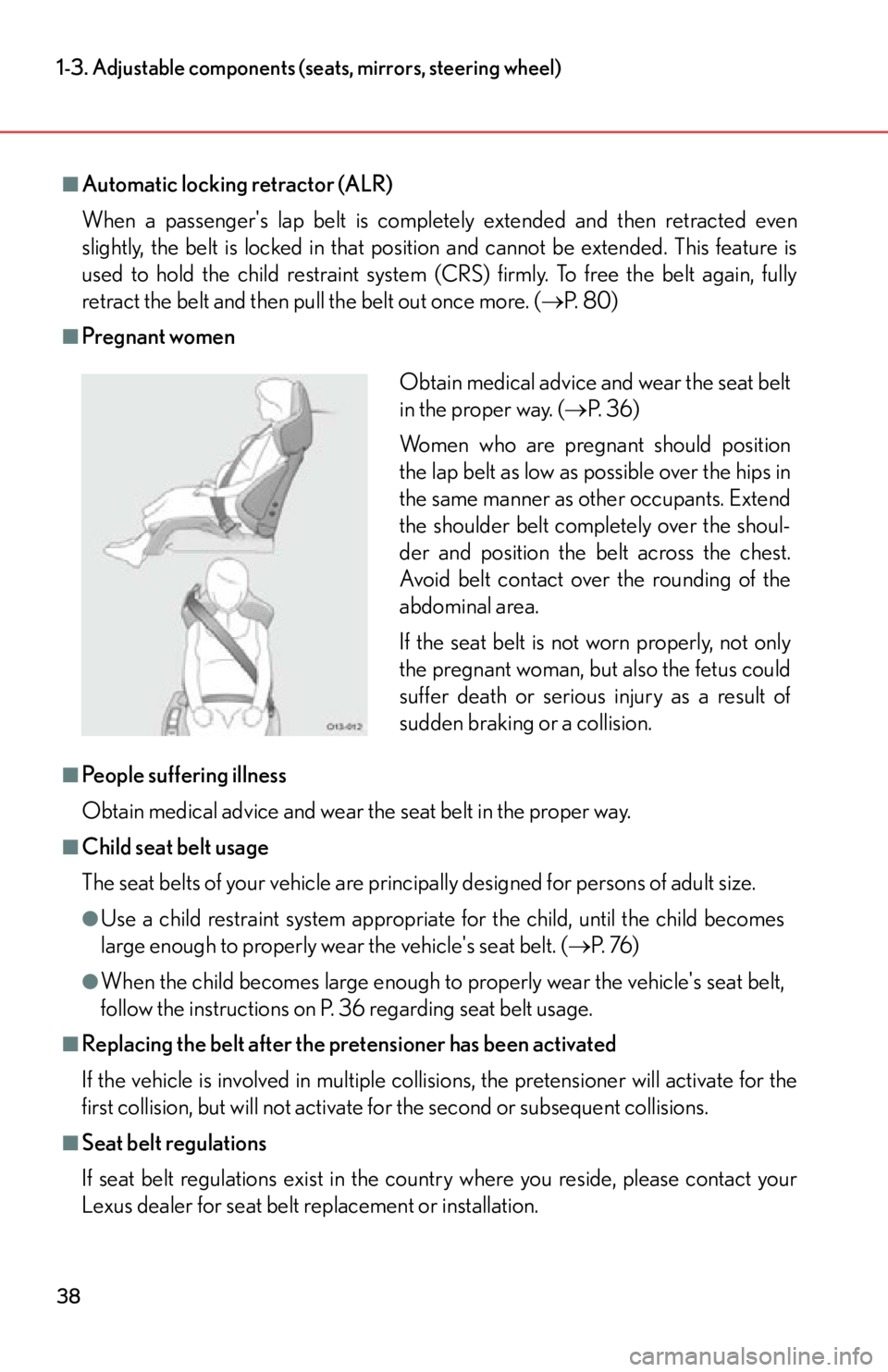
Women who are pregnant should position
the lap belt as low as possible over the hips in
the same manner as other occupants. Extend
the shoulder belt completely over the shoul-
der and position the belt across the chest.
Avoid belt contact over the rounding of the
abdominal area.
If the seat belt is not worn properly, not only
the pregnant woman, but also the fetus could
suffer death or serious injury as a result of
sudden braking or a collision.
Page 42 of 420
40
1-3. Adjustable components (seats, mirrors, steering wheel)
CAUTION
■Child restraint lock function belt precaution
Do not allow children to play with the child restraint lock function belt. If the belt
becomes twisted around a child’s neck, it will not be possible to pull the belt out
leading to choking or other serious in juries that could result in death.
If this occurs and the buckle cannot be un fastened, scissors should be used to cut
the belt behind the seat belt guide.
■Seat belt damage and wear
●Do not damage the seat belts by allowing the belt, plate, or buckle to be jammed
in the door.
If the seat belt is damaged, the built-in SRS seat belt airbag may not inflate in an
accident.
●Inspect the seat belt system periodically. Check for cuts, fraying, and loose parts.
Do not use a damaged seat belt until it is replaced. Damaged seat belts cannot
protect an occupant from death or serious injury.
●Ensure that the belt and tab are lo cked and the belt is not twisted.
If the seat belt does not function co rrectly, immediately contact your Lexus
dealer.
●If your vehicle has been involved in an accident, have the seat assembly including
the belts inspected at your Lexus dealer even if there is no obvious damage.
●Do not attempt to install, remove, modify, disassemble or dispose of the seat belts.
Have any necessary repairs carried out by your Lexus dealer. Inappropriate han-
dling of the pretensioner may prevent it from operating properly resulting in
death or serious injury.
■When using the seat belt guide
●Always make sure that the belt is not twisted, and runs freely through the guide.
●Always make sure the seat belt passes through the seat belt guide. If the seat belt
is not passing through the seat belt guide correctly and the SRS airbags are
inflated, the SRS seat belt airbag may no t inflate correctly, resulting in death or
serious injury.
Page 43 of 420
41
1
1-3. Adjustable components (seats, mirrors, steering wheel)
Before driving
Steering wheel
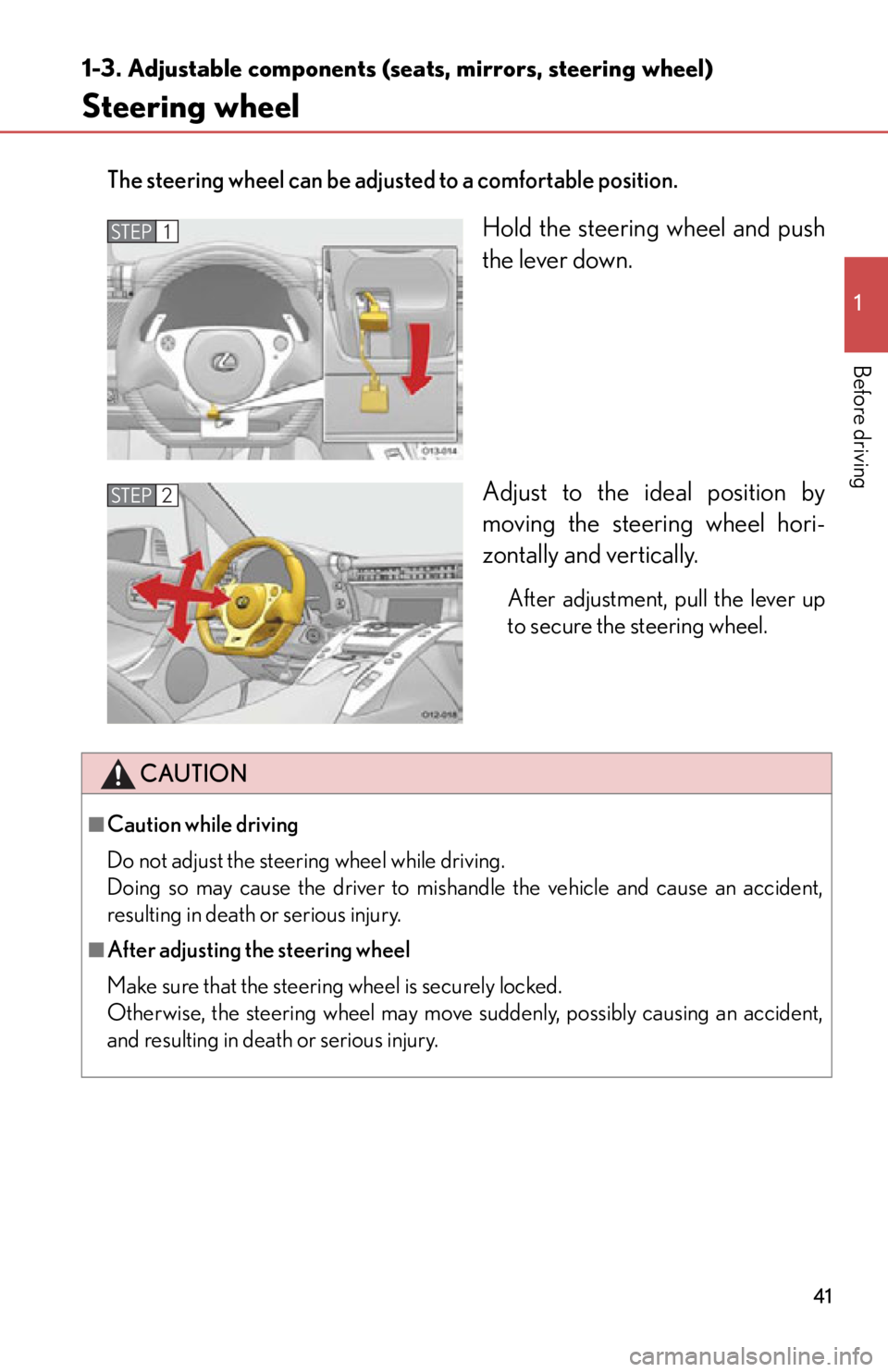
The steering wheel can be adjusted to a comfortable position.
Hold the steering wheel and push
the lever down.
Adjust to the ideal position by
moving the steering wheel hori-
zontally and vertically.
After adjustment, pull the lever up
to secure the steering wheel.
STEP1
STEP2
CAUTION
■Caution while driving
Do not adjust the steering wheel while driving.
Doing so may cause the driver to mishandle the vehicle and cause an accident,
resulting in death or serious injury.
■After adjusting the steering wheel
Make sure that the steering wheel is securely locked.
Otherwise, the steering wheel may move suddenly, possibly causing an accident,
and resulting in death or serious injury.
Page 48 of 420
46
1-4.Opening and closing the windows
Power windows
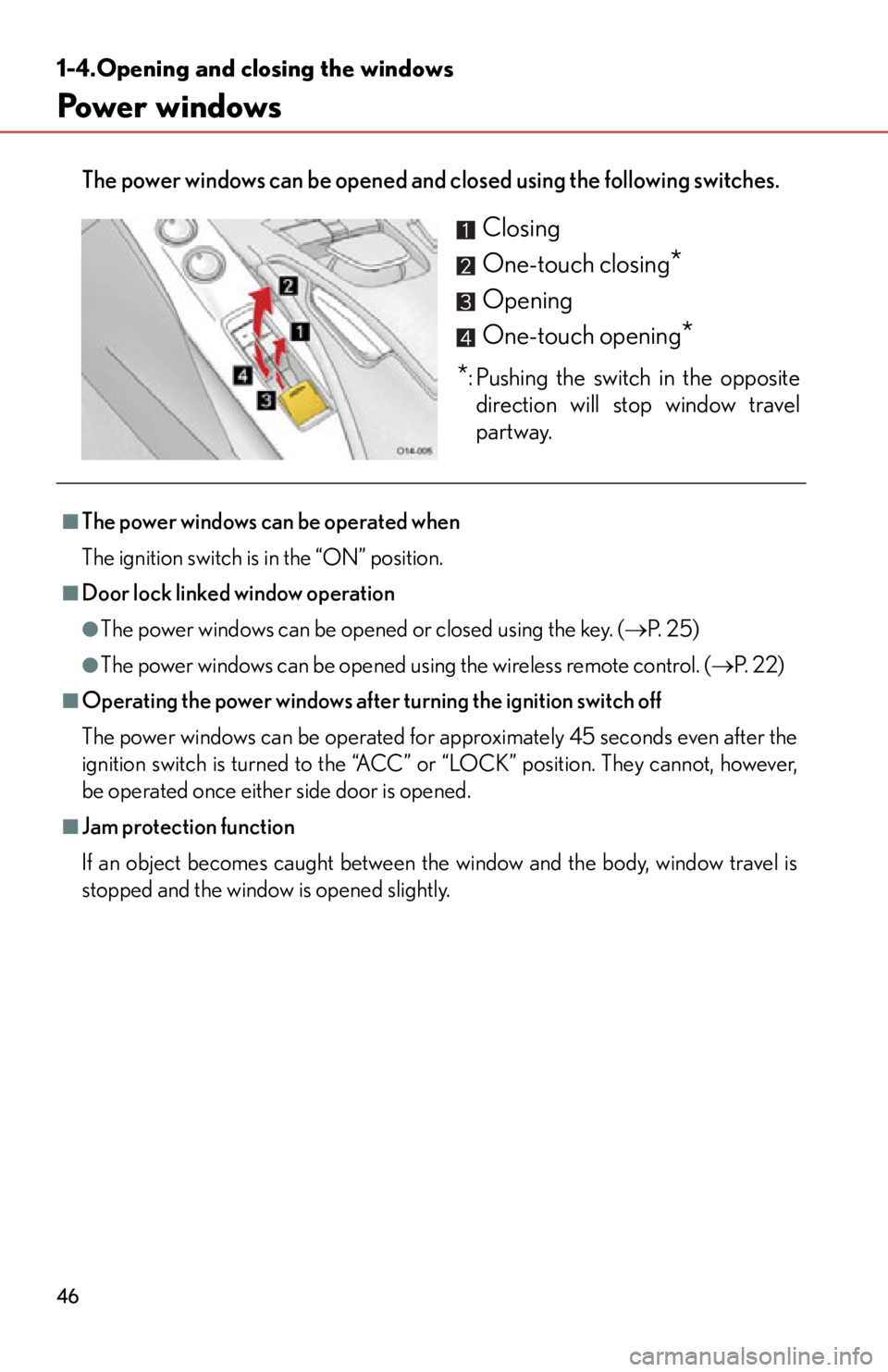
The power windows can be opened and closed using the following switches.
Closing
One-touch closing
*
Opening
One-touch opening
*
*: Pushing the switch in the opposite
direction will stop window travel
partway.
■The power windows can be operated when
The ignition switch is in the “ON” position.
■Door lock linked window operation
●The power windows can be opened or closed using the key. (P. 2 5 )
●The power windows can be opened using the wireless remote control. ( P. 2 2 )
■Operating the power windows after turning the ignition switch off
The power windows can be operated for ap proximately 45 seconds even after the
ignition switch is turned to the “ACC” or “LOCK” position. They cannot, however,
be operated once either side door is opened.
■Jam protection function
If an object becomes caught between the window and the body, window travel is
stopped and the window is opened slightly.