2012 KIA Soul ABS
[x] Cancel search: ABSPage 252 of 393

Driving your vehicle
30
5
When you drive on a road having
poor traction, such as an icy road,
and have operated your brakes
continuously, the ABS will be active
continuously and the ABS warning
light may illuminate. Pull your car
over to a safe place and stop the
engine.
Restart the engine. If the ABS warning light goes off, then your
ABS is normal. Otherwise, you
may have a problem with the ABS.
Contact an authorized Kia dealer
as soon as possible.
✽ ✽ NOTICE
When you jump start your vehicle
because of a drained battery, the
engine may not run as smoothly and
the ABS warning light may turn on
at the same time. This happens
because of low battery voltage. It
does not mean your ABS has mal-
functioned.
• Do not pump your brakes!
• Have the battery recharged before
driving the vehicle.
Electronic stability control
(ESC)
The Electronic Stability control (ESC)
system is designed to stabilize the
vehicle during cornering maneuvers.
ESC checks where you are steering
and where the vehicle is actually
going. ESC applies the brakes on
individual wheels and intervenes with
the engine management system to
stabilize the vehicle. Electronic stability control (ESC) will
not prevent accidents. Excessive
speed in turns, abrupt maneuvers
and hydroplaning on wet surfaces
can still result in serious accidents.
Only a safe and attentive driver can
prevent accidents by avoiding
maneuvers that cause the vehicle to
lose traction. Even with ESC
installed, always follow all the normal
precautions for driving - including
driving at safe speeds for the condi-
tions.
The Electronic Stability Control
(ESC) system is an electronic system
designed to help the driver maintain
vehicle control under adverse
conditions. It is not a substitute for
safe driving practices. Factors
including speed, road conditions and
driver steering input can all affect
whether ESC will be effective in
preventing a loss of control. It is still
your responsibility to drive and corner
at reasonable speeds and to leave a
sufficient margin of safety.
OAM059006
Page 266 of 393
Driving your vehicle
44
5
Hazardous driving conditions
When hazardous driving conditions
are encountered such as water,
snow, ice, mud, sand, or similar haz-
ards, follow these suggestions:
Drive cautiously and allow extra
distance for braking.
Avoid sudden braking or steering.
When braking with non-ABS brakes pump the brake pedal with
a light up-and-down motion until
the vehicle is stopped.
Do not pump the brake pedal on a
vehicle equipped with ABS. If stalled in snow, mud, or sand,
use second gear. Accelerate slow-
ly to avoid spinning the drive
wheels.
Use sand, rock salt, or other non- slip material under the drive
wheels to provide traction when
stalled in ice, snow, or mud.
Reducing the risk of a rollover
This multi-purpose passenger vehi-
cle is defined as a Crossover Utility
Vehicle (CUV). CUV’s have higher
ground clearance and a narrower
track to make them capable of per-
forming in a wide variety of road
applications. Specific design charac-
teristics give them a higher center of
gravity than ordinary vehicles. An
advantage of the higher ground
clearance is a better view of the
road, which allows you to anticipate
problems. They are not designed for
cornering at the same speeds as
conventional passenger vehicles.
Due to this risk, driver and passen-
gers are strongly recommended to
buckle their seat belts. In a rollover
crash, an unbelted person is more
likely to die than a person wearing a
seat belt. There are steps that a driv-
er can make to reduce the risk of a
rollover. If at all possible, avoid sharp
turns or abrupt maneuvers, do not
load your roof rack with heavy cargo,
and never modify your vehicle in any
way.
SPECIAL DRIVING CONDITIONS
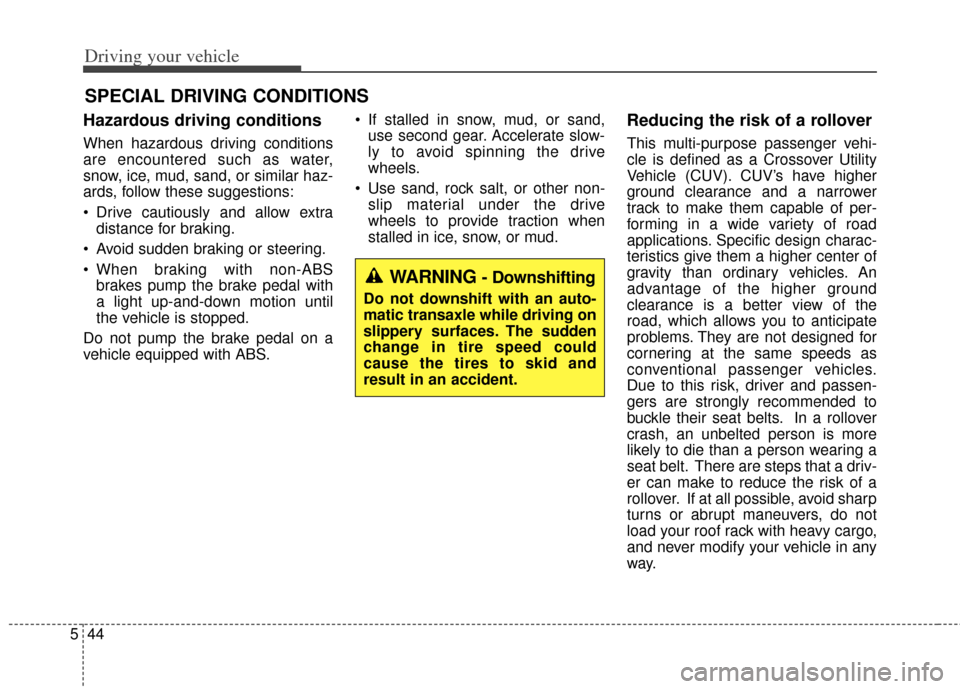
WARNING - Downshifting
Do not downshift with an auto-
matic transaxle while driving on
slippery surfaces. The sudden
change in tire speed could
cause the tires to skid and
result in an accident.
Page 284 of 393

65
What to do in an emergency
Jump starting
Jump starting can be dangerous if
done incorrectly. Therefore, to avoid
harm to yourself or damage to your
vehicle or battery, follow these jump
starting procedures. If in doubt, we
strongly recommend that you have a
competent technician or towing serv-
ice jump start your vehicle.
Jump starting procedure
Absorbent Glass Matt (AGM) batter-
ies are maintenance-free and should
only be serviced by an authorized
Kia dealer. For charging your AGM
battery, use only fully automatic bat-
tery chargers that are specially
developed for AGM batteries.
When replacing the AGM battery,
use only the Kia genuine battery for
the ISG system.
✽ ✽NOTICE
If the AGM battery is reconnected
or replaced, ISG function will not
operate immediately.
If you want to use the ISG function,
the battery sensor needs to be cali-
brated for approximately 4 hours
with the ignition off and then, turn
the engine on and off 2 or 3 times.
CAUTION - 12 volt
battery
Use only a 12-volt jumper sys-
tem. You can damage a 12-voltstarting motor, ignition system,and other electrical partsbeyond repair by use of a 24-volt power supply (either two12-volt batteries in series or a24-volt motor generator set).
WARNING - Battery
Never attempt to check the elec-
trolyte level of the battery as
this may cause the battery to
rupture or explode.
WARNING - Frozen batteries
Do not attempt to jump start the
vehicle if the discharged battery
is frozen or if the electrolyte
level is low as the battery may
rupture or explode.
WARNING - Battery
Keep all flames or sparks away
from the battery. The battery
produces hydrogen gas which
will explode if exposed to flame
or sparks.
WARNING - Sulfuricacid risk
When jump starting your vehi-
cle be careful not to get acid on
yourself, your clothing or on the
vehicle. Automobile batteries
contain sulfuric acid. This is
poisonous and highly corro-
sive.
WARNING - AGM battery
cap
Do not open or remove the cap
on top of the battery. This may
cause the leak of dangerous
internal electrolytes.
Page 355 of 393
745
Maintenance
Tire replacement
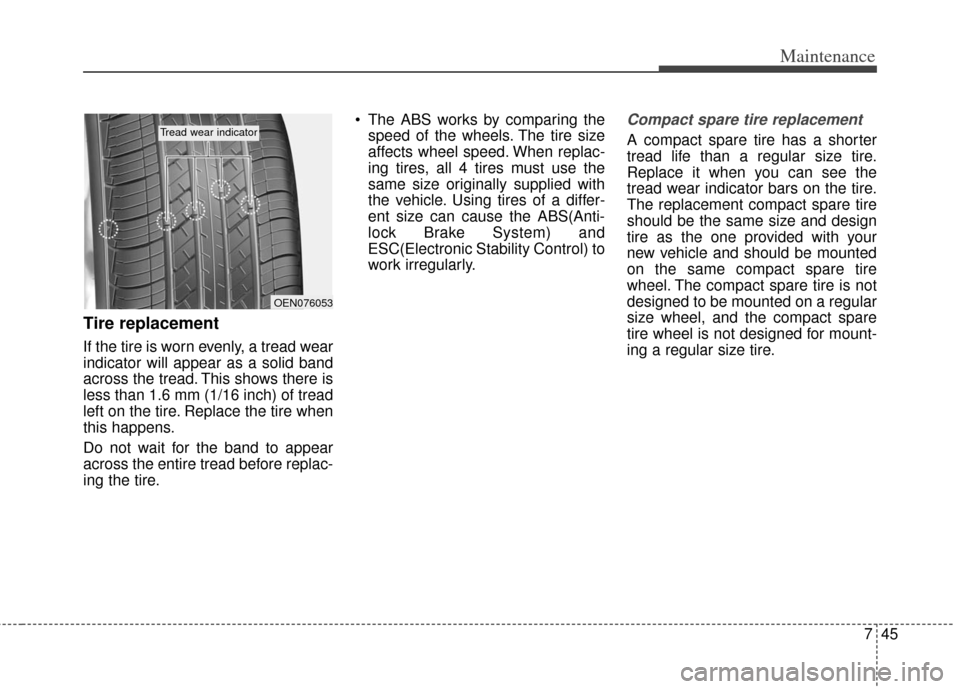
If the tire is worn evenly, a tread wear
indicator will appear as a solid band
across the tread. This shows there is
less than 1.6 mm (1/16 inch) of tread
left on the tire. Replace the tire when
this happens.
Do not wait for the band to appear
across the entire tread before replac-
ing the tire. The ABS works by comparing the
speed of the wheels. The tire size
affects wheel speed. When replac-
ing tires, all 4 tires must use the
same size originally supplied with
the vehicle. Using tires of a differ-
ent size can cause the ABS(Anti-
lock Brake System) and
ESC(Electronic Stability Control) to
work irregularly.
Compact spare tire replacement
A compact spare tire has a shorter
tread life than a regular size tire.
Replace it when you can see the
tread wear indicator bars on the tire.
The replacement compact spare tire
should be the same size and design
tire as the one provided with your
new vehicle and should be mounted
on the same compact spare tire
wheel. The compact spare tire is not
designed to be mounted on a regular
size wheel, and the compact spare
tire wheel is not designed for mount-
ing a regular size tire.
OEN076053
Tread wear indicator
Page 370 of 393

Maintenance
60
7
Description Fuse rating Protected component
HTD MIRR 10A ECM/PCM, Driver/Passenger Power Outside Mirror, A/C Control Module, A/V & Navigation Touch
DR LOCK 20A Door Lock Relay, Door Unlock Relay, 2 Turn Lock Relay
STOP LP 15AStop Lamp Switch, Multipurpose Check Connector, HAC Relay, Stop Lamp Relay,
Sport Mode Switch, Key Solenoid
TCU 10AVehicle Speed Sensor (M/T), ATM Shift Lever Indicator, ATM Key Lock Control Module,
Transaxle Range Switch
ABS 10A ESC Module, ESC Switch, E/R Fuse & Relay Box (Multipurpose Check Connector)
IG 1 10ATire Pressure Monitoring Module, ISG Low DC - DC Converter (Audio/AMP),
Driver/Passenger Seat Warmer Switch, Driver/Passenger Seat Warmer, ISG Switch,
Electro Chromic Mirror, Oil Pump Invertor, Stop Lamp Switch, HAC Relay
P/OUTLET FRT 15A Front Power Outlet
A/BAG 15A SRS Control Module, Weight Classification Module, Telltale Lamp
IGN COIL 15A G4FD : Condenser, Ignition Coil #1 ~ #4
T/SIG 10A Hazard Switch, Multifunction Switch (Light)
CLUSTER 10A BCM, Instrument Cluster (IND.), A/C Control Module, Smart Key Control Module, PDM
ECU 10A ECM, PCM
START 10AE/R Fuse & Relay Box (Start Relay), PDM, Transaxle Range Switch, Ignition Lock Switch,
PCM/ECM
B/UP LP 10A Back-up Lamp Switch (M/T)
A/BAG IND 10A Instrument Cluster (Air Bag IND.)
POWER
CONNECTOR MODULE 15A
Audio, RF Receiver, A/V & Navigation Touch, ISG Low DC - DC Converter (Audio),
A/V & Navigation Head Unit
ROOM LP 10A BCM, Instrument Cluster (IND.), A/C Control Module, Tire Pressure Monitoring Module,
Center Room Lamp, Luggage Lamp,
Overhead Console Assembly (Map Lamp), Ignition Key ILL. & Door Warning Switch,
Vanity Lamp LH/RH
Page 372 of 393
Maintenance
62
7
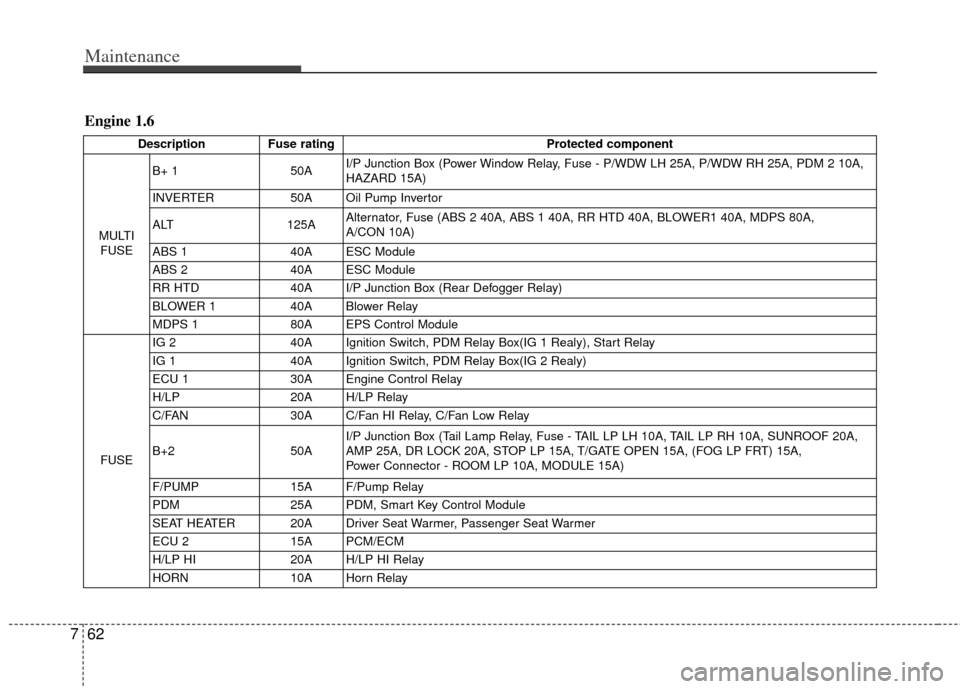
Engine 1.6
Description Fuse rating Protected component
MULTI FUSE B+ 1
50AI/P Junction Box (Power Window Relay, Fuse - P/WDW LH 25A, P/WDW RH 25A, PDM 2 10A,
HAZARD 15A)
INVERTER 50A Oil Pump Invertor
ALT 125AAlternator, Fuse (ABS 2 40A, ABS 1 40A, RR HTD 40A, BLOWER1 40A, MDPS 80A,
A/CON 10A)
ABS 1 40A ESC Module
ABS 2 40A ESC Module
RR HTD 40A I/P Junction Box (Rear Defogger Relay)
BLOWER 1 40A Blower Relay
MDPS 1 80A EPS Control Module
FUSE IG 2
40A Ignition Switch, PDM Relay Box(IG 1 Realy), Start Relay
IG 1 40A Ignition Switch, PDM Relay Box(IG 2 Realy)
ECU 1 30A Engine Control Relay
H/LP 20A H/LP Relay
C/FAN 30A C/Fan HI Relay, C/Fan Low Relay
B+2 50AI/P Junction Box (Tail Lamp Relay, Fuse - TAIL LP LH 10A, TAIL LP RH 10A, SUNROOF 20A,
AMP 25A, DR LOCK 20A, STOP LP 15A, T/GATE OPEN 15A, (FOG LP FRT) 15A,
Power Connector - ROOM LP 10A, MODULE 15A)
F/PUMP 15A F/Pump Relay
PDM 25A PDM, Smart Key Control Module
SEAT HEATER 20A Driver Seat Warmer, Passenger Seat Warmer
ECU 2 15A PCM/ECM
H/LP HI 20A H/LP HI Relay
HORN 10A Horn Relay
Page 374 of 393
Maintenance
64
7
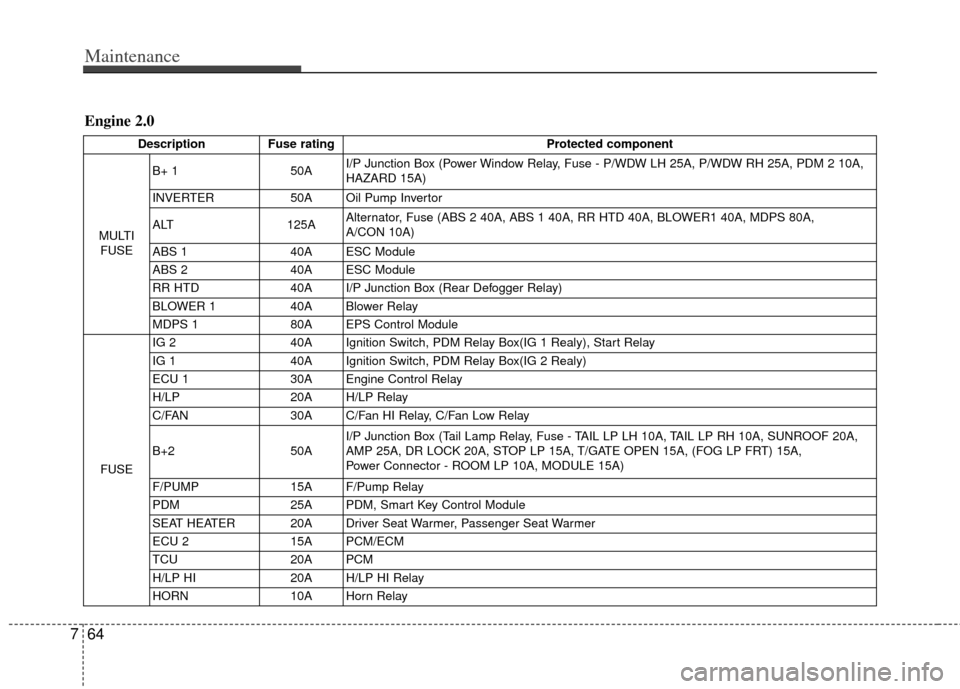
Engine 2.0
Description Fuse rating Protected component
MULTI FUSE B+ 1
50AI/P Junction Box (Power Window Relay, Fuse - P/WDW LH 25A, P/WDW RH 25A, PDM 2 10A,
HAZARD 15A)
INVERTER 50A Oil Pump Invertor
ALT 125AAlternator, Fuse (ABS 2 40A, ABS 1 40A, RR HTD 40A, BLOWER1 40A, MDPS 80A,
A/CON 10A)
ABS 1 40A ESC Module
ABS 2 40A ESC Module
RR HTD 40A I/P Junction Box (Rear Defogger Relay)
BLOWER 1 40A Blower Relay
MDPS 1 80A EPS Control Module
FUSE IG 2
40A Ignition Switch, PDM Relay Box(IG 1 Realy), Start Relay
IG 1 40A Ignition Switch, PDM Relay Box(IG 2 Realy)
ECU 1 30A Engine Control Relay
H/LP 20A H/LP Relay
C/FAN 30A C/Fan HI Relay, C/Fan Low Relay
B+2 50AI/P Junction Box (Tail Lamp Relay, Fuse - TAIL LP LH 10A, TAIL LP RH 10A, SUNROOF 20A,
AMP 25A, DR LOCK 20A, STOP LP 15A, T/GATE OPEN 15A, (FOG LP FRT) 15A,
Power Connector - ROOM LP 10A, MODULE 15A)
F/PUMP 15A F/Pump Relay
PDM 25A PDM, Smart Key Control Module
SEAT HEATER 20A Driver Seat Warmer, Passenger Seat Warmer
ECU 2 15A PCM/ECM
TCU 20A PCM
H/LP HI 20A H/LP HI Relay
HORN 10A Horn Relay
Page 383 of 393
773
Maintenance
Canister
Fuel vapors generated inside the fuel
tank are absorbed and stored in the
onboard canister. When the engine is
running, the fuel vapors absorbed in
the canister are drawn into the surge
tank through the purge control sole-
noid valve.
Purge Control Solenoid Valve(PCSV)
The purge control solenoid valve is
controlled by the Engine Control
Module (ECM); when the engine
coolant temperature is low during
idling, the PCSV closes so that evap-
orated fuel is not taken into the
engine. After the engine warms up
during ordinary driving, the PCSV
opens to introduce evaporated fuel to
the engine.
3. Exhaust emission control
system
The Exhaust Emission Control
System is a highly effective system
which controls exhaust emissions
while maintaining good vehicle per-
formance.
Vehicle modifications
This vehicle should not be modified.
Modification of your vehicle could
affect its performance, safety or
durability and may even violate gov-
ernmental safety and emissions reg-
ulations.
In addition, damage or performance
problems resulting from any modifi-
cation may not be covered under
warranty.
If you use unauthorized electronic
devices, it may cause the vehicle to
operate abnormally, wire damage,
battery discharge and fire. For your
safety, be careful not to damage.
Engine exhaust gas precautions
(carbon monoxide)
Carbon monoxide can be present with other exhaust fumes.
Therefore, if you smell exhaust
fumes of any kind inside your vehi-
cle, have it inspected and repaired
immediately. If you ever suspect
exhaust fumes are coming into
your vehicle, drive it only with all
the windows fully open. Have your
vehicle checked and repaired
immediately.
WARNING - Exhaust
Engine exhaust gases contain
carbon monoxide (CO). Though
colorless and odorless, it is
dangerous and could be lethal if
inhaled. Follow the instructions
on this page to avoid CO poi-
soning.