Page 248 of 840

Driving your vehicle
4
5
Ignition switch position
LOCK
The steering wheel locks to protect
against theft. The ignition key can be
removed only in the LOCK position.
When turning the ignition switch to the
LOCK position, push the key inward at
the ACC position and turn the key towardthe LOCK position.
ACC (Accessory)
The steering wheel is unlocked and elec-
trical accessories are operative.
✽✽
NOTICE
If difficulty is experienced turning the
ignition switch to the ACC position, turn
the key while turning the steering wheel
right and left to release the tension.
ON
The warning lights can be checked
before the engine is started. This is the
normal running position after the engine
is started.
Do not leave the ignition switch ON if the engine is not running to prevent batterydischarge.
START
Turn the ignition switch to the START
position to start the engine. The engine
will crank until you release the key; then
it returns to the ON position. The brake
warning light can be checked in this posi-tion.
OSA057001
WARNING
When you intend to park or stop the vehicle with the engine on, be careful not to depress the accel-
erator pedal for a long period of
time. It may overheat the engine
or exhaust system and cause fire.
When you make a sudden stop or turn the steering wheel rapidly,
loose objects may drop on the
floor and it could interfere with
the operation of the foot pedals,
possibly causing an accident.
Keep all things in the vehicle
safely stored.
If you do not focus on driving, it may cause an accident. Be care-
ful when operating what may dis-
turb driving such as audio or
heater. It is the responsibility of
the driver to always drive safely.
KEY POSITIONS
Page 249 of 840

55
Driving your vehicle
WARNING- Ignition switch
Never turn the ignition switch to LOCK or ACC while the vehicle is
moving. This would result in loss
of directional control and braking
function, which could cause anaccident.
The anti-theft steering column lock is not a substitute for the parking
brake. Before leaving the driver’s
seat, always make sure the shift
lever is engaged in 1 st
gear for the
manual transaxle or P (Park) for
the automatic transaxle, set the
parking brake fully and shut the
engine off. Unexpected and sud-
den vehicle movement may occurif these precautions are not taken.
Never reach for the ignition switch, or any other controls
through the steering wheel while
the vehicle is in motion. The pres-
ence of your hand or arm in this
area could cause a loss of vehicle
control, an accident and serious
bodily injury or death.
(Continued)(Continued)
Do not place any movable objectsaround the driver’s seat as they
may move while driving, interferewith the driver and lead to anaccident.
Page 253 of 840

59
Driving your vehicle
Starting the engine with an igni-
tion key (if equipped)
1. Make sure the parking brake isapplied.
2. Manual Transaxle - Depress the
clutch pedal fully and shift the
transaxle into Neutral. Keep the clutch
pedal and brake pedal depressed
while turning the ignition switch to the
start position.
Automatic Transaxle - Place the
transaxle shift lever in P (Park).
Depress the brake pedal fully.
You can also start the engine when
the shift lever is in the N (Neutral)
position.
3. Turn the ignition switch to START and hold it there until the engine starts (a
maximum of 10 seconds), then
release the key.
4. In extremely cold weather (below -18°C / 0°F) or after the vehicle has
not been operated for several days, let
the engine warm up without depress-
ing the accelerator.
Whether the engine is cold or warm, it
should be started without depressing
the accelerator.
STARTING THE ENGINE
WARNING
Always wear appropriate shoes
when operating your vehicle.
Unsuitable shoes (high heels, ski
boots,etc.) may interfere with your
ability to use the brake, accelerator
pedal, and clutch (if equipped).
CAUTION
If the engine stalls while the vehicle is in motion, do not attempt to move the shift lever to the P (Park) posi-tion. If traffic and road conditions
permit, you may put the shift leverin the N (Neutral) position while thevehicle is still moving and turn theignition switch to the START posi- tion in an attempt to restart the
engine.
CAUTION
Do not engage the starter for more than 10 seconds. If the engine stalls
or fails to start, wait 5 to 10 seconds before re-engaging the starter.Improper use of the starter may damage it.
Page 257 of 840

513
Driving your vehicle
✽✽NOTICE
If you unfasten the seatbelt or open the
driver's door (or engine hood) in auto
stop mode, the following will happen:
The ISG system will deactivate (the light on the ISG OFF button will illu-
minate). (Continued)(Continued)
A message "Auto Start Deactivated
Start Manually" will appear on the
LCD display.
Turn the ignition switch to the START
position to start the engine manually.
The engine will also restart automati-
cally without the driver’s any actions if the following occurs:
- The fan speed of manual climate con- trol system is set above the 3rd position when the air conditioning is on.
- The fan speed of automatic climate control system is set above the 6thposition when the air conditioning is on.
- When a certain amount of time has passed with the climate control systemon.
- When the defroster is on.
- The brake vaccum pressure is low.
- The battery charging status is low.
- The vehicle speed exceeds 5 km/h (3 mph).
OTA050018LOTA052021L
Page 260 of 840
Driving your vehicle
16
5
WARNING
When the engine is in Idle Stop
mode, it's possible to restart theengine without the driver taking
any action.
Before leaving the car or doing any-
thing in the engine room area, stop
the engine by turning the ignition
switch to the LOCK(OFF) position
or removing the ignition key.
Page 261 of 840

517
Driving your vehicle
LPG system operation
The LPG system engine starts ongasoline (gasoline fuel indicator on) if there is enough gasoline and if the
gasoline fuel system is operating nor-
mally regardless of the GSL switchcondition.
If the GSL switch is off (switch not pressed), the system will convert toLPG after some time and the gasoline
fuel indicator will turn off.
If the GSL switch is on (switch pressed), the system will operate ongasoline and the gasoline fuel indicator
will turn on.
It is recommended to use gasoline only when you start the engine and when
LPG is empty. The engine starts with LPG when
gasoline is empty or when there is a
problem with the gasoline fuel system. LPG engine start conditions
When gasoline is empty or when there
is a problem with the gasoline fuel sys-
tem. (GSL switch off)
If the ignition switch is in the ON posi- tion, the gasoline fuel indicator will
blink.
However, if the switch is turned off and
on again within a few seconds the indi-
cator may not blink.
Turn the engine on after a few seconds after the gasoline fuel indicator is
turned off.
If you turn the engine on after a long period, the engine may not start imme-
diately. If this occurs, turn the engine
off and follow the above instructionsagain.
LPG SYSTEM (IF EQUIPPED)
OTA040204L
Page 262 of 840
Driving your vehicle
18
5
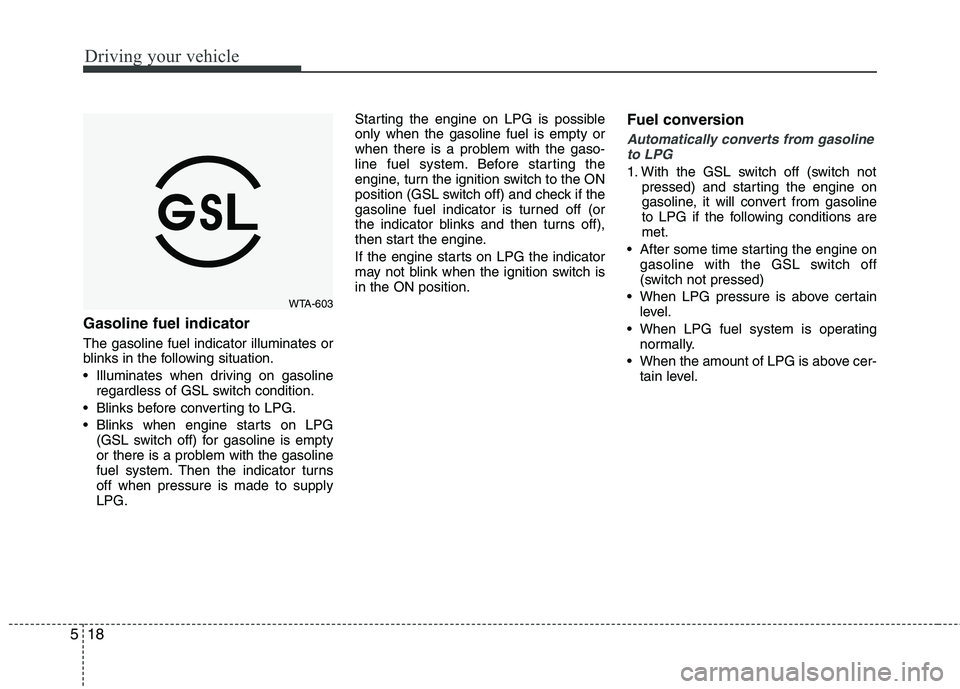
Gasoline fuel indicator The gasoline fuel indicator illuminates or
blinks in the following situation.
Illuminates when driving on gasoline
regardless of GSL switch condition.
Blinks before converting to LPG.
Blinks when engine starts on LPG (GSL switch off) for gasoline is empty
or there is a problem with the gasoline
fuel system. Then the indicator turnsoff when pressure is made to supplyLPG. Starting the engine on LPG is possibleonly when the gasoline fuel is empty or
when there is a problem with the gaso-
line fuel system. Before starting the
engine, turn the ignition switch to the ON
position (GSL switch off) and check if the
gasoline fuel indicator is turned off (or
the indicator blinks and then turns off),
then start the engine.
If the engine starts on LPG the indicator
may not blink when the ignition switch isin the ON position.
Fuel conversion
Automatically converts from gasoline
to LPG
1. With the GSL switch off (switch not pressed) and starting the engine on
gasoline, it will convert from gasoline
to LPG if the following conditions aremet.
After some time starting the engine on gasoline with the GSL switch off
(switch not pressed)
When LPG pressure is above certain level.
When LPG fuel system is operating normally.
When the amount of LPG is above cer- tain level.
WTA-603
Page 272 of 840

Driving your vehicle
28
5
For smooth operation, depress the brake
pedal when shifting from N (Neutral) to aforward or reverse gear.Transaxle ranges
The indicator in the instrument cluster
displays the shift lever position when the
ignition switch is in the ON position.
P (Park)
Always come to a complete stop before
shifting into P (Park). This position locks
the transaxle and prevents the drivewheels from rotating.
WARNING - Automatic
transaxle
Always check the surrounding areas near your vehicle for peo-
ple, especially children, beforeshifting a car into D (Drive) or R
(Reverse).
Before leaving the driver’s seat, always make sure the shift lever
is in the P (Park) position; then
set the parking brake fully and
shut the engine off. Unexpected
and sudden vehicle movementcan occur if these precautions
are not followed in the order iden-tified.
CAUTION
To avoid damage to your
transaxle, do not accelerate the
engine in R (Reverse) or any for-ward gear position with thebrakes on.
When stopped on an incline, do not hold the vehicle stationarywith engine power. Use the serv-ice brake or the parking brake.
Do not shift from N (Neutral) or P (Park) into D (Drive), or R
(Reverse) when the engine isabove idle speed.
WARNING
Shifting into P (Park) while the vehicle is in motion will cause the
drive wheels to lock which will
cause you to lose control of the
vehicle.
Do not use the P (Park) position in place of the parking brake.
Always make sure the shift lever
is latched in the P (Park) position
and set the parking brake fully.
Never leave a child unattended in a vehicle.
CAUTION
The transaxle may be damaged if
you shift into P (Park) while the vehicle is in motion.
