Page 138 of 613
position. Then, using body pressure, move forward and
rearward on the seat to be sure that the seat adjusters
have latched.WARNING!
•Adjusting a seat while driving may be dangerous.
Moving a seat while driving could result in loss of
control which could cause a collision and serious
injury or death.
•Seats should be adjusted before fastening the seat
belts and while the vehicle is parked. Serious
injury or death could result from a poorly adjusted
seat belt.
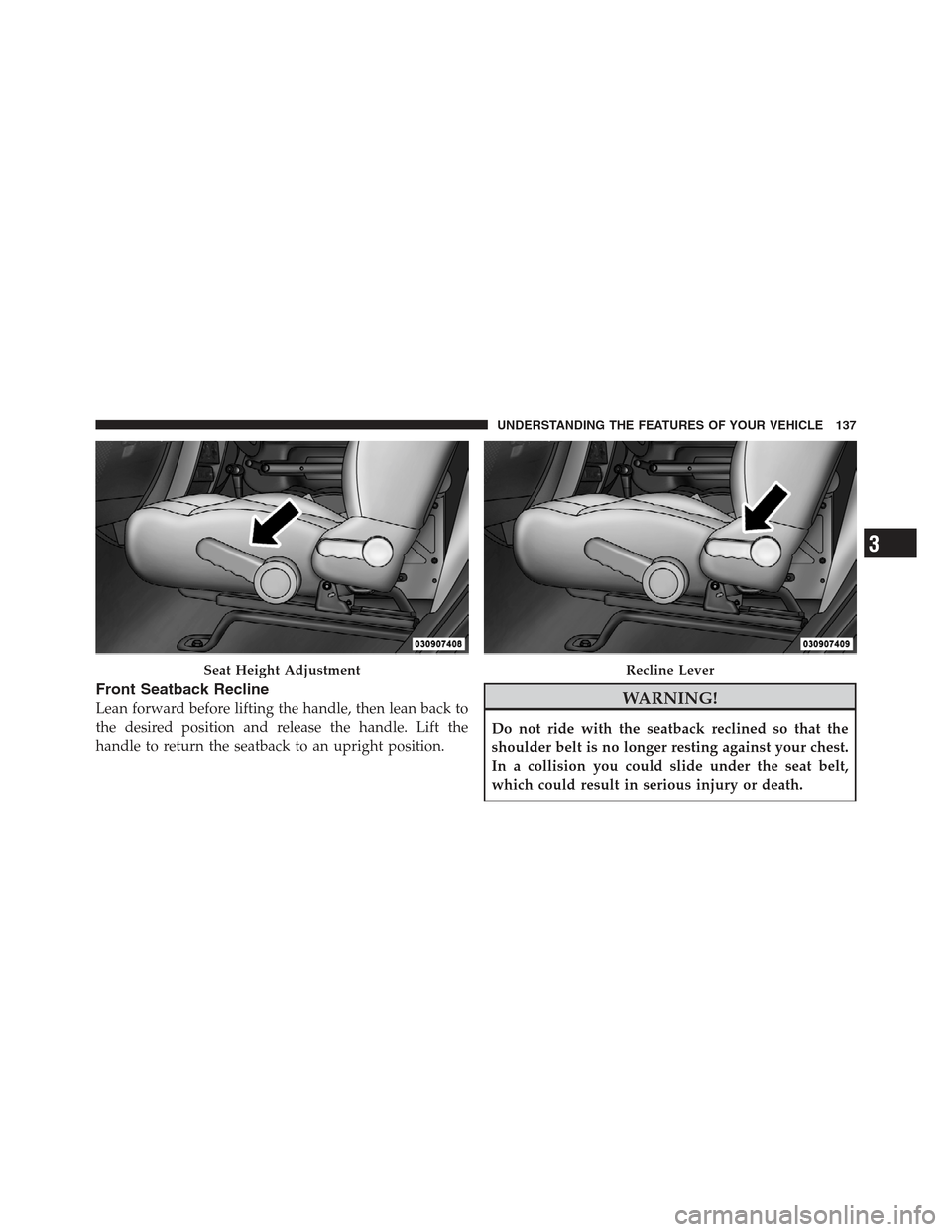
Manual Seat Height Adjustment — If Equipped
The driver’s seat height can be raised or lowered by using
the ratcheting handle, located on the outboard side of the
seat. Pull upward on the handle to raise the seat; push
downward on the handle to lower the seat.
Manual Seat Adjustment
136 UNDERSTANDING THE FEATURES OF YOUR VEHICLE
Page 139 of 613
Front Seatback Recline
Lean forward before lifting the handle, then lean back to
the desired position and release the handle. Lift the
handle to return the seatback to an upright position.WARNING!
Do not ride with the seatback reclined so that the
shoulder belt is no longer resting against your chest.
In a collision you could slide under the seat belt,
which could result in serious injury or death.
Seat Height AdjustmentRecline Lever
3
UNDERSTANDING THE FEATURES OF YOUR VEHICLE 137
Page 147 of 613
3. Return the seat to the normal position.
4. Raise the rear seatback using the assist strap and
firmly lock the seat into position.
Removing The Rear Seat — Two-Door Models
WARNING!
•It is extremely dangerous to ride in a cargo area,
inside or outside of a vehicle. In a collision, people
riding in these areas are more likely to be seri-
ously injured or killed.
•Do not allow people to ride in any area of your
vehicle that is not equipped with seats and seat
belts.
•Be sure everyone in your vehicle is in a seat and
using a seat belt properly.
•In a collision, you or others in your vehicle could
be injured if seats are not properly latched to their
floor attachments. Always be sure that the seats
are fully latched.
1. Fold the rear seat forward following steps 1 and 2
under “Fold And Tumble Rear Seat” in this section.
Folding Rear Seat
3
UNDERSTANDING THE FEATURES OF YOUR VEHICLE 145
Page 148 of 613
2. Press down on the release bar on each side, and pull
the seat out and away from the lower bracket.
3. Remove the seat from the vehicle.Replacing The Rear Seat — Two-Door Models
Reverse the steps for removing the seat.
WARNING!
•To help protect against personal injury, passengers
should not be seated in the rear cargo area with the
rear seat folded down or removed from the ve-
hicle.
•The rear cargo space is intended for load carrying
purposes only, not for passengers who should sit
in seats and use seat belts.
60/40 Split Folding Rear Seat — Four-Door
Models
To provide additional storage area, each rear seat can be
folded flat to allow for extended cargo space and still
maintain some rear seating room.
Release Bar Location
146 UNDERSTANDING THE FEATURES OF YOUR VEHICLE
Page 149 of 613
NOTE:
•Prior to folding the rear seat, it may be necessary to
reposition the front seat to its mid-track position.
•Be sure that the front seats are fully upright and
positioned forward. This will allow the rear seat to
fold down easily.
WARNING!
•It is extremely dangerous to ride in a cargo area,
inside or outside of a vehicle. In a collision, people
riding in these areas are more likely to be seri-
ously injured or killed.
•Do not allow people to ride in any area of your
vehicle that is not equipped with seats and seat
belts.
•Be sure everyone in your vehicle is in a seat and
using a seat belt properly.
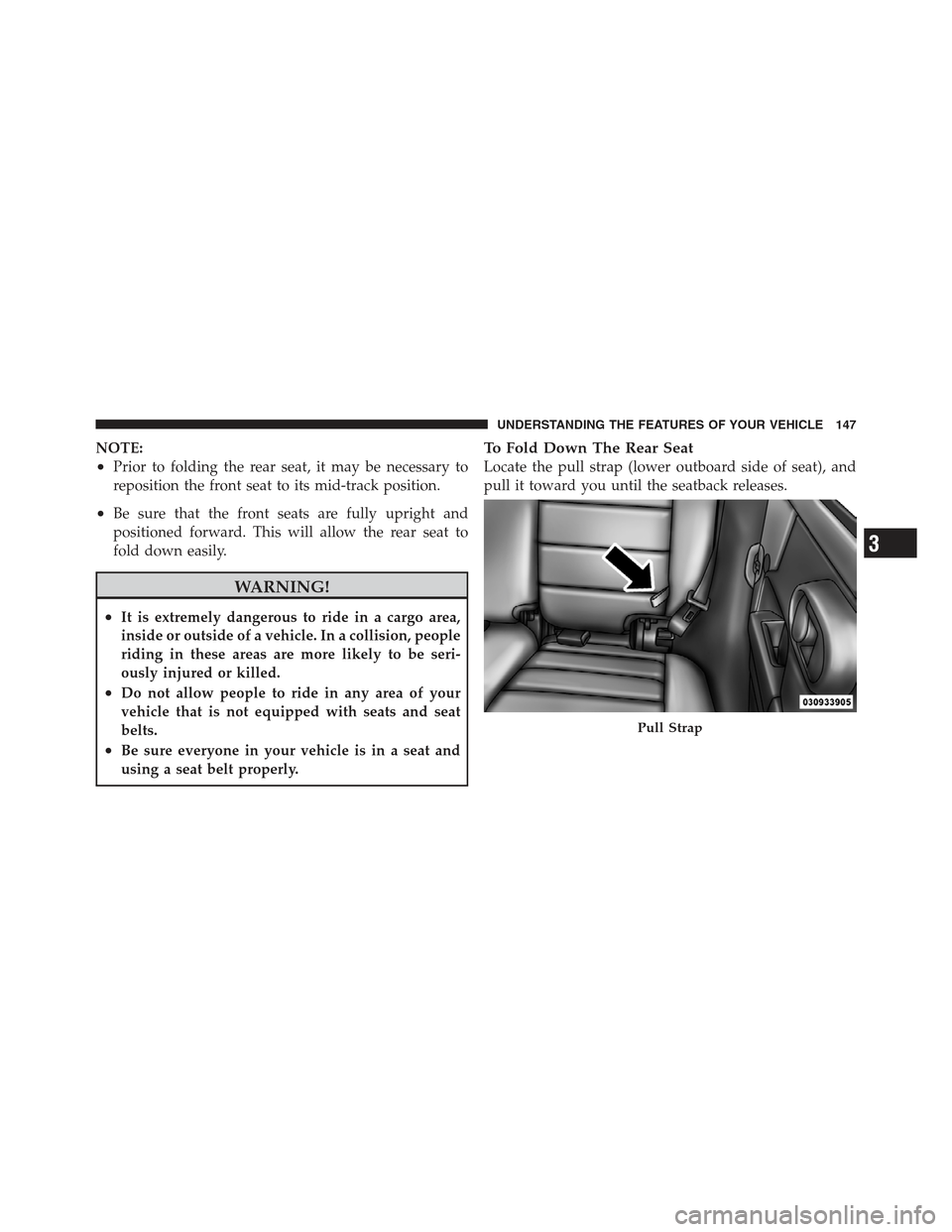
To Fold Down The Rear Seat
Locate the pull strap (lower outboard side of seat), and
pull it toward you until the seatback releases.
Pull Strap
3
UNDERSTANDING THE FEATURES OF YOUR VEHICLE 147
Page 150 of 613

To Raise The Rear Seat
Raise the seatback and lock it into place. If interference
from the cargo area prevents the seatback from fully
locking, you will have difficulty returning the seat to its
proper position.
NOTE:If the rear seatback is not fully latched, the
center shoulder belt will not be able to be extended for
use. If you cannot extend the center shoulder belt, make
sure your seatback is fully latched.
WARNING!
Be certain that the seatback is securely locked into
position. If the seatback in not securely locked into
position the seat will not provide the proper stability
for child seats and/or passengers. An improperly
latched seat could cause serious injury.
TO OPEN AND CLOSE THE HOOD
Release both the hood latches.
Raise the hood and locate the safety latch, located in the
middle of the hood opening. Push the latch to the left side
of the vehicle, to open the hood. You may have to push
down slightly on the hood before pushing the safety
latch. Insert the support rod into the slot on the hood.
Hood Latch
148 UNDERSTANDING THE FEATURES OF YOUR VEHICLE
Page 180 of 613
3. Turn the center L-shaped locks (two) from the center
of the roof panel.4. Turn the rear L-shaped lock (located above the shoul-
der belt anchorage).
178 UNDERSTANDING THE FEATURES OF YOUR VEHICLE
Page 197 of 613
CAUTION! (Continued)
•Refer to “Appearance Care For Fabric Top Models”
in “Maintaining Your Vehicle” for further infor-
mation. It contains important information on
cleaning and caring for your vehicle’s fabric top.
•Do not use any tools (screwdrivers, etc.) to pry or
force any of the clamps, clips, or retainers securing
the soft top. Do not force or pry the soft top
framework when opening or closing. Damage to
the top may result.
WARNING!
•Do not drive the vehicle with the rear window
curtain up unless the side curtains are also re-
moved. Dangerous exhaust gases could enter the
vehicle causing harm to the driver and passengers.
•The fabric upper doors and fabric top are designed
only for protection against the elements. Do not
rely on them to contain occupants within the
vehicle or to protect against injury during an
accident. Remember, always wear seat belts.
3
UNDERSTANDING THE FEATURES OF YOUR VEHICLE 195