Page 480 of 558
If an examination of your engine compartment shows no
evidence of radiator or hose leaks, the vehicle may be
safely driven. The vapor will soon dissipate.
•Do not overfill the coolant bottle.
•Check coolant freeze point in the radiator and in the
coolant recovery bottle. If engine coolant (antifreeze)
needs to be added, contents of coolant recovery bottle
must also be protected against freezing.
•If frequent engine coolant (antifreeze) additions are
required, or if the level in the coolant recovery bottle
does not drop when the engine cools, the cooling
system should be pressure tested for leaks.
•Maintain engine coolant (antifreeze) concentration at
50% HOAT engine coolant (antifreeze) (minimum)
and distilled water for proper corrosion protection of
your engine, which contains aluminum components.
•Make sure that the radiator and coolant recovery
bottle hoses are not kinked or obstructed.
•Keep the front of the radiator clean. If your vehicle is
equipped with air conditioning, keep the front of the
condenser clean.
•Do not change the thermostat for Summer or Winter
operation. If replacement is ever necessary, install
ONLY the correct type thermostat. Other designs may
result in unsatisfactory cooling performance, poor gas
mileage, and increased emissions.
Brake System
In order to assure brake system performance, all brake
system components should be inspected periodically.
Refer to the “Maintenance Schedule” for the proper
maintenance intervals.
478 MAINTAINING YOUR VEHICLE
Page 484 of 558
CAUTION!
Using a transmission fluid other than the manufac-
turer’s recommended fluid may cause deterioration
in transmission shift quality and/or torque converter
shudder. Using a transmission fluid other than that
recommended by the manufacturer will require more
frequent fluid and filter changes. Refer to “Fluids,
Lubricants, and Genuine Parts” in “Maintaining
Your Vehicle” for further information.
Fluid And Filter Changes
Refer to the “Maintenance Schedule” for the proper
maintenance intervals.
In addition, change the fluid and filter if the transmission
is disassembled for any reason.
Transfer Case
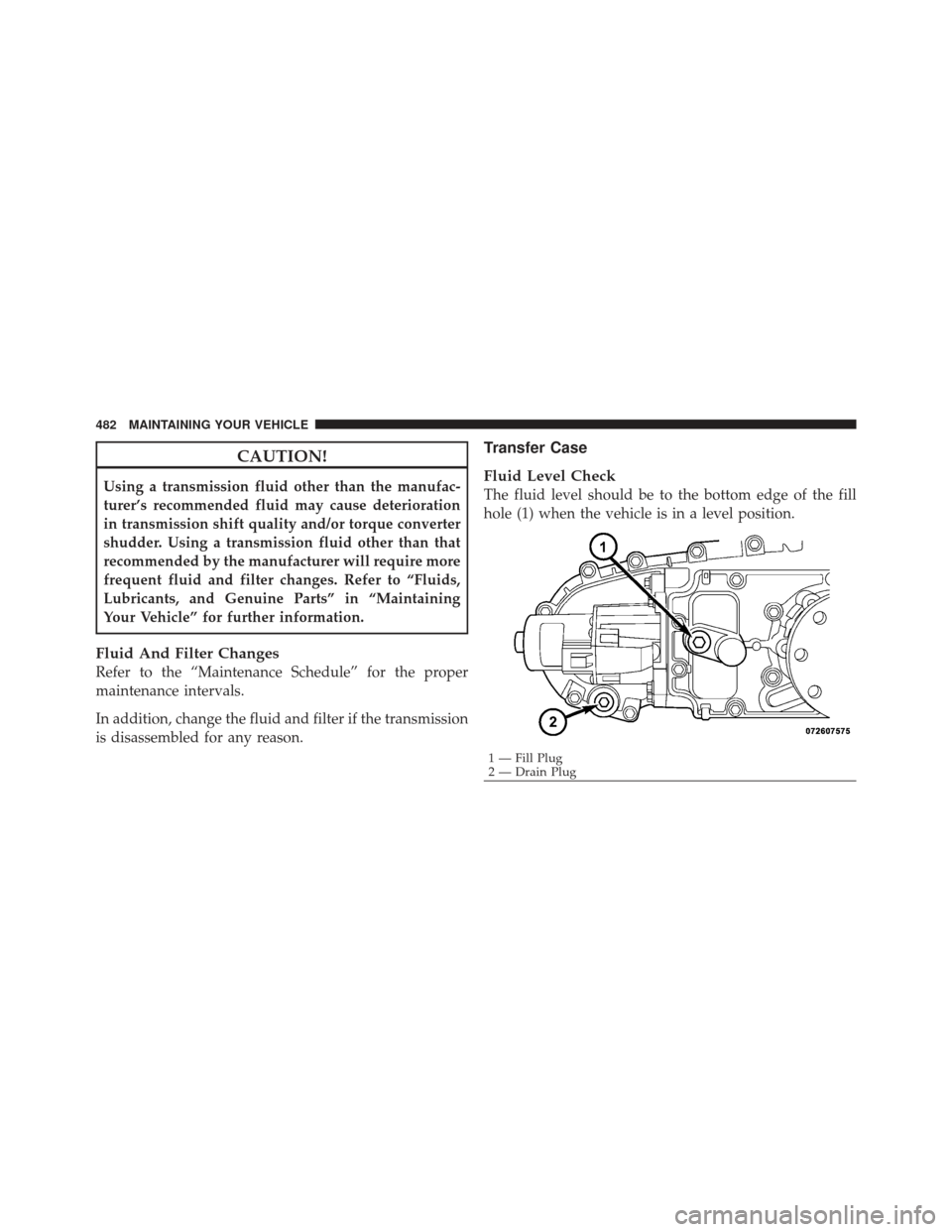
Fluid Level Check
The fluid level should be to the bottom edge of the fill
hole (1) when the vehicle is in a level position.
1 — Fill Plug
2 — Drain Plug
482 MAINTAINING YOUR VEHICLE
Page 489 of 558
The following maintenance recommendations will enable
you to obtain maximum benefit from the corrosion
resistance built into your vehicle.
What Causes Corrosion?
Corrosion is the result of deterioration or removal of
paint and protective coatings from your vehicle.
The most common causes are:
•Road salt, dirt, and moisture accumulation.
•Stone and gravel impact.
•Insects, tree sap, and tar.
•Salt in the air near seacoast localities.
•Atmospheric fallout/industrial pollutants.
Washing
•
Wash your vehicle regularly. Always wash your ve-
hicle in the shade using MOPAR�Car Wash or equiva-
lent, or a mild car wash soap, and rinse the panels
completely with clear water.
•If insects, tar, or other similar deposits have accumu-
lated on your vehicle, use MOPAR� Super Kleen Bug
and Tar Remover or equivalent to remove.
•Use a high quality cleaner wax, such as MOPAR �
Cleaner Wax or equivalent, to remove road film, stains,
and to protect your paint finish. Take care never to
scratch the paint.
•Avoid using abrasive compounds and power buffing
that may diminish the gloss or thin out the paint
finish.
7
MAINTAINING YOUR VEHICLE 487
Page 494 of 558
Seat Belt Maintenance
Do not bleach, dye, or clean the seat belts with chemical
solvents or abrasive cleaners. This will weaken the fabric.
Sun damage can also weaken the fabric.
If the seat belts need cleaning, use a mild soap solution or
lukewarm water. Dry with a soft cloth. Do not remove the
seat belts from the car to wash them. Dry with a soft
cloth.
Replace the seat belts if they appear frayed or worn or if
the buckles do not work properly.
FUSES
Totally Integrated Power Module
The Totally Integrated Power Module is located in the
engine compartment near the battery. This center con-
tains cartridge fuses, mini-fuses and relays. A label that
identifies each component is printed on the inside of the
cover.
Cavity CartridgeFuseMini-
Fuse Description
J1 — — —
J2 30 Amp Pink — Transfer Case Module
– If Equipped
J3 — — —
Totally Integrated Power Module
492 MAINTAINING YOUR VEHICLE
Page 507 of 558
MAINTENANCE SCHEDULES
CONTENTS
�Maintenance Schedule .................. 506
▫ Required Maintenance Intervals .......... 508
8
M
A I
N T
E
N A
N CE
S
C
H E
D
U L
E
S
Page 508 of 558
MAINTENANCE SCHEDULE
The Scheduled Maintenance services listed in this
manual must be done at the times or mileages specified
to protect your vehicle warranty and ensure the best
vehicle performance and reliability. More frequent main-
tenance may be needed for vehicles in severe operating
conditions, such as dusty areas and very short trip
driving. Inspection and service should also be done
anytime a malfunction is suspected.
Your vehicle is equipped with an automatic oil change
indicator system. The oil change indicator system will
remind you that it is time to take your vehicle in for
scheduled maintenance.
On Electronic Vehicle Information Center (EVIC)
equipped vehicles, “Oil Change Required” will be dis-
played in the EVIC and a single chime will sound,
indicating that an oil change is necessary.On Non-EVIC equipped vehicles, “Change Oil” will flash
in the instrument cluster odometer and a single chime
will sound, indicating that an oil change is necessary.
Based on engine operation conditions, the oil change
indicator message will illuminate. This means that ser-
vice is required for your vehicle. Operating conditions
such as frequent short-trips, trailer tow, extremely hot or
cold ambient temperatures, and E85 fuel usage will
influence when the “Change Oil” message is displayed.
Depending on operating conditions, the message may
appear as early as 3,500 miles (5 630 km) since last reset.
Have your vehicle serviced as soon as possible, within
the next 500 miles (805 km).
8
M
A I
N T
E
N A
N CE
S
C
H E
D
U L
E
S506 MAINTENANCE SCHEDULES
Page 509 of 558
NOTE:
•The oil change indicator message will not monitor the
time since the last oil change. Change your vehicle’s
oil if it has been six months since your last oil change,
even if the oil change indicator message is NOT
illuminated.
•Change your engine oil more often if you drive your
vehicle off-road for an extended period of time.
•Under no circumstances should oil change intervals
exceed 8,000 miles (13 000 km) or six months, which-
ever comes first.
Your authorized dealer will reset the oil change indicator
message after completing the scheduled oil change. If a
scheduled oil change is performed by someone other
than your authorized dealer, the message can be reset by referring to the steps described under “Electronic Vehicle
Information Center (EVIC)/Oil Change Required” in
“Understanding Your Instrument Panel” or under “In-
strument Cluster Description/Odometer/Trip Odom-
eter” in “Understanding Your Instrument Panel” for
further information.
At Each Stop For Fuel
•Check the engine oil level about five minutes after a
fully warmed engine is shut off. Checking the oil level
while the vehicle is on level ground will improve the
accuracy of the oil level reading. Add oil only when
the level is at or below the ADD or MIN mark.
•Check the windshield washer solvent and add if
required.
8
M
A I
N T
E
N A
N CE
S
C
H E
D
U L
E
SMAINTENANCE SCHEDULES 507
Page 510 of 558
Once A Month
•Check tire pressure and look for unusual wear or
damage.
•Inspect the battery and clean and tighten the terminals
as required.
•Check the fluid levels of the coolant reservoir and the
brake master cylinder, add as needed.
•Check all lights and other electrical items for correct
operation.
At Each Oil Change
•Change the engine oil filter.
•Inspect the brake hoses and lines.
CAUTION!
•Failure to perform the required maintenance items
may result in damage to the vehicle.
•Proper operation of four-wheel drive vehicles de-
pends on tires of equal size, type and circumfer-
ence on each wheel. Any difference in tire size can
cause damage to the transfer case. Tire rotation
schedule should be followed to balance tire wear.
Required Maintenance Intervals
Refer to the Maintenance Schedules on the following
pages for the required maintenance intervals.
8
M A I
N T
E
N A
N CE
S
C
H E
D
U L
E
S508 MAINTENANCE SCHEDULES