Page 554 of 679
Jacking Instructions
WARNING!
Carefully follow these tire changing warnings to
help prevent personal injury or damage to your
vehicle:
•Always park on a firm, level surface as far from
the edge of the roadway as possible before raising
the vehicle.
•Turn on the Hazard Warning flasher.
•Block the wheel diagonally opposite the wheel to
be raised.
•Set the parking brake firmly and set an automatic
transmission in PARK.
•Never start or run the engine with the vehicle on a
jack.(Continued)
WARNING! (Continued)
•Do not let anyone sit in the vehicle when it is on a
jack.
•Do not get under the vehicle when it is on a jack.
•Only use the jack in the positions indicated and
for lifting this vehicle during a tire change.
•If working on or near a roadway, be extremely
careful of motor traffic.
•To assure that spare tires, flat or inflated, are
securely stowed, spares must be stowed with the
valve stem facing the ground.
Jack Warning Label
552 WHAT TO DO IN EMERGENCIES
Page 563 of 679

WARNING!
•Take care to avoid the radiator cooling fan when-
ever the hood is raised. It can start anytime the
ignition switch is on. You can be injured by
moving fan blades.
•Remove any metal jewelry such as watch bands or
bracelets that might make an inadvertent electrical
contact. You could be seriously injured.
•Batteries contain sulfuric acid that can burn your
skin or eyes and generate hydrogen gas which is
flammable and explosive. Keep open flames or
sparks away from the battery.
1. Set the parking brake, shift the automatic transmission
into PARK and turn the ignition to LOCK.
2. Turn off the heater, radio, and all unnecessary electri-
cal accessories. 3. Remove the protective cover over the remote positive
(+)
battery post. Pull upward on the cover to remove it.
4. If using another vehicle to jump-start the battery, park
the vehicle within the jumper cables reach, set the
parking brake and make sure the ignition is OFF.
WARNING!
Do not allow vehicles to touch each other as this
could establish a ground connection and personal
injury could result.
Jump-Starting Procedure
WARNING!
Failure to follow this procedure could result in per-
sonal injury or property damage due to battery ex-
plosion.
6
WHAT TO DO IN EMERGENCIES 561
Page 565 of 679

9. Disconnect the positive(+)end of the jumper cable
from the remote positive (+)post of the discharged
vehicle.
10. Reinstall the protective cover over the remote posi-
tive (+)battery post of the discharged vehicle.
If frequent jump-starting is required to start your vehicle
you should have the battery and charging system in-
spected at your authorized dealer.
CAUTION!
Accessories that can be plugged into the vehicle
power outlets draw power from the vehicle’s battery,
even when not in use (i.e., cellular phones, etc.).
Eventually, if plugged in long enough, the vehicle’s
battery will discharge sufficiently to degrade battery
life and/or prevent the engine from starting.
FREEING A STUCK VEHICLE
If the vehicle becomes stuck in snow, sand or mud, it can
often be moved by a rocking motion. Move the shift lever
rhythmically between DRIVE and REVERSE while ap-
plying slight pressure to the accelerator. In general, the
least amount of accelerator pedal pressure to maintain
the rocking motion without spinning the wheels or racing
the engine is most effective.
CAUTION!
Racing the engine or spinning the wheels may lead to
transmission overheating and failure. Allow the en-
gine to idle with the shift lever in NEUTRAL for at
least one minute after every five rocking-motion
cycles. This will minimize overheating and reduce
the risk of transmission failure during prolonged
efforts to free a stuck vehicle.6
WHAT TO DO IN EMERGENCIES 563
Page 566 of 679

CAUTION!
•When “rocking” a stuck vehicle by moving be-
tween DRIVE and REVERSE, do not spin the
wheels faster than 15 mph (24 km/h), or drivetrain
damage may result.
•Revving the engine or spinning the wheels too fast
may lead to transmission overheating and failure.
It can also damage the tires. Do not spin the
wheels above 30 mph (48 km/h) while in gear (no
transmission shifting occurring).
WARNING!
Fast spinning tires can be dangerous. Forces gener-
ated by excessive wheel speeds may cause damage, or
even failure, of the axle and tires. A tire could
explode and injure someone. Do not spin your vehi-
cle’s wheels faster than 30 mph (48 km/h) or for
longer than 30 seconds continuously without stop-
ping when you are stuck and do not let anyone near
a spinning wheel, no matter what the speed.
EMERGENCY TOW HOOKS — IF EQUIPPED
If your vehicle is equipped with tow hooks, there will be
one in the rear and two mounted on the front of the
vehicle. The rear hook will be located on the driver’s side
of the vehicle.
NOTE:For off-road recovery, it is recommended to use
both of the front tow hooks to minimize the risk of
damage to the vehicle.
564 WHAT TO DO IN EMERGENCIES
Page 569 of 679
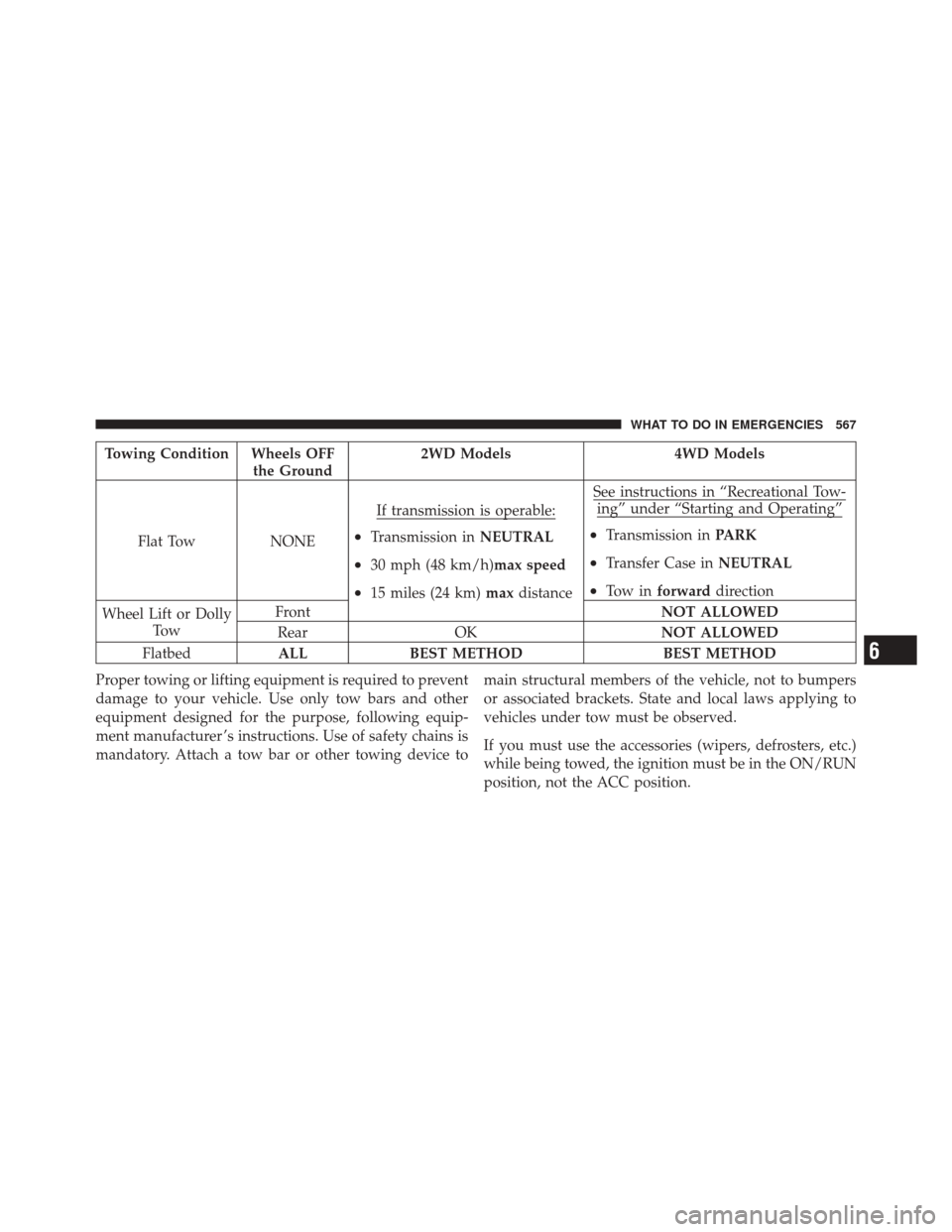
Towing Condition Wheels OFFthe Ground 2WD Models
4WD Models
Flat Tow NONEIf transmission is operable:
•Transmission in
NEUTRAL
•30 mph (48 km/h)max speed
•15 miles (24 km) maxdistance See instructions in “Recreational Tow-
ing” under “Starting and Operating”
•Transmission in
PARK
•Transfer Case in NEUTRAL
•To w i nforward direction
Wheel Lift or Dolly To w Front
NOT ALLOWED
Rear OK NOT ALLOWED
Flatbed ALL BEST METHOD BEST METHOD
Proper towing or lifting equipment is required to prevent
damage to your vehicle. Use only tow bars and other
equipment designed for the purpose, following equip-
ment manufacturer ’s instructions. Use of safety chains is
mandatory. Attach a tow bar or other towing device to main structural members of the vehicle, not to bumpers
or associated brackets. State and local laws applying to
vehicles under tow must be observed.
If you must use the accessories (wipers, defrosters, etc.)
while being towed, the ignition must be in the ON/RUN
position, not the ACC position.
6
WHAT TO DO IN EMERGENCIES 567
Page 570 of 679

If the vehicle’s battery is discharged, refer to “Shift Lever
Override” in “What to Do in Emergencies” for instruc-
tions on shifting the automatic transmission out of the
PARK position for towing.
CAUTION!
Do not attempt to use sling type equipment when
towing. When securing the vehicle to a flat bed truck,
do not attach to front or rear suspension components.
Damage to your vehicle may result from improper
towing.
Towing Without The Ignition Key Fob
Special care must be taken when the vehicle is towed
with the ignition in the LOCK/OFF position. The only
approved method of towing without the ignition key is
with a flatbed truck. Proper towing equipment is neces-
sary to prevent damage to the vehicle.
Two-Wheel Drive Models
The manufacturer recommends towing your vehicle with
all four wheelsOFFthe ground using a flatbed.
If flatbed equipment is not available, and the transmis-
sion is operable, the vehicle may be towed (with rear
wheels on the ground) with the transmission in NEU-
TRAL. Speed must not exceed 30 mph (48 km/h) and the
distance must not exceed 15 miles (24 km).
CAUTION!
Towing faster than 30 mph (48 km/h) or farther than
15 miles (24 km) with rear wheels on the ground can
cause severe damage to the transmission. Such dam-
age is not covered by the New Vehicle Limited
Warranty.
568 WHAT TO DO IN EMERGENCIES
Page 571 of 679

If the transmission is not operable, or the vehicle must be
towed faster than 30 mph (48 km/h) or farther than
15 miles (24 km), tow with the rear wheelsOFFthe
ground. Acceptable methods are to tow the vehicle on a
flatbed, or with the front wheels raised and the rear
wheels on a towing dolly, or (when using a suitable
steering wheel stabilizer to hold the front wheels in the
straight position) with the rear wheels raised and the
front wheels on the ground.
Four-Wheel Drive Models
The manufacturer recommends towing with all wheels
OFF the ground. Acceptable methods are to tow the
vehicle on a flatbed or with one end of vehicle raised and
the opposite end on a towing dolly.
If flatbed equipment is not available, and the transfer
case is operable, vehicles with a two-speed transfer case
may be towed (in the forward direction, with ALLwheels
on the ground), IFthe transfer case is in NEUTRAL and the transmission is in
PARK. Refer to “Recreational
Towing” in “Starting And Operating” for detailed in-
structions.
Vehicles equipped with a single-speed transfer case have
no NEUTRAL position, and therefore mustbe towed
with all four wheels OFFthe ground.
CAUTION!
•Front or rear wheel lifts should not be used.
Internal damage to the transmission or transfer
case will occur if a front or rear wheel lift is used
when towing.
•Failure to follow these towing methods can cause
severe damage to the transmission and/or transfer
case. Such damage is not covered by the New
Vehicle Limited Warranty.
6
WHAT TO DO IN EMERGENCIES 569
Page 574 of 679

▫Brake System ....................... 597
▫ Front/Rear Axle Fluid ................. 599
▫ Transfer Case ....................... 600
▫ Automatic Transmission ............... 601
▫ Appearance Care And Protection From
Corrosion .......................... 604
� Fuses .............................. 610
▫ Totally Integrated Power Module ......... 610
� Vehicle Storage ....................... 616
� Replacement Bulbs .................... 616
� Bulb Replacement ..................... 617
▫ High Intensity Discharge Headlamps (HID) –
If Equipped ........................ 617 ▫
Halogen Headlamps – If Equipped ........ 618
▫ Front Turn Signal .................... 618
▫ Front Fog Lamps .................... 619
▫ Rear Tail, Stop, Turn Signal, And Backup
Lamps ............................ 620
▫ Rear Liftgate Mounted Tail Lamp ......... 620
▫ Center High-Mounted Stop Lamp
(CHMSL) .......................... 621
▫ Rear License Lamp ................... 622
� Fluid Capacities ...................... 622
� Fluids, Lubricants, And Genuine Parts ....... 623
▫ Engine ............................ 623
▫ Chassis ........................... 624
572 MAINTAINING YOUR VEHICLE
