2012 Hyundai Sonata Hybrid parking brake
[x] Cancel search: parking brakePage 314 of 403
721
Maintenance
Parking brake
Inspect the parking brake system includ-
ing the parking brake pedal and cables.
Brake discs, pads, calipers and
rotors
Check the pads for excessive wear, discs
for run out and wear, and calipers for fluid
leakage.
Exhaust pipe and muffler
Visually inspect the exhaust pipes, muf-
fler and hangers for cracks, deterioration,
or damage. Start the engine and listen
carefully for any exhaust gas leakage.
Tighten connections or replace parts as
necessary.
Suspension mounting bolts
Check the suspension connections for
looseness or damage. Retighten to the
specified torque.
Steering gear box, linkage &
boots/lower arm ball joint
With the vehicle stopped and engine off,
check for excessive free-play in the
steering wheel.
Check the linkage for bends or damage.
Check the dust boots and ball joints for
deterioration, cracks, or damage.
Replace any damaged parts.
Drive shafts and boots
Check the drive shafts, boots and clamps
for cracks, deterioration, or damage.
Replace any damaged parts and, if nec-
essary, repack the grease.
Air conditioning refrigerant
Check the air conditioning lines and con-
nections for leakage and damage.
Page 321 of 403
Maintenance
28
7
WASHER FLUID
Checking the washer fluid level
The reservoir is translucent so that you
can check the level with a quick visual
inspection.
Check the fluid level in the washer fluid
reservoir and add fluid if necessary. Plain
water may be used if washer fluid is not
available. However, use washer solvent
with antifreeze characteristics in cold cli-
mates to prevent freezing.
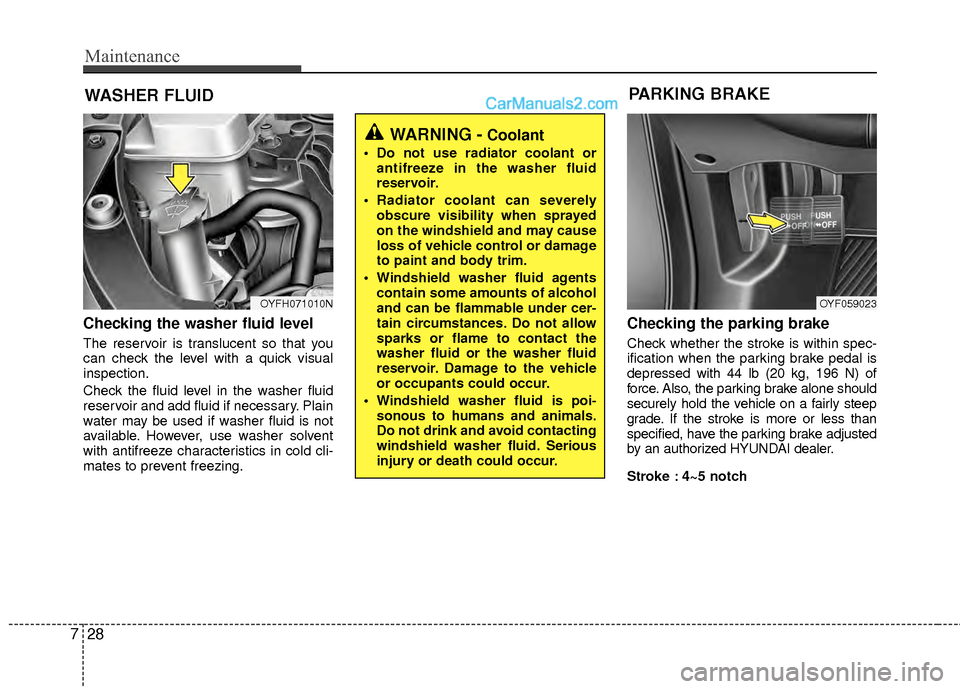
Checking the parking brake
Check whether the stroke is within spec-
ification when the parking brake pedal is
depressed with 44 lb (20 kg, 196 N) of
force. Also, the parking brake alone should
securely hold the vehicle on a fairly steep
grade. If the stroke is more or less than
specified, have the parking brake adjusted
by an authorized HYUNDAI dealer.
Stroke : 4~5 notch
WARNING -Coolant
Do not use radiator coolant or
antifreeze in the washer fluid
reservoir.
Radiator coolant can severely obscure visibility when sprayed
on the windshield and may cause
loss of vehicle control or damage
to paint and body trim.
Windshield washer fluid agents contain some amounts of alcohol
and can be flammable under cer-
tain circumstances. Do not allow
sparks or flame to contact the
washer fluid or the washer fluid
reservoir. Damage to the vehicle
or occupants could occur.
Windshield washer fluid is poi- sonous to humans and animals.
Do not drink and avoid contacting
windshield washer fluid. Serious
injury or death could occur.
OYFH071010N
PARKING BRAKE
OYF059023
Page 353 of 403
Maintenance
60
7
LIGHT BULBS
Use only bulbs of the specified wattage.
✽
✽
NOTICE
After heavy, driving rain or washing,
headlight and taillight lenses could
appear frosty. This condition is caused by
the temperature difference between the
lamp inside and outside. This is similar
to the condensation on your windows
inside your vehicle during the rain and
doesn’t indicate a problem with your
vehicle. If the water leaks into the lamp
bulb circuitry, have the vehicle checked
by an authorized HYUNDAI dealer.WARNING - Working on
the lights
Prior to working on the light, firmly
apply the parking brake, ensure
that the engine start/stop button is
turned to the LOCK position and
turn off the lights to avoid sudden
movement of the vehicle and burn-
ing your fingers or receiving an
electric shock.
CAUTION
Be sure to replace the burned-out
bulb with one of the same wattagerating. Otherwise, it may causedamage to the fuse or electric wiring system.
CAUTION
If you don’t have necessary tools,the correct bulbs and the expertise,consult an authorized HYUNDAIdealer. In many cases, it is difficultto replace vehicle light bulbsbecause other parts of the vehicle must be removed before you canget to the bulb. This is especiallytrue if you have to remove the head-light assembly to
get to the bulb(s).
Removing/installingthe headlight
assembly can result in damage to the vehicle.
WARNING
When you replace the bulb of front-
light, be careful the HPCU system,
high voltage cable (orange color)
and high voltage components for
hybrid.
It is very dangerous because the
HPCU has the high voltage. Always
pay strongly attention to your
hands. If not, it may result in the
electric shock or burns.
Page 387 of 403
H6
Starting the engine
1. Carry the smart key or leave it insidethe vehicle.
2. Make sure the parking brake is firmly applied.
3. Place the shift lever in the P(Park) position. In N(Neutral) position, you
can not start the vehicle.
4. Depress the brake pedal.
5. Press the engine start/stop button.
6. In extremely cold weather or after the vehicle has not been operated for sev-
eral days, let the engine warm up with-
out depressing the accelerator.
Whether the engine is cold or warm, it
should be started without depressing
the accelerator.
if it is far away from you, the engine
may not start.
in the ACC or ON position, if any door
is open, the system checks for the
smart key. If the smart key is not in
the vehicle, the warning, "Key is not
in vehicle" will come on, and if all
doors are closed, the chime will also
sound for about 5 seconds. The indi-
cator will turn off while the vehicle is
moving. Keep the smart key in the
vehicle when using the ACC position
or if the vehicle engine is on. IF the starting procedure is followed,
the "READY" symbol on the instru-
ment cluster will turn on. For more
details, Please check chapter 5.
ECONOMICAL and SAFE OPERA-
TION of Hybrid system
Drive smoothly. Accelerate at a mod-
erate rate and maintain a steady cruis-
ing speed. Don't make "jack-rabbit"
starts. Don't race between stoplights.
Avoid heavy traffic whenever possible.
Always maintain a safe distance from
other vehicles so you can avoid unnec-
essary braking. This also reduces
brake wear.
The regenerative brake generates energy when the vehicle decelerates.
When the hybrid battery power is low, the hybrid system automatically
recharges the hybrid battery.
When the engine runs in "N" position, the hybrid system can not generate
electricity. The hybrid battery cannot
recharge in "N" position. Please check
chapter 5.
✽ ✽ NOTICE
In the hybrid system, the engine auto-
matically runs and stops. If the hybrid
system operates, the "READY" symbol
is illuminated.
In the following situation, the engine
may operate automatically.
- When the engine is ready to run
- When the hybrid battery is charged
- Depending on the temperature condi-
tion of the hybrid battery
STARTING THE HYBRID VEHICLE (SMART KEY)
Page 394 of 403
H13
If An Accident OccursWhen the hybrid vehicle shuts off
When the high voltage battery dis-
charged, 12-volt battery discharged, or
fuel tank is empty, the hybrid system may
not operate while driving. If the Hybrid
system is not operated, do the following;
1. Reduce the vehicle speed gradually.
Pull your vehicle off the road as safe
area.
2. Shift the transmission into "P" position.
3. Turn on the hazard warning flashers.
4. Set the start button at OFF, and try to start the Hybrid system by applying the
brake pedal and pushing the start but-
ton.
5. If the Hybrid system will not operate, refer to "EMERGENCY STARTING" in
chapter 6.
When you try to jump start the vehicle,
confirm the fuel level and exact proce-
dure of jump start. For details, see the
"EMERGENCY STARING" in chapter 6.
If the fuel level is low, do not try to drive
the vehicle on battery power. The high
voltage battery may be discharged and
the Hybrid system will turn off.
WARNING
After parking the vehicle, shift the transmission into "P" position.
Turn off the hybrid system. Push
the button again to turn off.
For your safety, do not touch high voltage cables, connectors and
package modules.
Exposed cables or wires maybe visible inside or outside of the
vehicle. Never touch the wires or
cables, because an electrical
shock may occur causing injury or
death.
If a fire occurs, never use water to put out a fire. For safety, use an
extinguisher for electrical fires
with proper chemicals and evacu-
ate immediately.
If you need towing, refer to chapter 6.
WARNING
When you pull your vehicle off the
road as safe area, open the door
when the vehicle completely stops.
Page 396 of 403

Index
2I
Air bags··················\
··················\
··················\
··················\
··3-35Air bag warning label··················\
··················\
············3-62
Air bag warning light ··················\
··················\
············3-38
Curtain air bag··················\
··················\
··················\
·····3-53
Driver's and passenger's front air bag ··················\
·····3-48
Occupant classification system ··················\
···············3-42
Side impact air bag··················\
··················\
················3-52
SRS components and functions ··················\
··············3-39
Air cleaner ··················\
··················\
··················\
···············7-30
Antenna (glass) ··················\
··················\
··················\
······4-111
Anti-lock brake system (ABS) ··················\
··················\
··5-18
Appearance care··················\
··················\
··················\
·······7-69 Exterior care ··················\
··················\
··················\
········7-69
Interior care ··················\
··················\
··················\
·········7-73
Armrest ··················\
··················\
··················\
··················\
··3-13
Audio system ··················\
··················\
··················\
·········4-111 Glass antenna ··················\
··················\
··················\
·····4-111
Steering wheel audio control ··················\
·················4-111
Automatic climate control system (Type A)··················\
4-80 Air conditioning ··················\
··················\
··················\
··4-88
Climate control air filter··················\
··················\
········4-90
Economy air conditioning ··················\
··················\
·····4-87
Heating and air conditioning··················\
··················\
·4-81
Automatic climate control system (Type B)··················\
4-91 Air conditioning ··················\
··················\
··················\
··4-99
Automatic heating and air conditioning··················\
··4-92
Economy air conditioning ··················\
··················\
·····4-98 Manual heating and air conditioning ··················\
······4-93
Automatic transaxle ··················\
··················\
··················\
···5-9 Shift lock system ··················\
··················\
··················\
·5-12
Aux, USB and iPod port ··················\
··················\
··········4-110
Battery ··················\
··················\
··················\
··············7-34, 8-2
Battery saver function··················\
··················\
················4-69
Before driving ··················\
··················\
··················\
············5-3
Bottle holders, see cup holders ··················\
··················\
4-106
Brake system··················\
··················\
··················\
············5-14 Anti-lock brake system (ABS) ··················\
················5-18
Electronic stability control (ESC) ··················\
···········5-19
Hill-start assist control (HAC) ··················\
················5-22
Parking brake ··················\
··················\
··················\
······5-16
Power brakes ··················\
··················\
··················\
·······5-14
Brakes fluid··················\
··················\
··················\
··············7-27
Bulb replacement ··················\
··················\
··················\
·····7-60
Bulb wattage ··················\
··················\
··················\
·············8-3
Button start/stop, see engine start/stop button·················5-5
California perchlorate notice ··················\
··················\
·····7-78
Camera (Rear view) ··················\
··················\
··················\
·4-68
Capacities (Lubricants) ··················\
··················\
···············8-5
Capacity/Weight ·················\
··················\
··················\
·········8-2
A
B
C
Page 401 of 403

I7
Index
Occupant classification system··················\
··················\
··3-42
Odometer ··················\
··················\
··················\
·················4-41\
Oil (Engine) ··················\
··················\
··················\
·············7-22
Outside rearview mirror··················\
··················\
·············4-39
Overheats ··················\
··················\
··················\
··················\
·6-7
Owner maintenance ··················\
··················\
··················\
···7-5
Panorama sunroof ··················\
··················\
··················\
····4-25
Parking brake ··················\
··················\
··················\
···········5-14
Parking brake inspect··················\
··················\
·················7-28\
Passenger's front air bag ··················\
··················\
············3-48
Power brakes··················\
··················\
··················\
············5-21
Power outlet ··················\
··················\
··················\
···········4-108
Power window lock button ··················\
··················\
········4-20
Pre-tensioner seat belt··················\
··················\
················3-21
Push starting··················\
··················\
··················\
···············6-6
Rear seat··················\
··················\
··················\
··················\
·3-11
Rear view camera ··················\
··················\
··················\
····4-68
Recommended cold tire inflation pressures ··················\
7-37
Recommended lubricants and capacities ··················\
·······8-5Recommended SAE viscosity number··················\
······8-5 Refrigerant label ··················\
··················\
··················\
········8-8
Replacement light bulb ··················\
··················\
··············7-60
Reporting safety defects ··················\
··················\
············8-10
Road warning ··················\
··················\
··················\
·············6-2
Rocking the vehicle ··················\
··················\
··················\
·5-30
Scheduled maintenance service ··················\
··················\
···7-7
Maintenance under severe usage conditions ·············7-18
Normal maintenance schedule ··················\
··················\
7-8
Seat belt warning ··················\
··················\
··················\
·····3-16
Seat belts ··················\
··················\
··················\
··················\
3-15 Driver's 3-point system with emergency locking retractor ··················\
··················\
··················\
·············3-17
Front passenger and rear seat 3-point system with combination locking retractor ··················\
···············3-20
Height adjustment ··················\
··················\
·················3-18\
Pre-tensioner seat belt ··················\
··················\
···········3-21
Seat belt warning··················\
··················\
··················\
·3-16
Seat belts height adjustment ··················\
··················\
······3-18
Seat warmer ··················\
··················\
··················\
······3-9, 3-12
Seatback pocket ··················\
··················\
··················\
·········3-8
Seats ··················\
··················\
··················\
··················\
·········3-2 Armrest ··················\
··················\
··················\
················3-13
Front seat adjustment ··················\
··················\
··············3-4
Headrest ··················\
··················\
··················\
·······3-7, 3-11
Rear seat ··················\
··················\
··················\
··············3-11
Seat warmer ··················\
··················\
··················\
·3-9, 3-12
P
R
S
O