Page 6 of 560
Introduction
6
1
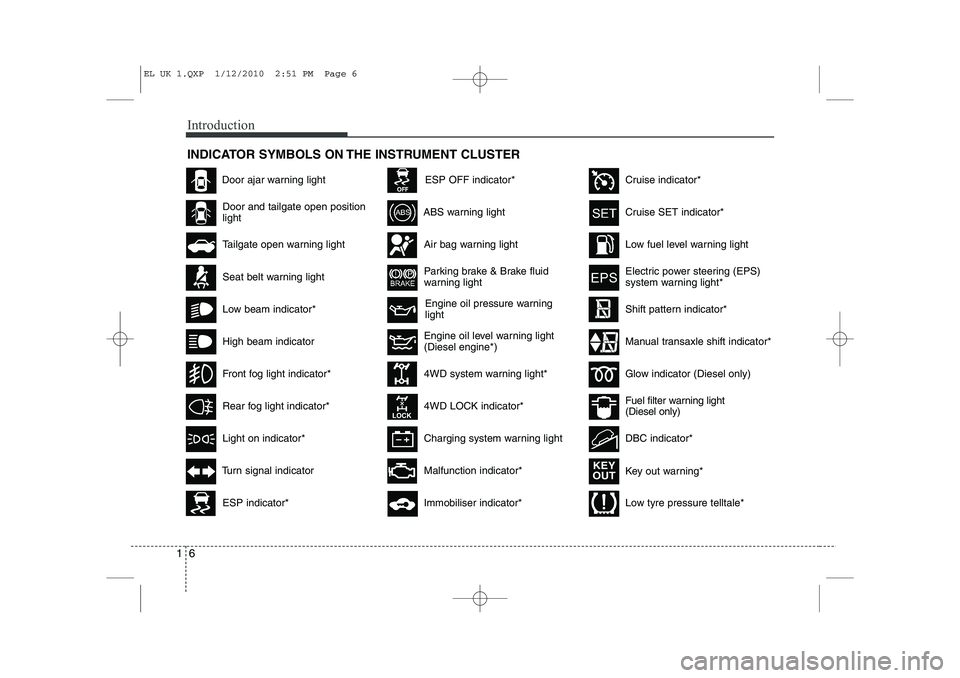
INDICATOR SYMBOLS ON THE INSTRUMENT CLUSTER
Engine oil pressure warning light
Seat belt warning light
Door and tailgate open position light
High beam indicator
Light on indicator*
Turn signal indicator
ABS warning light
Parking brake & Brake fluid
warning light
4WD system warning light* 4WD LOCK indicator*
Malfunction indicator*
Air bag warning light
Cruise SET indicator*
Low fuel level warning light
Charging system warning light
Door ajar warning light
Glow indicator (Diesel only)
Fuel filter warning light (Diesel only)
Cruise indicator*
ESP indicator*
ESP OFF indicator*
Immobiliser indicator*
Shift pattern indicator*
Front fog light indicator*
Rear fog light indicator*
Low beam indicator*
Electric power steering (EPS)
system warning light*
Key out warning*
KEY
OUT
DBC indicator*
Tailgate open warning light
Engine oil level warning light (Diesel engine*)
Low tyre pressure telltale*
Manual transaxle shift indicator*
EL UK 1.QXP 1/12/2010 2:51 PM Page 6
Page 9 of 560
Your vehicle at a glance
2
2
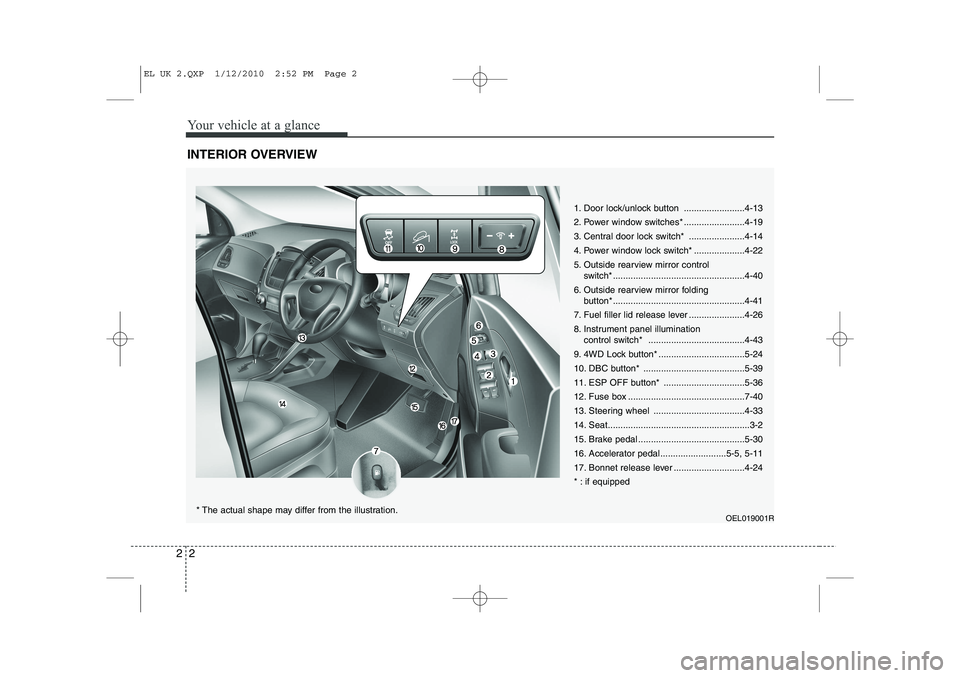
INTERIOR OVERVIEW
1. Door lock/unlock button ........................4-13
2. Power window switches* ........................4-19
3. Central door lock switch* ......................4-14
4. Power window lock switch* ....................4-22
5. Outside rearview mirror control
switch* ....................................................4-40
6. Outside rearview mirror folding button* ....................................................4-41
7. Fuel filler lid release lever ......................4-26
8. Instrument panel illumination control switch* ......................................4-43
9. 4WD Lock button* ..................................5-24
10. DBC button* ........................................5-39
11. ESP OFF button* ................................5-36
12. Fuse box ..............................................7-40
13. Steering wheel ....................................4-33
14. Seat........................................................3-2
15. Brake pedal ..........................................5-30
16. Accelerator pedal..........................5-5, 5-11
17. Bonnet release lever ............................4-24
* : if equipped
OEL019001R
* The actual shape may differ from the illustration.
EL UK 2.QXP 1/12/2010 2:52 PM Page 2
Page 14 of 560
Safety system of your vehicle
2
3
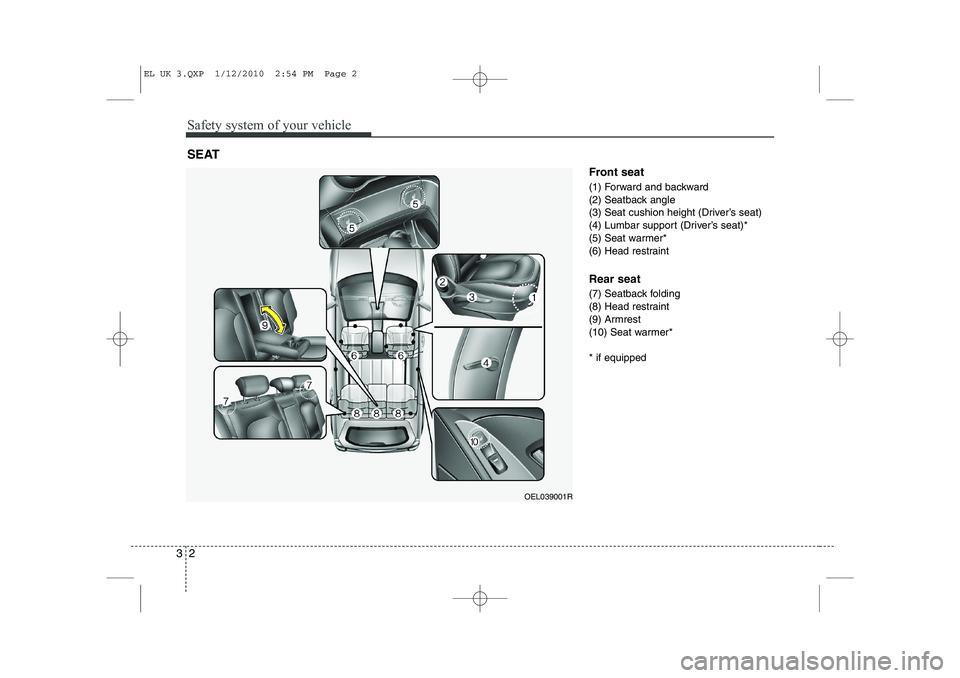
Front seat
(1) Forward and backward
(2) Seatback angle
(3) Seat cushion height (Driver’s seat)
(4) Lumbar support (Driver’s seat)*
(5) Seat warmer*
(6) Head restraint Rear seat
(7) Seatback folding
(8) Head restraint
(9) Armrest
(10) Seat warmer* * if equipped
SEAT
OEL039001R
EL UK 3.QXP 1/12/2010 2:54 PM Page 2
Page 16 of 560
Safety system of your vehicle
4
3
(Continued)
When resetting the seatback to
the upright position, make sure it
is securely latched by pushing it
forward and reverse.WARNING - Rear seatbacks
The rear seatback must be securely latched. If not, passen-
gers and objects could be thrown
forward resulting in serious
injury or death in the event of a
sudden stop or collision.
Luggage and other cargo should be laid flat in the cargo area. If
objects are large, heavy, or must
be piled, they must be secured.
Under no circumstances should
cargo be piled higher than the
seatbacks. Failure to follow thesewarnings could result in serious
injury or death in the event of a
sudden stop, collision or rollover.
No passenger should ride in the cargo area or sit or lie on folded
seatbacks whilst the vehicle is
moving. All passengers must be
properly seated in seats and
restrained properly whilst riding.
(Continued)WARNING
After adjusting the seat, always
check that it is securely locked into
place by attempting to move the
seat forward or reverse without
using the lock release lever.
Sudden or unexpected movement
of the driver's seat could cause you
to lose control of the vehicle result-ing in an accident.
EL UK 3.QXP 1/12/2010 2:54 PM Page 4
Page 17 of 560
35
Safety system of your vehicle
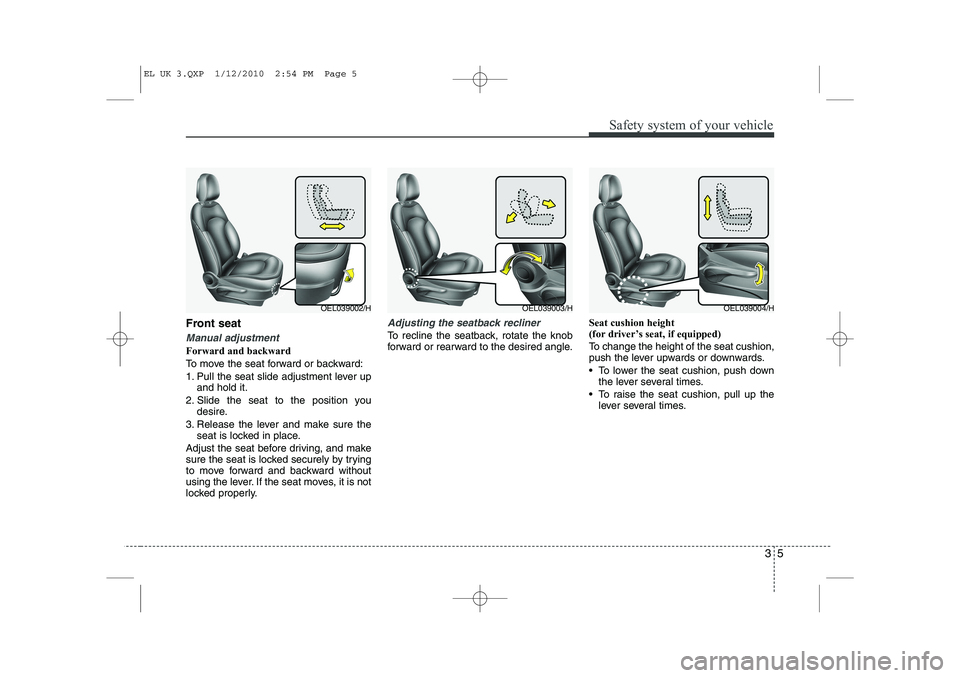
Front seat
Manual adjustment
Forward and backward
To move the seat forward or backward:
1. Pull the seat slide adjustment lever upand hold it.
2. Slide the seat to the position you desire.
3. Release the lever and make sure the seat is locked in place.
Adjust the seat before driving, and make
sure the seat is locked securely by trying
to move forward and backward without
using the lever. If the seat moves, it is not
locked properly.
Adjusting the seatback recliner
To recline the seatback, rotate the knob
forward or rearward to the desired angle. Seat cushion height
(for driver’s seat, if equipped)
To change the height of the seat cushion,
push the lever upwards or downwards.
To lower the seat cushion, push down
the lever several times.
To raise the seat cushion, pull up the lever several times.
OEL039002/HOEL039003/HOEL039004/H
EL UK 3.QXP 1/12/2010 2:54 PM Page 5
Page 19 of 560
37
Safety system of your vehicle
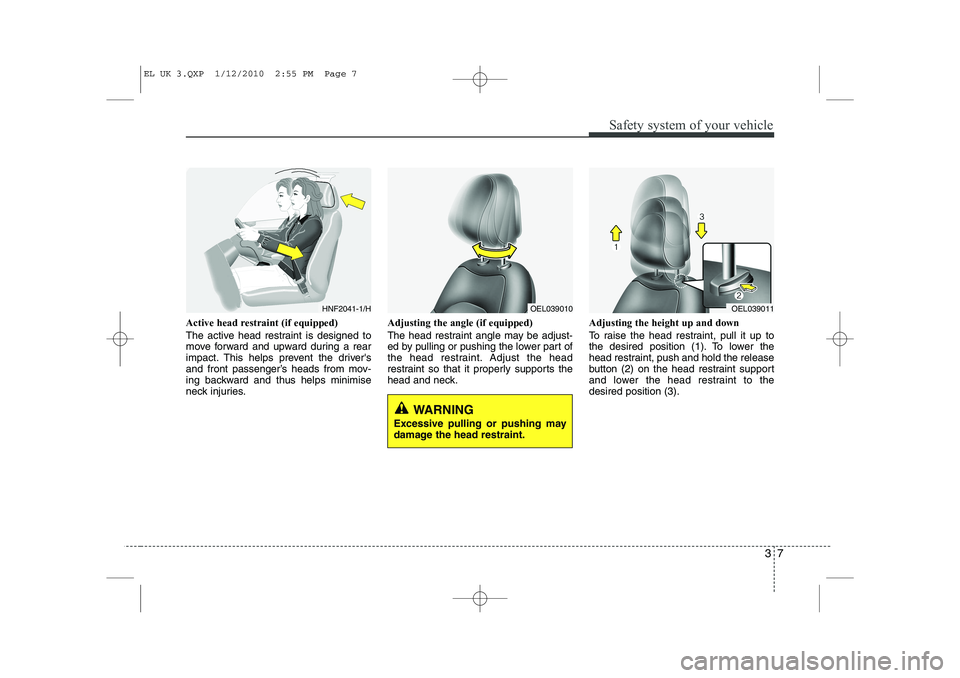
Active head restraint (if equipped)
The active head restraint is designed to
move forward and upward during a rear
impact. This helps prevent the driver's
and front passenger’s heads from mov-
ing backward and thus helps minimise
neck injuries.Adjusting the angle (if equipped)
The head restraint angle may be adjust-
ed by pulling or pushing the lower part of
the head restraint. Adjust the head
restraint so that it properly supports the
head and neck.
Adjusting the height up and down
To raise the head restraint, pull it up to
the desired position (1). To lower the
head restraint, push and hold the release
button (2) on the head restraint support
and lower the head restraint to thedesired position (3).
HNF2041-1/HOEL039010OEL039011
WARNING
Excessive pulling or pushing may
damage the head restraint.
EL UK 3.QXP 1/12/2010 2:55 PM Page 7
Page 22 of 560
Safety system of your vehicle
10
3
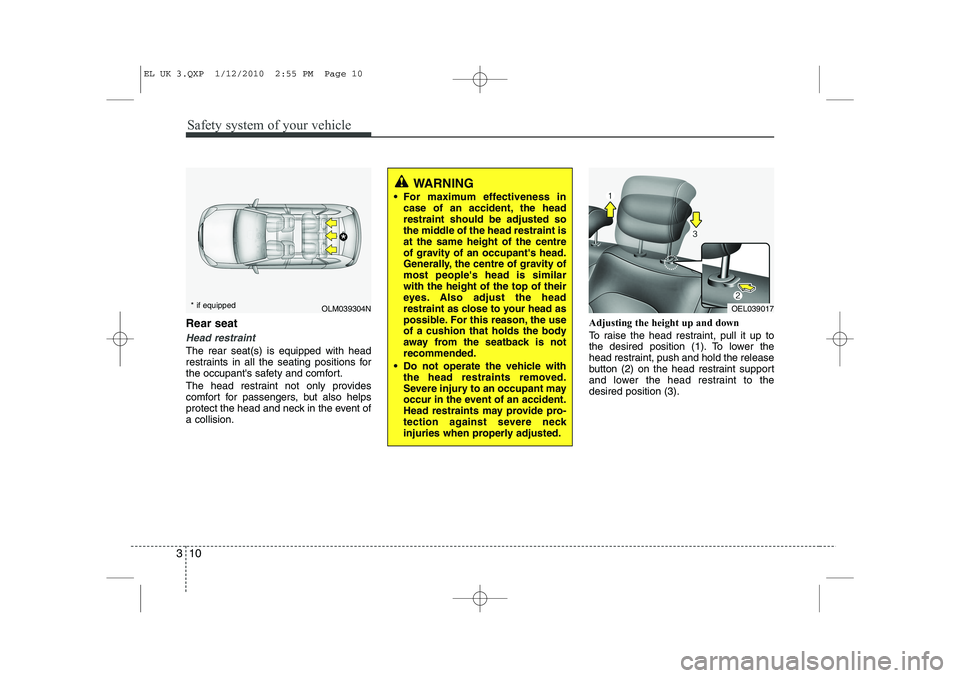
Rear seat
Head restraint
The rear seat(s) is equipped with head
restraints in all the seating positions for
the occupant's safety and comfort.
The head restraint not only provides
comfort for passengers, but also helps
protect the head and neck in the event ofa collision. Adjusting the height up and down
To raise the head restraint, pull it up to
the desired position (1). To lower the
head restraint, push and hold the release
button (2) on the head restraint support
and lower the head restraint to thedesired position (3).
OLM039304N
*
* if equipped
WARNING
For maximum effectiveness in case of an accident, the head restraint should be adjusted so
the middle of the head restraint isat the same height of the centre
of gravity of an occupant's head.
Generally, the centre of gravity ofmost people's head is similarwith the height of the top of their
eyes. Also adjust the head
restraint as close to your head as
possible. For this reason, the use
of a cushion that holds the body
away from the seatback is notrecommended.
Do not operate the vehicle with the head restraints removed.
Severe injury to an occupant may
occur in the event of an accident.
Head restraints may provide pro-
tection against severe neck
injuries when properly adjusted.
OEL039017
EL UK 3.QXP 1/12/2010 2:55 PM Page 10
Page 23 of 560
311
Safety system of your vehicle
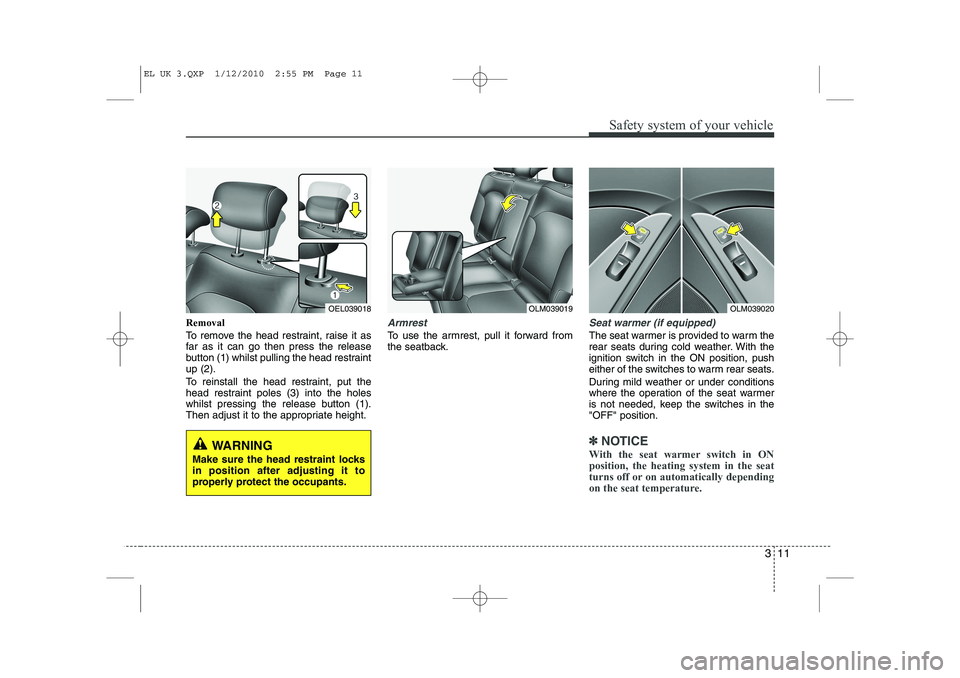
Removal
To remove the head restraint, raise it as
far as it can go then press the release
button (1) whilst pulling the head restraintup (2).
To reinstall the head restraint, put the
head restraint poles (3) into the holes
whilst pressing the release button (1).
Then adjust it to the appropriate height.Armrest
To use the armrest, pull it forward from
the seatback.
Seat warmer (if equipped)
The seat warmer is provided to warm the
rear seats during cold weather. With the
ignition switch in the ON position, push
either of the switches to warm rear seats.
During mild weather or under conditions
where the operation of the seat warmer
is not needed, keep the switches in the"OFF" position.
✽✽NOTICE
With the seat warmer switch in ON position, the heating system in the seat
turns off or on automatically depending
on the seat temperature.
OEL039018
WARNING
Make sure the head restraint locks in position after adjusting it to
properly protect the occupants.
OLM039019OLM039020
EL UK 3.QXP 1/12/2010 2:55 PM Page 11