2012 HYUNDAI IX35 radiator
[x] Cancel search: radiatorPage 330 of 560

Maintenance
10
7
Vapour hose and fuel filler cap
The vapour hose and fuel filler cap
should be inspected at those intervals
specified in the maintenance schedule.
Make sure that a new vapour hose or fuelfiller cap is correctly replaced.
Vacuum crankcase ventilation hoses (if equipped)
Inspect the surface of hoses for evidence
of heat and/or mechanical damage. Hard
and brittle rubber, cracking, tears, cuts,
abrasions, and excessive swelling indi-
cate deterioration. Particular attention
should be paid to examine those hose
surfaces nearest to high heat sources,
such as the exhaust manifold. Inspect the hose routing to assure that the hoses do not come in contact with
any heat source, sharp edges or movingcomponent which might cause heat dam-
age or mechanical wear. Inspect all hose
connections, such as clamps and cou-
plings, to make sure they are secure, and
that no leaks are present. Hoses should
be replaced immediately if there is any
evidence of deterioration or damage. Air cleaner filter
A Genuine HYUNDAI air cleaner filter is recommended when the filter is replaced.
Spark plugs (for petrol engine)
Make sure to install new spark plugs of
the correct heat range.
Valve clearance
(for petrol engine)
Inspect excessive valve noise and/or
engine vibration and adjust if necessary.
A HYUNDAI authorised repairer should
perform the operation. Cooling system
Check the cooling system parts, such as
radiator, coolant reservoir, hoses and
connections for leakage and damage.
Replace any damaged parts.
Coolant The coolant should be changed at the
intervals specified in the maintenance
schedule.
Manual transaxle fluid (if equipped)
Inspect the manual transaxle fluid
according to the maintenance schedule.
Automatic transaxle fluid (if equipped)
Automatic transaxle fluid should not be
checked under normal usage conditions.
But in severe conditions, the fluid should
be changed at a HYUNDAI authorisedrepairer in accordance to the sched-uled maintenance at the beginning of this
chapter.
✽✽
NOTICE
Automatic transaxle fluid colour is basi-
cally red. As the vehicle is driven, the automatic
transaxle fluid will begin to look darker.It is normal condition and you should
not judge the need to replace the fluid
based upon the changed colour.
EL UK 7.QXP 1/25/2010 10:01 AM Page 10
Page 332 of 560
Maintenance
12
7
ENGINE OIL
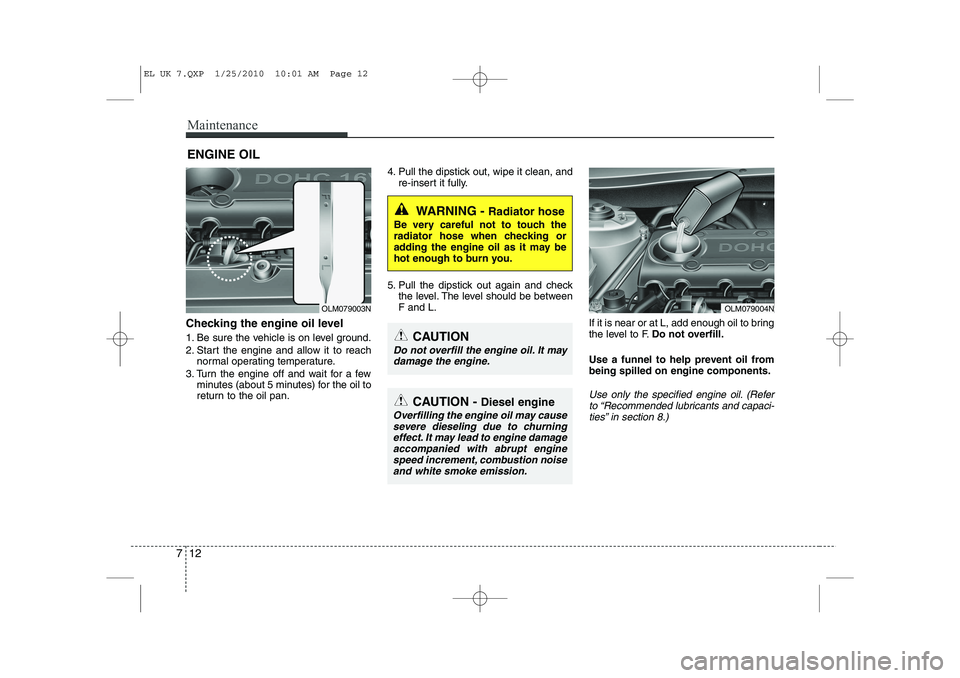
Checking the engine oil level
1. Be sure the vehicle is on level ground.
2. Start the engine and allow it to reach normal operating temperature.
3. Turn the engine off and wait for a few minutes (about 5 minutes) for the oil to
return to the oil pan. 4. Pull the dipstick out, wipe it clean, and
re-insert it fully.
5. Pull the dipstick out again and check the level. The level should be between F and L.
If it is near or at L, add enough oil to bring
the level to F.Do not overfill.
Use a funnel to help prevent oil frombeing spilled on engine components.
Use only the specified engine oil. (Refer to “Recommended lubricants and capaci-ties” in section 8.)
WARNING - Radiator hose
Be very careful not to touch the
radiator hose when checking or
adding the engine oil as it may be
hot enough to burn you.
OLM079003NOLM079004N
CAUTION
Do not overfill the engine oil. It may damage the engine.
CAUTION - Diesel engine
Overfilling the engine oil may cause
severe dieseling due to churning
effect. It may lead to engine damageaccompanied with abrupt engine speed increment, combustion noise and white smoke emission.
EL UK 7.QXP 1/25/2010 10:01 AM Page 12
Page 333 of 560
713
Maintenance
ENGINE COOLANT
Changing the engine oil and filter
Have engine oil and filter changed by a
HYUNDAI authorised repairer according
to the Maintenance Schedule. The high-pressure cooling system has a
reservoir filled with year-round antifreeze
coolant. The reservoir is filled at the fac-
tory.
Check the antifreeze protection and
coolant concentration level at least once
a year, at the beginning of the winter sea-
son, and before travelling to a colder cli-
mate.
Checking the coolant level
WARNING
- Removing
radiator cap
Never attempt to remove the radi- ator cap whilst the engine is
operating or hot. Doing so mightlead to cooling system and
engine damage and could result
in serious personal injury fromescaping hot coolant or steam.
(Continued)
WARNING
Prolonged and repeated contact
with used engine oils may result in
serious skin disorders including
dermatitis and cancer. Avoid con-
tact with skin as far as possible and
always wash thoroughly after any
contact. Keep used oils out of
reach of children. It is illegal to pol-
lute drains, water courses and soil.
Use only authorised waste collec-
tion facilities including civic ameni-
ty sites and garages for the dispos-
al of used oil and oil filters. If in
doubt, contact the local authority
for disposal instructions.
EL UK 7.QXP 1/25/2010 10:01 AM Page 13
Page 334 of 560
Maintenance
14
7
Check the condition and connections of all cooling system hoses and heater
hoses. Replace any swollen or deterio-
rated hoses.
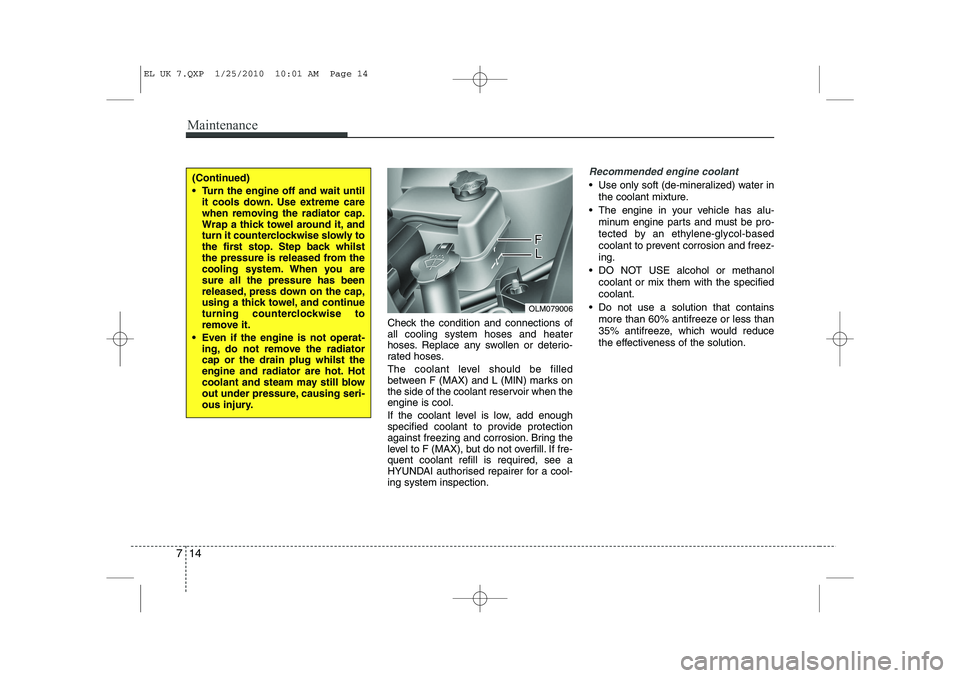
The coolant level should be filled
between F (MAX) and L (MIN) marks on
the side of the coolant reservoir when theengine is cool.
If the coolant level is low, add enough
specified coolant to provide protection
against freezing and corrosion. Bring the
level to F (MAX), but do not overfill. If fre-quent coolant refill is required, see a
HYUNDAI authorised repairer for a cool-ing system inspection.
Recommended engine coolant
Use only soft (de-mineralized) water in
the coolant mixture.
The engine in your vehicle has alu- minum engine parts and must be pro-
tected by an ethylene-glycol-based
coolant to prevent corrosion and freez-ing.
DO NOT USE alcohol or methanol coolant or mix them with the specifiedcoolant.
Do not use a solution that contains more than 60% antifreeze or less than
35% antifreeze, which would reduce
the effectiveness of the solution.
OLM079006
(Continued)
Turn the engine off and wait untilit cools down. Use extreme care
when removing the radiator cap.
Wrap a thick towel around it, and
turn it counterclockwise slowly to
the first stop. Step back whilst
the pressure is released from the
cooling system. When you aresure all the pressure has been
released, press down on the cap,
using a thick towel, and continue
turning counterclockwise to
remove it.
Even if the engine is not operat- ing, do not remove the radiatorcap or the drain plug whilst the
engine and radiator are hot. Hot
coolant and steam may still blow
out under pressure, causing seri-
ous injury.
EL UK 7.QXP 1/25/2010 10:01 AM Page 14
Page 335 of 560
715
Maintenance
For mixture percentage, refer to the fol-
lowing table.Changing the coolant
Have coolant changed by a HYUNDAI
authorised repairer according to the
Maintenance Schedule.
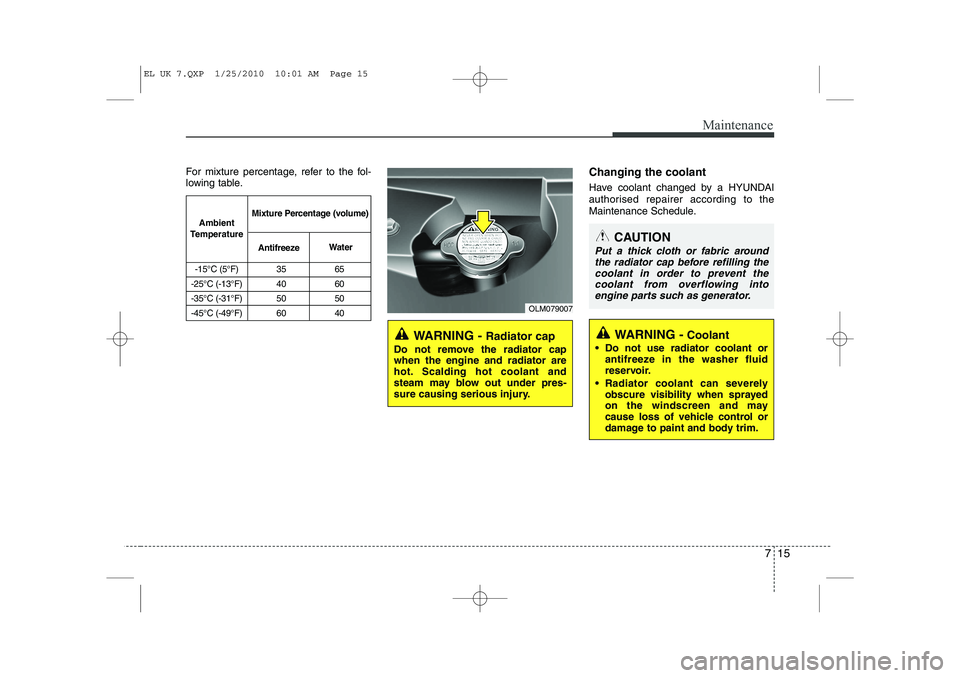
WARNING -
Radiator cap
Do not remove the radiator cap when the engine and radiator are
hot. Scalding hot coolant and
steam may blow out under pres-
sure causing serious injury.
CAUTION
Put a thick cloth or fabric around the radiator cap before refilling the
coolant in order to prevent the coolant from overflowing into engine parts such as generator.
WARNING - Coolant
Do not use radiator coolant or antifreeze in the washer fluid
reservoir.
Radiator coolant can severely obscure visibility when sprayed
on the windscreen and may
cause loss of vehicle control or
damage to paint and body trim.
OLM079007
-15°C (5°F) 35 65
-25°C (-13°F) 40 60
-35°C (-31°F) 50 50
-45°C (-49°F) 60 40
Ambient
Temperature Mixture Percentage (volume)
Antifreeze Water
EL UK 7.QXP 1/25/2010 10:01 AM Page 15
Page 337 of 560
717
Maintenance
WASHER FLUID
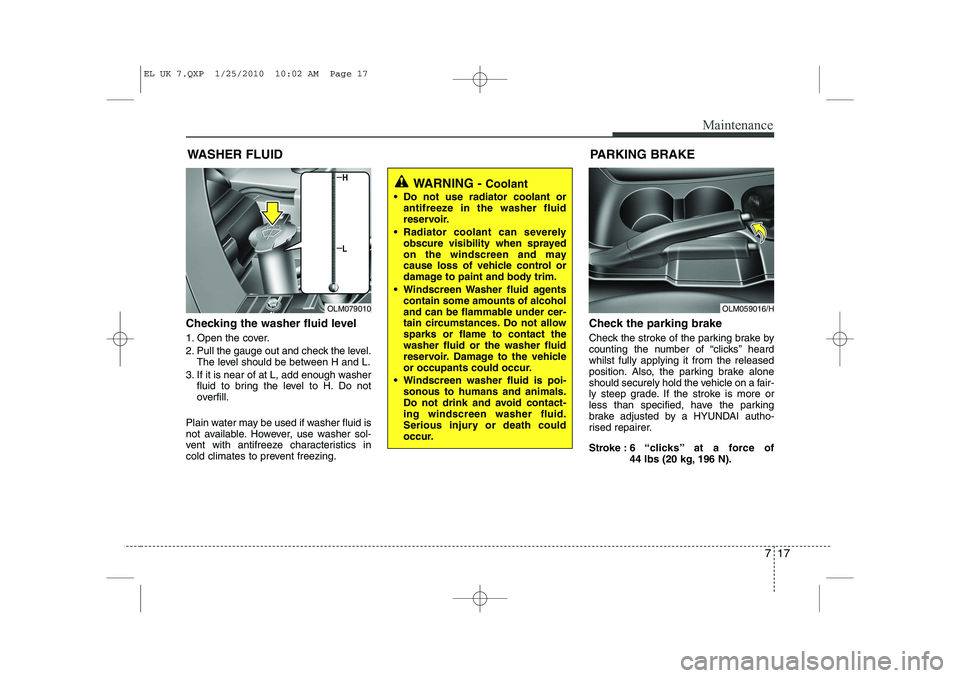
Checking the washer fluid level
1. Open the cover.
2. Pull the gauge out and check the level. The level should be between H and L.
3. If it is near of at L, add enough washer fluid to bring the level to H. Do not
overfill.
Plain water may be used if washer fluid is
not available. However, use washer sol-
vent with antifreeze characteristics in
cold climates to prevent freezing. Check the parking brake
Check the stroke of the parking brake by
counting the number of “clicks’’ heardwhilst fully applying it from the released
position. Also, the parking brake alone
should securely hold the vehicle on a fair-
ly steep grade. If the stroke is more or
less than specified, have the parking
brake adjusted by a HYUNDAI autho-
rised repairer.
Stroke : 6 “clicks’’ at a force of
44 lbs (20 kg, 196 N).
OLM079010
WARNING - Coolant
Do not use radiator coolant or antifreeze in the washer fluid
reservoir.
Radiator coolant can severely obscure visibility when sprayed
on the windscreen and may
cause loss of vehicle control or
damage to paint and body trim.
Windscreen Washer fluid agents contain some amounts of alcohol
and can be flammable under cer-
tain circumstances. Do not allowsparks or flame to contact thewasher fluid or the washer fluid
reservoir. Damage to the vehicle
or occupants could occur.
Windscreen washer fluid is poi- sonous to humans and animals.
Do not drink and avoid contact-ing windscreen washer fluid.
Serious injury or death could
occur.
PARKING BRAKE
OLM059016/H
EL UK 7.QXP 1/25/2010 10:02 AM Page 17
Page 390 of 560
Specifications & Consumer information
4
8
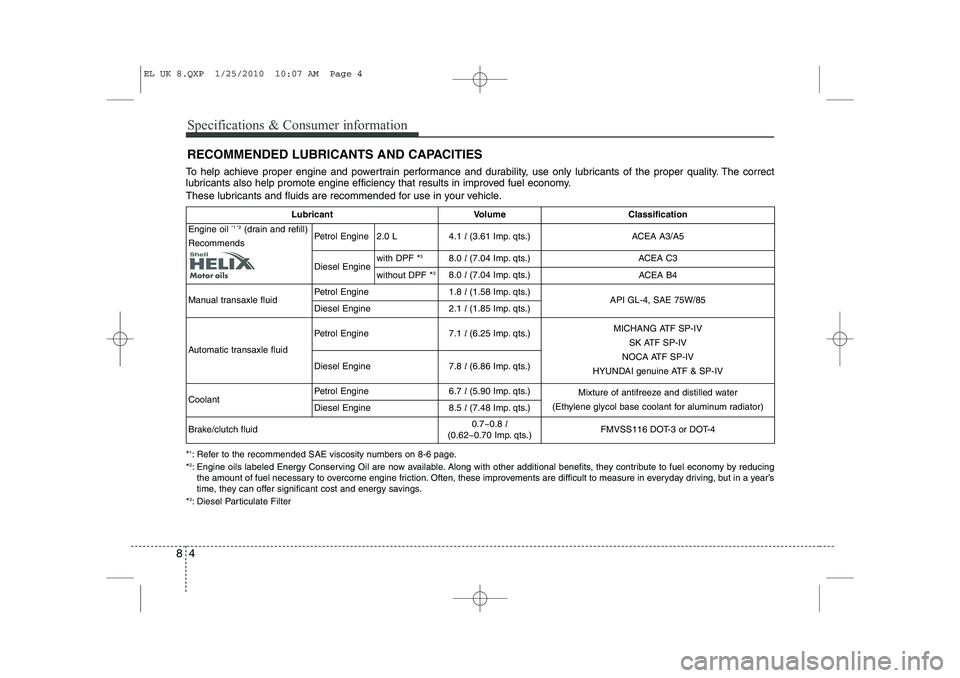
To help achieve proper engine and powertrain performance and durability, use only lubricants of the proper quality. The correct
lubricants also help promote engine efficiency that results in improved fuel economy.
These lubricants and fluids are recommended for use in your vehicle.
RECOMMENDED LUBRICANTS AND CAPACITIES
* 1
: Refer to the recommended SAE viscosity numbers on 8-6 page.
* 2
: Engine oils labeled Energy Conserving Oil are now available. Along with other additional benefits, they contribute to fuel economy by reducing
the amount of fuel necessary to overcome engine friction. Often, these improvements are difficult to measure in everyday driving, but in a year’s
time, they can offer significant cost and energy savings.
* 3
: Diesel Particulate Filter Lubricant Volume Classification
Engine oil *1 *2
(drain and refill)
Recommends Petrol Engine 2.0 L
4.1
l(3.61 Imp. qts.)
ACEA A3/A5
Diesel Engine with DPF *
3
8.0 l(7.04 Imp. qts.)
ACEA C3
without DPF * 3
8.0 l(7.04 Imp. qts.)
ACEA B4
Manual transaxle fluid Petrol Engine
1.8
l(1.58 Imp. qts.)
API GL-4, SAE 75W/85
Diesel Engine2.1 l(1.85 Imp. qts.)
Automatic transaxle fluid Petrol Engine
7.1
l(6.25 Imp. qts.) MICHANG ATF SP-IV
SK ATF SP-IV
NOCA ATF SP-IV
HYUNDAI genuine ATF & SP-IV
Diesel Engine
7.8
l(6.86 Imp. qts.)
Coolant Petrol Engine
6.7
l(5.90 Imp. qts.)
Mixture of antifreeze and distilled water
(Ethylene glycol base coolant for aluminum radiator)
Diesel Engine 8.5
l(7.48 Imp. qts.)
Brake/clutch fluid 0.7~0.8
l
(0.62~0.70 Imp. qts.) FMVSS116 DOT-3 or DOT-4
EL UK 8.QXP 1/25/2010 10:07 AM Page 4
Page 438 of 560
Features of your vehicle
26
4
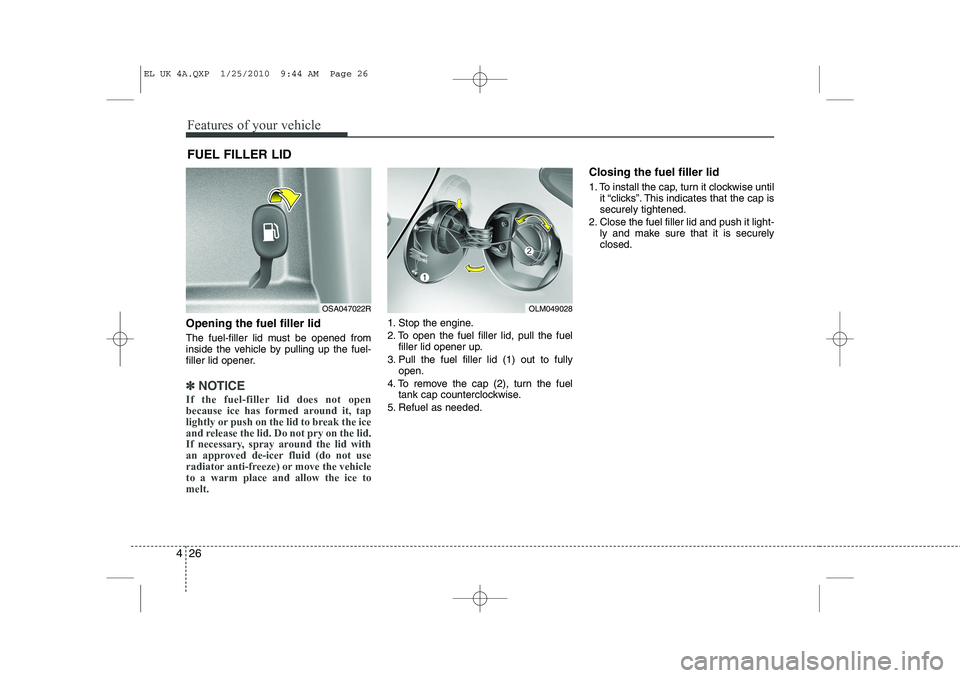
Opening the fuel filler lid
The fuel-filler lid must be opened from
inside the vehicle by pulling up the fuel-
filler lid opener.
✽✽
NOTICE
If the fuel-filler lid does not open
because ice has formed around it, tap
lightly or push on the lid to break the ice
and release the lid. Do not pry on the lid.
If necessary, spray around the lid with
an approved de-icer fluid (do not use
radiator anti-freeze) or move the vehicleto a warm place and allow the ice tomelt.
1. Stop the engine.
2. To open the fuel filler lid, pull the fuel filler lid opener up.
3. Pull the fuel filler lid (1) out to fully open.
4. To remove the cap (2), turn the fuel tank cap counterclockwise.
5. Refuel as needed. Closing the fuel filler lid
1. To install the cap, turn it clockwise until
it “clicks”. This indicates that the cap is securely tightened.
2. Close the fuel filler lid and push it light- ly and make sure that it is securelyclosed.
FUEL FILLER LID
OSA047022ROLM049028
EL UK 4A.QXP 1/25/2010 9:44 AM Page 26