2012 Hyundai H-100 Truck radiator
[x] Cancel search: radiatorPage 42 of 217
1FEATURES OF YOUR HYUNDAI
30
!
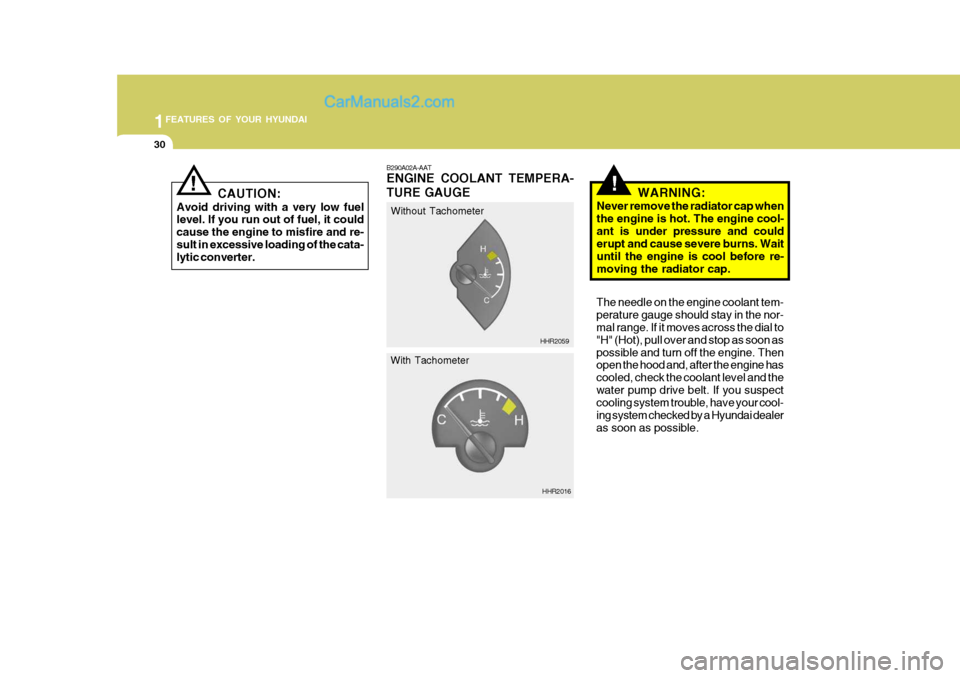
B290A02A-AAT ENGINE COOLANT TEMPERA- TURE GAUGE
WARNING:
Never remove the radiator cap when the engine is hot. The engine cool-ant is under pressure and could erupt and cause severe burns. Wait until the engine is cool before re-moving the radiator cap.
The needle on the engine coolant tem-perature gauge should stay in the nor-mal range. If it moves across the dial to "H" (Hot), pull over and stop as soon as possible and turn off the engine. Then open the hood and, after the engine has cooled, check the coolant level and thewater pump drive belt. If you suspect cooling system trouble, have your cool- ing system checked by a Hyundai dealeras soon as possible.
HHR2059
HHR2016
Without Tachometer
With Tachometer
CAUTION:
Avoid driving with a very low fuel level. If you run out of fuel, it could cause the engine to misfire and re-sult in excessive loading of the cata- lytic converter.
!
Page 59 of 217

1
FEATURES OF YOUR HYUNDAI
47HOOD RELEASE
B570A01HR-GAT
1. Pull the release knob to unlatch the hood. B570B01HR
B570A01HR
Releasing the parking brake To release the parking brake, first apply the foot brake and pull the parking brake lever slightly. Secondly, depress therelease button and lower the parking brake lever while holding the button. CAUTION:
o Driving with the parking brake ap- plied will cause excessive brake pad (or lining) and brake rotor wear.
o Do not operate the parking brake while the vehicle is moving exceptin an emergency situation. It could damage the vehicle system andmake endanger driving safety.
!
!WARNING:
Open the hood after turning off the engine on a flat surface, shifting theshift lever to the 1st(First) gear or R(Reverse) for manual transaxle, and setting the parking brake. 2. Push the secondary latch lever to
the left and lower the hood.
To close the hood, lift up it and hit thecenter of the hood with your hand. Makesure that it locks into place. NOTE: If the hood will not open because ice has formed around it, tap lightly orpush on the hood to break the ice and release the hood. Do not pry on the hood. If necessary, spray aroundthe hood with an approved de-icer fluid (do not use radiator anti-freeze) or move the vehicle to a warm placeand allow the ice to melt.
Page 119 of 217
3 WHAT TO DO IN AN EMERGENCY
4
!
IF THE ENGINE OVERHEATS
D030A01HR-GAT If your temperature gauge indicates overheating, you experience a loss of power, or hear loud pinging or knock- ing, the engine is probably too hot. Ifthis happens to you, you should:
1. Pull off the road and stop as soon as it is safe to do so.
2. Place the gear selector lever in neu-
tral and set the parking brake. If the air conditioning is on, turn it off.
3. If engine coolant is running out un-
der the car or steam is coming outfrom the hood, allow the engine to idle. Do not open the hood until the engine coolant has stopped runningor the steaming has stopped. If there is no visible loss of engine coolant and no steam, leave the enginerunning, lift up the passenger's seat
(Refer to "To Inspect the Engine
Compartment Under the Passenger's
Seat" on page 1-13.) and check to be sure the engine cooling fan is oper- ating. If the fan is not running, turnthe engine off.
6. Carefully remove the jumper cables
in the reverse order of attachment.
If you do not know why your batterybecame discharged (because the lightswere left on, etc.), have the charging system checked by your Hyundai dealer. 4. Check to see if the water pump drive
belt is missing. If it is not missing,check to see that it is tight. If the drive belt seems to be satisfactory, check for coolant leaking from theradiator, hoses or under the car. (If the air conditioning had been in use, it is normal for cold water to bedraining from it when you stop).
WARNING:
While the engine is running, keephair, hands, and clothing away from moving parts such as the fan and drive belts to prevent injury.
HHR4002
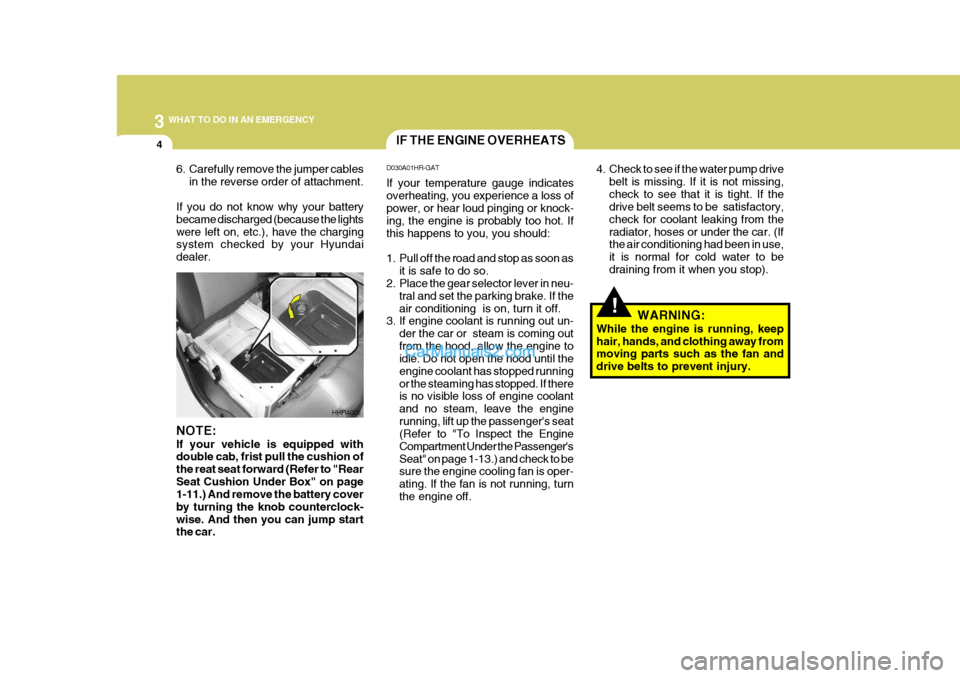
NOTE: If your vehicle is equipped with double cab, frist pull the cushion of the reat seat forward (Refer to "RearSeat Cushion Under Box" on page 1-11.) And remove the battery cover by turning the knob counterclock-wise. And then you can jump start the car.
Page 120 of 217
3
WHAT TO DO IN AN EMERGENCY
5
195/70R15C-6PR 155R12C-8PR 195/70R15C-8PR FRONT
290kPa (42PSI)
- - -
!!
SPARE TIRE
WARNING:
Never work on injection system with engine running or within 30 sec- onds after shutting off engine. High pressure pump, rail, injectors andhigh pressure pipes are subject to high pressure even after the engine stopped. The fuel jet produced byfuel leaks may cause serious in- jury, if it touch the body. People using pacemakers should not movethan 30cm closer to the ECU or wiring harness within the engine room while engine is running, sincethe high currents in the Common Rail system produce considerable magnetic fields. WARNING:
Do not remove the radiator cap whenthe engine is hot. This can allowcoolant to be blown out of the open- ing and cause serious burns.
6. If you cannot find the cause of the overheating, wait until the engine temperature has returned to nor-mal. Then, if the engine coolant has been lost, carefully add coolant to the reservoir (Page 6-10) to bringthe fluid level in the reservoir up to the halfway mark.
7. Proceed with caution, keeping alert
for further signs of overheating. Ifoverheating happens again, call a Hyundai dealer for assistance.
!
5. If the water pump drive belt is broken
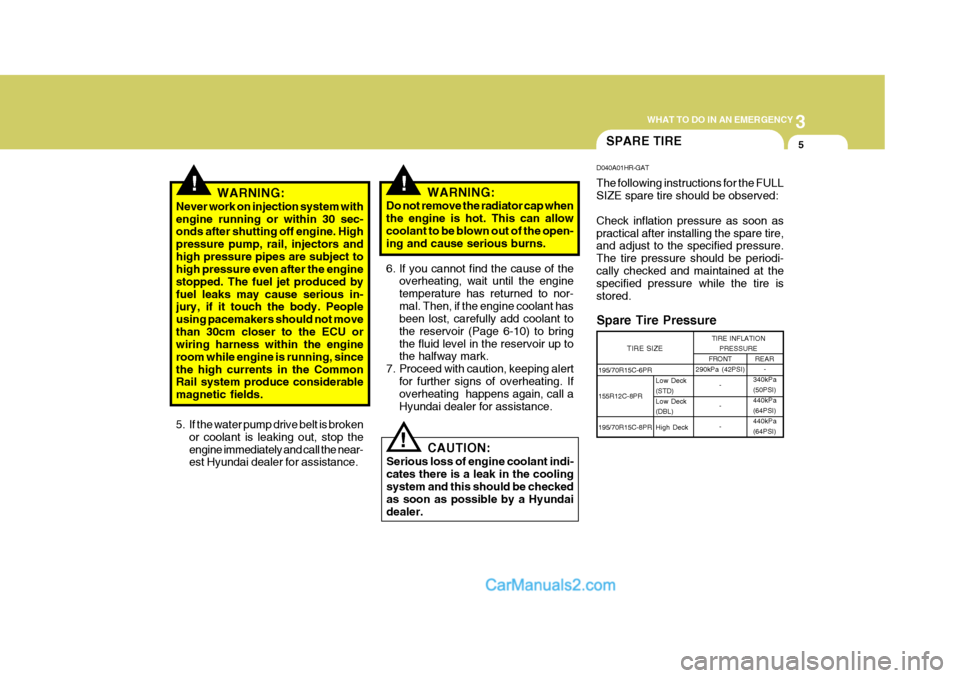
or coolant is leaking out, stop the engine immediately and call the near- est Hyundai dealer for assistance. D040A01HR-GAT The following instructions for the FULL SIZE spare tire should be observed: Check inflation pressure as soon as practical after installing the spare tire, and adjust to the specified pressure. The tire pressure should be periodi-cally checked and maintained at the specified pressure while the tire is stored.
Spare Tire PressureCAUTION:
Serious loss of engine coolant indi- cates there is a leak in the coolingsystem and this should be checked as soon as possible by a Hyundai dealer. TIRE SIZE
TIRE INFLATION
PRESSURE REAR-
340kPa (50PSI)440kPa(64PSI)440kPa (64PSI)
Low Deck (STD)Low Deck (DBL) High Deck
Page 150 of 217
5
VEHICLE MAINTENANCE REQUIREMENTS
11
F060F01A-AAT
o Vacuum and Crankcase
Ventilation Hoses
Inspect the surface of hoses for evi-
dence of heat and/or mechanical dam- age. Hard and brittle rubber, cracking, tears, cuts, abrasions, and excessiveswelling indicate deterioration. Particu- lar attention should be paid to examin- ing those hose surfaces nearest tohigh heat sources, such as the ex- haust manifold.
Inspect the hose routing to assure that
the hoses do not come in contact withany heat source, sharp edges or mov- ing component which might cause heatdamage or mechanical wear. Inspect all hose connections, such as clamps and couplings, to make sure they aresecure, and that no leaks are present. Hoses should be replaced immedi- ately if there is any evidence of dete-rioration or damage. F060B01HR-GAT
o Drive Belts
Inspect all drive belts (water pump andalternator) for evidence of cuts, cracks, excessive wear or oiliness, and re- place if necessary. Drive belts shouldbe checked periodically for proper ten- sion and adjusted as necessary. F060E01A-GAT
o Timing Belt
Inspect all parts related with the timing
belt for damage and deformation. Re- place any damaged parts immediately.
F060H01A-AAT
o Air Cleaner Filter
A Genuine Hyundai air cleaner filter isrecommended when the filter is re-placed.
F060G01A-AAT
o Vapor Hose and Fuel Filler Cap
The vapor hose and fuel filler cap
should be inspected at those intervals specified in the maintenance sched- ule. Make sure that a new vapor hoseor fuel filler cap is correctly replaced.
F070B01A-GAT
o Cooling System
Check the cooling system part, suchas radiator, coolant reservoir, hoses and connections for leakage and dam- age. Replace any damaged parts. F070C01A-AAT
o Coolant
The coolant should be changed at the intervals specified in the mainte- nance schedule. F070D01HP-GAT
o Manual Transmission Oil Inspect the manual transmission oil according to the maintenance sched- ule. NOTE: If the oil level is low, check for possible leaks before adding oil.Do not overfill.
Page 155 of 217
6
DO-IT-YOURSELF MAINTENANCE
3ENGINE COMPARTMENT
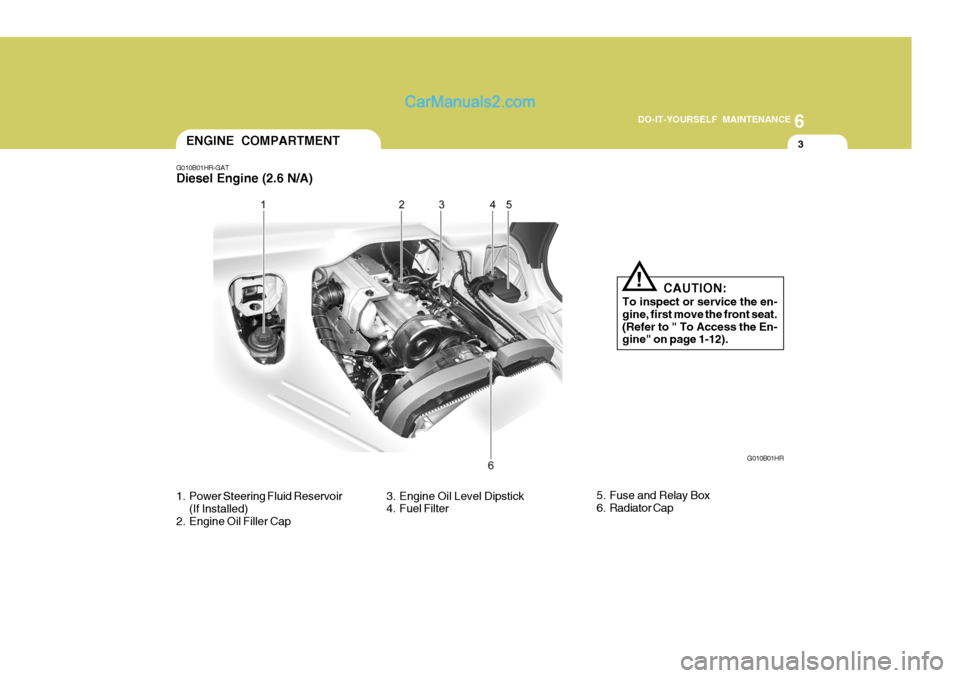
1. Power Steering Fluid Reservoir (If Installed)
2. Engine Oil Filler Cap 3. Engine Oil Level Dipstick
4. Fuel Filter
G010B01HR-GAT Diesel Engine (2.6 N/A)
G010B01HR
5. Fuse and Relay Box
6. Radiator CapCAUTION:
To inspect or service the en-gine, first move the front seat.(Refer to " To Access the En- gine" on page 1-12).
!
Page 156 of 217
6 DO-IT-YOURSELF MAINTENANCE
4
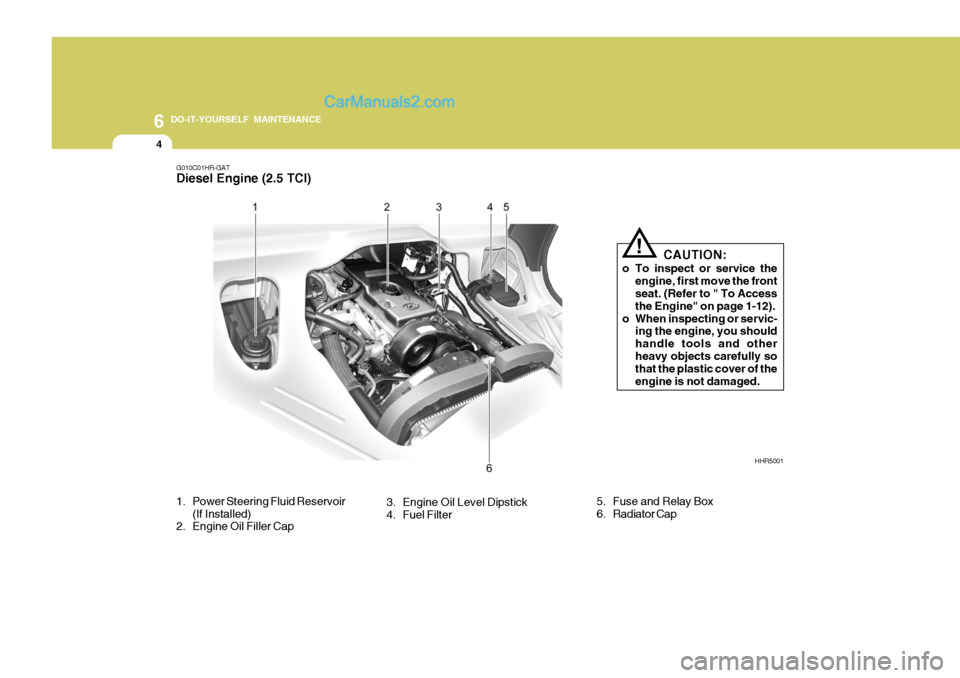
G010C01HR-GAT Diesel Engine (2.5 TCI)
HHR5001
1. Power Steering Fluid Reservoir (If Installed)
2. Engine Oil Filler Cap 3. Engine Oil Level Dipstick
4. Fuel Filter CAUTION:
o To inspect or service the engine, first move the front seat. (Refer to " To Access the Engine" on page 1-12).
o When inspecting or servic- ing the engine, you shouldhandle tools and other heavy objects carefully so that the plastic cover of theengine is not damaged.
!
5. Fuse and Relay Box
6. Radiator Cap
Page 162 of 217
6 DO-IT-YOURSELF MAINTENANCE
10
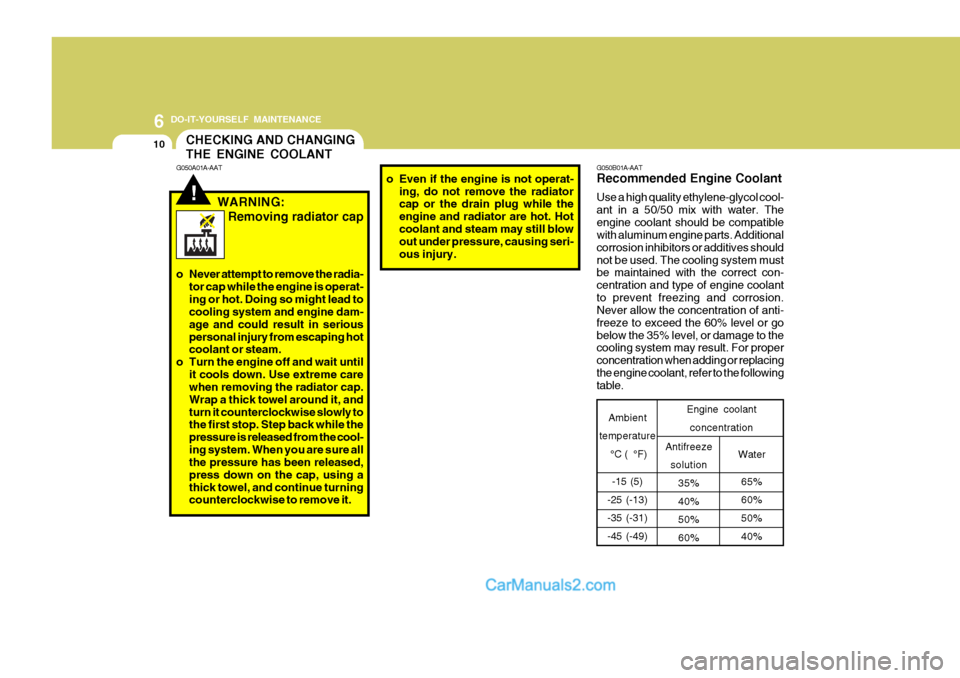
G050B01A-AAT Recommended Engine Coolant Use a high quality ethylene-glycol cool- ant in a 50/50 mix with water. Theengine coolant should be compatible with aluminum engine parts. Additional corrosion inhibitors or additives shouldnot be used. The cooling system must be maintained with the correct con- centration and type of engine coolantto prevent freezing and corrosion. Never allow the concentration of anti- freeze to exceed the 60% level or gobelow the 35% level, or damage to the cooling system may result. For proper concentration when adding or replacingthe engine coolant, refer to the following table.
!
CHECKING AND CHANGING THE ENGINE COOLANT
G050A01A-AAT
WARNING:
o Never attempt to remove the radia-tor cap while the engine is operat- ing or hot. Doing so might lead to cooling system and engine dam- age and could result in seriouspersonal injury from escaping hot coolant or steam.
o Turn the engine off and wait until
it cools down. Use extreme carewhen removing the radiator cap. Wrap a thick towel around it, andturn it counterclockwise slowly to the first stop. Step back while the pressure is released from the cool-ing system. When you are sure all the pressure has been released, press down on the cap, using athick towel, and continue turning counterclockwise to remove it. Removing radiator cap
Water
65% 60% 50% 40%
Antifreeze
solution
35% 40% 50%60%
Ambient
temperature
°C ( °F)
-15 (5)
-25 (-13)-35 (-31) -45 (-49) Engine coolant
concentration
o Even if the engine is not operat-
ing, do not remove the radiator cap or the drain plug while the engine and radiator are hot. Hotcoolant and steam may still blow out under pressure, causing seri- ous injury.