2012 Hyundai H-100 Truck flat tire
[x] Cancel search: flat tirePage 202 of 217
8
CONSUMER INFORMATION
5
!
!
I070A01A-AAT TIRE BALANCING A tire that is out of balance may affect handling and tire wear. The tires on your Hyundai were balanced before the car was delivered but may needbalancing again during the years you own the car. Whenever a tire is dismounted forrepair, it should be rebalanced before
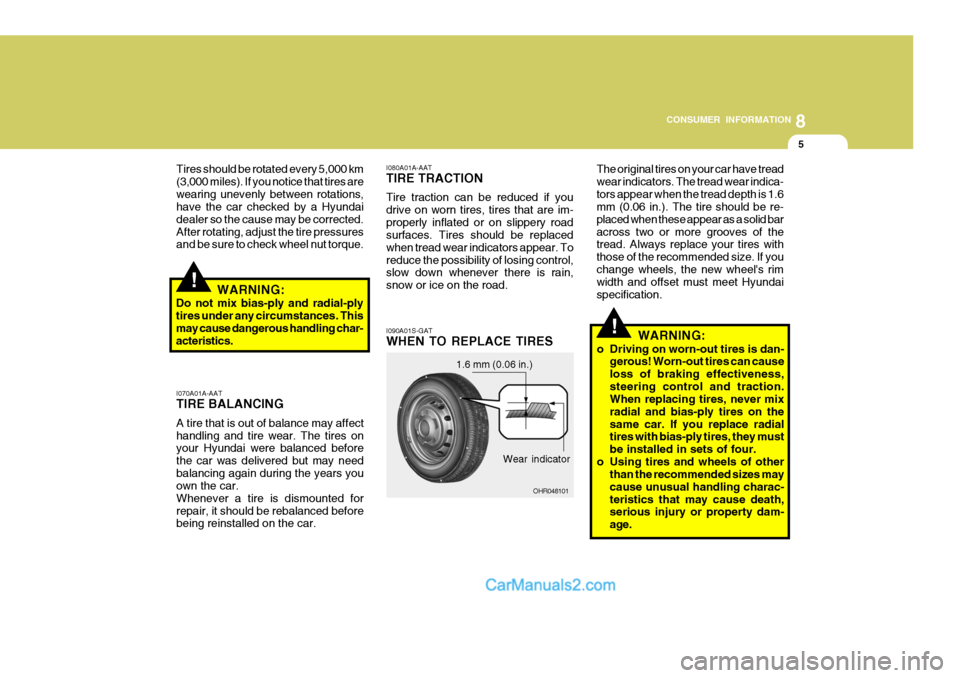
being reinstalled on the car. I080A01A-AAT TIRE TRACTION Tire traction can be reduced if you drive on worn tires, tires that are im-properly inflated or on slippery road surfaces. Tires should be replaced when tread wear indicators appear. Toreduce the possibility of losing control, slow down whenever there is rain, snow or ice on the road. I090A01S-GAT WHEN TO REPLACE TIRES
Tires should be rotated every 5,000 km (3,000 miles). If you notice that tires arewearing unevenly between rotations, have the car checked by a Hyundai dealer so the cause may be corrected.After rotating, adjust the tire pressures and be sure to check wheel nut torque.
WARNING:
Do not mix bias-ply and radial-ply tires under any circumstances. Thismay cause dangerous handling char- acteristics.
Wear indicator
1.6 mm (0.06 in.)
OHR048101 WARNING:
o Driving on worn-out tires is dan- gerous! Worn-out tires can cause loss of braking effectiveness,steering control and traction.
When replacing tires, never mix radial and bias-ply tires on thesame car. If you replace radial tires with bias-ply tires, they must be installed in sets of four.
o Using tires and wheels of other than the recommended sizes maycause unusual handling charac-teristics that may cause death, serious injury or property dam- age.
The original tires on your car have treadwear indicators. The tread wear indica-tors appear when the tread depth is 1.6 mm (0.06 in.). The tire should be re- placed when these appear as a solid baracross two or more grooves of the tread. Always replace your tires with those of the recommended size. If youchange wheels, the new wheel's rim width and offset must meet Hyundai specification.
Page 205 of 217
8CONSUMER INFORMATION
8
7. Uniform tire quality grading Quality grades can be found where applicable on the tire sidewall between tread shoulder and maximum sectionwidth. For example: TREADWEAR 200TRACTION AA TEMPERATURE A
o Tread wear The tread wear grade is a comparative rating based on the wear rate of the tire when tested under controlled condi-tions on a specified government test course. For example, a tire graded 150 would wear one-and-a-half times (1½)as well on the government course as a tire graded 100. The relative performance of tires de-pends upon the actual conditions of their use, however, and may depart significantly from the norm due to varia-tions in driving habits, service prac- tices and differences in road character- istics and climate.
!WARNING: Tire age
Tires degrade over time, even when they are not being used.Regardless of the remaining tread, we recommend that tires be re- placed after approximately six (6)years of normal service. Heat caused by hot climates or frequent high load- ing conditions can accelerate theaging process. Failure to follow this warning can result in sudden tire failure, which could lead to a loss ofcontrol and an accident involving serious injury or death. 4. Tire ply composition and ma-
terial
The number of layers or plies of rubber-coated fabric in the tire. Tire manufac- turers also must indicate the materialsin the tire, which include steel, nylon, polyester, and others. The letter "R" means radial ply construction; the letter"D" means diagonal or bias ply con- struction; and the letter "B" means belted-bias ply construction. 5. Maximum permissible inflation
pressure
This number is the greatest amount of air pressure that should be put in the tire. Do not exceed the maximum per-missible inflation pressure. Refer to the Tire and Loading Information label for recommended inflation pressure. 6. Maximum load rating This number indicates the maximum load in kilograms and pounds that can be carried by the tire. When replacingthe tires on the vehicle, always use a tire that has the same load rating as the factory installed tire.
Page 206 of 217
8
CONSUMER INFORMATION
9
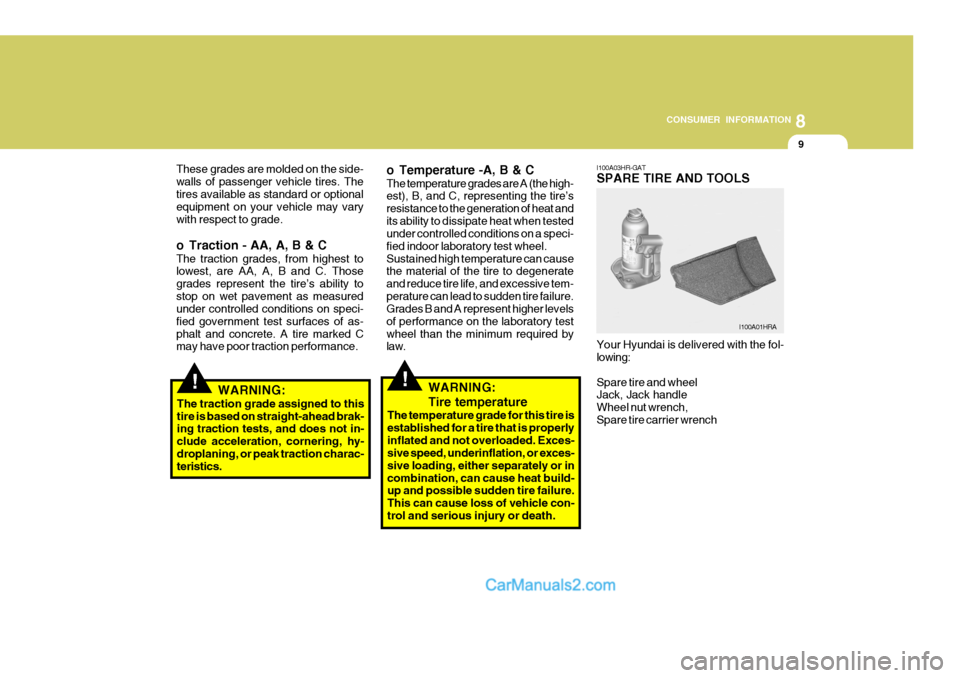
I100A03HR-GAT SPARE TIRE AND TOOLS Your Hyundai is delivered with the fol- lowing: Spare tire and wheel Jack, Jack handle Wheel nut wrench,Spare tire carrier wrench
I100A01HRA
These grades are molded on the side- walls of passenger vehicle tires. Thetires available as standard or optional equipment on your vehicle may vary with respect to grade.
o Traction - AA, A, B & C The traction grades, from highest to lowest, are AA, A, B and C. Those grades represent the tire’s ability tostop on wet pavement as measured under controlled conditions on speci- fied government test surfaces of as-phalt and concrete. A tire marked C may have poor traction performance. o Temperature -A, B & C The temperature grades are A (the high- est), B, and C, representing the tire’s resistance to the generation of heat andits ability to dissipate heat when tested under controlled conditions on a speci- fied indoor laboratory test wheel.Sustained high temperature can cause the material of the tire to degenerate and reduce tire life, and excessive tem-perature can lead to sudden tire failure. Grades B and A represent higher levels of performance on the laboratory testwheel than the minimum required by law.
!WARNING:
The traction grade assigned to this tire is based on straight-ahead brak- ing traction tests, and does not in- clude acceleration, cornering, hy-droplaning, or peak traction charac- teristics.!WARNING: Tire temperature
The temperature grade for this tire is established for a tire that is properlyinflated and not overloaded. Exces- sive speed, underinflation, or exces- sive loading, either separately or incombination, can cause heat build- up and possible sudden tire failure. This can cause loss of vehicle con-trol and serious injury or death.
Page 216 of 217
10
INDEX
5
O Odometer/Trip Odometer ............................................ 1-31
PParking Brake ............................................................. 1-46
Power Steering Fluid Level ......................................... 6-27
Power Windows ........................................................... 1-8
R Rear Axle Oi l .............................................................. 6-17
Rear Seat ................................................................... 1-11
Rear seat cushion under box ................................... 1-11
Rear Window Defroster Switch ................................... 1-48
S Seat Front seat ................................................................. 1-8Rear seat ................................................................. 1-11
Seat Belts 2-Point type ............................................................. 1-17
3-Point system ........................................................ 1-16
Adjusting your seat belt ........................................... 1-17
Care of seat belts .................................................... 1-15
Precautions .............................................................. 1-14
Spectacle Ca se .......................................................... 1-43
Speedometer .............................................................. 1-31
Starting ........................................................................ 2-5 Steering Wheel Free-play
........................................... 6-21
Steering Wheel Tilt Lever ........................................... 1-52
Stereo Sound System ................................................ 1-64
Sun Visor .................................................................... 1-51
TTachometer ................................................................. 1-31
Ticket Holder .............................................................. 1-39
Tires Balancing .................................................................. 8-5
Chains ...................................................................... 8-4
If you have a flat tire ................................................ 3-8
Information ................................................................ 8-3
Pressure ................................................................... 8-3
Replacement ............................................................. 8-5
Rotation .................................................................... 8-4
Snow tires ................................................................ 8-4
Spare tire .................................................................. 3-5
Traction ..................................................................... 8-5
Towing A trailer (or vehicle) ................................................. 2-15
Emergency .............................................................. 3-18
If your vehicle must be towed ................................. 3-16
Trailer or Vehicle Towing ............................................ 2-15
Transmission Manual ...................................................................... 2-7
Manual transmission Oil checking ........................... 6-16
Trip Odometer ............................................................. 1-31