Page 340 of 429
CONT INUED
Check the f luid level with the engine
at normal operating temperature.Park the vehicle on level ground.
Start the engine, let it run until the
radiator f an comes on, then shut
of f the engine. For accurate
results, wait about 60 seconds (but
no longer than 90 seconds) bef ore
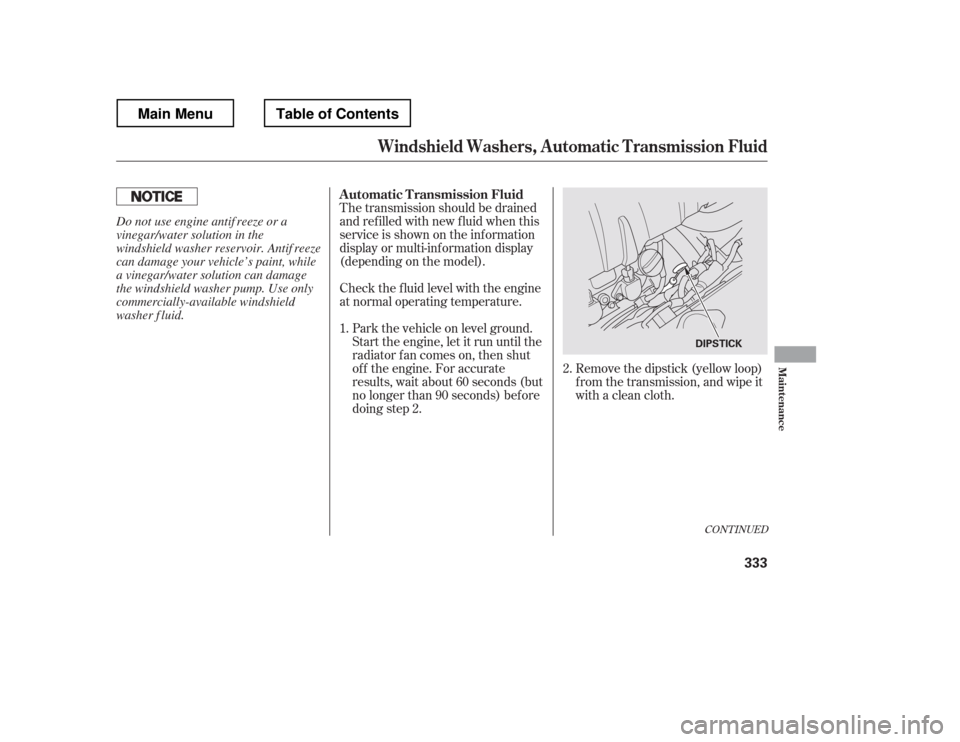
doing step 2. Remove the dipstick (yellow loop)
f rom the transmission, and wipe it
with a clean cloth.
The transmission should be drained
and ref illed with new f luid when this
service is shown on the inf ormation
display or multi-inf ormation display
(depending on the model). 1.
2.
Windshield Washers, A ut omat ic T ransmission Fluid
Automatic Transmission Fluid
Maint enance
333
DIPSTICK
Do not use engine antif reeze or a
vinegar/water solution in the
windshield washer reservoir. Antif reeze
can damage your vehicle’s paint, while
a vinegar/water solution can damage
the windshield washer pump. Use only
commercially-available windshield
washer f luid.
Main MenuTable of Contents
Page 341 of 429
Insert the dipstick all the way back
in the transmission.
If you are not sure how to add f luid,
contact your dealer.
If the level is below the lower
mark, remove the f ill plug, then
add the f luid into the f ill hole to
bring it to the level between the
upper and lower marks on the
dipstick.
Pour the f luid slowly and caref ully so
you do not spill any. Clean up any
spill immediately; it could damage
components in the engine
compartment.
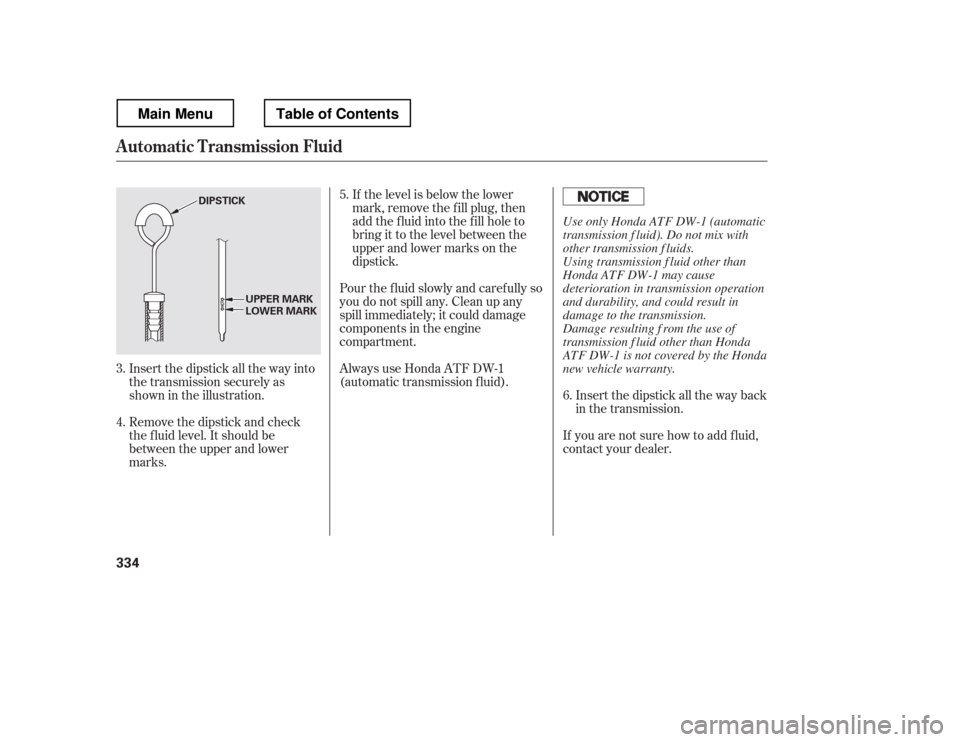
Insert the dipstick all the way into
the transmission securely as
shown in the illustration.
Remove the dipstick and check
the f luid level. It should be
between the upper and lower
marks. Always use Honda ATF DW-1
(automatic transmission f luid).
6.
5.
3. 4.
Automatic Transmission Fluid
334
DIPSTICK UPPER MARKLOWER MARK
Use only Honda ATF DW-1 (automatic
transmission f luid). Do not mix with
other transmission f luids.
Using transmission f luid other than
Honda ATF DW-1 may cause
deterioration in transmission operation
and durability, and could result in
damage to the transmission.
Damage resulting f rom the use of
transmission f luid other than Honda
ATF DW-1 is not covered by the Honda
new vehicle warranty.
Main MenuTable of Contents
Page 370 of 429
Turn on the hazard warning lights,
and turn the ignition switch to the
LOCK (0) position. Have all
passengers get out of the vehicle
while you change the tire.
Park the vehicle on f irm, level, and
non-slippery ground. Put the
transmission in Park. Apply the
parking brake.
If you are towing a trailer, unhitch
it.
If you have a f lat tire while driving,
stop in a saf e place to change it.
Drive slowly along the shoulder until
you get to an exit or an area to stop
that is far away from the traffic lanes.
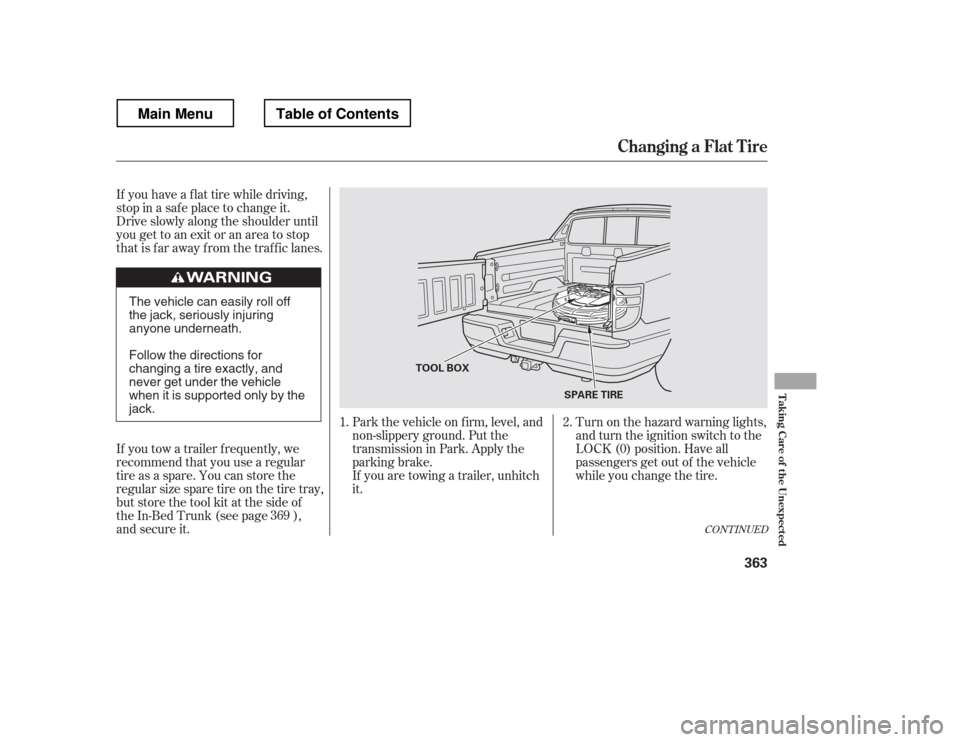
If you tow a trailer f requently, we
recommend that you use a regular
tire as a spare. You can store the
regular size spare tire on the tire tray,
but store the tool kit at the side of
the In-Bed Trunk (see page ),
and secure it.
2.
1.
369
CONT INUED
Changing a Flat T ire
T aking Care of the Unexpected
363
TOOL BOX SPARE TIRE
The vehicle can easily roll off
the jack, seriously injuring
anyone underneath.
Follow the directions for
changing a tire exactly, and
never get under the vehicle
when it is supported only by the jack.
Main MenuTable of Contents
Page 379 of 429
Are you using the proper starting
procedure? Ref er toon page .
There may be an electrical
problem, such as no power to the
f uel pump. Check all the f uses
(see page ).
If youfindnothingwrong,youwill
need a qualif ied technician to f ind
the problem. See on page . Although this seems like a simple
procedure, you should take several
precautions.
You cannot start your vehicle by
pushing or pulling it.
Do you have f uel? Check the f uel
gauge; the low f uel indicator may
not be working.
Turn of f all electrical accessories:
heater, A/C, climate control, audio
system, lights, etc. Put the
transmission in Park, and set the
parking brake.
Open the hood, and check the
physical condition of the battery.
In very cold weather, check the
condition of the electrolyte. If it
seems slushy or f rozen, do not try
jump starting until it thaws.
1. 2.
272
385
380 Starting the
Engine
Emergency
Towing Jump Starting
If the Engine Won
Page 381 of 429
If you see steam and/or spray
coming f rom under the hood, turn
of f the engine. Wait until you see
no more signs of steam or spray,
then open the hood.
If you do not see steam or spray,
leave the engine running and
watch the temperature gauge. If
the high heat is due to overloading,
the engine should start to cool
down almost immediately. If it
does, wait until the temperature
gauge comes down to the midpoint,
then continue driving.
Saf ely pull to the side of the road.
Put the transmission in Park, and
set the parking brake. Turn of f all
the accessories, and turn on the
hazard warning lights.
The pointer of your vehicle
Page 392 of 429
CONT INUED
If your vehicle needs to be towed,
call a prof essional towing service or
organization. Never tow your vehicle
with just a rope or chain. It is very
dangerous.The operator will load
your vehicle on the back of a truck.
Any other method of towing will
damage the drive system. When you
contact the towing agency, inf orm
them a f lat-bed is required. If your vehicle gets stuck in sand,
mud, or snow, call a towing service
to pull it out (see the previous
column).
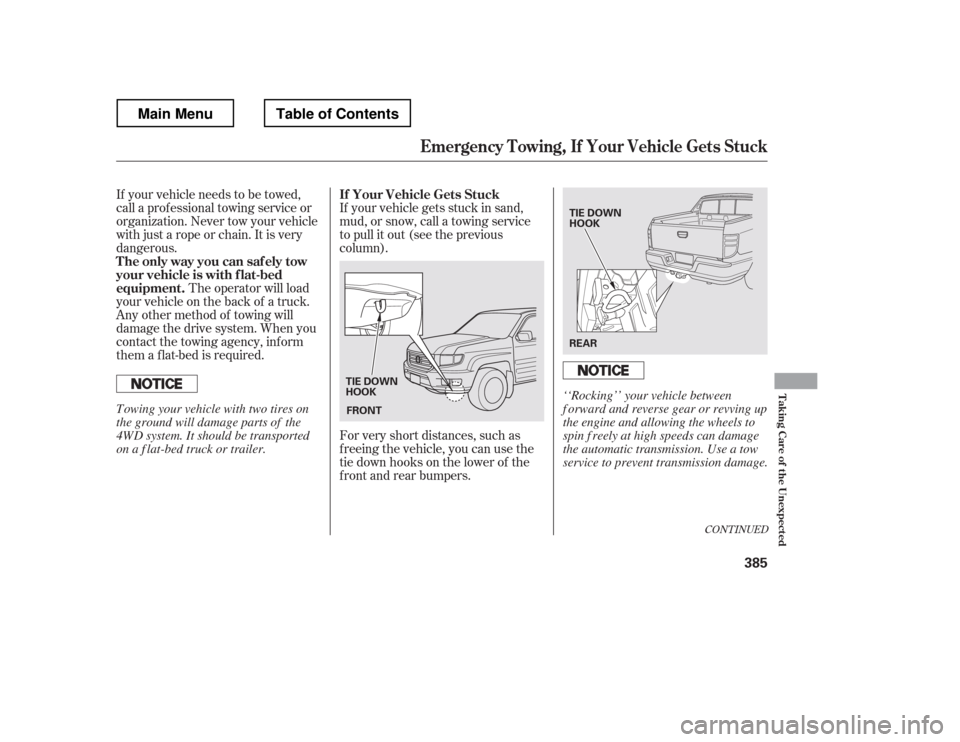
For very short distances, such as
f reeing the vehicle, you can use the
tie down hooks on the lower of the
f ront and rear bumpers.
Emergency Towing, If Your Vehicle Gets Stuck
The only way you can saf ely tow
your vehicle is with f lat-bed
equipment.
If Your Vehicle Gets Stuck
T aking Care of the Unexpected
385
FRONT
REAR
TIE DOWN
HOOK TIE DOWN
HOOK
‘‘Rocking’’ your vehicle between
f orward and reverse gear or revving up
the engine and allowing the wheels to
spin f reely at high speeds can damage
the automatic transmission. Use a tow
service to prevent transmission damage.
Towing your vehicle with two tires on
the ground will damage parts of the
4WD system. It should be transported
on a f lat-bed truck or trailer.
Main MenuTable of Contents
Page 396 of 429
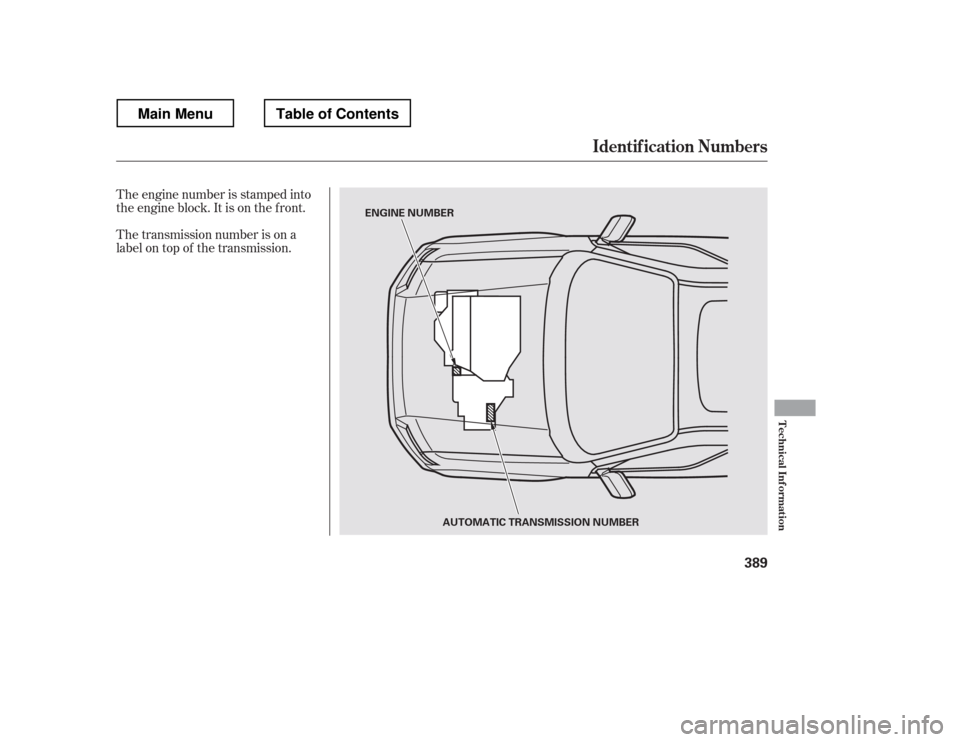
The engine number is stamped into
the engine block. It is on the f ront.
The transmission number is on a
label on top of the transmission.
Identif ication Numbers
T echnical Inf ormat ion
389
ENGINE NUMBERAUTOMATIC TRANSMISSION NUMBER
Main MenuTable of Contents
Page 397 of 429
�µ�µ
�Î �Î
�Î �Î �Î
�Î
�Î
�Î �Î �Î�Î �Î
�Î
�Î
Specif ications
390 Air Conditioning
Dimensions
Capacities
Weights
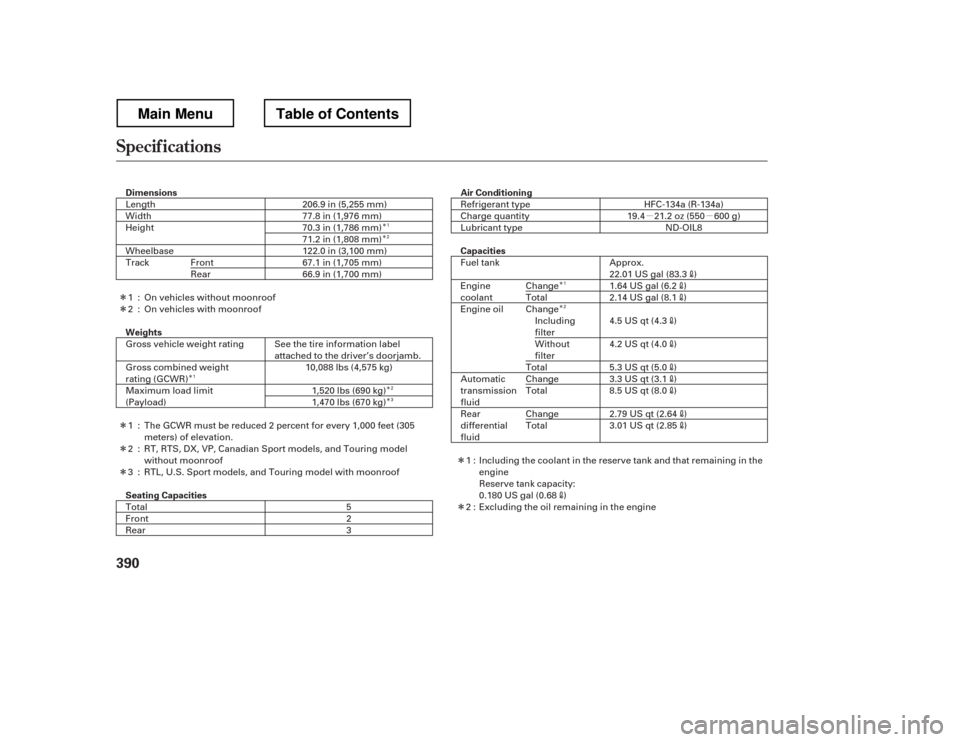
Seating Capacities 206.9 in (5,255 mm)
77.8 in (1,976 mm)
70.3 in (1,786 mm)
Refrigerant type
Charge quantity
Lubricant type HFC-134a (R-134a)
19.4 21.2 oz (550 600 g) ND-OIL8
1,470 lbs (670 kg)
1,520 lbs (690 kg)
10,088 lbs (4,575 kg)
Length
Width
Height
Wheelbase
Track
66.9 in (1,700 mm)
67.1 in (1,705 mm)
122.0 in (3,100 mm)
The GCWR must be reduced 2 percent for every 1,000 feet (305
meters) of elevation. Fuel tank
Engine
coolant
Engine oil Automatic
transmission
fluidRear
differential
fluid
22.01 US gal (83.3
)
1.64 US gal (6.2)
2.14 US gal (8.1)
4.2 US qt (4.0
)
4.5 US qt (4.3
)
5.3 US qt (5.0
)
3.3 US qt (3.1)
8.5 US qt (8.0)
2.79 US qt (2.64
)
3.01 US qt (2.85)
Including the coolant in the reserve tank and that remaining in the
engine
Reserve tank capacity:
0.180 US gal (0.68
)
Excluding the oil remaining in the engine
71.2 in (1,808 mm)
Gross vehicle weight rating
Gross combined weight
rating (GCWR)
Maximum load limit
(Payload) See the tire information label
attached to the driver’s doorjamb.
3
2
5
Total
FrontRear Approx.
FrontRear
1: 2:
1: 2: 3:
Change Total
Change
Including
filter
Without
filter
Total
ChangeTotal
Change Total
1:
2:
On vehicles without moonroof
On vehicles with moonroof
RT, RTS, DX, VP, Canadian Sport models, and Touring model
without moonroof
RTL, U.S. Sport models, and Touring model with moonroof 1
231 2
1
2
Main MenuTable of Contents