Page 614 of 681
�µ
Check the terminals f or corrosion (a
white or yellowish powder). To
remove it, cover the terminals with a
solution of baking soda and water. It
will bubble up and turn brown. When
this stops, wash it of f with plain
water. Dry off the battery with a
cloth or paper towel. Coat the
terminals with grease to help prevent
f urther corrosion.
Battery posts,
terminals, and related accessories
contain lead and lead compounds.
If additional battery maintenance is
needed, see your dealer or a
qualif ied technician.
If you need to connect the battery to
a charger, disconnect both cables to
prevent damaging your vehicle
Page 616 of 681
Block the rear wheels.
If the vehicle is to be stored f or a
longer period, it should be
supported on jackstands so the
tires are of f the ground.
Leave one window open slightly (if
the vehicle is being stored
indoors).
Disconnect the battery.
Support the f ront and rear wiper
blade arms with a f olded towel or
ragsotheydonottouchthe
windshield.
To minimize sticking, apply a
silicone spray lubricant to all door
and tailgate seals. Also, apply a
vehiclebodywaxtothepainted
surfaces that mate with the door
and tailgate seals.Cover the vehicle with a
‘‘breathable
Page 618 of 681
This section covers the more
common problems that motorists
experience with their vehicles. It
gives you inf ormation about how to
safely evaluate the problem and what
to do to correct it. If the problem has
stranded you on the side of the road,
you may be able to get going again.
If not, you will also f ind instructions
on getting your vehicle towed.......................
Compact Spare Tire . 612
....................
Changing a Flat Tire . 613
.............
If the Engine Won
Page 626 of 681
Slowly turn the extension with the
wheel nut wrench clockwise to
take up the slack of the hoist cable.
Make sure the bracket is seated in
the center hole of the flat tire.
Turn the extension with the wheel
nut wrench clockwise until the f lat
tire rests against the underbody of
the vehicle and you hear the hoist
click.Store the jack and the tools in the
tool box.
Refer to
(see page or ).
23. 24. 25. 26.
524 529
Changing a Flat T ire
Changing a T ire with
TPMS
T aking Care of the Unexpected
619
WHEEL NUT WRENCH
Loose items can fly around the
interiorinacrashandcould
seriously injure the occupants.
Store the wheel, jack, and tools
securely before driving.
Always raise the spare tire hoist, even
if you are not stowing a tire. If the
hoist is lef t down, it will be damaged
during driving and need to be replaced.
Main MenuTable of Contents
Page 628 of 681
Are you using the proper starting
procedure? Ref er toon page .
Do you have f uel? Check the f uel
gauge; the warning indicator may
not be working.
There may be an electrical
problem, such as no power to the
f uel pump. Check all the f uses
(see page ).
If youfindnothingwrong,youwill
need a qualif ied technician to f ind
the problem. See on page . Although this seems like a simple
procedure, you should take several
precautions.
You cannot start your vehicle by
pushing or pulling it. Put the transmission in neutral or
Park, and set the parking brake.
Turn of f all the electrical acces-
sories: heater, A/C, climate
control, audio system, lights, etc.
Open the hood, and check the
physical condition of the battery.
In very cold weather, check the
condition of the electrolyte. If it
seems slushy or f rozen, do not try
jump starting until it thaws.
1. 2.
513
630 636
CONT INUED
Starting the
Engine
Emergency
Towing Jump Starting
To Jump Start Your Vehicle:
If the Engine Won
Page 635 of 681
If you must drive the vehicle a short
distance in this condition, drive
slowly and caref ully.
If the ABS indicator and the VSA
system indicator come on with the
brake system indicator, have your
vehicle inspected by your dealer
immediately.
Slow down by shif ting to a lower
gear, and pull to the side of the road
when it is saf e. Because of the long
distance needed to stop, it is
hazardous to drive the vehicle. You
should have it towed, and repaired as
soon as possible (see
on page ).636Emergency
Towing
Brake System Indicator
628
Main MenuTable of Contents
Page 643 of 681

�µ�µ
If your vehicle needs to be towed,
call a prof essional towing service or
organization. Never tow your vehicle
with just a rope or chain. It is very
dangerous.
The operator will load
your vehicle on the back of a truck.
Any other method of towing will
damage the drive system. When you
contact the towing agency, inf orm
them a f lat-bed is required. Therearetwowaystotowyour
vehicle:
The operator
loads your vehicle on the back of a
truck.
The tow
truck uses two pivoting arms that go
under the f ront tires and lif t them of f
the ground. The rear tires remain on
the ground.
4WD models Except 4WD models
Emergency T owing
The only way you can saf ely tow
your vehicle is with f lat-bed
equipment.
T his is the best way to
transport your vehicle.
This is an acceptable
way to tow your vehicle.
Flat -bed Equipment
Wheel-lif t Equipment
636
Towing with only two tires on the
ground will damage parts of the 4WD
system. It should be transported on a
f lat-bed truck or trailer.
Main MenuTable of Contents
Page 644 of 681
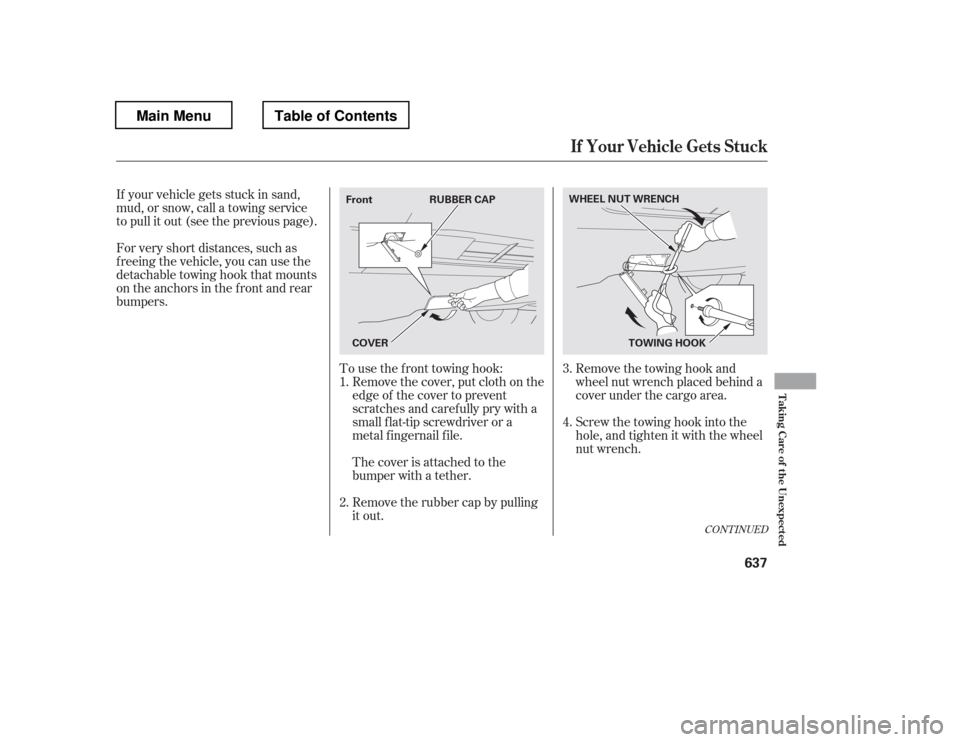
If your vehicle gets stuck in sand,
mud, or snow, call a towing service
to pull it out (see the previous page).
For very short distances, such as
f reeing the vehicle, you can use the
detachable towing hook that mounts
on the anchors in the front and rear
bumpers.Remove the towing hook and
wheel nut wrench placed behind a
cover under the cargo area.
Screw the towing hook into the
hole, and tighten it with the wheel
nut wrench.
Remove the cover, put cloth on the
edge of the cover to prevent
scratches and caref ully pry with a
small f lat-tip screwdriver or a
metalfingernailfile.
To use the f ront towing hook:
The cover is attached to the
bumper with a tether.
Remove the rubber cap by pulling
it out.
1. 2. 3. 4.
CONT INUED
If Your Vehicle Gets Stuck
T aking Care of the Unexpected
637
COVER
Front
RUBBER CAP WHEEL NUT WRENCH
TOWING HOOK
Main MenuTable of Contents