Page 308 of 435

�µ�µ
�µ
�µ To shif t to second,
pressthereleasebuttononthefront
of the shif t lever. This position locks
the transmission in second gear. It
does not downshif t to f irst gear
when you come to a stop.
Use second gear:
For more power when climbing.
To increase engine braking when
going down steep hills.
For starting out on a slippery
surf ace or in deep snow.
To help reduce wheel spin.
When driving downhill with a
trailer. To shif t f rom second to
first, press the release button on the
f ront of the shif t lever. This position
locks the transmission in f irst gear.
By upshif ting and downshif ting
through 1, 2, D3, and D, you can
operate this transmission much like
a manual transmission without a
clutch pedal.
Use this position f or
your normal driving. The
transmission automatically selects a
suitable gear (1 through 5) f or your
speed and acceleration.
To shift from D to D3,
press the shif t lever release button.
This position is similar to D, except
only the f irst three gears are
selected. Use D3 when towing a
trailer in hilly terrain, or to provide
engine braking when going down a
steep hill. D3 can also keep the
transmission f rom cycling between
third and f ourth gears in stop-and-go
driving. Second (2)
First (1)
Drive (D)
Drive (D3)
Automatic Transmission
304
Driving
2012 Crosstour
Page 311 of 435

Always use the parking brake when
you park your vehicle. Make sure
the parking brake is set f irmly, or
your vehicle may roll if it is parked
on an incline.If the vehicle is f acing uphill, turn
the front wheels away from the
curb.
Make sure the moonroof and the
windows are closed.
Turn of f the lights.
Set the parking brake bef ore you put
the transmission in Park. This keeps
the vehicle from moving and putting
pressure on the parking mechanism
in the transmission. Place any packages, valuables, etc.,
wheretheycannotbeseenfrom
outsidethevehicleortakethem
with you.
Never park over dry leaves, tall
grass, or other f lammable
materials. The hot three way
catalytic converter could cause
these materials to catch on fire. Check the indicator on the
instrument panel to verif y that the
security system is set. Lock the doors and the tailgate.
Make sure the parking brake is
f ully released bef ore driving away.
Driving with the parking brake
partially set can overheat or
damage the rear brakes. If the vehicle is f acing downhill,
turn the front wheels toward the
curb.
Parking T ips
Parking
307
Driving
2012 Crosstour
Page 320 of 435
Your vehicle has been designed
primarily to carry passengers and
their cargo. You can also use it to
tow a trailer if you caref ully observe
the load limits, use the proper
equipment, and f ollow the guidelines
in this section.
Avoid towing a trailer during your
vehicle’s f irst 600 miles (1,000 km)
(see page ).The
maximum allowable weight of the
trailer and everything in or on it
must not exceed 1,500 lbs (680 kg).
Towing a load that is too heavy
can seriously af f ect your vehicle’s
handling and perf ormance. It can
also damage the engine and
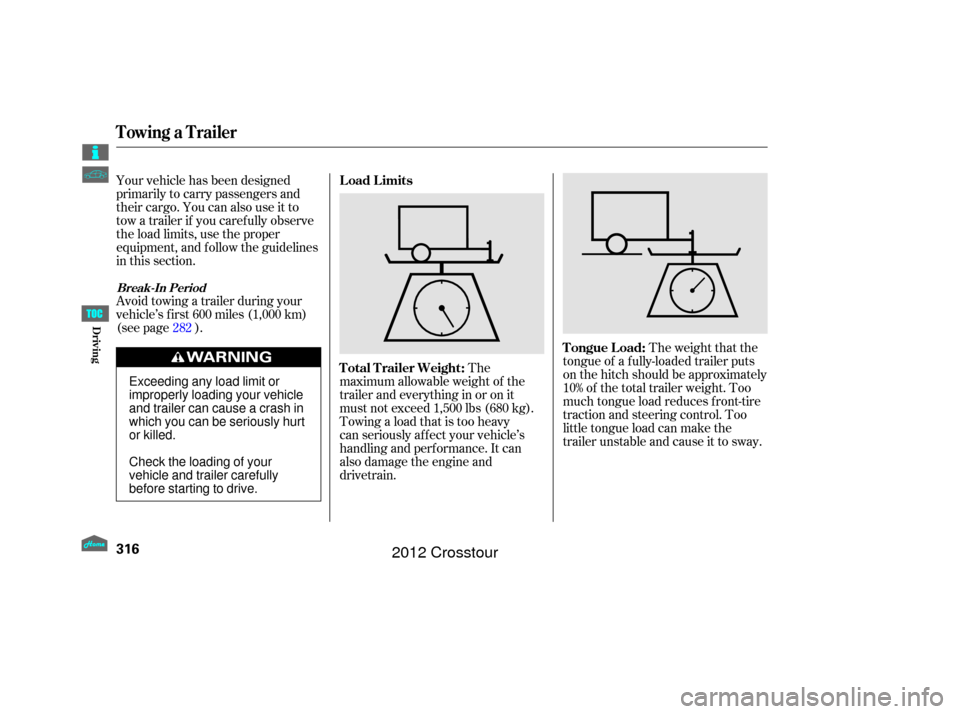
drivetrain. Theweightthatthe
tongue of a f ully-loaded trailer puts
on the hitch should be approximately
10% of the total trailer weight. Too
much tongue load reduces f ront-tire
traction and steering control. Too
little tongue load can make the
trailer unstable and cause it to sway.
282
Break-In Period
Load Limits
T otal T railer Weight:
T ongue L oad:
Towing a Trailer
316
Exceeding any load limit or
improperly loading your vehicle
and trailer can cause a crash in
which you can be seriously hurt
or killed.
Check the loading of your
vehicle and trailer carefully
beforestartingtodrive.
Driving
2012 Crosstour
Page 321 of 435

To achieve a proper tongue load,
start by loading 60% of the load
toward the front of the trailer and
40% toward the rear, then re-adjust
the load as needed.The maximum allowable weight of
the vehicle, all occupants, all
accessories, all cargo, and the
tongue load is: The maximum allowable weight at
the vehicle axles is:
The best way to confirm that all
loads are within limits is to
check them at a public scale. For
public scales in your area, check
your local phone book, or
contact your trailer dealer or
rental agency for assistance.
If you cannot get to a public scale,
you can estimate the total trailer
weight by adding the weight of
your trailer (as quoted by the
manufacturer) with everything
in or on the trailer.
If you normally pull the same load
each time you tow a trailer, you can
use a suitable scale or a special
tongue load gauge to check the
tongue load the first time you set up
a towing combination (a fully loaded
vehicle and trailer), then recheck
the tongue load whenever the
conditions change.
on the f ront axle
on the rear axle
on the f ront axle
on the rear axle
2WD models:
4WD models:
2WD models:
4WD models:
Gross Vehicle Weight Rating
(GVWR): Checking L oads
Gross Axle Weight Rating
(GA WR):
Towing a Trailer
317
4,938 lbs (2,240 kg) 2,623 lbs (1,190 kg)
2,381 lbs (1,080 kg)
5,115 lbs (2,320 kg) 2,668 lbs (1,210 kg)
2,513 lbs (1,140 kg)
Driving
2012 Crosstour
Page 322 of 435

If you choose electric brakes, be
sure they are electronically actuated.
Do not attempt to tap into your
vehicle’s hydraulic system. No
matter how successf ul it may seem,
any attempt to attach trailer brakes
to your vehicle’s hydraulic system
will lower braking ef f ectiveness and
create a potential hazard.
Seeyourtrailerdealerorrental
agency f or more inf ormation on
installing electric brakes.
Towing can require a variety of
equipment, depending on the size of
your trailer, how it will be used, how
much load you are towing, and
where you tow.
Any hitch used on your vehicle must
be properly bolted to the underbody.
Always use saf ety chains when you
tow a trailer. Make sure the chains
are secured to the trailer and hitch,
and that they cross under the tongue
and can catch the trailer if it
becomes unhitched. Leave enough
slack to allow the trailer to turn
corners easily, but do not let the
chains drag on the ground.There are two common types of
trailer brakes: surge and electric.
Surge brakes are common f or boat
trailers, since the brakes will get wet.
Discuss your needs with your trailer
sales or rental agency, and f ollow the
guidelines in the rest of this section.
Also make sure that all equipment is
properly installed and that it meets
f ederal, state, provincial, territorial,
and local regulations.
Trailer Brakes
Hitches
Saf et y ChainsT owing Equipment and
A ccessories
Towing a Trailer
318
Driving
2012 Crosstour
Page 323 of 435
CONT INUED
Trailer lights and equipment must
comply with f ederal, state, provincial,
territorial, and local regulations.
Check with your local trailer dealer
or rental agency for the
requirements in the area where you
plan to tow, and use only equipment
designed f or your vehicle.Since lighting and wiring vary by
trailer type and brand, you should
have a qualif ied technician install a
suitable connector between the
vehicle and the trailer. Improper
equipment or installation can cause
damage to your vehicle’s electrical
system and af f ect your vehicle
warranty.
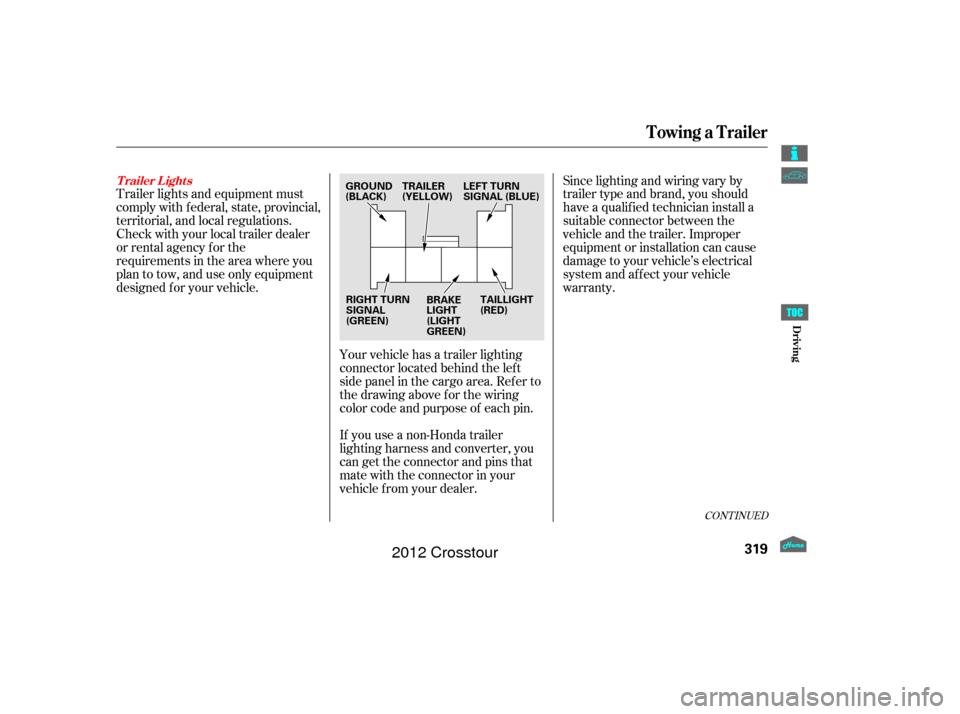
Your vehicle has a trailer lighting
connector located behind the lef t
side panel in the cargo area. Ref er to
thedrawingaboveforthewiring
color code and purpose of each pin.
If you use a non-Honda trailer
lighting harness and converter, you
can get the connector and pins that
mate with the connector in your
vehicle f rom your dealer.
T railer L ights
Towing a Trailer
319
GROUND
(BLACK) TRAILER
(YELLOW) LEFT TURN
SIGNAL (BLUE)
BRAKE
LIGHT
(LIGHT
GREEN) TAILLIGHT
(RED)
RIGHT TURN
SIGNAL
(GREEN)
Driving
2012 Crosstour
Page 324 of 435

The lights and brakes on your
vehicle and the trailer are working
properly.
Your vehicle tires and spare are
properly inf lated, and the trailer
tires and spare are inflated as
recommended by the trailer
maker.
Askyourtrailersalesorrental
agency if any other items are
recommended or required f or your
towing situation. When preparing to tow, and bef ore
driving away, be sure to check the
f ollowing:
Many states and Canadian
provinces/territories require special
outside mirrors when towing a trailer.
Even if they don’t, you should install
special mirrors if you cannot clearly
see behind you, or if the trailer
creates a blind spot. The vehicle has been properly
serviced, and the suspension and
the cooling system are in good
operating condition.
The trailer has been properly
serviced and is in good condition.
All weights and loads are within
limits.
Thehitch,safetychains,andany
other attachments are secure.
All items in or on the trailer are
properly secured and cannot shif t
while you drive.
Towing a Trailer
A ddit ional T owing EquipmentPre-T ow Checklist
320
Driving
2012 Crosstour
Page 325 of 435

When driving down hills, reduce
your speed, and shif t down to second
gear. Do not ‘‘ride’’ the brakes, and
remember, it will take longer to slow
downandstopwhentowingatrailer.
If youmuststopwhenfacinguphill,
use the f oot brake or parking brake.
Do not try to hold the vehicle in
place by pressing on the accelerator,
as this can cause the automatic
transmission to overheat.
Crosswinds and air turbulence
caused by passing trucks can disrupt
your steering and cause the trailer to
sway. When being passed by a large
vehicle, keep a constant speed, and
steer straight ahead. Do not try to
make quick steering or braking
corrections.
Maketurnsmoreslowlyandwider
than normal. The trailer tracks a
smaller arc than your vehicle, and it
canhitorrunoversomethingthe
vehicle misses. Allow more time and
distance f or braking. Do not brake or
turn suddenly as this could cause the
trailer to jackknif e or turn over.
When climbing hills, closely watch
your temperature gauge. If it nears
the red (Hot) mark, turn the air
conditioning of f , reduce speed and, if
necessary, pull to the side of the
road to let the engine cool.
The added weight, length, and
height of a trailer will af f ect your
vehicle’s handling and perf ormance,
so driving with a trailer requires
some special driving skills and
techniques.
Foryoursafetyandthesafetyof
others,taketimetopracticedriving
maneuvers bef ore heading f or the
open road, and f ollow the guidelines
in this section.
Drive slower than normal in all
driving situations, and obey posted
speed limits f or vehicles with trailers.
Use the D position when towing a
trailer on level roads. D3 is the
proper shif t lever position to use
when towing a trailer in hilly terrain.
(See ‘‘
’’ in the
f ollowing column f or additional gear
inf ormation.) If the automatic transmission shifts
f requently while going up a hill, shif t
to D3.
Towing a Trailer
Handling Crosswinds and Buf f et ing
Making T urns and Braking
Driving on Hills
T owing Speeds and Gears
Driving on Hills
Driving Saf ely With a T railer
321
Driving
2012 Crosstour