Page 2 of 345

Contents
Child Safety P. 50 Exhaust Gas Hazard P. 62 Safety Labels P. 63
Opening and Closing the Trunk P. 109Security System P. 112 Opening and Closing the Windows P. 114
Operating the Switches Around the Steering Wheel P. 117Adjusting the Mirrors P. 125
Interior Lights/Interior Convenience Items P.134 Heating and Cooling
* P. 140
Audio Error Messages* P. 172 General Information on the Audio System* P. 174
When Driving P. 211 Braking P.229 Parking Your Vehicle P.233
Accessories and Modifications P. 238
Maintenance Under the Hood P.251 Replacing Light Bulbs P. 268
Checking and Maintaining Tires P. 280Battery P. 289 Remote Transmitter Care* P. 290
Cleaning P. 292
Engine Does Not Start P. 306 Jump Starting P.307 Shift Lever Does Not Move P. 310
Fuses P. 318 Emergency Towing P. 321
Devices that Emit Radio Waves P. 329Reporting Safety Defects P. 330
Authorized Manuals P. 335 Customer Service Information P. 336
Quick Reference GuideP. 2
Safe DrivingP. 23
Instrument PanelP. 65
ControlsP. 97
FeaturesP. 143
DrivingP. 201
MaintenanceP. 239
Handling the UnexpectedP. 297
InformationP. 323
IndexP. 337
CIVIC 4D-31TR3600.book 1 ページ 2011年2月14日 月曜日 午後2時51分
* Not available on all models2012 Civic Sedan
Page 9 of 345

8
Quick Reference Guide - 2012 Civic SedanSafe Driving (P 23)
Airbags (P 35)
● Your vehicle is fitted with ai rbags to help protect you and
your passengers during a moderate-to-severe collision.
Child Safety (P 50)
● All children 12 and younger should be seated in the rear seat.
● Smaller children should be properly restra ined in a forward-facing child seat.
● Infants must be properly restrained in a rear-facing child seat.
Exhaust Gas Hazard (P 62)
● Your vehicle emits dangerous exhaust gases that contain carbon
monoxide. Do not run the engine in confined spaces where carbon
monoxide gas can accumulate.
Before Driving Checklist (P 27)
● Before driving, check that the front seats, head restraints,
steering wheel, and mirrors have been properly adjusted.
Seat Belts (P 28)
● Fasten your seat belt and sit upright well
back in the seat.
● Check that your passengers are wearing
their seat belts correctly.
Fasten your lap belt as
low as possible.
CIVIC 4D-31TR3600.book 8 ページ 2011年2月14日 月曜日 午後2時51分
Home
QRG
Index
Page 16 of 345
15
Quick Reference Guide - 2012 Civic SedanDriving (P 201)
2
1
D3
P
R
N
DRelease Button
Shift Lever
Depress the brake pedal and press the
release button to move out of
(P.
Move the shift lever without
pressing the release button.
Press the release button to
move the shift lever.
Manual Transmission (P 217)
Automatic Transmission (P 215)
● Shift to
(P and depress the brake pedal when starting the engine.
● Shifting
Park
Turn off or start the engine.
Transmission is locked.
Reverse
Neutral
Transmission is not locked.
Drive
Normal driving.
Drive (D3)
Used when:
•Going up or down hills
•Towing a trailer in hilly terrain
Second
Used to increase engine braking
(the transmission is locked in 2nd gear)
First
Used to further increase engine braking
(the transmission is locked in 1st gear)
CIVIC 4D-31TR3600.book 15 ページ 2011年2月14日 月曜日 午後2時51分
Home
QRG
Index
Page 17 of 345
16
Quick Reference Guide - 2012 Civic Sedan
VSA® OFF Button (P 224)
● The vehicle stability assist (VSA
®) system
helps stabilize the vehicle during
cornering, and helps maintain traction
while accelerating on loose or slippery
road surfaces.
● VSA
® comes on automatically every time
you start the engine.
● To turn VSA
® on or off, press and hold
the button until you hear a beep.
Cruise Control* (P 220)
● Cruise control allows you to maintain a
set speed without keeping your foot on
the accelerator pedal.
● To use cruise control, press the CRUISE
button, then press once you have
received the desired speed (above 25 mph
or 40 km/h).
Tire Pressure Monitoring
System (TPMS)
(P 225)
● TPMS monitors tire pressure.
● TPMS is turned on automatically every
time you start the engine.
–/SET
U.S. models only
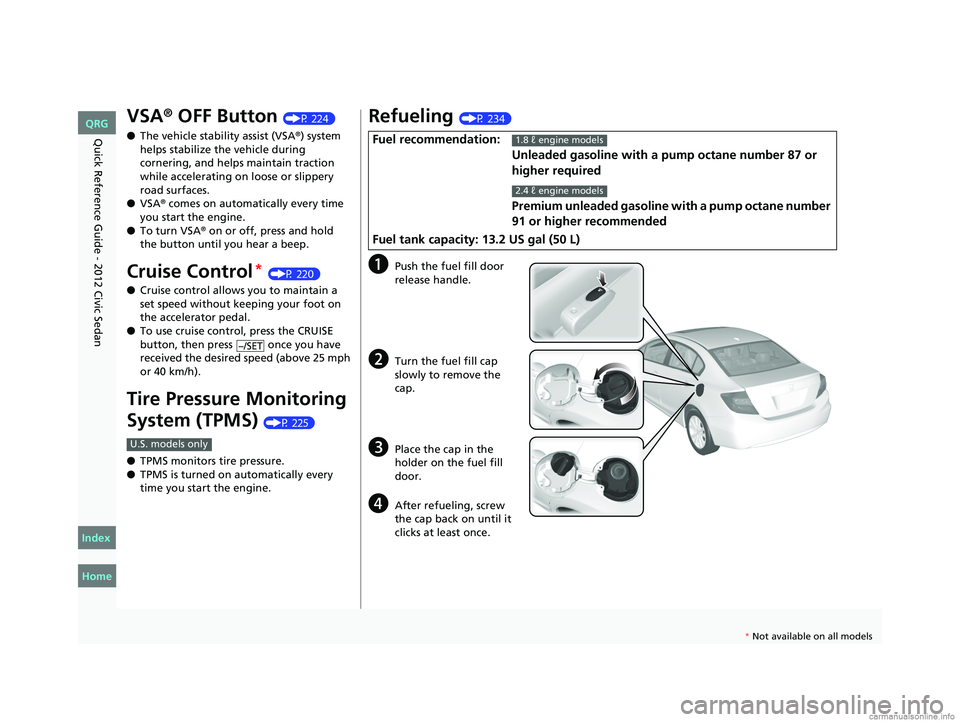
Refueling (P 234)
aPush the fuel fill door
release handle.
bTurn the fuel fill cap
slowly to remove the
cap.
cPlace the cap in the
holder on the fuel fill
door.
dAfter refueling, screw
the cap back on until it
clicks at least once.
Fuel recommendation:
Unleaded gasoline with a pu mp octane number 87 or
higher required
Premium unleaded gasoline wi th a pump octane number
91 or higher recommended
Fuel tank capacity: 13.2 US gal (50 L)1.8 ℓ engine models
2.4 ℓ engine models
CIVIC 4D-31TR3600.book 16 ページ 2011年2月14日 月曜日 午後2時51分
Home
QRG
Index
* No t avai lable on all m odel s
Page 18 of 345
17
Quick Reference Guide - 2012 Civic SedanMaintenance (P 239)
Under the Hood (P 251)
● Check engine oil, engine coolant, and windshield washer
fluid. Add when necessary.
● Check brake fluid and clutch fluid.
● Check the battery regularly.
aPull the hood release handle under the corner of the
dashboard.
bLocate the hood latch lever, pull the lever up, and lift up
the hood.
cWhen finished, close the hood and make sure it is firmly
locked in place.
Lights (P 268)
● Inspect all lights regularly.
Wiper Blades (P 278)
● Replace blades if they leave streaks
across the windshield.
Tires (P 280)
● Inspect tires and wheels regularly.
● Check tire pressures regularly.
● Install snow tires for winter
driving.
CIVIC 4D-31TR3600.book 17 ページ 2011年2月14日 月曜日 午後2時51分
Home
QRG
Index
Page 19 of 345
18
Quick Reference Guide - 2012 Civic SedanHandling the Unexpected (P 297)
Flat Tire (P 299)
● Park in a safe location and replace the
flat tire with the compact spare tire in the
trunk.
Indicators Come On
(P 313)
●Identify the indicator and consult the
owner's manual.
Engine Won't Start
(P 306)
● If the battery is dead, jump start using a
booster battery.
Blown Fuse (P 318)
● Check for a blown fuse if an electrical
device does not operate.
Overheating (P 311)
● Park in a safe location. If you do not see
steam under the hood, open the hood,
and let the engine cool down.
Emergency Towing
(P 321)
●Call a professional towing service if you
need to tow your vehicle.
CIVIC 4D-31TR3600.book 18 ページ 2011年2月14日 月曜日 午後2時51分
Home
QRG
Index
Page 21 of 345

20
Quick Reference Guide - 2012 Civic SedanWhy do the doors lock
after I unlocked the doors
using a remote
transmitter?If you do not open the doors within 30 seconds, the doors are
relocked automatically for security.
Why does the beeper
sound when I open the
driver's door? The beeper sounds when:
●The key is left in the ignition switch.
●The exterior lights are left on.
Why does the beeper
sound when I start driving? The beeper sounds when:
●Driver and/or front passenger are not wearing their seat belts.
●The parking brake lever is not fully released.
Why do I hear a screeching
sound when I apply the
brake pedal? The brake pads may need to be replaced. Have your vehicle
inspected by a dealer.
Is it possible to use
unleaded gasoline with a
Pump Octane Number
(PON) of 87 or higher on
this vehicle? Unleaded gasoline with a PON of
91 or higher is recommended.
If premium unleaded gasoline with a PON of 91 or higher is not
available, you can temporarily use the gasoline with a PON of
87 or higher.
This will result in decreased engine performance, and can cause
occasional metallic knocking noise in the engine.
Models with remote transmitter
2.4 ℓ engine models
CIVIC 4D-31TR3600.book 20 ページ 2011年2月14日 月曜日 午後2時51分
Home
QRG
Index
Page 63 of 345
62
Safe Driving
Exhaust Gas Hazard
Carbon Monoxide Gas
The engine exhaust from this vehicle contains carbon monoxide, a colorless,
odorless, and highly toxic gas. As long as you properly maintain your vehicle, carbon
monoxide gas will not get into the interior.
■Have the exhaust system inspected for leaks whenever
• The exhaust system is m aking an unusual noise.
• The exhaust system may have been damaged.
• The vehicle is raised for an oil change.
When you operate a vehicle with the trunk open, airflow can pull exhaust gas into
the interior and create a hazardous condition. If you must drive with the trunk open,
open all the windows and se t the heating and cooling
* system as shown below.
1. Select the fresh air mode.
2. Select the mode.
3. Set the fan speed to high.
4. Set the temperature control to a comfortable setting.
Adjust the heating and cooling
* system in the same manner if you sit in your parked
vehicle with the engine running.
1 Carbon Monoxide Gas
An enclosed area such as a garage can quickly fill up
with carbon monoxide gas.
Do not run the engine with the garage door closed.
Even when the garage door is open, drive out of the
garage immediat ely after starting the engine.
3WARNING
Carbon monoxide gas is toxic.
Breathing it can cause unconsciousness and
even kill you.
Avoid any enclosed areas or activities that
expose you to carbon monoxide.
* Not available on all models
CIVIC 4D-31TR3600.book 62 ページ 2011年2月14日 月曜日 午後2時51分
TOC
Home
QRG
Index


