Page 376 of 454
IDENTIFYING COMPONENTS IN THE ENGINE COMPARTMENT
Refer to the diesel supplement for diesel engine component locations.
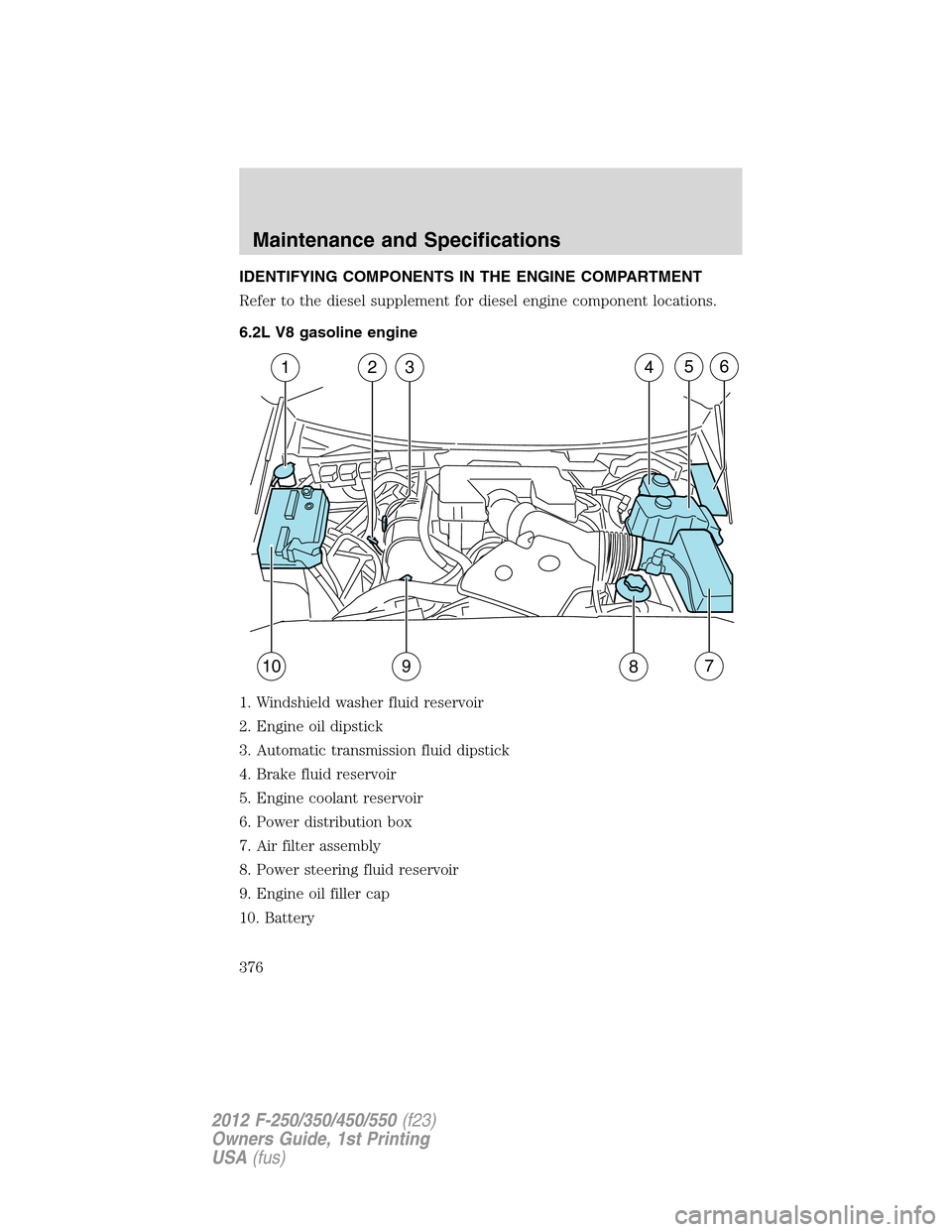
6.2L V8 gasoline engine
1. Windshield washer fluid reservoir
2. Engine oil dipstick
3. Automatic transmission fluid dipstick
4. Brake fluid reservoir
5. Engine coolant reservoir
6. Power distribution box
7. Air filter assembly
8. Power steering fluid reservoir
9. Engine oil filler cap
10. Battery
123456
10987
Maintenance and Specifications
376
2012 F-250/350/450/550(f23)
Owners Guide, 1st Printing
USA(fus)
Page 377 of 454
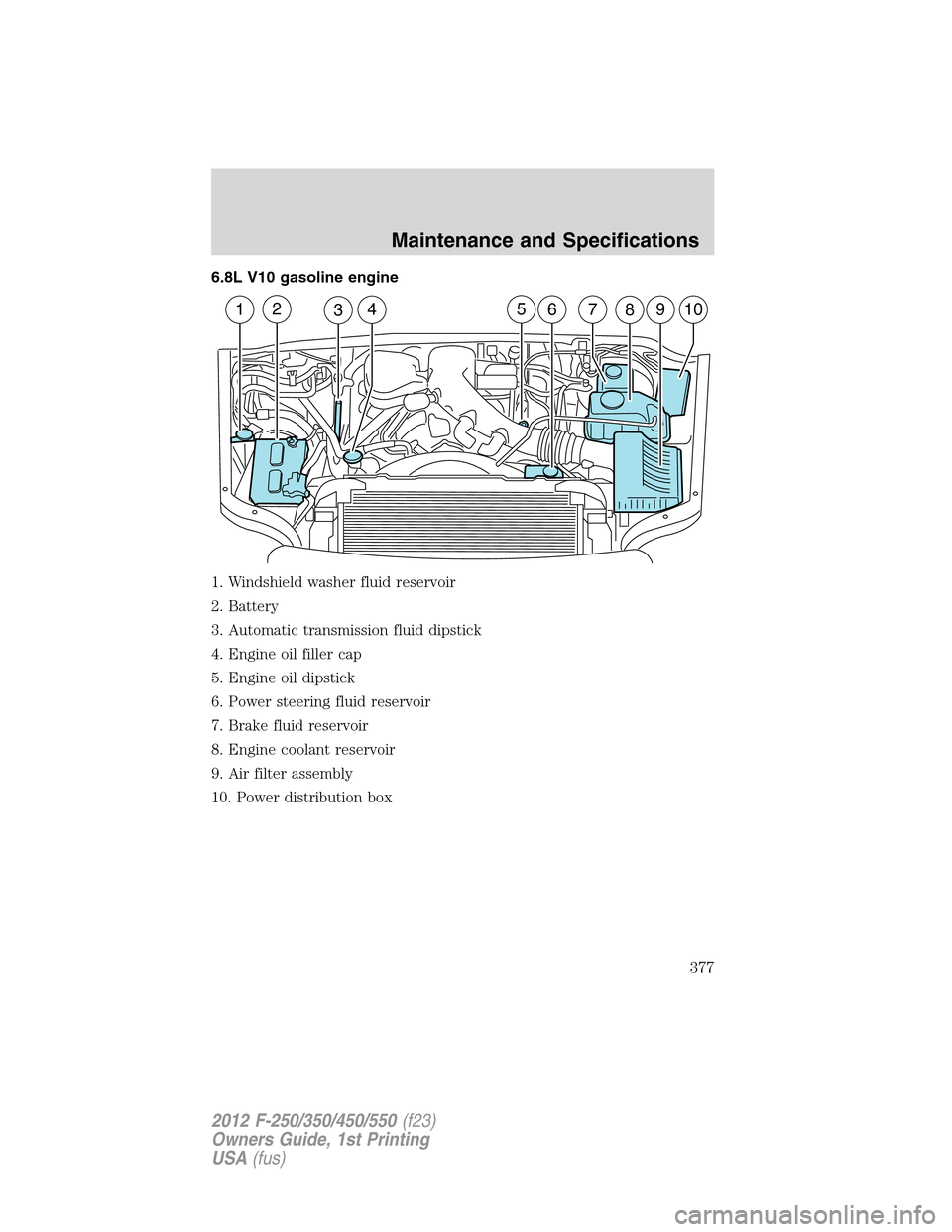
6.8L V10 gasoline engine
1. Windshield washer fluid reservoir
2. Battery
3. Automatic transmission fluid dipstick
4. Engine oil filler cap
5. Engine oil dipstick
6. Power steering fluid reservoir
7. Brake fluid reservoir
8. Engine coolant reservoir
9. Air filter assembly
10. Power distribution box
12356789104
Maintenance and Specifications
377
2012 F-250/350/450/550(f23)
Owners Guide, 1st Printing
USA(fus)
Page 379 of 454
To prolong the life of the wiper blades, it is highly recommended to
scrape off the ice on the windshield before turning on the wipers. The
layer of ice has many sharp edges and can damage the micro edge of the
wiper rubber element.
ENGINE OIL
Checking the engine oil
Refer to thescheduled maintenance informationfor the appropriate
intervals for checking the engine oil.
1. Make sure the vehicle is on level ground.
2. Turn the engine off and wait 15 minutes for the oil to drain into the
oil pan.
3. Set the parking brake and ensure the gearshift is securely latched in P
(Park).
4. Open the hood. Protect yourself from engine heat.
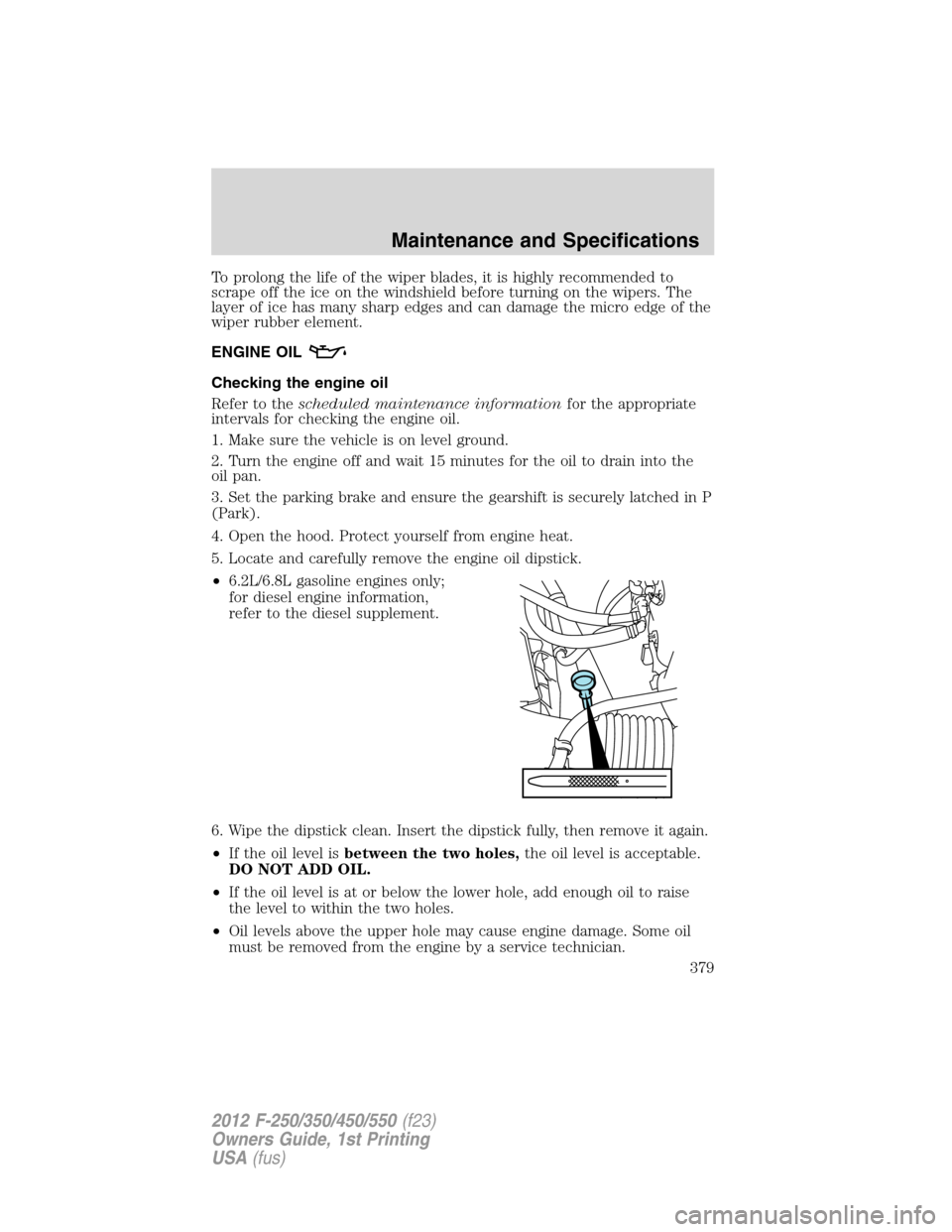
5. Locate and carefully remove the engine oil dipstick.
•6.2L/6.8L gasoline engines only;
for diesel engine information,
refer to the diesel supplement.
6. Wipe the dipstick clean. Insert the dipstick fully, then remove it again.
•If the oil level isbetween the two holes,the oil level is acceptable.
DO NOT ADD OIL.
•If the oil level is at or below the lower hole, add enough oil to raise
the level to within the two holes.
•Oil levels above the upper hole may cause engine damage. Some oil
must be removed from the engine by a service technician.
Maintenance and Specifications
379
2012 F-250/350/450/550(f23)
Owners Guide, 1st Printing
USA(fus)
Page 380 of 454
7. Put the dipstick back in and ensure it is fully seated.
Adding engine oil
1. Check the engine oil. For instructions, refer toChecking the engine
oilin this chapter.
2. If the engine oil level is not within the normal range, add only certified
engine oil of the recommended viscosity. Remove the engine oil filler cap
and use a funnel to pour the engine oil into the opening.
3. Recheck the engine oil level. Make sure the oil level is not above the
normal operating range on the engine oil level dipstick.
4. Install the dipstick and ensure it is fully seated.
5. Fully install the engine oil filler cap by turning the filler cap clockwise
1/4 of a turn until three clicks are heard or until the cap is fully seated.
To avoid possible oil loss, DO NOT operate the vehicle with the
engine oil level dipstick and/or the engine oil filler cap removed.
Engine oil and filter recommendations
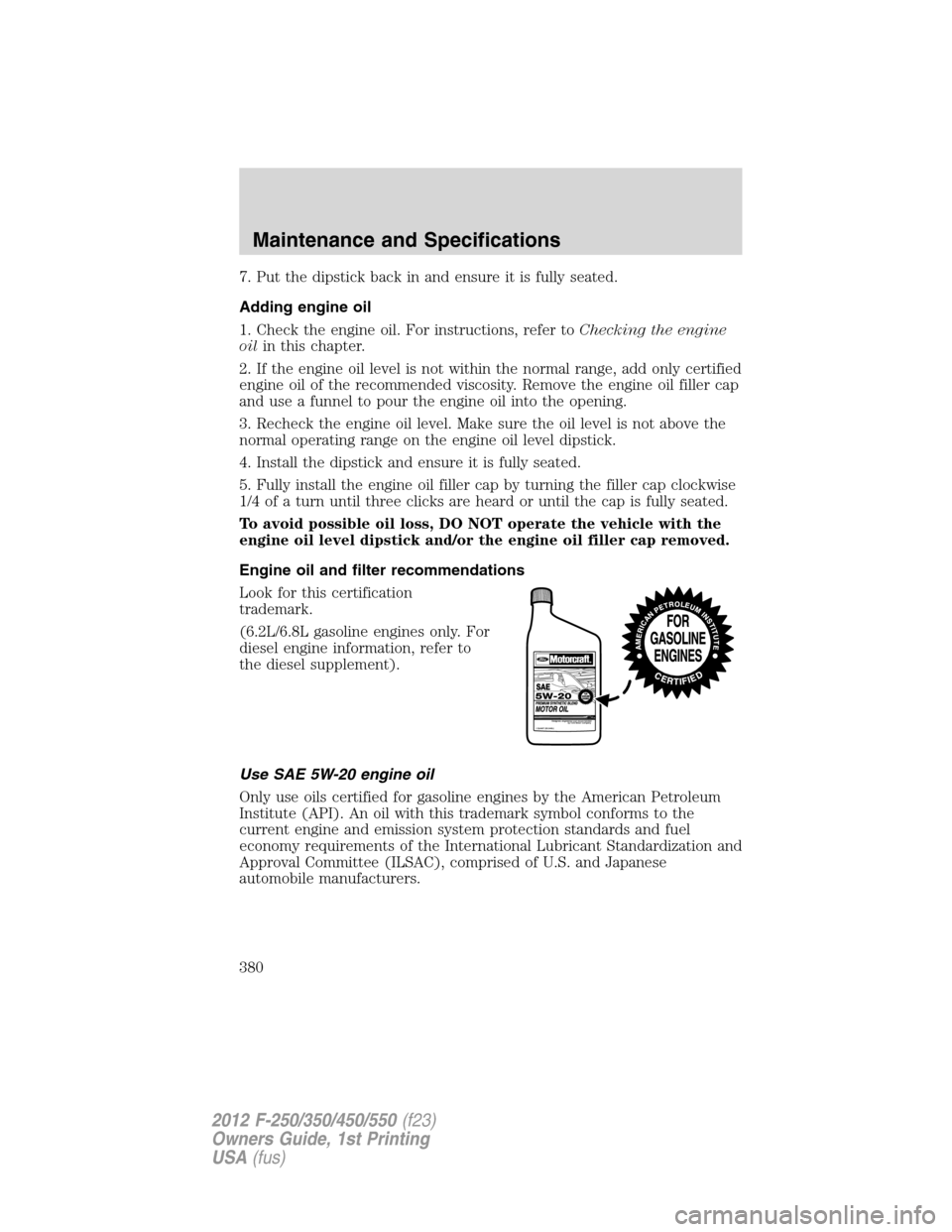
Look for this certification
trademark.
(6.2L/6.8L gasoline engines only. For
diesel engine information, refer to
the diesel supplement).
Use SAE 5W-20 engine oil
Only use oils certified for gasoline engines by the American Petroleum
Institute (API). An oil with this trademark symbol conforms to the
current engine and emission system protection standards and fuel
economy requirements of the International Lubricant Standardization and
Approval Committee (ILSAC), comprised of U.S. and Japanese
automobile manufacturers.
Maintenance and Specifications
380
2012 F-250/350/450/550(f23)
Owners Guide, 1st Printing
USA(fus)
Page 381 of 454
To protect your engine and engine’s warranty, use Motorcraft�SAE
5W-20 or an equivalent SAE 5W-20 oil meeting Ford specification
WSS-M2C945-A.SAE 5W-20 oil provides optimum fuel economy and
durability performance meeting all requirements for your
vehicle’s engine.Refer toMaintenance product specifications and
capacitieslater in this chapter for more information.
Do not use supplemental engine oil additives, cleaners or other engine
treatments. They are unnecessary and could lead to engine damage that
is not covered by Ford warranty.
Change your engine oil and filter according to the appropriate schedule
listed in thescheduled maintenance information.
Ford production and Motorcraft�replacement oil filters are designed for
added engine protection and long life. If a replacement oil filter is used
that does not meet Ford material and design specifications, start-up
engine noises or knock may be experienced.
It is recommended you use the appropriate Motorcraft�oil filter or
another with equivalent performance for your engine application.
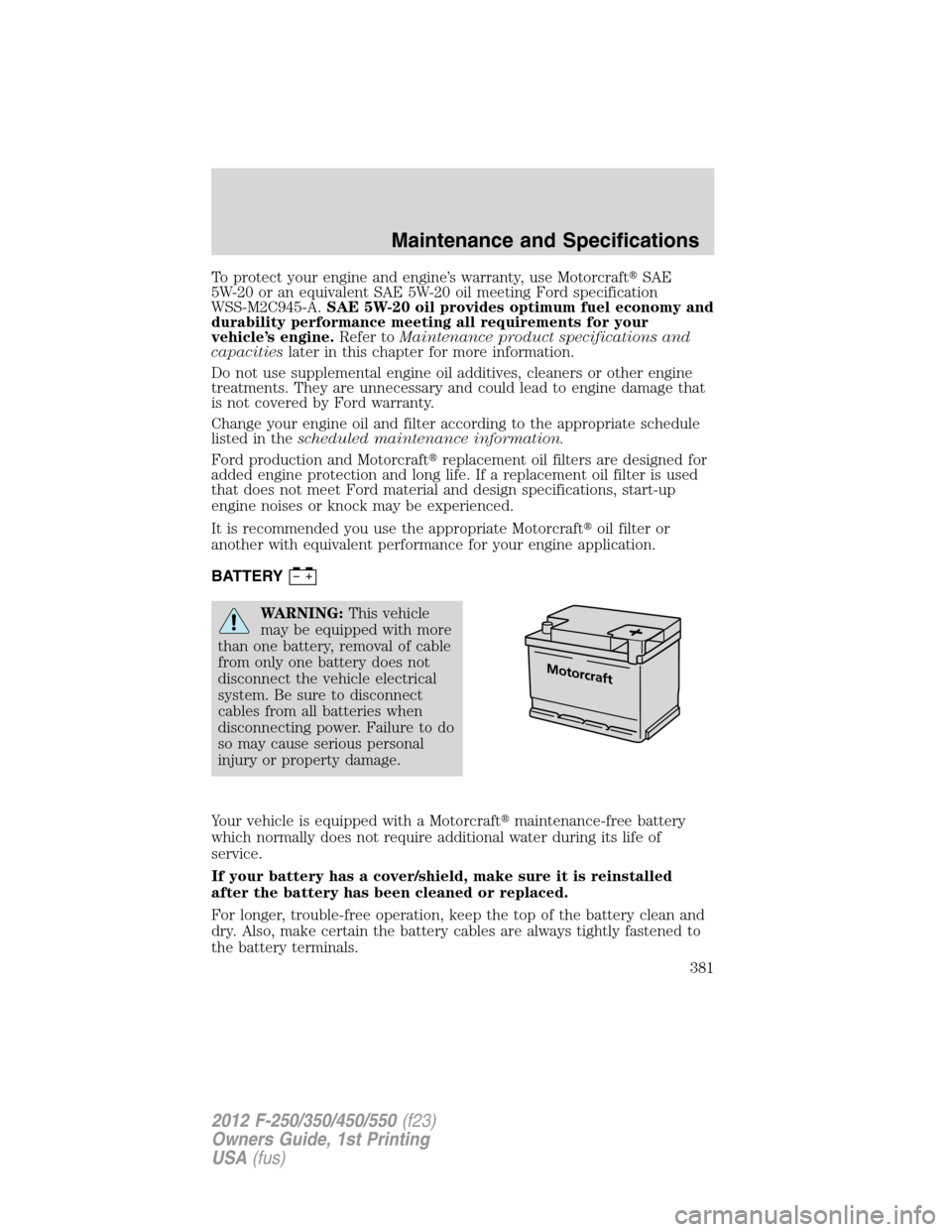
BATTERY
WARNING:This vehicle
may be equipped with more
than one battery, removal of cable
from only one battery does not
disconnect the vehicle electrical
system. Be sure to disconnect
cables from all batteries when
disconnecting power. Failure to do
so may cause serious personal
injury or property damage.
Your vehicle is equipped with a Motorcraft�maintenance-free battery
which normally does not require additional water during its life of
service.
If your battery has a cover/shield, make sure it is reinstalled
after the battery has been cleaned or replaced.
For longer, trouble-free operation, keep the top of the battery clean and
dry. Also, make certain the battery cables are always tightly fastened to
the battery terminals.
Maintenance and Specifications
381
2012 F-250/350/450/550(f23)
Owners Guide, 1st Printing
USA(fus)
Page 384 of 454
•Improved boiling protection.
•Protection against rust and other forms of corrosion.
•Proper function of calibrated gauges.
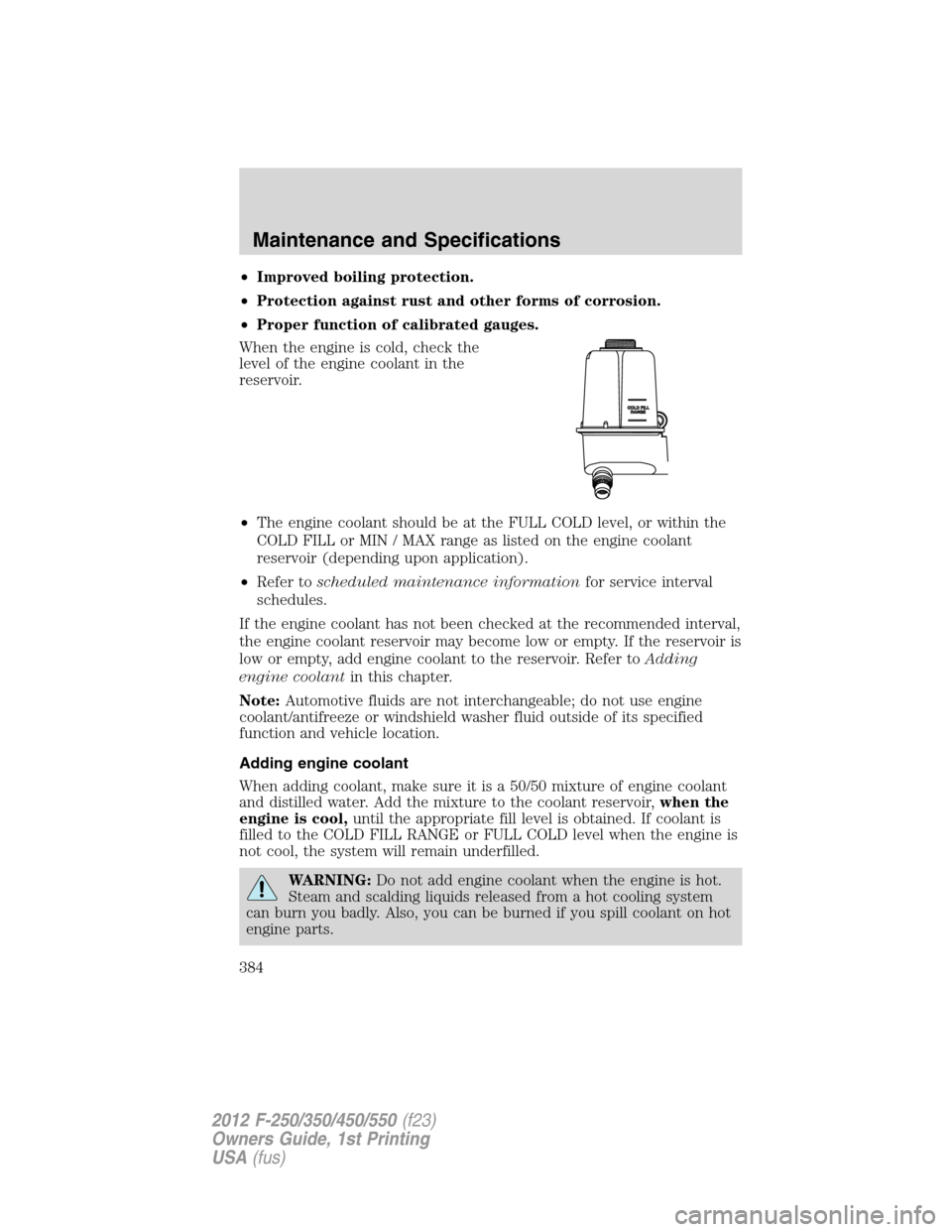
When the engine is cold, check the
level of the engine coolant in the
reservoir.
•The engine coolant should be at the FULL COLD level, or within the
COLD FILL or MIN / MAX range as listed on the engine coolant
reservoir (depending upon application).
•Refer toscheduled maintenance informationfor service interval
schedules.
If the engine coolant has not been checked at the recommended interval,
the engine coolant reservoir may become low or empty. If the reservoir is
low or empty, add engine coolant to the reservoir. Refer toAdding
engine coolantin this chapter.
Note:Automotive fluids are not interchangeable; do not use engine
coolant/antifreeze or windshield washer fluid outside of its specified
function and vehicle location.
Adding engine coolant
When adding coolant, make sure it is a 50/50 mixture of engine coolant
and distilled water. Add the mixture to the coolant reservoir,when the
engine is cool,until the appropriate fill level is obtained. If coolant is
filled to the COLD FILL RANGE or FULL COLD level when the engine is
not cool, the system will remain underfilled.
WARNING:Do not add engine coolant when the engine is hot.
Steam and scalding liquids released from a hot cooling system
can burn you badly. Also, you can be burned if you spill coolant on hot
engine parts.
Maintenance and Specifications
384
2012 F-250/350/450/550(f23)
Owners Guide, 1st Printing
USA(fus)
Page 395 of 454
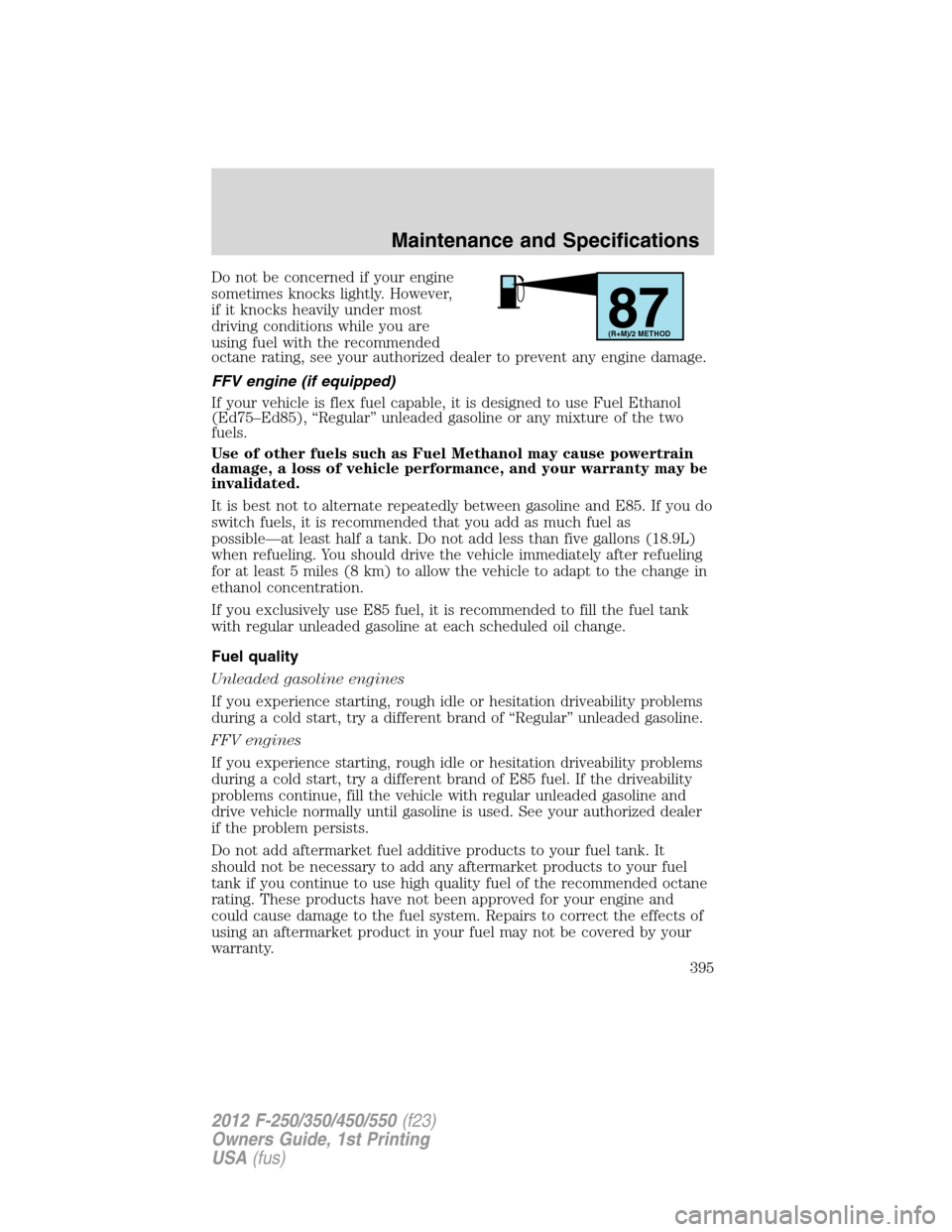
Do not be concerned if your engine
sometimes knocks lightly. However,
if it knocks heavily under most
driving conditions while you are
using fuel with the recommended
octane rating, see your authorized dealer to prevent any engine damage.
FFV engine (if equipped)
If your vehicle is flex fuel capable, it is designed to use Fuel Ethanol
(Ed75–Ed85), “Regular” unleaded gasoline or any mixture of the two
fuels.
Use of other fuels such as Fuel Methanol may cause powertrain
damage, a loss of vehicle performance, and your warranty may be
invalidated.
It is best not to alternate repeatedly between gasoline and E85. If you do
switch fuels, it is recommended that you add as much fuel as
possible—at least half a tank. Do not add less than five gallons (18.9L)
when refueling. You should drive the vehicle immediately after refueling
for at least 5 miles (8 km) to allow the vehicle to adapt to the change in
ethanol concentration.
If you exclusively use E85 fuel, it is recommended to fill the fuel tank
with regular unleaded gasoline at each scheduled oil change.
Fuel quality
Unleaded gasoline engines
If you experience starting, rough idle or hesitation driveability problems
during a cold start, try a different brand of “Regular” unleaded gasoline.
FFV engines
If you experience starting, rough idle or hesitation driveability problems
during a cold start, try a different brand of E85 fuel. If the driveability
problems continue, fill the vehicle with regular unleaded gasoline and
drive vehicle normally until gasoline is used. See your authorized dealer
if the problem persists.
Do not add aftermarket fuel additive products to your fuel tank. It
should not be necessary to add any aftermarket products to your fuel
tank if you continue to use high quality fuel of the recommended octane
rating. These products have not been approved for your engine and
could cause damage to the fuel system. Repairs to correct the effects of
using an aftermarket product in your fuel may not be covered by your
warranty.
87(R+M)/2 METHOD
Maintenance and Specifications
395
2012 F-250/350/450/550(f23)
Owners Guide, 1st Printing
USA(fus)
Page 399 of 454
•Use recommended engine oil. Refer toMaintenance product
specifications and capacitiesin this chapter.
•Perform all regularly scheduled maintenance items. Follow the
recommended maintenance schedule and owner maintenance checks
found inscheduled maintenance information.
Conditions
•Heavily loading a vehicle or towing a trailer may reduce fuel economy
at any speed.
•Carrying unnecessary weight may reduce fuel economy (approximately
1 mpg [0.4 km/L] is lost for every 400 lb [180 kg] of weight carried).
•Adding certain accessories to your vehicle (for example bug
deflectors, rollbars/light bars, running boards, ski/luggage racks) may
reduce fuel economy.
•To maximize the fuel economy, drive with the tonneau cover installed
(if equipped).
•Using fuel blended with alcohol may lower fuel economy.
•Fuel economy may decrease with lower temperatures during the first
8–10 miles (12–16 km) of driving.
•Driving on flat terrain offers improved fuel economy as compared to
driving on hilly terrain.
•Transmissions give their best fuel economy when operated in the top
cruise gear and with steady pressure on the gas pedal.
•Four-wheel-drive operation (if equipped) is less fuel efficient than
two-wheel-drive operation.
•Close windows for high speed driving.
EMISSION CONTROL SYSTEM
WARNING:Do not park, idle, or drive your vehicle in dry grass
or other dry ground cover. The emission system heats up the
engine compartment and exhaust system, which can start a fire.
WARNING:Exhaust leaks may result in entry of harmful and
potentially lethal fumes into the passenger compartment.
Maintenance and Specifications
399
2012 F-250/350/450/550(f23)
Owners Guide, 1st Printing
USA(fus)