Page 168 of 454
Easy-access/easy-out feature (if equipped)
The easy entry feature can be turned off or on through the vehicle
message center. Refer toMessage centerin theInstrument Cluster
chapter.
The easy entry feature automatically moves the driver’s seat 2 inches
(5 cm) forward when:
•the transmission is in P (Park)
•the key is inserted into the ignition cylinder
(If the seat is located less than 2 inches [5 cm] from the front of the seat
track, the seat will travel up to
14inch (6 mm) to the front of the seat
track).
The easy out feature automatically moves the driver’s seat 2 inches
(5 cm) backward when:
•the transmission is in P (Park)
•the key is removed from the ignition cylinder
(If the seat is located less than 2 inches (5 cm) from the rear of the seat
track, the seat will travel up to
14inch (6 mm) to the rear of the seat
track).
If the memory setting is programmed through the remote transmitter,
upon unlocking the door via remote entry system, the seat position will
travel to the desired memory setting less 2 inches (5 cm). Once entering
the vehicle and inserting the key in the ignition while in P (Park), the
easy entry feature will move the seat an additional 2 inches (5 cm) to
the desired memory location. SeeLocks and Securityfor activating the
memory seat feature through the remote entry system.
REAR SEATS
Non-adjustable second-row head restraints
Your vehicle is equipped with second row head restraints that are
non-adjustable.
WARNING:To minimize the risk of neck injury in the event of a
crash, the driver and passenger occupants should not sit in
and/or operate the vehicle, until the head restraint is placed in its
proper position. The driver should never adjust the head restraint
while the vehicle is in motion.
Seating and Safety Restraints
168
2012 F-250/350/450/550(f23)
Owners Guide, 1st Printing
USA(fus)
Page 169 of 454
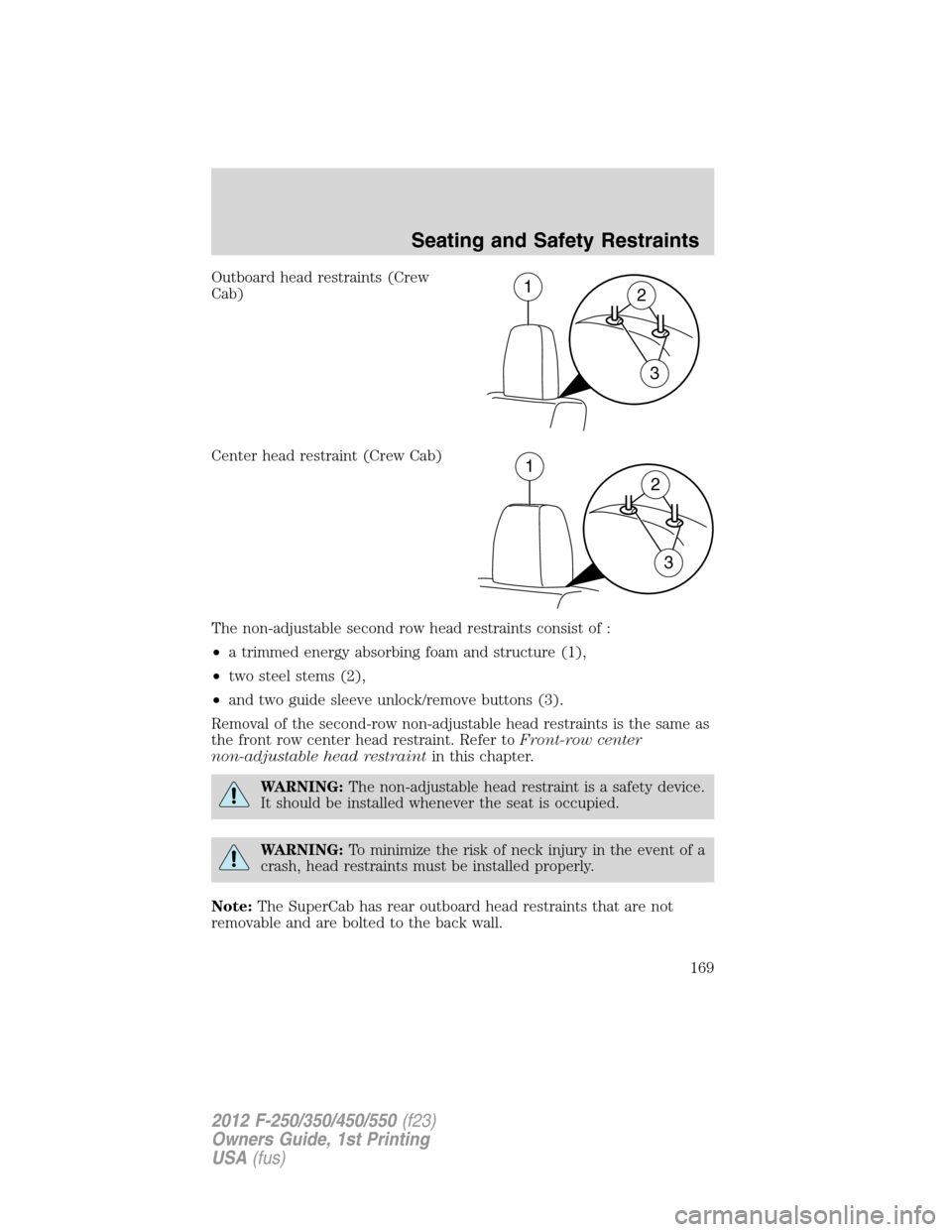
Outboard head restraints (Crew
Cab)
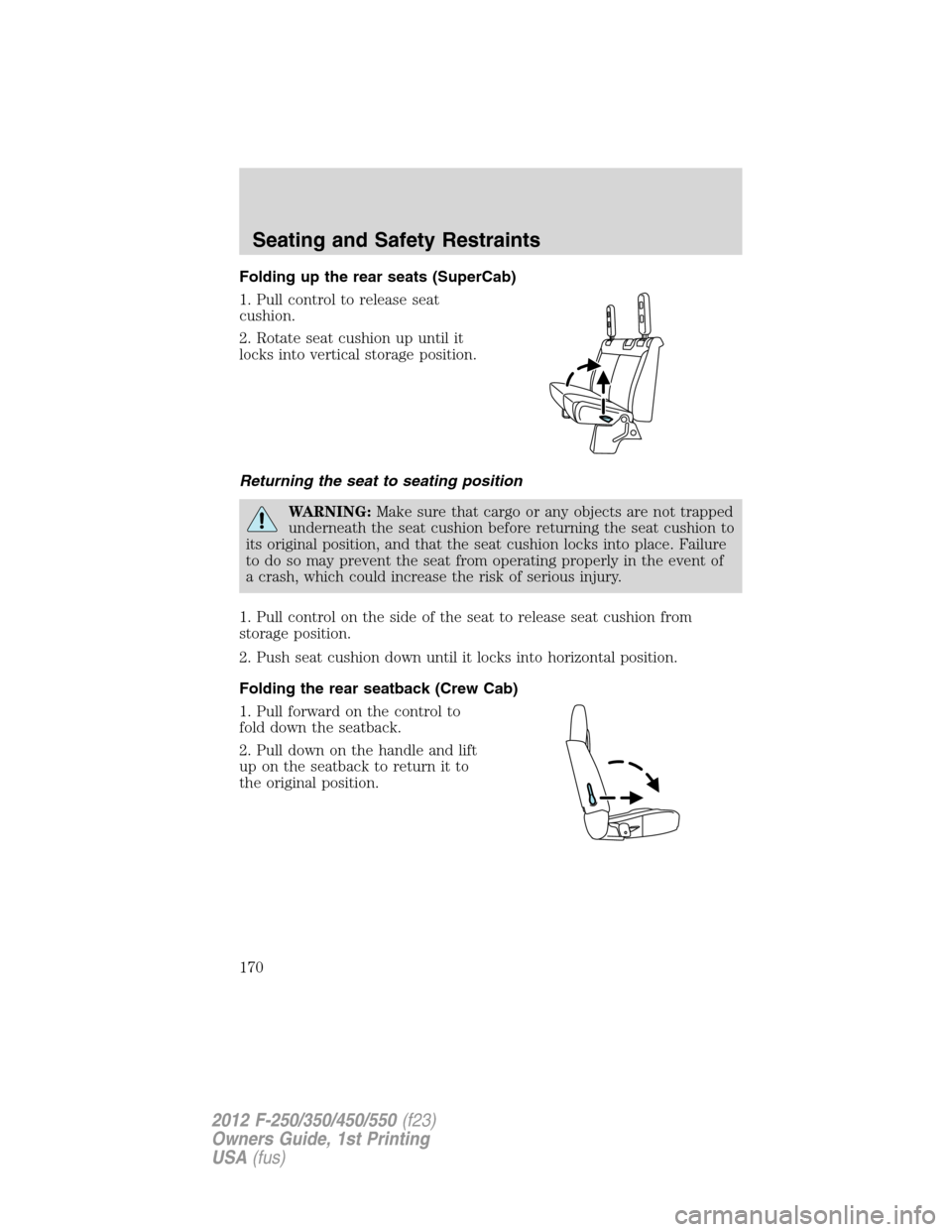
Center head restraint (Crew Cab)
The non-adjustable second row head restraints consist of :
•a trimmed energy absorbing foam and structure (1),
•two steel stems (2),
•and two guide sleeve unlock/remove buttons (3).
Removal of the second-row non-adjustable head restraints is the same as
the front row center head restraint. Refer toFront-row center
non-adjustable head restraintin this chapter.
WARNING:The non-adjustable head restraint is a safety device.
It should be installed whenever the seat is occupied.
WARNING:To minimize the risk of neck injury in the event of a
crash, head restraints must be installed properly.
Note:The SuperCab has rear outboard head restraints that are not
removable and are bolted to the back wall.
12
3
1
2
3
Seating and Safety Restraints
169
2012 F-250/350/450/550(f23)
Owners Guide, 1st Printing
USA(fus)
Page 170 of 454
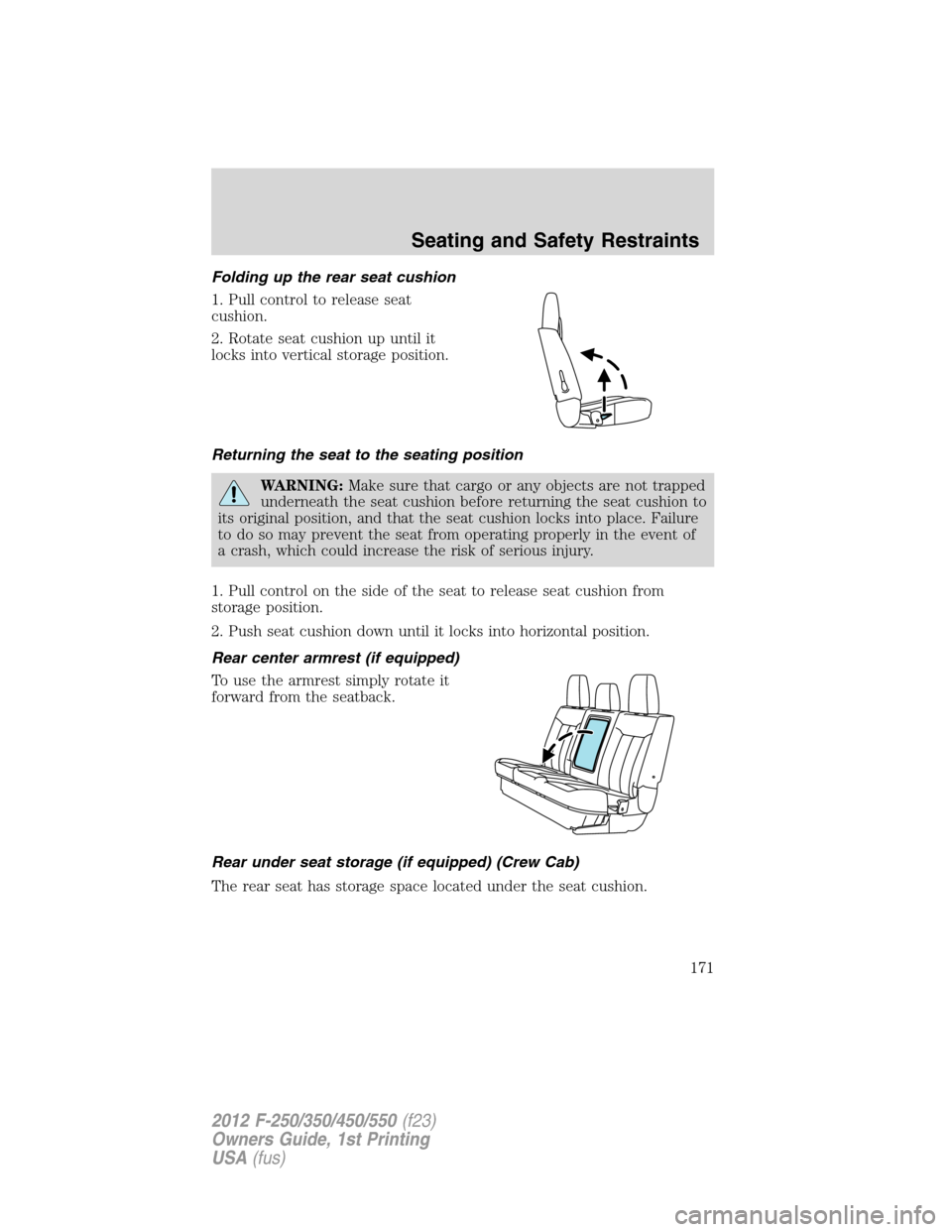
Folding up the rear seats (SuperCab)
1. Pull control to release seat
cushion.
2. Rotate seat cushion up until it
locks into vertical storage position.
Returning the seat to seating position
WARNING:Make sure that cargo or any objects are not trapped
underneath the seat cushion before returning the seat cushion to
its original position, and that the seat cushion locks into place. Failure
to do so may prevent the seat from operating properly in the event of
a crash, which could increase the risk of serious injury.
1. Pull control on the side of the seat to release seat cushion from
storage position.
2. Push seat cushion down until it locks into horizontal position.
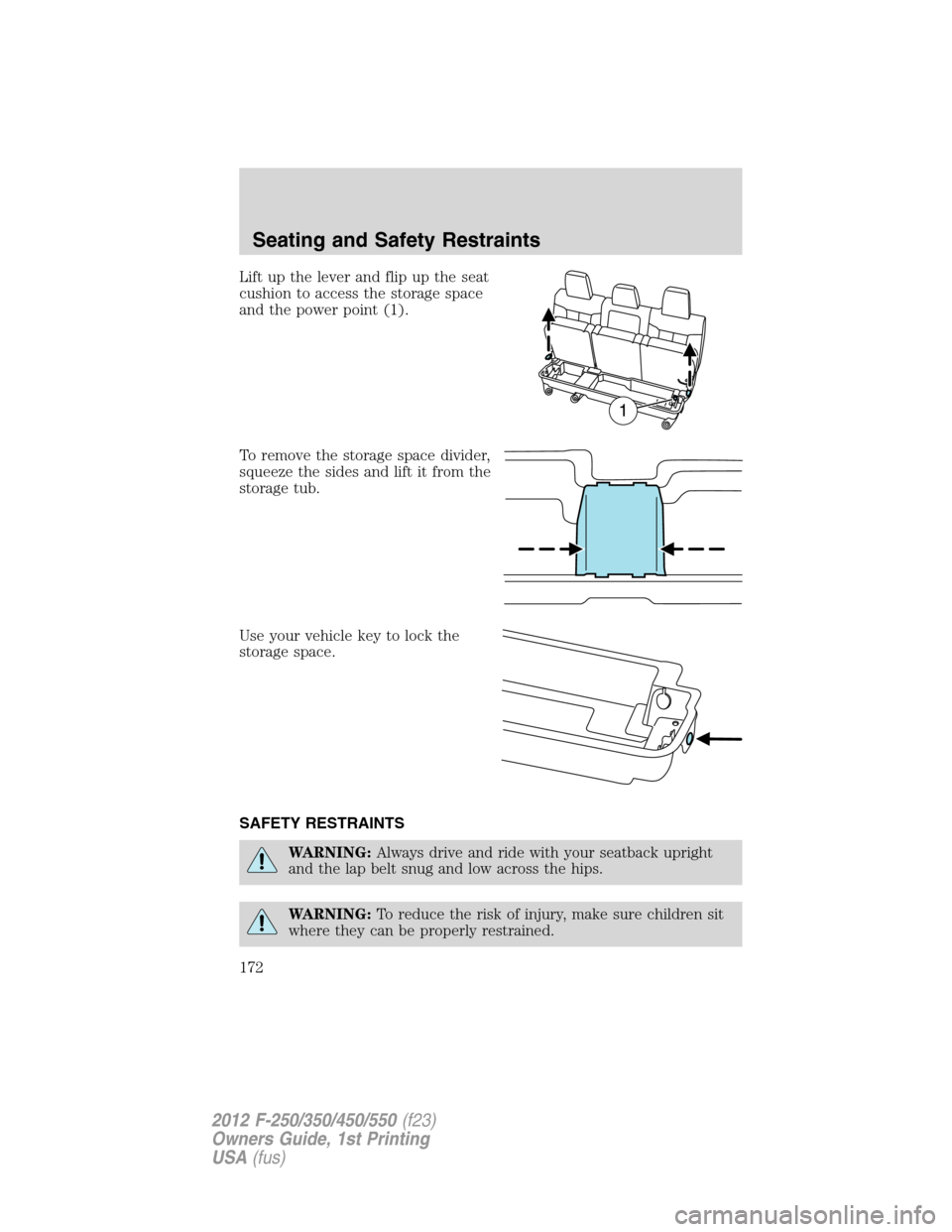
Folding the rear seatback (Crew Cab)
1. Pull forward on the control to
fold down the seatback.
2. Pull down on the handle and lift
up on the seatback to return it to
the original position.
Seating and Safety Restraints
170
2012 F-250/350/450/550(f23)
Owners Guide, 1st Printing
USA(fus)
Page 171 of 454
Folding up the rear seat cushion
1. Pull control to release seat
cushion.
2. Rotate seat cushion up until it
locks into vertical storage position.
Returning the seat to the seating position
WARNING:Make sure that cargo or any objects are not trapped
underneath the seat cushion before returning the seat cushion to
its original position, and that the seat cushion locks into place. Failure
to do so may prevent the seat from operating properly in the event of
a crash, which could increase the risk of serious injury.
1. Pull control on the side of the seat to release seat cushion from
storage position.
2. Push seat cushion down until it locks into horizontal position.
Rear center armrest (if equipped)
To use the armrest simply rotate it
forward from the seatback.
Rear under seat storage (if equipped) (Crew Cab)
The rear seat has storage space located under the seat cushion.
Seating and Safety Restraints
171
2012 F-250/350/450/550(f23)
Owners Guide, 1st Printing
USA(fus)
Page 172 of 454
Lift up the lever and flip up the seat
cushion to access the storage space
and the power point (1).
To remove the storage space divider,
squeeze the sides and lift it from the
storage tub.
Use your vehicle key to lock the
storage space.
SAFETY RESTRAINTS
WARNING:Always drive and ride with your seatback upright
and the lap belt snug and low across the hips.
WARNING:To reduce the risk of injury, make sure children sit
where they can be properly restrained.
1
Seating and Safety Restraints
172
2012 F-250/350/450/550(f23)
Owners Guide, 1st Printing
USA(fus)
Page 176 of 454
While you are fastened in the safety belt, the combination lap/shoulder
belt with a cinch tongue adjusts to your movement. However, if you
brake hard, turn hard, or if your vehicle receives an impact of 5 mph
(8 km/h) or more, the safety belt will become locked and help reduce
your forward movement.
Restraint of pregnant women
WARNING:Always ride and drive with your seatback upright
and the safety belt properly fastened. The lap portion of the
safety belt should fit snug and be positioned low across the hips. The
shoulder portion of the safety belt should be positioned across the
chest. Pregnant women should also follow this practice. See figure
below.
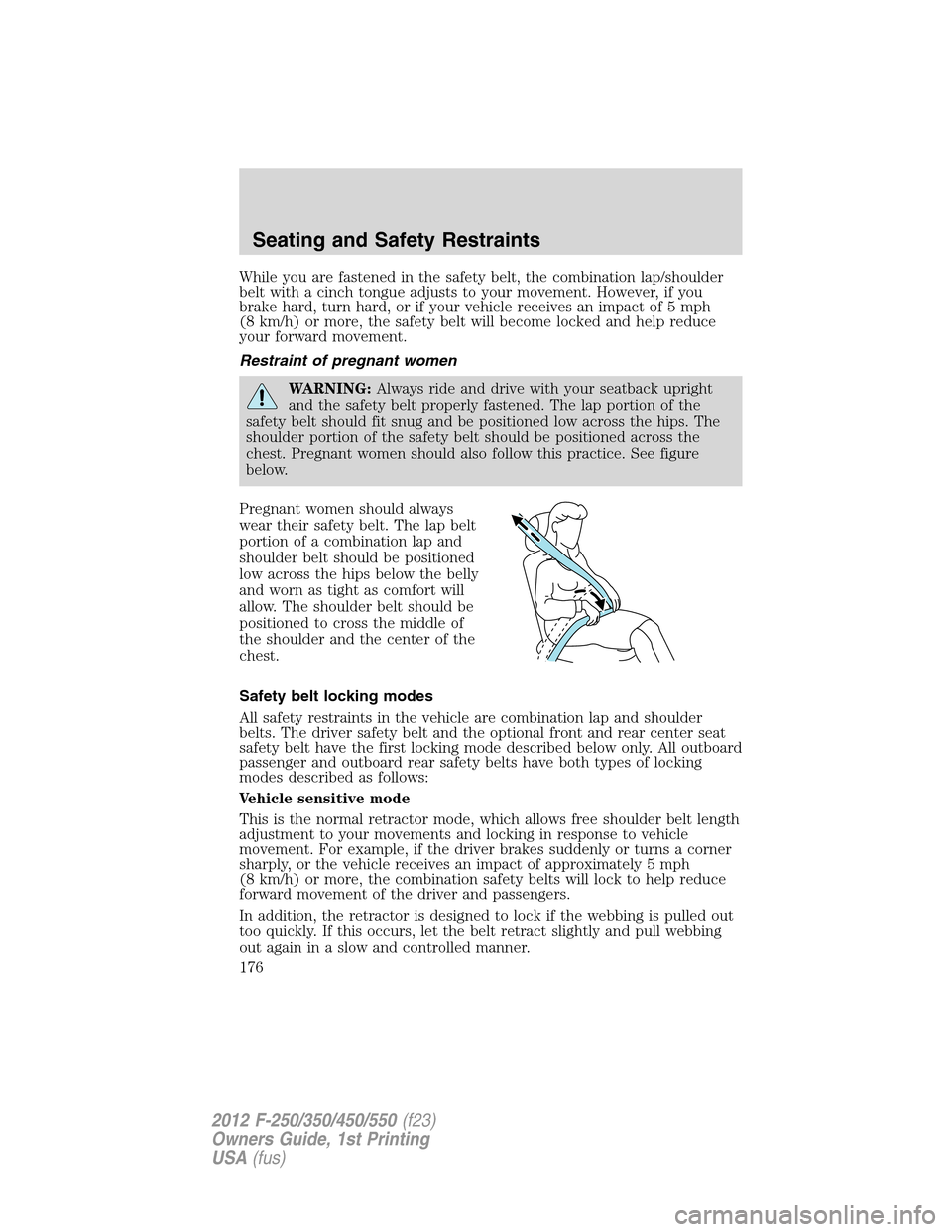
Pregnant women should always
wear their safety belt. The lap belt
portion of a combination lap and
shoulder belt should be positioned
low across the hips below the belly
and worn as tight as comfort will
allow. The shoulder belt should be
positioned to cross the middle of
the shoulder and the center of the
chest.
Safety belt locking modes
All safety restraints in the vehicle are combination lap and shoulder
belts. The driver safety belt and the optional front and rear center seat
safety belt have the first locking mode described below only. All outboard
passenger and outboard rear safety belts have both types of locking
modes described as follows:
Vehicle sensitive mode
This is the normal retractor mode, which allows free shoulder belt length
adjustment to your movements and locking in response to vehicle
movement. For example, if the driver brakes suddenly or turns a corner
sharply, or the vehicle receives an impact of approximately 5 mph
(8 km/h) or more, the combination safety belts will lock to help reduce
forward movement of the driver and passengers.
In addition, the retractor is designed to lock if the webbing is pulled out
too quickly. If this occurs, let the belt retract slightly and pull webbing
out again in a slow and controlled manner.
Seating and Safety Restraints
176
2012 F-250/350/450/550(f23)
Owners Guide, 1st Printing
USA(fus)
Page 177 of 454
Automatic locking mode
In this mode, the shoulder belt is automatically pre-locked. The belt will
still retract to remove any slack in the shoulder belt. The automatic
locking mode is not available on the driver safety belt or the optional
front or rear seat center safety belt.
When to use the automatic locking mode
This mode should be usedany timea child safety seat is installed in a
front outboard passenger seating position or any outboard rear seating
position (if equipped). The optional front and rear seat center safety belt
have a cinch mechanism. Refer toSafety belt with cinch tongueearlier
in this chapter. Children 12 years old and under should be properly
restrained in a rear seat whenever possible. Refer toSafety restraints
for childrenorSafety seats for childrenlater in this chapter.
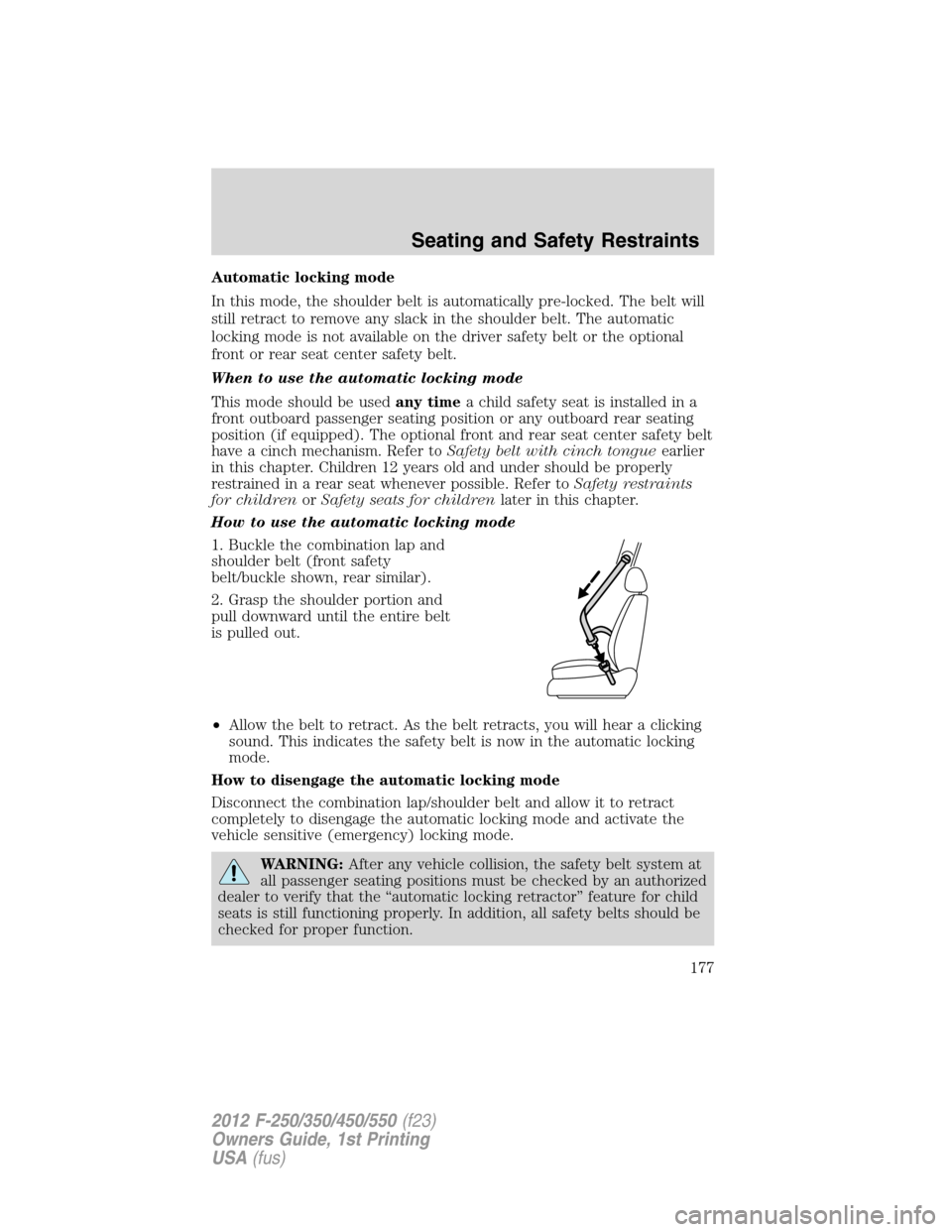
How to use the automatic locking mode
1. Buckle the combination lap and
shoulder belt (front safety
belt/buckle shown, rear similar).
2. Grasp the shoulder portion and
pull downward until the entire belt
is pulled out.
•Allow the belt to retract. As the belt retracts, you will hear a clicking
sound. This indicates the safety belt is now in the automatic locking
mode.
How to disengage the automatic locking mode
Disconnect the combination lap/shoulder belt and allow it to retract
completely to disengage the automatic locking mode and activate the
vehicle sensitive (emergency) locking mode.
WARNING:After any vehicle collision, the safety belt system at
all passenger seating positions must be checked by an authorized
dealer to verify that the “automatic locking retractor” feature for child
seats is still functioning properly. In addition, all safety belts should be
checked for proper function.
Seating and Safety Restraints
177
2012 F-250/350/450/550(f23)
Owners Guide, 1st Printing
USA(fus)
Page 178 of 454
WARNING:BELT AND RETRACTOR ASSEMBLY MUST BE
REPLACED if the safety belt assembly “automatic locking
retractor” feature or any other safety belt function is not operating
properly when checked by an authorized dealer. Failure to replace the
belt and retractor assembly could increase the risk of injury in
collisions.
Energy management feature
•This vehicle has a safety belt system with an energy management
feature at the front outboard seating positions to help further reduce
the risk of injury in the event of a head-on collision.
•The front outboard safety belt systems have a retractor assembly that
is designed to pay out webbing in a controlled manner. This feature is
designed to help reduce the belt force acting on the occupant’s chest.
Safety belt pretensioner
The safety belt pretensioners at the front outboard seating positions are
designed to tighten the safety belts firmly against the occupant’s body
during frontal collisions, and in side collisions and rollovers. This helps
increase the effectiveness of the safety belts. In frontal collisions, the
safety belt pretensioners can be activated alone or, if the collision is of
sufficient severity, together with the front airbags.
The driver and front outboard passenger safety belt system (including
retractors, buckles and height adjusters) must be replaced if the vehicle
is involved in a collision that results in the activation of the safety belt
pretensioners. Refer to theChild restraint and safety belt
maintenancesection in this chapter.
WARNING:Failure to replace the safety belt assembly under
the above conditions could result in severe personal injuries in
the event of a collision.
Seating and Safety Restraints
178
2012 F-250/350/450/550(f23)
Owners Guide, 1st Printing
USA(fus)