2012 FORD FOCUS fuel
[x] Cancel search: fuelPage 243 of 406
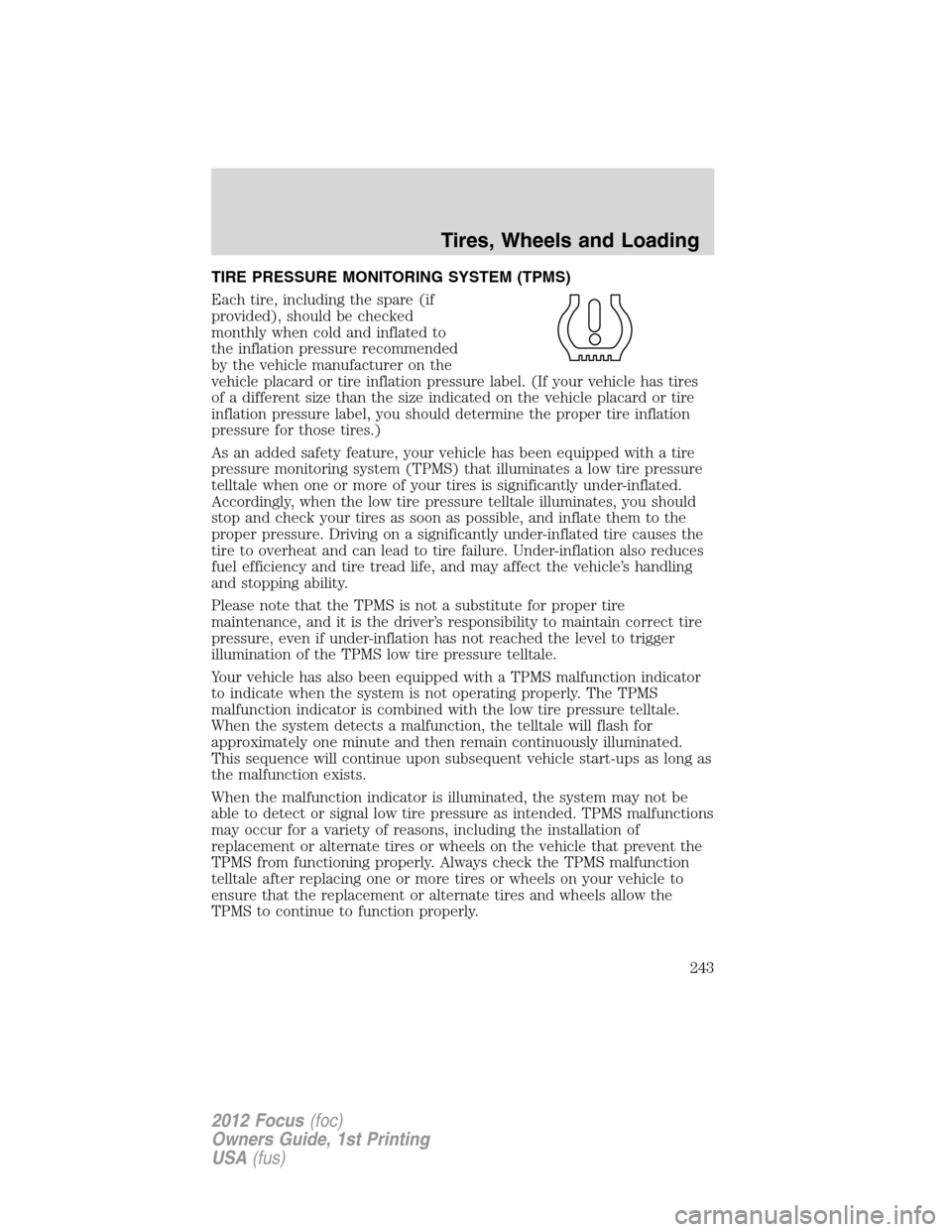
TIRE PRESSURE MONITORING SYSTEM (TPMS)
Each tire, including the spare (if
provided), should be checked
monthly when cold and inflated to
the inflation pressure recommended
by the vehicle manufacturer on the
vehicle placard or tire inflation pressure label. (If your vehicle has tires
of a different size than the size indicated on the vehicle placard or tire
inflation pressure label, you should determine the proper tire inflation
pressure for those tires.)
As an added safety feature, your vehicle has been equipped with a tire
pressure monitoring system (TPMS) that illuminates a low tire pressure
telltale when one or more of your tires is significantly under-inflated.
Accordingly, when the low tire pressure telltale illuminates, you should
stop and check your tires as soon as possible, and inflate them to the
proper pressure. Driving on a significantly under-inflated tire causes the
tire to overheat and can lead to tire failure. Under-inflation also reduces
fuel efficiency and tire tread life, and may affect the vehicle’s handling
and stopping ability.
Please note that the TPMS is not a substitute for proper tire
maintenance, and it is the driver’s responsibility to maintain correct tire
pressure, even if under-inflation has not reached the level to trigger
illumination of the TPMS low tire pressure telltale.
Your vehicle has also been equipped with a TPMS malfunction indicator
to indicate when the system is not operating properly. The TPMS
malfunction indicator is combined with the low tire pressure telltale.
When the system detects a malfunction, the telltale will flash for
approximately one minute and then remain continuously illuminated.
This sequence will continue upon subsequent vehicle start-ups as long as
the malfunction exists.
When the malfunction indicator is illuminated, the system may not be
able to detect or signal low tire pressure as intended. TPMS malfunctions
may occur for a variety of reasons, including the installation of
replacement or alternate tires or wheels on the vehicle that prevent the
TPMS from functioning properly. Always check the TPMS malfunction
telltale after replacing one or more tires or wheels on your vehicle to
ensure that the replacement or alternate tires and wheels allow the
TPMS to continue to function properly.
Tires, Wheels and Loading
243
2012 Focus(foc)
Owners Guide, 1st Printing
USA(fus)
Page 248 of 406
SNOW TIRES AND CHAINS
WARNING:Snow tires must be the same size, load index, speed
rating as those originally provided by Ford. Use of any tire or
wheel not recommended by Ford can affect the safety and
performance of your vehicle, which could result in an increased risk of
loss of vehicle control, vehicle rollover, personal injury and death.
Additionally, the use of non-recommended tires and wheels could
cause steering, suspension, axle or transfer case/power transfer unit
failure.
The tires on your vehicle may have all-weather treads to provide traction
in rain and snow. However, in some climates, you may need to use snow
tires and chains. Use chains on the tires only in an emergency or if the
law requires them.
Note:The suspension insulation and bumpers will help prevent vehicle
damage. Do not remove these components from your vehicle when using
snow tires and chains.
Follow these guidelines when using snow tires and chains:
•If possible, avoid fully loading your vehicle.
•Chains may damage aluminum wheels.
•Use SAE Class S chains with 195/65R15 or 215/55R16 tires only; do
not use tire chains with any other size tires.
•Install chains securely, verifying that the chains do not touch any
wiring, brake lines or fuel lines.
•Drive cautiously. If you hear the chains rub or bang against your
vehicle, stop and retighten the chains. If this does not work, remove
the chains to prevent damage to your vehicle.
•Remove the tire chains when they are no longer needed. Do not use
tire chains on dry roads.
Tires, Wheels and Loading
248
2012 Focus(foc)
Owners Guide, 1st Printing
USA(fus)
Page 249 of 406
SUMMER TIRES
Your Ford vehicle may be equipped with summer tires to provide
superior performance on wet and dry roads. Summer tires do not have
the Mud and Snow (M+S or M/S) tire traction rating on the tire side
wall. Since summer tires do not have the same traction performance as
All-season or Snow tires, Ford does not recommend using summer tires
when temperatures drop to approximately 40°F (5°C) or below
(depending on tire wear and environmental conditions) or in snow/ice
conditions. Like any tire, summer tire performance is affected by tire
wear and environmental conditions. If you must drive in those
conditions, Ford recommends using Mud and Snow (M+S, M/S),
All-season or Snow tires.
VEHICLE LOADING
This section will guide you in the proper loading of your vehicle to keep
your loaded vehicle weight within its design rating capability. Properly
loading your vehicle will provide maximum return of vehicle design
performance. Before loading your vehicle, familiarize yourself with the
following terms for determining your vehicle’s weight ratings from the
vehicle’s Tire Label or Safety Compliance Certification Label:
Base Curb Weight– is the weight of the vehicle including a full tank of
fuel and all standard equipment. It does not include passengers, cargo, or
optional equipment.
Vehicle Curb Weight– is the weight of your new vehicle when you
picked it up from your authorized dealer plus any aftermarket
equipment.
Tires, Wheels and Loading
249
2012 Focus(foc)
Owners Guide, 1st Printing
USA(fus)
Page 258 of 406

STARTING
Positions of the ignition
If your vehicle is equipped with a push button start system, refer to
Push button start systemin this section for ignition modes.
1. 0 (off) — locks the automatic
transmission gearshift lever and
allows key removal. This position
also shuts the engine and all
electrical accessories off.Note:In
order to switch off the engine while
the vehicle is in motion, shift to
neutral and use the brakes to bring
the vehicle to a safe stop. After the vehicle has stopped, turn the engine
off and shift into park. Then, turn the key to the accessory or off
position.
2. I (accessory) — allows the electrical accessories such as the radio to
operate while the engine is not running.
3. II (on) — all electrical circuits operational. Warning lights illuminated.
Key position when driving.
4. III (start) — cranks the engine. Release the key as soon as the engine
starts.
Preparing to start your vehicle
Engine starting is controlled by the powertrain control system.
This system meets all Canadian interference-causing equipment standard
requirements regulating the impulse electrical field strength of radio
noise.
When starting a fuel-injected engine, don’t press the accelerator before
or during starting. Only use the accelerator when you have difficulty
starting the engine. For more information on starting the vehicle, refer to
Starting the enginein this chapter.
WARNING:Extended idling at high engine speeds can produce
very high temperatures in the engine and exhaust system,
creating the risk of fire or other damage.
Driving
258
2012 Focus(foc)
Owners Guide, 1st Printing
USA(fus)
Page 261 of 406

Starting the engine
Note:If your vehicle is equipped with a push button start system, refer
toPush button start systemin this section for starting.
1. Turn the key to II (on) without
turning the key to III (start).
2. Turn the key to III (start), then
release the key as soon as the
engine begins cranking. Your vehicle
has a computer assisted cranking
system that assists in starting the
engine. After releasing the key from
the III (start) position, the engine may continue cranking for up to
10 seconds or until the vehicle starts.
Note:Cranking may be stopped at any time by turning the key to the off
position.
3. After idling for a few seconds, release the parking brake, apply the
brake, shift into gear and drive.
Note:If the engine does not start on the first try, turn the vehicle to the
off position, wait 10 seconds and try Step 2 again. If the engine still fails
to start, press the accelerator to the floor and try Step 2 again, keeping
the accelerator on the floor until the engine begins to accelerate above
cranking speeds; this will allow the engine to crank with the fuel shut off
in case the engine is flooded with fuel.
Push button start system (if equipped)
If your vehicle is equipped with the
push button start system, you can
start your vehicle by pressing the
start button in combination with the
brake pedal (automatic
transmission) or clutch pedal
(manual transmission) rather than
using a key. The start button is
located on the instrument panel to
the right of the steering wheel.
In order to operate the push button
start system and start the vehicle, your intelligent access key (IA key)
must be present inside the vehicle.
Driving
261
2012 Focus(foc)
Owners Guide, 1st Printing
USA(fus)
Page 274 of 406
AUTOMATIC TRANSMISSION OPERATION (IF EQUIPPED)
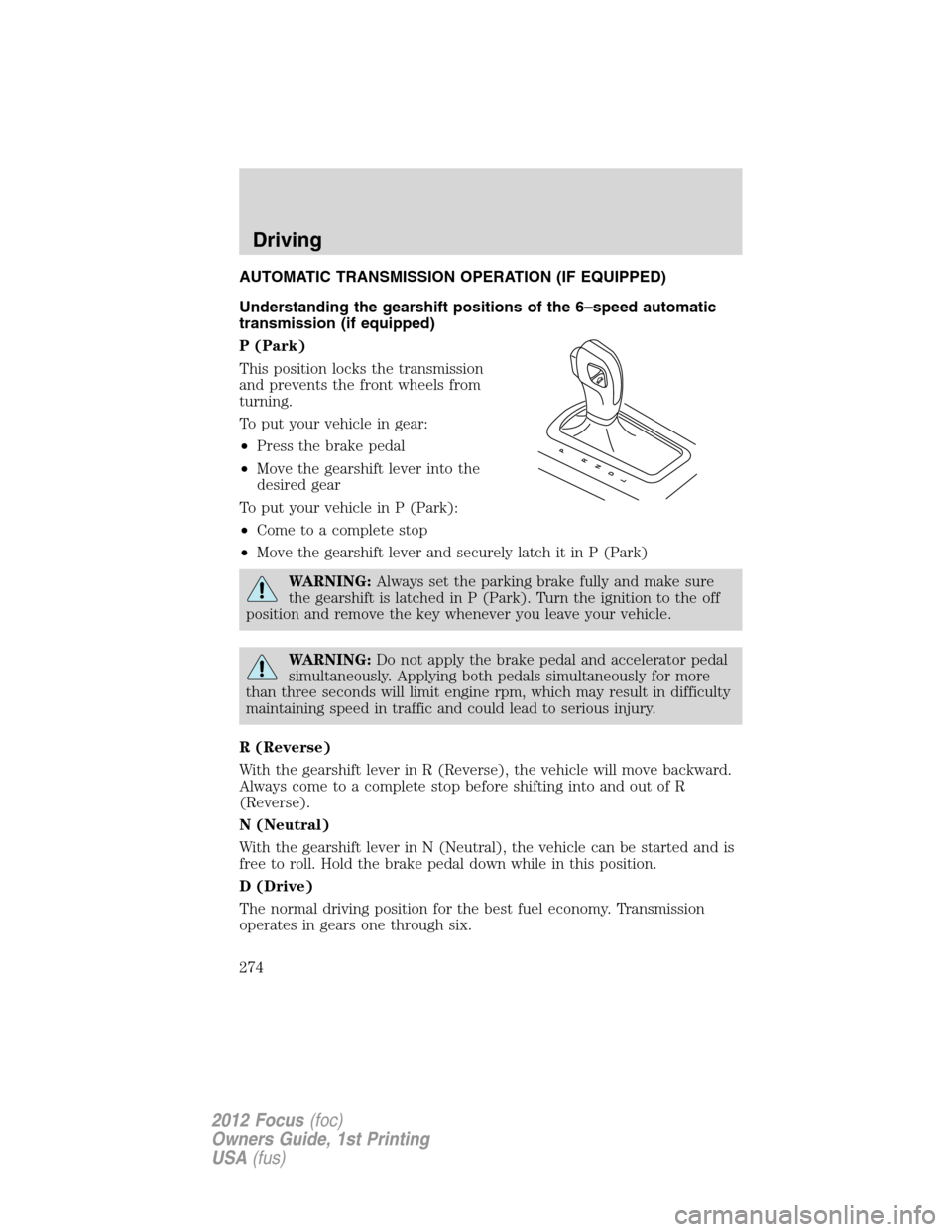
Understanding the gearshift positions of the 6–speed automatic
transmission (if equipped)
P (Park)
This position locks the transmission
and prevents the front wheels from
turning.
To put your vehicle in gear:
•Press the brake pedal
•Move the gearshift lever into the
desired gear
To put your vehicle in P (Park):
•Come to a complete stop
•Move the gearshift lever and securely latch it in P (Park)
WARNING:Always set the parking brake fully and make sure
the gearshift is latched in P (Park). Turn the ignition to the off
position and remove the key whenever you leave your vehicle.
WARNING:Do not apply the brake pedal and accelerator pedal
simultaneously. Applying both pedals simultaneously for more
than three seconds will limit engine rpm, which may result in difficulty
maintaining speed in traffic and could lead to serious injury.
R (Reverse)
With the gearshift lever in R (Reverse), the vehicle will move backward.
Always come to a complete stop before shifting into and out of R
(Reverse).
N (Neutral)
With the gearshift lever in N (Neutral), the vehicle can be started and is
free to roll. Hold the brake pedal down while in this position.
D (Drive)
The normal driving position for the best fuel economy. Transmission
operates in gears one through six.
PRNDL
Driving
274
2012 Focus(foc)
Owners Guide, 1st Printing
USA(fus)
Page 275 of 406
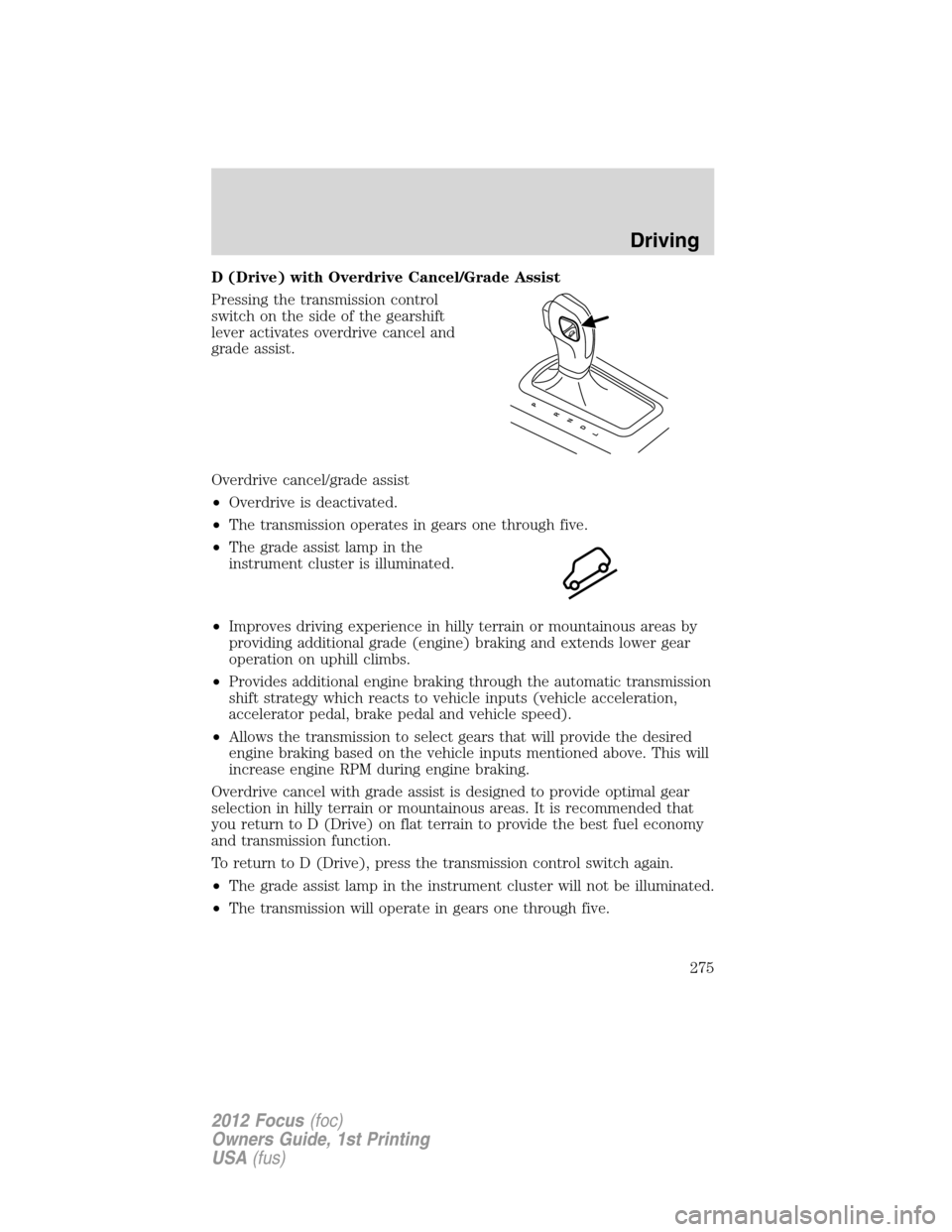
D (Drive) with Overdrive Cancel/Grade Assist
Pressing the transmission control
switch on the side of the gearshift
lever activates overdrive cancel and
grade assist.
Overdrive cancel/grade assist
•Overdrive is deactivated.
•The transmission operates in gears one through five.
•The grade assist lamp in the
instrument cluster is illuminated.
•Improves driving experience in hilly terrain or mountainous areas by
providing additional grade (engine) braking and extends lower gear
operation on uphill climbs.
•Provides additional engine braking through the automatic transmission
shift strategy which reacts to vehicle inputs (vehicle acceleration,
accelerator pedal, brake pedal and vehicle speed).
•Allows the transmission to select gears that will provide the desired
engine braking based on the vehicle inputs mentioned above. This will
increase engine RPM during engine braking.
Overdrive cancel with grade assist is designed to provide optimal gear
selection in hilly terrain or mountainous areas. It is recommended that
you return to D (Drive) on flat terrain to provide the best fuel economy
and transmission function.
To return to D (Drive), press the transmission control switch again.
•The grade assist lamp in the instrument cluster will not be illuminated.
•The transmission will operate in gears one through five.
PRNDL
Driving
275
2012 Focus(foc)
Owners Guide, 1st Printing
USA(fus)
Page 276 of 406
L (Low)
This position:
•Provides maximum engine braking.
•Will downshift to the lowest available gear for the current vehicle
speed; allows for first gear when vehicle reaches slower speeds.
•Is not intended for use under extended or normal driving conditions
and results in lower fuel economy.
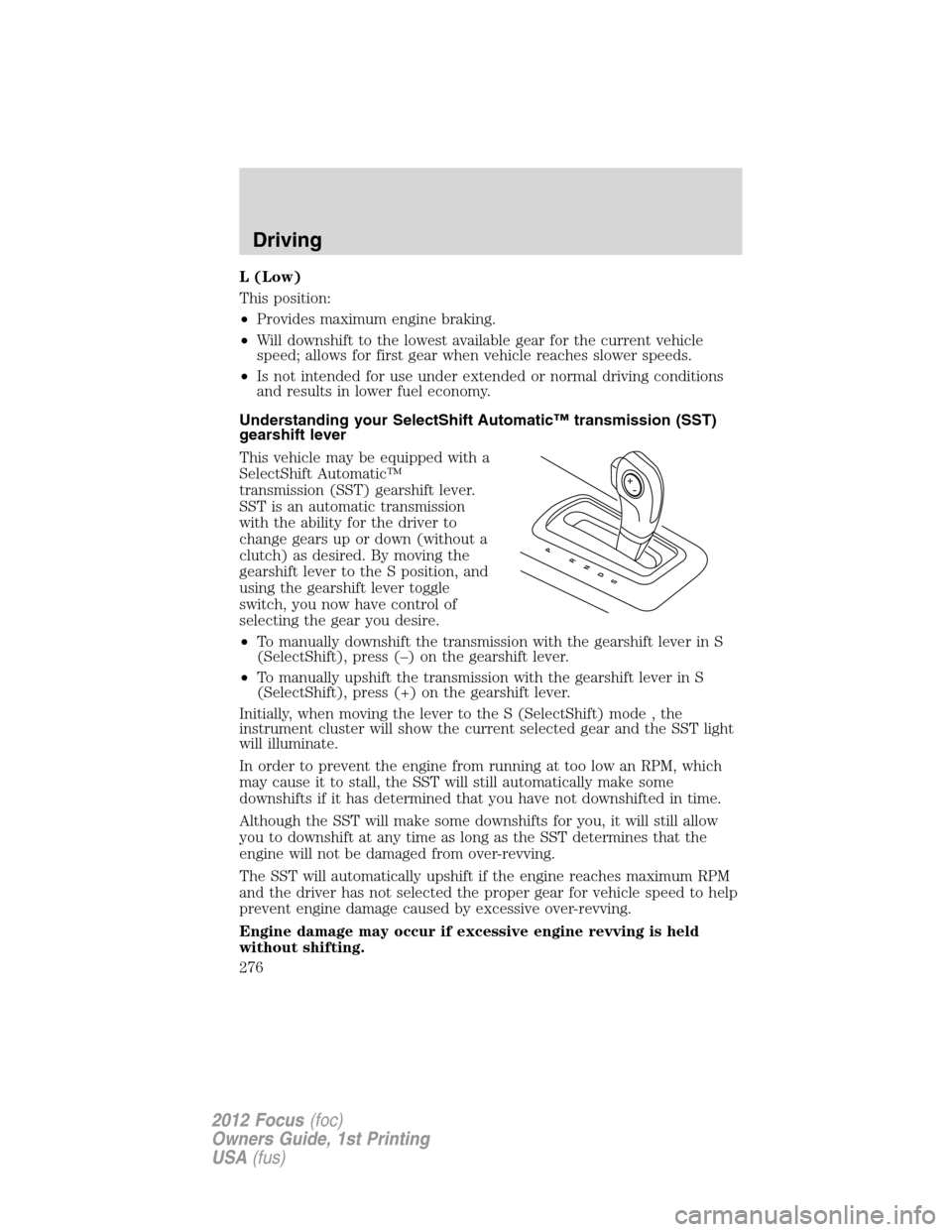
Understanding your SelectShift Automatic™ transmission (SST)
gearshift lever
This vehicle may be equipped with a
SelectShift Automatic™
transmission (SST) gearshift lever.
SST is an automatic transmission
with the ability for the driver to
change gears up or down (without a
clutch) as desired. By moving the
gearshift lever to the S position, and
using the gearshift lever toggle
switch, you now have control of
selecting the gear you desire.
•To manually downshift the transmission with the gearshift lever in S
(SelectShift), press (–) on the gearshift lever.
•To manually upshift the transmission with the gearshift lever in S
(SelectShift), press (+) on the gearshift lever.
Initially, when moving the lever to the S (SelectShift) mode , the
instrument cluster will show the current selected gear and the SST light
will illuminate.
In order to prevent the engine from running at too low an RPM, which
may cause it to stall, the SST will still automatically make some
downshifts if it has determined that you have not downshifted in time.
Although the SST will make some downshifts for you, it will still allow
you to downshift at any time as long as the SST determines that the
engine will not be damaged from over-revving.
The SST will automatically upshift if the engine reaches maximum RPM
and the driver has not selected the proper gear for vehicle speed to help
prevent engine damage caused by excessive over-revving.
Engine damage may occur if excessive engine revving is held
without shifting.
PRNDS
Driving
276
2012 Focus(foc)
Owners Guide, 1st Printing
USA(fus)