Page 260 of 406
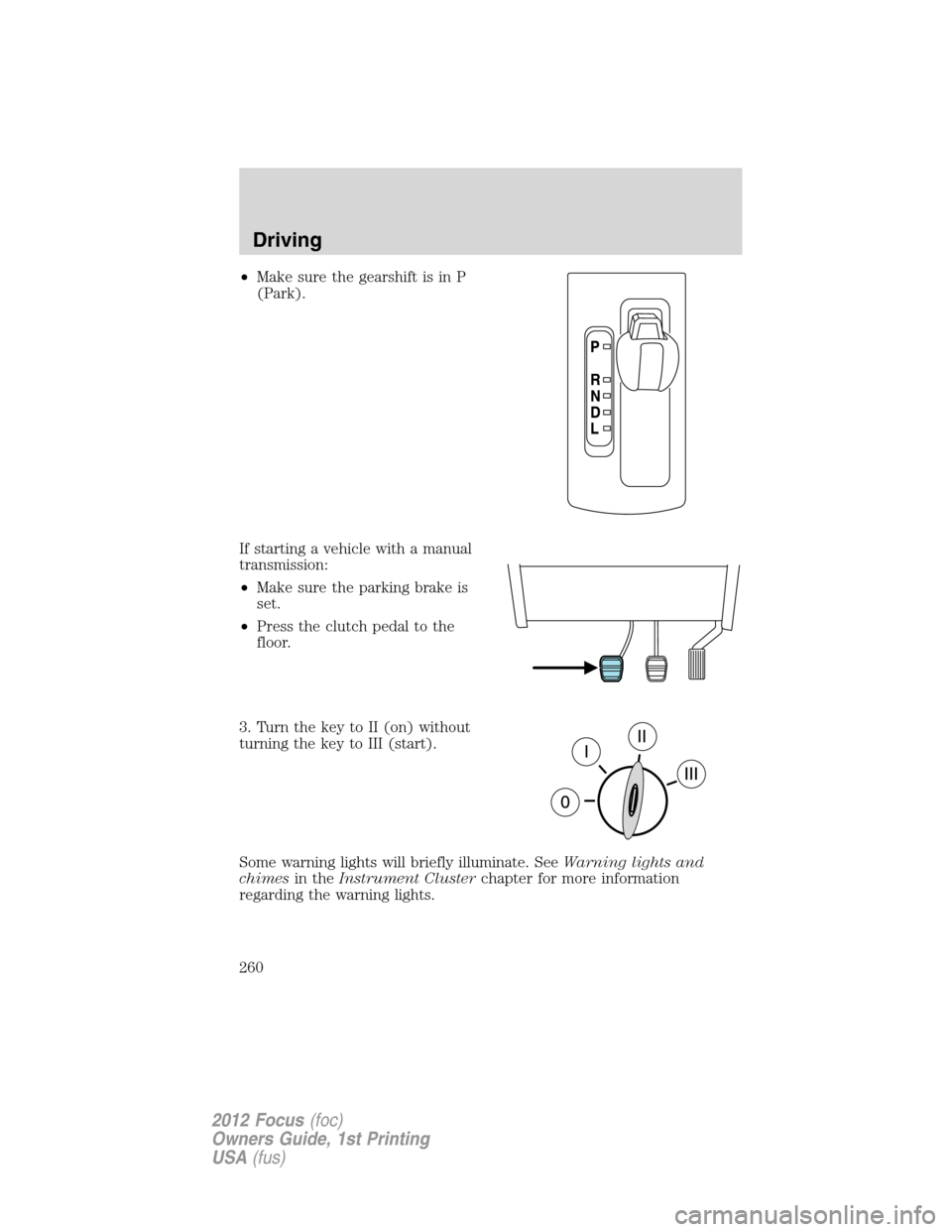
•Make sure the gearshift is in P
(Park).
If starting a vehicle with a manual
transmission:
•Make sure the parking brake is
set.
•Press the clutch pedal to the
floor.
3. Turn the key to II (on) without
turning the key to III (start).
Some warning lights will briefly illuminate. SeeWarning lights and
chimesin theInstrument Clusterchapter for more information
regarding the warning lights.
Driving
260
2012 Focus(foc)
Owners Guide, 1st Printing
USA(fus)
Page 261 of 406

Starting the engine
Note:If your vehicle is equipped with a push button start system, refer
toPush button start systemin this section for starting.
1. Turn the key to II (on) without
turning the key to III (start).
2. Turn the key to III (start), then
release the key as soon as the
engine begins cranking. Your vehicle
has a computer assisted cranking
system that assists in starting the
engine. After releasing the key from
the III (start) position, the engine may continue cranking for up to
10 seconds or until the vehicle starts.
Note:Cranking may be stopped at any time by turning the key to the off
position.
3. After idling for a few seconds, release the parking brake, apply the
brake, shift into gear and drive.
Note:If the engine does not start on the first try, turn the vehicle to the
off position, wait 10 seconds and try Step 2 again. If the engine still fails
to start, press the accelerator to the floor and try Step 2 again, keeping
the accelerator on the floor until the engine begins to accelerate above
cranking speeds; this will allow the engine to crank with the fuel shut off
in case the engine is flooded with fuel.
Push button start system (if equipped)
If your vehicle is equipped with the
push button start system, you can
start your vehicle by pressing the
start button in combination with the
brake pedal (automatic
transmission) or clutch pedal
(manual transmission) rather than
using a key. The start button is
located on the instrument panel to
the right of the steering wheel.
In order to operate the push button
start system and start the vehicle, your intelligent access key (IA key)
must be present inside the vehicle.
Driving
261
2012 Focus(foc)
Owners Guide, 1st Printing
USA(fus)
Page 267 of 406
Brake assist
The brake assist system provides full braking force during panic braking
situations. It detects a rapid application of the brake pedal and uses the
ABS system to achieve maximum braking pressure. Once a panic brake
application is detected, the system will remain activated as long as the
brake pedal is pressed or ABS is engaged. The system is deactivated by
either releasing the brake pedal or coming to a complete stop. When the
system activates, noise from the ABS pump motor and brake pedal
pulsation may be observed; this is normal.
ABS warning lamp
The ABS lamp in the instrument
cluster momentarily illuminates
when the ignition is turned on. If
the light does not illuminate during
start up, remains on or flashes, the
ABS may be disabled and may need to be serviced.
Even when the ABS is disabled,
normal braking is still effective. (If
your BRAKE warning lamp
illuminates with the parking brake
released, have your brake system
serviced immediately.)
Brake over accelerator
This vehicle is equipped with a brake over accelerator feature. In the
event the accelerator pedal becomes stuck or entrapped, applying steady
and firm pressure to the brake pedal will both slow the vehicle and
reduce engine power. If you experience this condition, apply the brakes
and bring your vehicle to a safe stop. Turn the engine off, shift to P
(Park) and apply the parking brake, and then inspect the accelerator
pedal for any interferences. If none are found and the condition persists,
have your vehicle towed to the nearest dealer.
ABS
Driving
267
2012 Focus(foc)
Owners Guide, 1st Printing
USA(fus)
Page 268 of 406
Parking brake
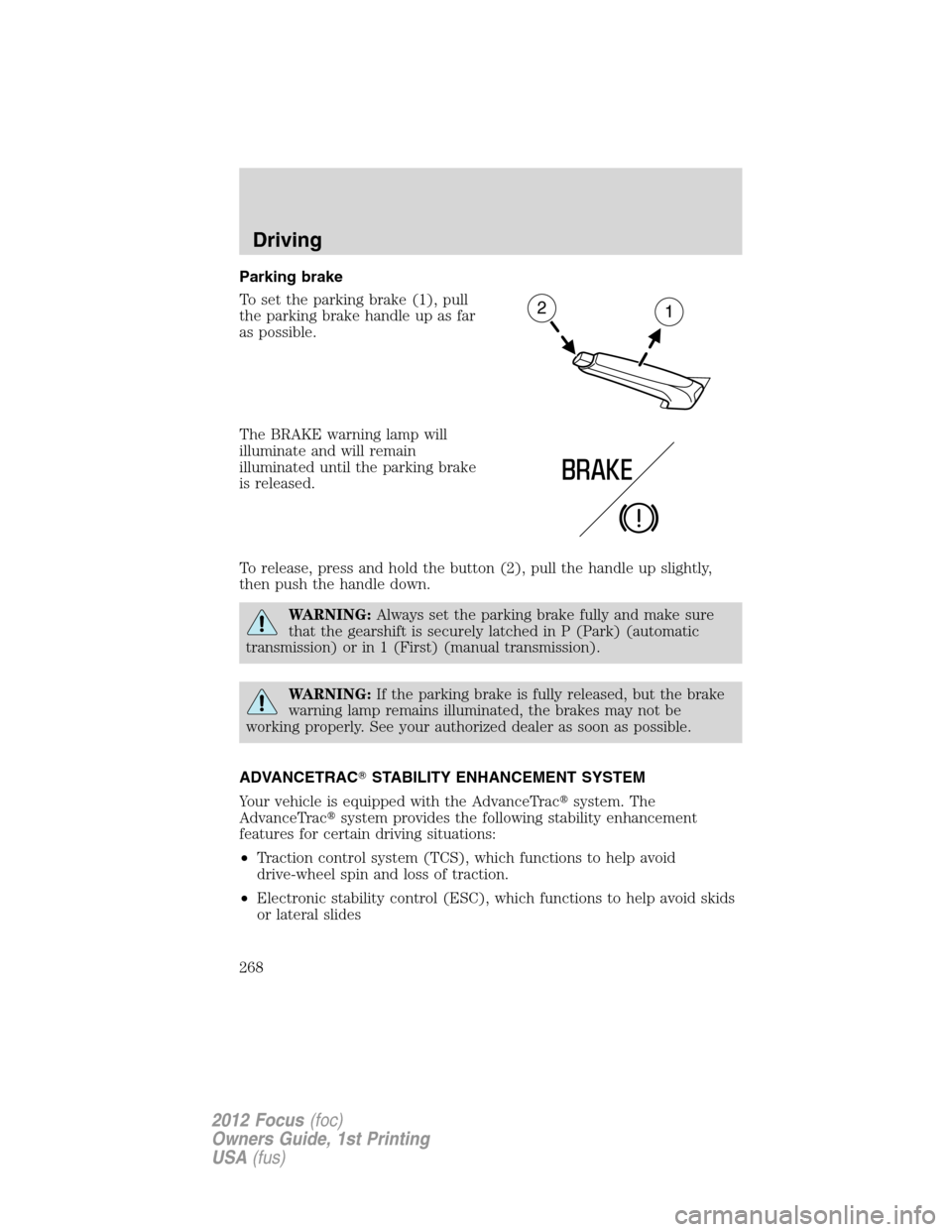
To set the parking brake (1), pull
the parking brake handle up as far
as possible.
The BRAKE warning lamp will
illuminate and will remain
illuminated until the parking brake
is released.
To release, press and hold the button (2), pull the handle up slightly,
then push the handle down.
WARNING:Always set the parking brake fully and make sure
that the gearshift is securely latched in P (Park) (automatic
transmission) or in 1 (First) (manual transmission).
WARNING:If the parking brake is fully released, but the brake
warning lamp remains illuminated, the brakes may not be
working properly. See your authorized dealer as soon as possible.
ADVANCETRAC�STABILITY ENHANCEMENT SYSTEM
Your vehicle is equipped with the AdvanceTrac�system. The
AdvanceTrac�system provides the following stability enhancement
features for certain driving situations:
•Traction control system (TCS), which functions to help avoid
drive-wheel spin and loss of traction.
•Electronic stability control (ESC), which functions to help avoid skids
or lateral slides
12
Driving
268
2012 Focus(foc)
Owners Guide, 1st Printing
USA(fus)
Page 273 of 406
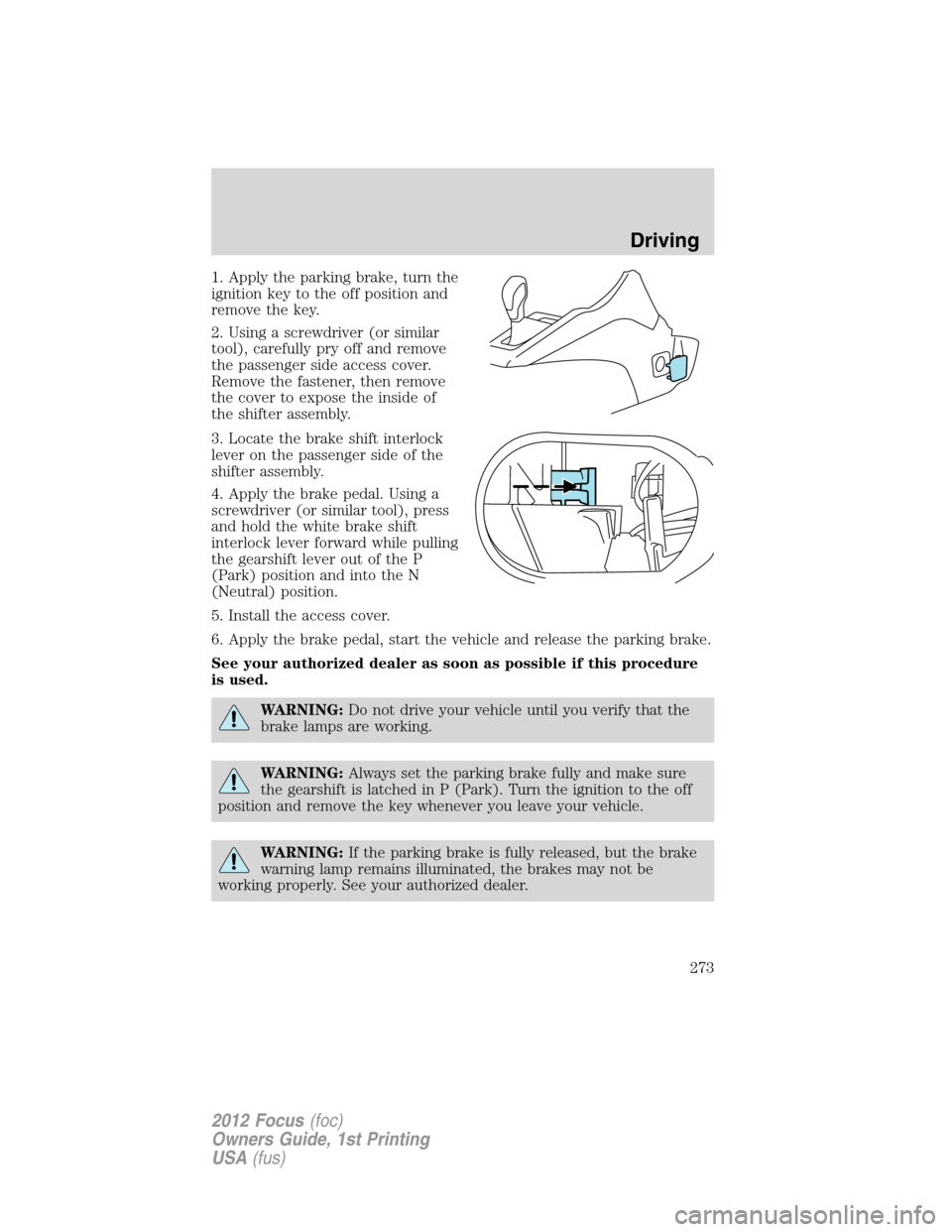
1. Apply the parking brake, turn the
ignition key to the off position and
remove the key.
2. Using a screwdriver (or similar
tool), carefully pry off and remove
the passenger side access cover.
Remove the fastener, then remove
the cover to expose the inside of
the shifter assembly.
3. Locate the brake shift interlock
lever on the passenger side of the
shifter assembly.
4. Apply the brake pedal. Using a
screwdriver (or similar tool), press
and hold the white brake shift
interlock lever forward while pulling
the gearshift lever out of the P
(Park) position and into the N
(Neutral) position.
5. Install the access cover.
6. Apply the brake pedal, start the vehicle and release the parking brake.
See your authorized dealer as soon as possible if this procedure
is used.
WARNING:Do not drive your vehicle until you verify that the
brake lamps are working.
WARNING:Always set the parking brake fully and make sure
the gearshift is latched in P (Park). Turn the ignition to the off
position and remove the key whenever you leave your vehicle.
WARNING:If the parking brake is fully released, but the brake
warning lamp remains illuminated, the brakes may not be
working properly. See your authorized dealer.
Driving
273
2012 Focus(foc)
Owners Guide, 1st Printing
USA(fus)
Page 274 of 406
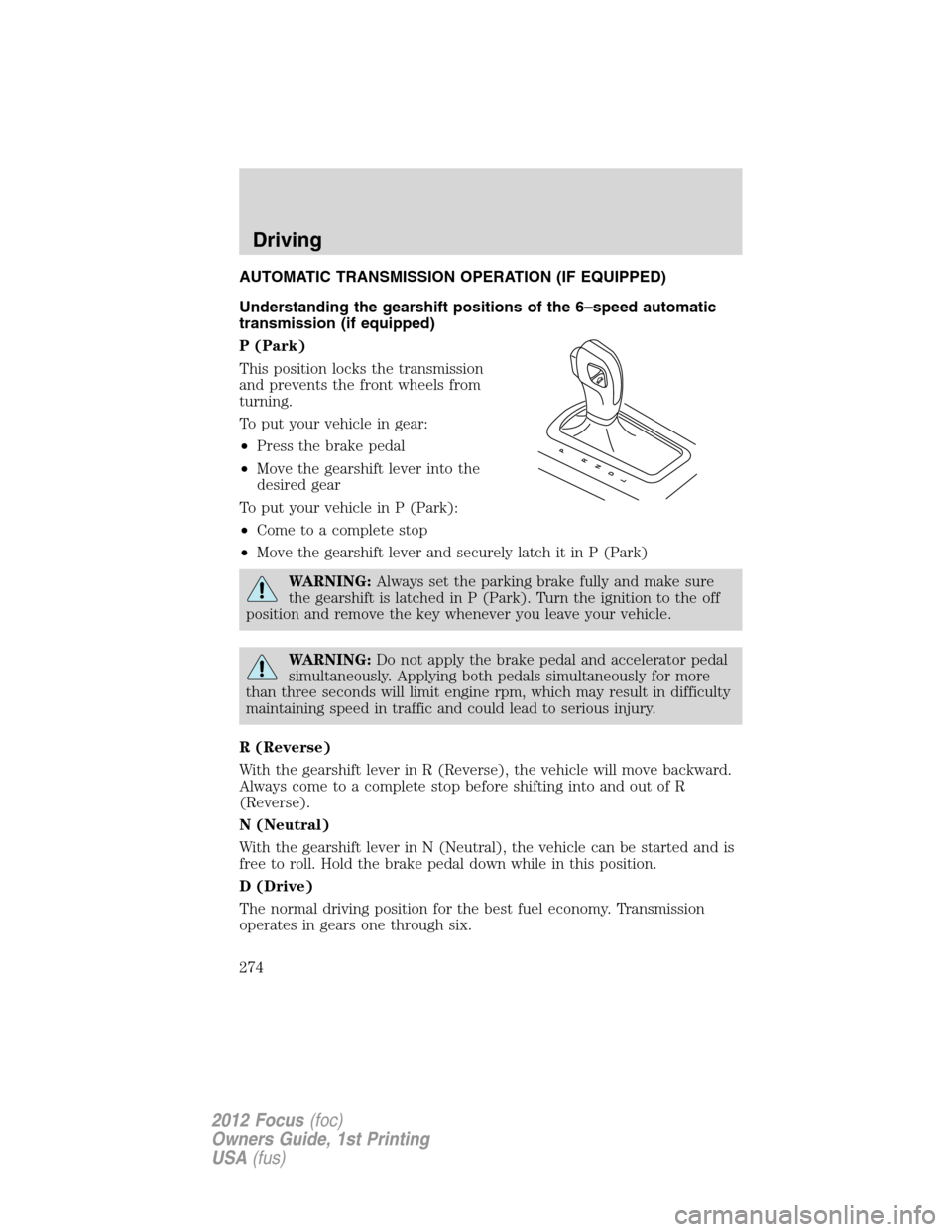
AUTOMATIC TRANSMISSION OPERATION (IF EQUIPPED)
Understanding the gearshift positions of the 6–speed automatic
transmission (if equipped)
P (Park)
This position locks the transmission
and prevents the front wheels from
turning.
To put your vehicle in gear:
•Press the brake pedal
•Move the gearshift lever into the
desired gear
To put your vehicle in P (Park):
•Come to a complete stop
•Move the gearshift lever and securely latch it in P (Park)
WARNING:Always set the parking brake fully and make sure
the gearshift is latched in P (Park). Turn the ignition to the off
position and remove the key whenever you leave your vehicle.
WARNING:Do not apply the brake pedal and accelerator pedal
simultaneously. Applying both pedals simultaneously for more
than three seconds will limit engine rpm, which may result in difficulty
maintaining speed in traffic and could lead to serious injury.
R (Reverse)
With the gearshift lever in R (Reverse), the vehicle will move backward.
Always come to a complete stop before shifting into and out of R
(Reverse).
N (Neutral)
With the gearshift lever in N (Neutral), the vehicle can be started and is
free to roll. Hold the brake pedal down while in this position.
D (Drive)
The normal driving position for the best fuel economy. Transmission
operates in gears one through six.
PRNDL
Driving
274
2012 Focus(foc)
Owners Guide, 1st Printing
USA(fus)
Page 277 of 406

Hill start assist (HSA) system (if equipped)
The hill start assist (HSA) system makes it easier to pull away when the
vehicle is on a slope without the need to use the parking brake. When
HSA is active, the vehicle will remain stationary on the slope for two to
three seconds after you release the brake pedal. During this time, you
have time to move your foot from the brake to the accelerator pedal and
pull away. The brakes are released automatically once the engine has
developed sufficient drive to prevent the vehicle from rolling down the
slope. This is an advantage when pulling away on a slope, (for example,
from a car park ramp, traffic lights or while in reverse traveling uphill
into a parking space).
WARNING:HSA does not replace the parking brake. When you
leave the vehicle, always apply the parking brake and select P
(Park).
Using HSA
The HSA system is activated automatically when the vehicle is stopped
on a slope greater than four degrees. HSA operates with the vehicle
facing downhill if reverse gear is selected.
WARNING:You must remain in the vehicle once you have
activated HSA.
WARNING:During all times you are responsible for controlling
the vehicle, supervising the HSA system and intervening, if
required.
Activating HSA
1. Press the brake pedal to bring the vehicle to a complete standstill.
Keep the brake pedal pressed.
2. If the sensors detect that the vehicle is on a slope, the HSA system
will be activated automatically in D (Drive) uphill or R (Reverse)
downhill.
3. When you remove your foot from the brake pedal, the vehicle will
remain on the slope without rolling away for approximately two to three
seconds. This hold time will automatically be extended if you are in the
process of driving off.
4. Drive off in the normal manner. The brakes will be released
automatically.
Driving
277
2012 Focus(foc)
Owners Guide, 1st Printing
USA(fus)
Page 278 of 406
Note:If the engine is revved excessively, HSA will be deactivated.
Deactivating hill start assist
To deactivate HSA, perform one of the following:
•Apply the parking brake.
•Drive off uphill without re-applying the brake.
•Wait for two to three seconds until the HSA system deactivates
automatically.
•If hill start assist is active in D (Drive), select R (Reverse).
•If hill start assist is active in R (Reverse), select N (Neutral).
Note:The HSA warning lamp (if
equipped) in the instrument cluster
momentarily illuminates when the
ignition is turned on. If a
malfunction is detected in the HSA system, HSA will be deactivated and
this warning lamp will appear on the instrument cluster.
If your vehicle gets stuck in mud or snow
If your vehicle gets stuck in mud or snow, it may be rocked out by
shifting between forward and reverse gears, stopping between shifts in a
steady pattern. Press lightly on the accelerator in each gear.
Do not rock the vehicle if the engine is not at normal operating
temperature or damage to the transmission may occur.
Do not rock the vehicle for more than a minute or damage to the
transmission and tires may occur, or the engine may overheat.
MANUAL TRANSMISSION OPERATION (IF EQUIPPED)
Using the clutch
Manual transmission vehicles have a starter interlock that prevents
cranking the engine unless the clutch pedal is fully pressed.
To start the vehicle:
1. Make sure the parking brake is fully set.
Driving
278
2012 Focus(foc)
Owners Guide, 1st Printing
USA(fus)