Page 255 of 356
ROADSIDE ASSISTANCE
Vehicles sold in the U.S. : Getting roadside assistance
To fully assist you should you have a vehicle concern, Ford Motor
Company offers a complimentary roadside assistance program. This
program is separate from the New Vehicle Limited Warranty. The service
is available:
•24-hours, seven days a week
•for the coverage period listed on the Roadside Assistance Card
included in your Owner Guide portfolio.
Roadside assistance will cover:
•a flat tire change with a good spare (except vehicles that have been
supplied with a tire inflation kit)
•battery jump start
•lock-out assistance (key replacement cost is the customer’s
responsibility)
•fuel delivery – Independent Service Contractors, if not prohibited by
state, local or municipal law shall deliver up to 2.0 gallons (7.5L) of
gasoline or 5.0 gallons (18.9L) of diesel fuel to a disabled vehicle. Fuel
delivery service is limited to two no-charge occurrences within a
12-month period.
•winch out – available within 100 feet (30.5 meters) of a paved or
county maintained road, no recoveries.
•towing – Ford and Lincoln eligible vehicles towed to an authorized
dealer within 35 miles (56 km) of the disablement location or to the
nearest authorized dealer. If a member requests to be towed to an
authorized dealer more than 35 miles (56 km) from the disablement
location, the member shall be responsible for any mileage costs in
excess of 35 miles (56 km).
Trailers shall be covered up to $200 if the disabled eligible vehicle
requires service at the nearest authorized dealer. If the trailer is disabled,
but the towing vehicle is operational, the trailer does not qualify for any
roadside services.
Roadside Emergencies
255
2012 Fiesta(fie)
Owners Guide, 1st Printing
USA(fus)
Page 260 of 356

Fuse/Relay
LocationFuse Amp
RatingProtected circuits
F8 7.5A Front dome lamp, Moon roof
switch
F9 20A Keyless vehicle module
F10 15A Radio, SYNC�module, Global
positioning system (GPS) module
F11 20A Front wipers, Body control
module (BCM)
F12 20A Tire pressure monitoring system
(TPMS)
F13 15A Rear wiper, BCM
F14 20A IA module
F15 15A Wiper switch
F16 7.5A Power mirror switch, Driver
window switch
F17 7.5A Heated seats (early build)
15A Heated seats (late build)
F18 10A Stop lamps, Turn signals
F19 7.5A Instrument cluster
F20 10A Airbag module
F21 10A BCM, Climate control, Passive
anti-theft system transceiver,
Electronic power steering module,
Instrument cluster, Engine
compartment fuse panel
F22 7.5A Accelerator pedal position sensor,
Powertrain control module
(PCM), Gear shifter, Anti-lock
brake system (ABS) ignition feed
F23 10A Transmission control unit ignition
feed, TPMS ignition feed
F24 — Not used
F25 7.5A Exterior mirrors
F26 7.5A TPMS
F27 — Not used
Roadside Emergencies
260
2012 Fiesta(fie)
Owners Guide, 1st Printing
USA(fus)
Page 262 of 356
If the battery has been disconnected and reconnected, refer to the
Batterysection of theMaintenance and Specificationschapter.
The high-current fuses are coded as follows:
Fuse/Relay
LocationFuse Amp
RatingProtected circuits
F1 40A* Anti-lock brake system (ABS) pump
F2 50A* Transmission control module (TCM)
F3 40A* Engine cooling fan relay and motor
F4 40A* Heater blower relay and motor
F5 60A* Passenger compartment fuse panel
F6 30A* Body control module (BCM) – door
locks
F7 60A* Passenger compartment fuse panel
F8 40A* Powertrain control module (PCM),
Power distribution box
F9 20A* ABS module valve
R11R8
R12R9
R5R3
R6R4
R13R10
R2R1
R15R14
R7
F41F35
F26F17F27F18F28F19F29F20F30F21F31F22F32F23F33F24F34F25
F42F36
F43F37
F44F38
F45F39
F40
F6F1
F7F2
F8F3
F9F4
F10F5
F14F11
F15F12
F16F13
F46
Roadside Emergencies
262
2012 Fiesta(fie)
Owners Guide, 1st Printing
USA(fus)
Page 267 of 356
•Winter weather driving capability
•Wet weather driving capability
•All-wheel driving capability (if applicable)
•Load leveling adjustment (if applicable)
When driving with the full-size dissimilar spare tire/wheel additional
caution should be given to:
•Towing a trailer
•Driving vehicles equipped with a camper body
•Driving vehicles with a load on the cargo rack
Drive cautiously when using a full-size dissimilar spare tire/wheel and
seek service as soon as possible.
Stopping and securing the vehicle
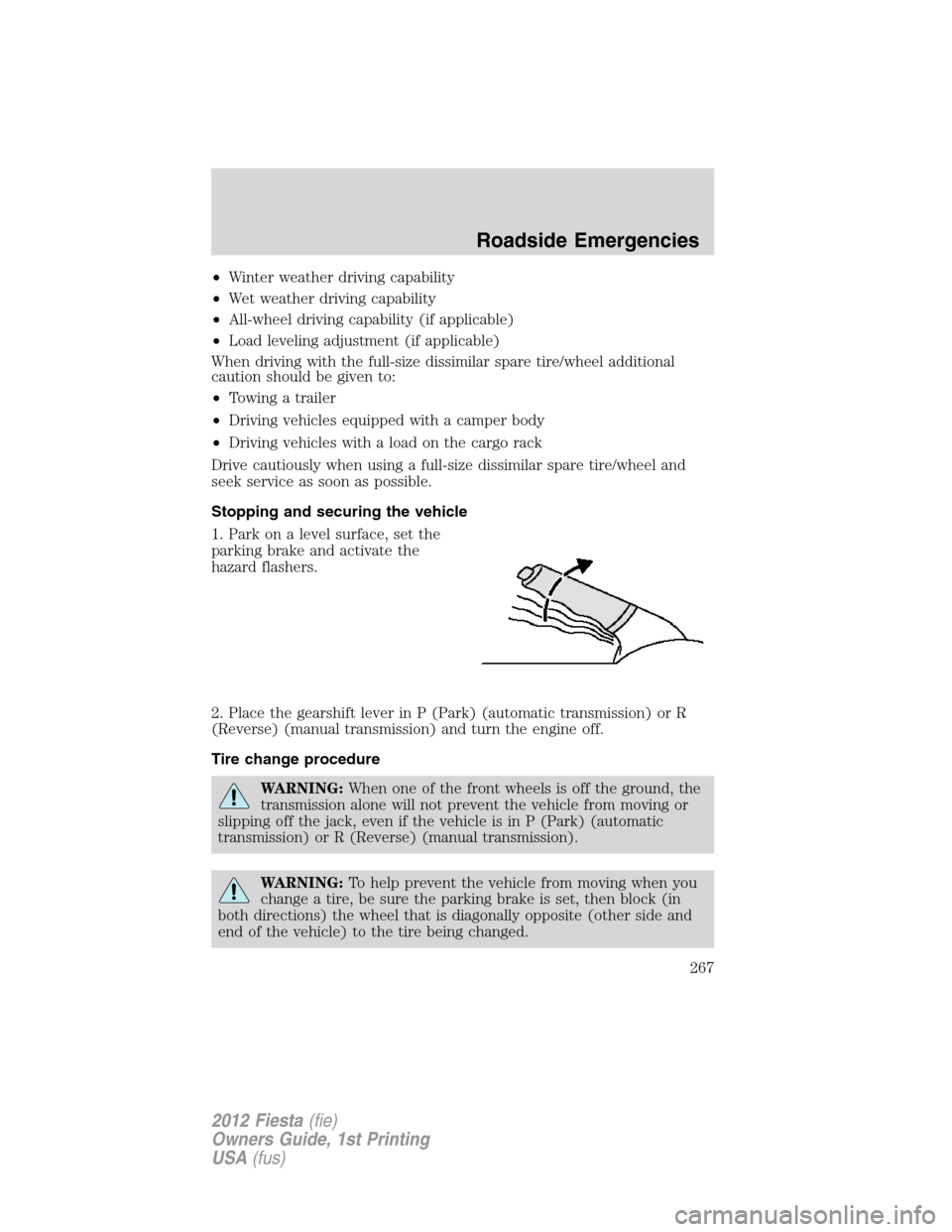
1. Park on a level surface, set the
parking brake and activate the
hazard flashers.
2. Place the gearshift lever in P (Park) (automatic transmission) or R
(Reverse) (manual transmission) and turn the engine off.
Tire change procedure
WARNING:When one of the front wheels is off the ground, the
transmission alone will not prevent the vehicle from moving or
slipping off the jack, even if the vehicle is in P (Park) (automatic
transmission) or R (Reverse) (manual transmission).
WARNING:To help prevent the vehicle from moving when you
change a tire, be sure the parking brake is set, then block (in
both directions) the wheel that is diagonally opposite (other side and
end of the vehicle) to the tire being changed.
Roadside Emergencies
267
2012 Fiesta(fie)
Owners Guide, 1st Printing
USA(fus)
Page 268 of 356
WARNING:If the vehicle slips off the jack, you or someone else
could be seriously injured.
WARNING:Do not attempt to change a tire on the side of the
vehicle close to moving traffic. Pull far enough off the road to
avoid the danger of being hit when operating the jack or changing the
wheel.
Note:Passengers should not remain in the vehicle when the vehicle is
being jacked.
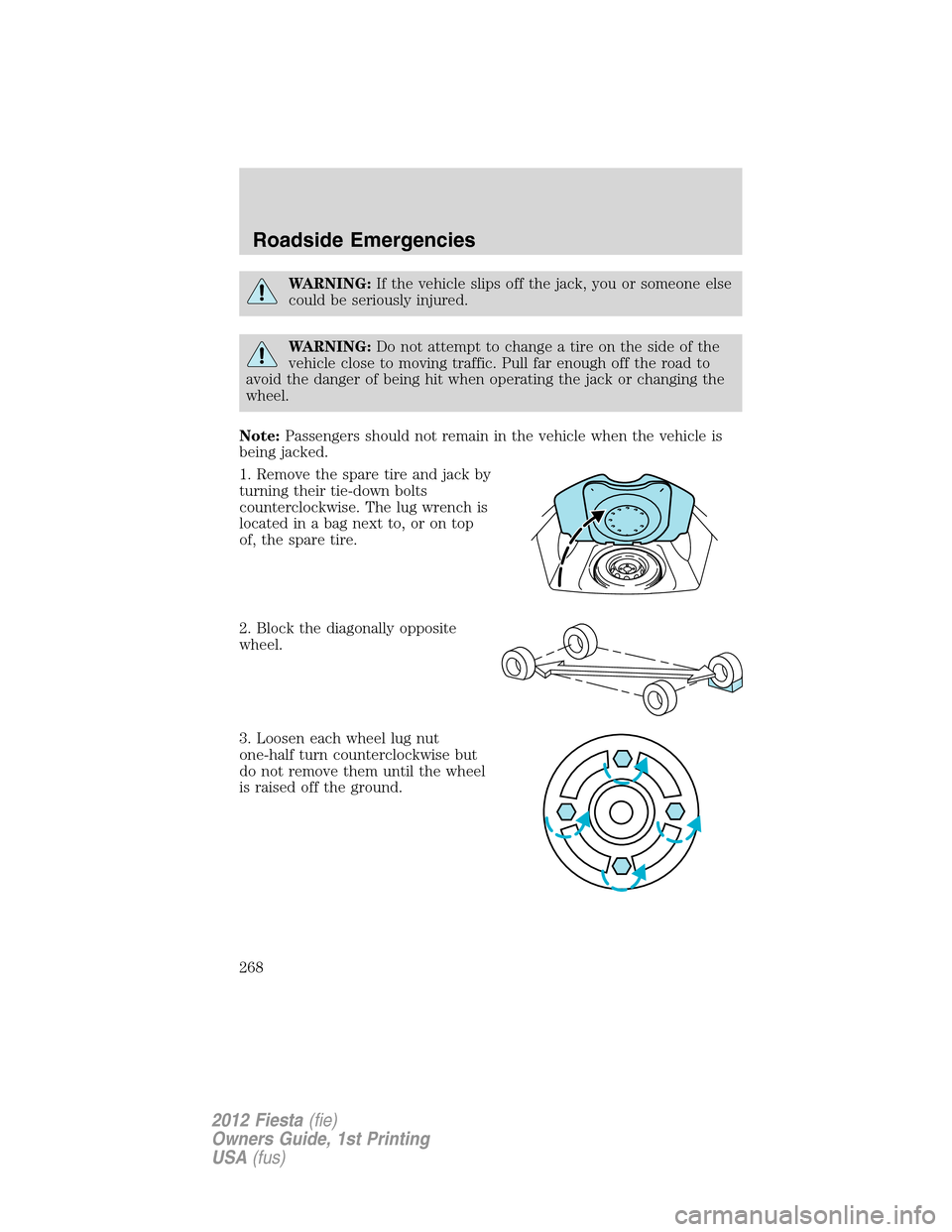
1. Remove the spare tire and jack by
turning their tie-down bolts
counterclockwise. The lug wrench is
located in a bag next to, or on top
of, the spare tire.
2. Block the diagonally opposite
wheel.
3. Loosen each wheel lug nut
one-half turn counterclockwise but
do not remove them until the wheel
is raised off the ground.
Roadside Emergencies
268
2012 Fiesta(fie)
Owners Guide, 1st Printing
USA(fus)
Page 269 of 356

4. The vehicle jacking points are
located inward of the wheels.
WARNING:To lessen the risk of personal injury, do not put any
part of your body under the vehicle while changing a tire. Do not
start the engine when your vehicle is on the jack. The jack is only
meant for changing the tire.
5. Position the jack in the indentions
on the sill next to the tire you are
changing. Turn the jack handle
clockwise until the tire is off the
ground.
6. Remove the lug nuts with the lug wrench.
7. Replace the flat tire with the spare tire, making sure the valve stem is
facing outward. Reinstall the lug nuts until the wheel is snug against the
hub. Do not fully tighten the lug nuts until the wheel has been lowered.
8. Lower the wheel by turning the jack handle counterclockwise.
9. Remove the jack and fully tighten
the lug nuts in the order shown.
Refer toWheel lug nut torque
specificationslater in this chapter
for the proper lug nut torque
specification.
10. Put the flat tire, jack and lug
wrench away. Make sure the jack is
fastened so it does not rattle when
you drive. Unblock the wheels.
1
4 3
2
Roadside Emergencies
269
2012 Fiesta(fie)
Owners Guide, 1st Printing
USA(fus)
Page 275 of 356
Emergency towing
In case of a roadside emergency with a disabled vehicle (without access
to wheel dollies, car hauling trailer, or flatbed transport vehicle) your
vehicle (regardless of transmission powertrain configuration) can be flat
towed (all wheels on the ground) under the following conditions:
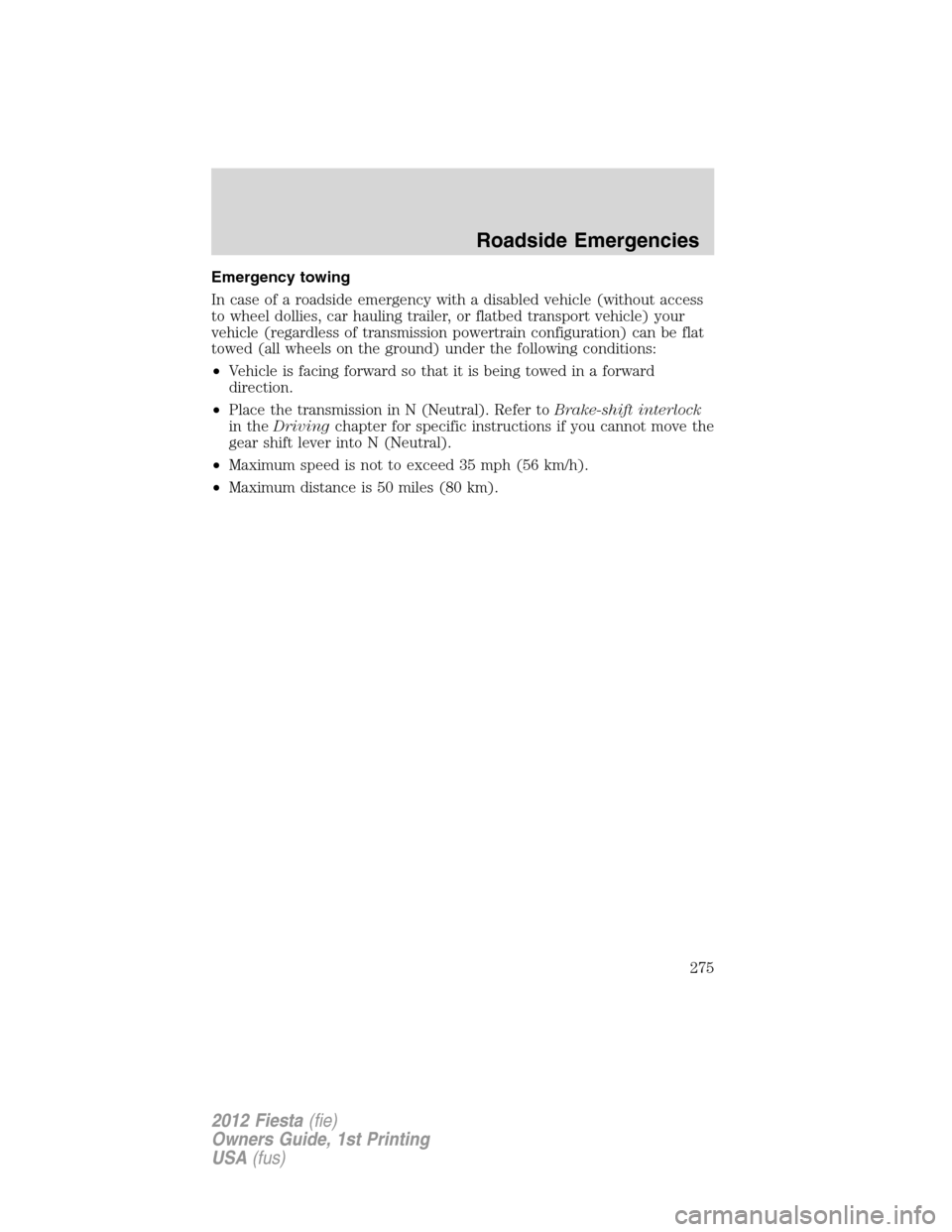
•Vehicle is facing forward so that it is being towed in a forward
direction.
•Place the transmission in N (Neutral). Refer toBrake-shift interlock
in theDrivingchapter for specific instructions if you cannot move the
gear shift lever into N (Neutral).
•Maximum speed is not to exceed 35 mph (56 km/h).
•Maximum distance is 50 miles (80 km).
Roadside Emergencies
275
2012 Fiesta(fie)
Owners Guide, 1st Printing
USA(fus)
Page 286 of 356
ENGINE
Engines are more efficient when they are clean because grease and dirt
buildup keep the engine warmer than normal.
When washing:
•
Take care when using a power washer to clean the engine. The
high-pressure fluid could penetrate the sealed parts and cause damage.
•Do not spray a hot engine with cold water to avoid cracking the
engine block or other engine components.
•Spray Motorcraft�Engine Shampoo and Degreaser (ZC-20) on all
parts that require cleaning and pressure rinse clean. In Canada, use
Motorcraft�Engine Shampoo (CXC-66-A).
•Never wash or rinse the engine while it is hot or running; water in the
running engine may cause internal damage.
•Never wash or rinse any ignition coil, spark plug wire or spark plug
well, or the area in and around these locations.
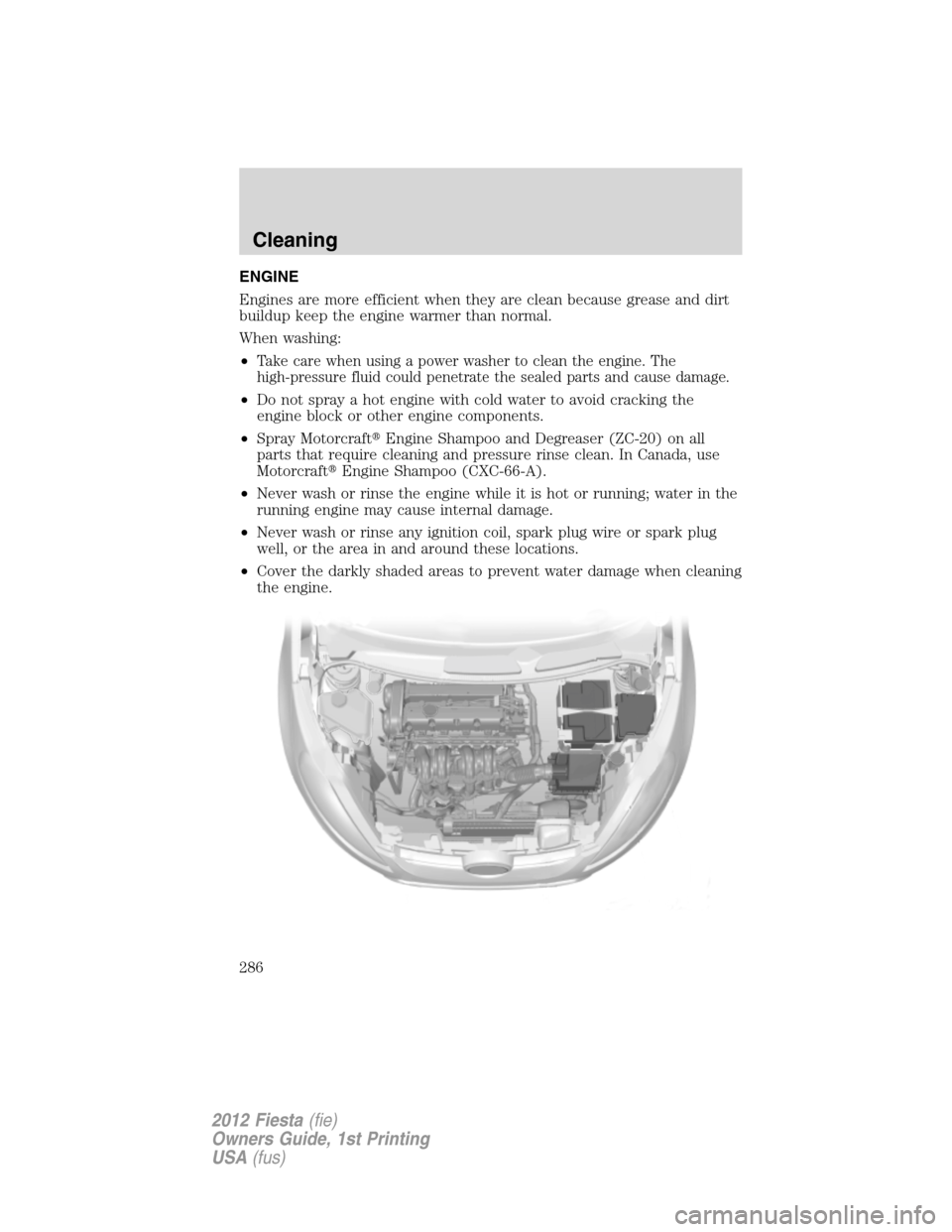
•Cover the darkly shaded areas to prevent water damage when cleaning
the engine.
Cleaning
286
2012 Fiesta(fie)
Owners Guide, 1st Printing
USA(fus)