2012 FORD FIESTA tow
[x] Cancel search: towPage 229 of 356

Vehicles with an automatic transmission and push button start
system
Note:Theremustbe battery power to properly move the transmission’s
internal components to N (Neutral) in Step 3. Also, moving the gearshift
to the N (Neutral) position without first turning the ignition to the on
(II) position limits the towing capability to 35 mph (56 km/h) and
50 miles (80 km).
1. Release the parking brake.
2. Activate the ignition by pressing the START/STOP button, butnot
applying the brake pedal.
3. Press the brake pedal, then move the gearshift to the N (Neutral)
position. Release the brake pedal.
4. Wait for TRANSMISSION READY to appear in the multi-function
display, then deactivate the ignition by pressing the START/STOP
button.
5. Disconnect the negative (black) cable from the battery. (The door
key [inside the Intelligent Access Key] is needed to lock/unlock doors
when the battery cable is disconnected. Also, the anti-theft system is
disabled until the battery cable is reconnected.) Refer toBatteryin
theMaintenance and Specificationschapter when disconnecting
and reconnecting the battery cable.
•The maximum towing speed is 70 mph (113 km/h).
•There is no limitation on towing distance.
When done towing, start the engine within 15 minutes of reconnecting
the battery cable. When reconnecting that cable, tighten it until it’s snug
against the terminal; be careful not to overtighten.
Tires, Wheels and Loading
229
2012 Fiesta(fie)
Owners Guide, 1st Printing
USA(fus)
Page 234 of 356

2. On — press the START/STOP button without applying the brake pedal
(automatic transmission) or clutch pedal (manual transmission). This will
power your vehicle’s electrical system and the warning lights in the
instrument cluster will illuminate, but the engine will remain off.
3. Start — press the START/STOP button (for any length of time) while
applying the brake pedal (automatic transmission) or clutch pedal
(manual transmission).Note:The indicator light on the start button will
illuminate when the vehicle is in on mode and when the engine is
started.
There may be areas inside your vehicle where the IA key is not detected.
If the message KEY NOT DETECTED appears on your multifunction
display when you press the START/STOP button, it may be necessary to
move your IA key to another area within the vehicle. The IA key may not
be detected near the roof (between the driver or passenger sunvisor and
the roof, or in the overhead console area) or in the extreme corners of
the rear package tray, near your audio speakers. It is not recommended
that you stow the IA key in these locations. If you move the IA key to a
location where it has been detected before and you still see the KEY
NOT DETECTED message, your IA key’s battery may be low or you may
be in an area with excessive radio frequency interference. If this occurs,
you can use the backup method to start your vehicle (see below).
Backup method of starting:Your
IA key uses a radio frequency signal
to communicate with your vehicle
and authorize your vehicle to start
when you press the START/STOP
button and apply the brake pedal or
clutch pedal. If excessive radio
frequency interference is present in
the area, or if the battery in your IA
key is low, it may be necessary to
start your car by holding the IA key
to the backup location near the steering column. After holding the IA
key to the backup location, use the START/STOP button and brake pedal
(automatic transmission) or clutch pedal (manual transmission) to start
your vehicle as usual. The vehicle should respond normally as long as the
IA key is at the backup location on the steering column. Once the vehicle
is started, the IA key can be moved from the backup location, if desired.
Fast restart feature:The fast restart feature allows you to re-start
your vehicle within 10 seconds of switching the vehicle off, if a valid IA
key is not present when the vehicle is switched off. You can re-start the
Driving
234
2012 Fiesta(fie)
Owners Guide, 1st Printing
USA(fus)
Page 237 of 356

•Be sure that areas where the vehicle is parked are clean and clear of
all combustibles such as petroleum products, dust, rags, paper and
similar items.
•Be sure that the engine block heater, heater cord and extension cord
are solidly connected. A poor connection can cause the cord to
become very hot and may result in an electrical shock or fire. Be sure
to check for heat anywhere in the electrical hookup once the system
has been operating for approximately a half hour.
•Finally, have the engine block heater system checked during your fall
tune-up to be sure it’s in good working order.
How to use the engine block heater
Ensure the receptacle terminals are clean and dry prior to use. To clean
them, use a dry cloth.
Depending on the type of factory installed equipment, your engine block
heater will use .4 to 1.0 kilowatt-hours of energy per hour of use. Your
factory installed block heater system does not have a thermostat;
however, maximum temperature is attained after approximately three
hours of operation. Block heater operation longer than three hours will
not improve system performance and will unnecessarily use additional
electricity.
Make sure system is unplugged and properly stowed before driving the
vehicle. While not in use, make sure the protective cover seals the
prongs of the engine block heater cord plug.
BRAKES
Occasional brake noise is normal. If a metal-to-metal, continuous grinding
or continuous squeal sound is present, the brake linings may be worn-out
and should be inspected by an authorized dealer. If the vehicle has
continuous vibration or shudder in the steering wheel while braking, the
vehicle should be inspected by an authorized dealer.
Refer toWarning lights and
chimesin theInstrument Cluster
chapter for information on the brake
system warning light.
Driving
237
2012 Fiesta(fie)
Owners Guide, 1st Printing
USA(fus)
Page 239 of 356
Brake over accelerator
This vehicle is equipped with a brake over accelerator feature. In the
event the accelerator pedal becomes stuck or entrapped, applying steady
and firm pressure to the brake pedal will both slow the vehicle and
reduce engine power. If you experience this condition, apply the brakes
and bring your vehicle to a safe stop. Turn the engine off, shift to P
(Park) and apply the parking brake, and then inspect the accelerator
pedal for any interferences. If none are found and the condition persists,
have your vehicle towed to the nearest authorized dealer.
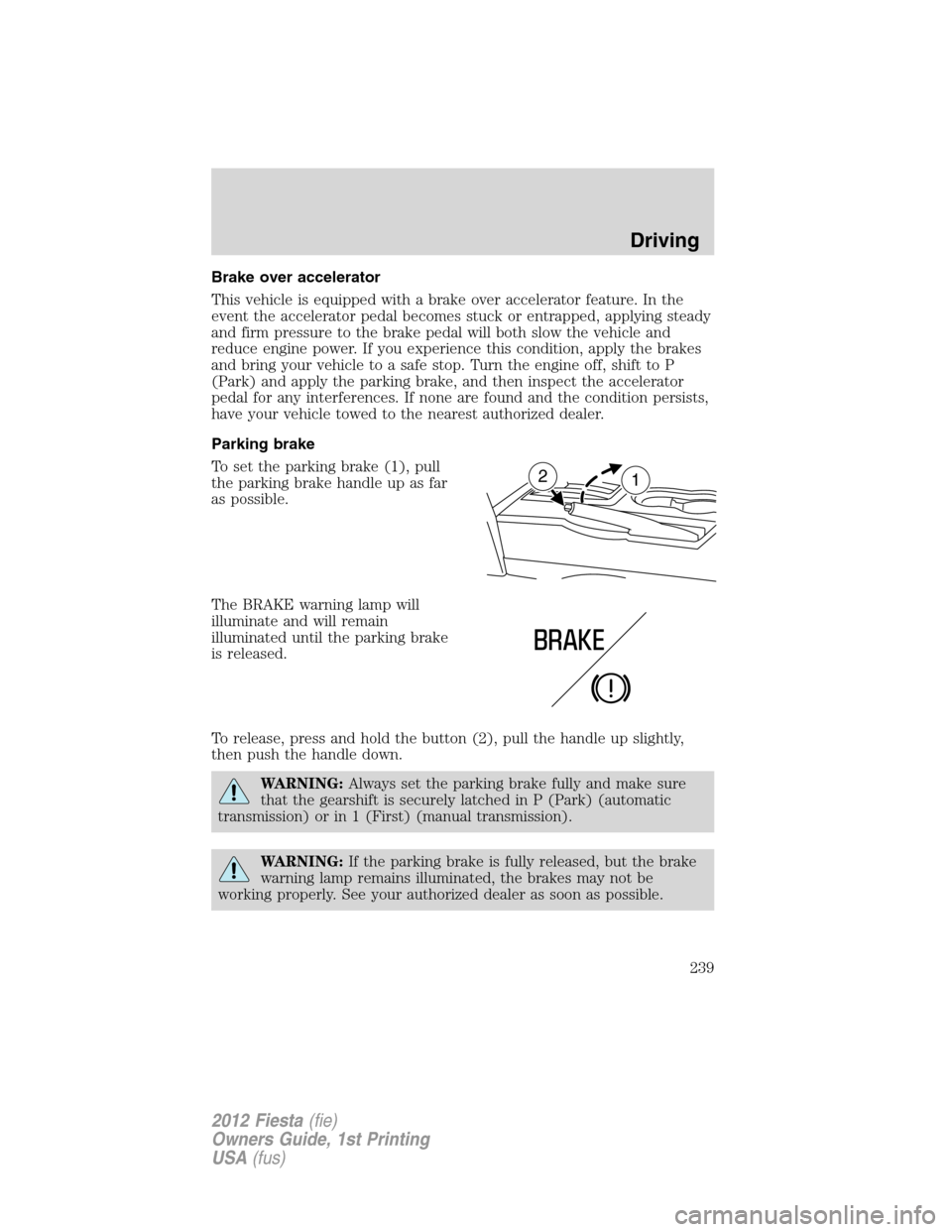
Parking brake
To set the parking brake (1), pull
the parking brake handle up as far
as possible.
The BRAKE warning lamp will
illuminate and will remain
illuminated until the parking brake
is released.
To release, press and hold the button (2), pull the handle up slightly,
then push the handle down.
WARNING:Always set the parking brake fully and make sure
that the gearshift is securely latched in P (Park) (automatic
transmission) or in 1 (First) (manual transmission).
WARNING:If the parking brake is fully released, but the brake
warning lamp remains illuminated, the brakes may not be
working properly. See your authorized dealer as soon as possible.
12
Driving
239
2012 Fiesta(fie)
Owners Guide, 1st Printing
USA(fus)
Page 255 of 356
ROADSIDE ASSISTANCE
Vehicles sold in the U.S. : Getting roadside assistance
To fully assist you should you have a vehicle concern, Ford Motor
Company offers a complimentary roadside assistance program. This
program is separate from the New Vehicle Limited Warranty. The service
is available:
•24-hours, seven days a week
•for the coverage period listed on the Roadside Assistance Card
included in your Owner Guide portfolio.
Roadside assistance will cover:
•a flat tire change with a good spare (except vehicles that have been
supplied with a tire inflation kit)
•battery jump start
•lock-out assistance (key replacement cost is the customer’s
responsibility)
•fuel delivery – Independent Service Contractors, if not prohibited by
state, local or municipal law shall deliver up to 2.0 gallons (7.5L) of
gasoline or 5.0 gallons (18.9L) of diesel fuel to a disabled vehicle. Fuel
delivery service is limited to two no-charge occurrences within a
12-month period.
•winch out – available within 100 feet (30.5 meters) of a paved or
county maintained road, no recoveries.
•towing – Ford and Lincoln eligible vehicles towed to an authorized
dealer within 35 miles (56 km) of the disablement location or to the
nearest authorized dealer. If a member requests to be towed to an
authorized dealer more than 35 miles (56 km) from the disablement
location, the member shall be responsible for any mileage costs in
excess of 35 miles (56 km).
Trailers shall be covered up to $200 if the disabled eligible vehicle
requires service at the nearest authorized dealer. If the trailer is disabled,
but the towing vehicle is operational, the trailer does not qualify for any
roadside services.
Roadside Emergencies
255
2012 Fiesta(fie)
Owners Guide, 1st Printing
USA(fus)
Page 256 of 356
Vehicles sold in the U.S. : Using roadside assistance
Complete the roadside assistance identification card and place it in your
wallet for quick reference. This card is found in the Owner’s Guide
portfolio in the glove compartment.
U.S. Ford vehicle customers who require Roadside Assistance, call
1-800-241-3673.
If you need to arrange roadside assistance for yourself, Ford Motor
Company will reimburse a reasonable amount for towing to the nearest
dealership within 35 miles (56 km). To obtain reimbursement
information, U.S. Ford vehicle customers call 1-800-241-3673. Customers
will be asked to submit their original receipts.
Vehicles sold in Canada : Getting roadside assistance
Canadian customers who require roadside assistance, call
1–800–665–2006.
Vehicles sold in Canada : Using roadside assistance
Complete the roadside assistance identification card and place it in your
wallet for quick reference. In Canada, the card is found in the Warranty
Guide in the glove box.
Canadian Roadside coverage and benefits may differ from the U.S.
coverage. Please refer to your Warranty Guide or visit our website at
www.ford.ca for information on Canadian services and benefits.
Canadian customers who need to obtain roadside information, call
1-800-665-2006 or visit our website at www.ford.ca.
HAZARD FLASHER CONTROL
The hazard flasher control is located
on the instrument panel by the
radio. The hazard flashers will
operate when the ignition is in any
position or if the key is not in the
ignition.
•Press the flasher control and all front and rear direction signals will
flash.
•Press the flasher control again to turn them off.
Use it when your vehicle is disabled and is creating a safety hazard for
other motorists.
Note:With extended use, the flasher may run down your battery.
Roadside Emergencies
256
2012 Fiesta(fie)
Owners Guide, 1st Printing
USA(fus)
Page 266 of 356
2.Full-size dissimilar spare with label on wheel:This spare tire has
a label on the wheel that states: “THIS TIRE AND WHEEL FOR
TEMPORARY USE ONLY”
When driving with one of the dissimilar spare tires listed above,do not:
•Exceed 50 mph (80 km/h)
•Load the vehicle beyond maximum vehicle load rating listed on the
Safety Compliance Label
•Tow a trailer
•Use snow chains on the end of the vehicle with the dissimilar spare
tire
•Use more than one dissimilar spare tire at a time
•Use commercial car washing equipment
•Try to repair the dissimilar spare tire
Use of one of the dissimilar spare tires listed above at any one wheel
location can lead to impairment of the following:
•Handling, stability and braking performance
•Comfort and noise
•Ground clearance and parking at curbs
•Winter weather driving capability
•Wet weather driving capability
•All-wheel driving capability (if applicable)
3.Full-size dissimilar spare without label on wheel
When driving with the full-size dissimilar spare tire/wheel,do not:
•Exceed 70 mph (113 km/h)
•Use more than one dissimilar spare tire/wheel at a time
•Use commercial car washing equipment
•Use snow chains on the end of the vehicle with the dissimilar spare
tire/wheel
The usage of a full-size dissimilar spare tire/wheel can lead to
impairment of the following:
•Handling, stability and braking performance
•Comfort and noise
•Ground clearance and parking at curbs
Roadside Emergencies
266
2012 Fiesta(fie)
Owners Guide, 1st Printing
USA(fus)
Page 267 of 356
•Winter weather driving capability
•Wet weather driving capability
•All-wheel driving capability (if applicable)
•Load leveling adjustment (if applicable)
When driving with the full-size dissimilar spare tire/wheel additional
caution should be given to:
•Towing a trailer
•Driving vehicles equipped with a camper body
•Driving vehicles with a load on the cargo rack
Drive cautiously when using a full-size dissimilar spare tire/wheel and
seek service as soon as possible.
Stopping and securing the vehicle
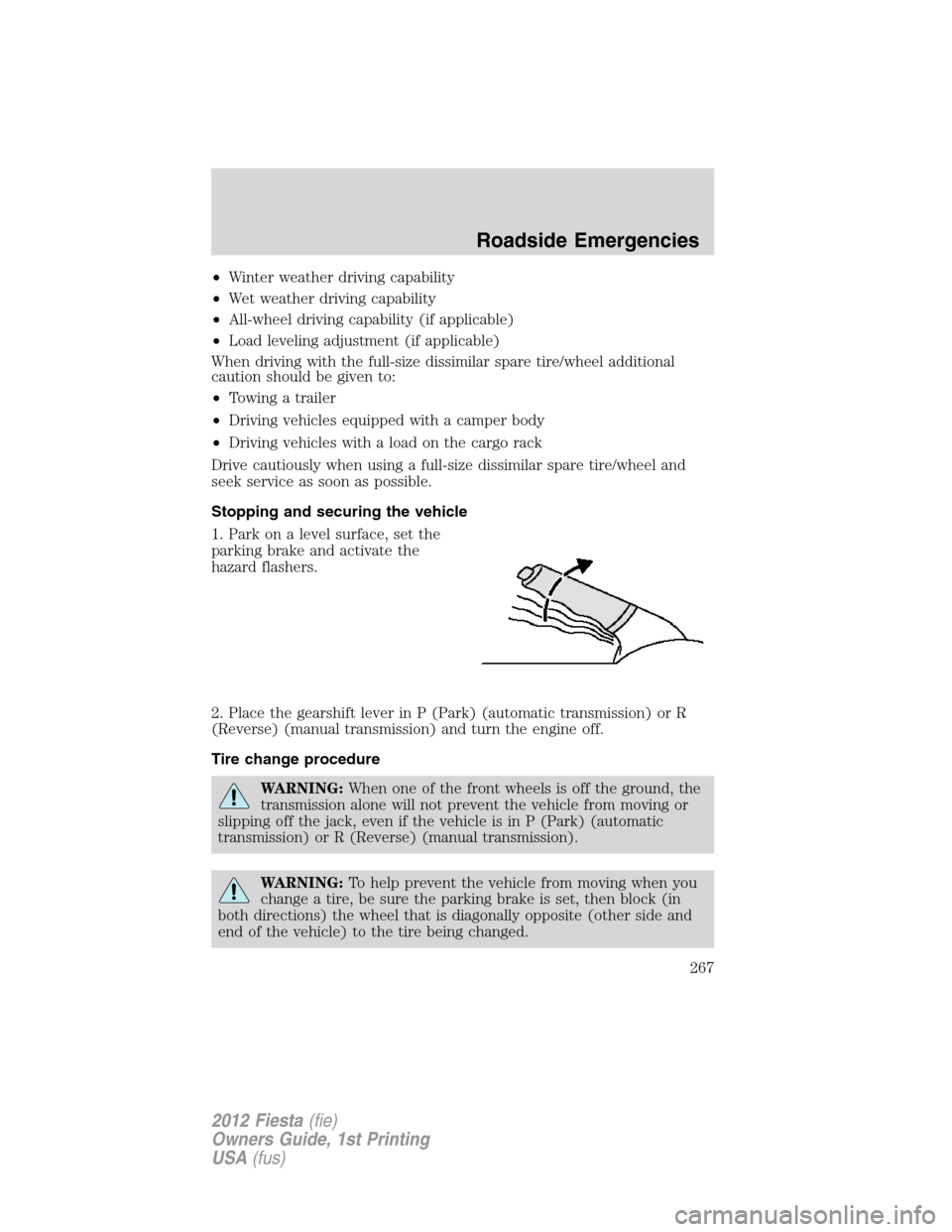
1. Park on a level surface, set the
parking brake and activate the
hazard flashers.
2. Place the gearshift lever in P (Park) (automatic transmission) or R
(Reverse) (manual transmission) and turn the engine off.
Tire change procedure
WARNING:When one of the front wheels is off the ground, the
transmission alone will not prevent the vehicle from moving or
slipping off the jack, even if the vehicle is in P (Park) (automatic
transmission) or R (Reverse) (manual transmission).
WARNING:To help prevent the vehicle from moving when you
change a tire, be sure the parking brake is set, then block (in
both directions) the wheel that is diagonally opposite (other side and
end of the vehicle) to the tire being changed.
Roadside Emergencies
267
2012 Fiesta(fie)
Owners Guide, 1st Printing
USA(fus)