Page 157 of 462

Replacement keys
If your keys are lost or stolen and you don’t have an extra coded key,
you will need to have your vehicle towed to an authorized dealer. The
key codes need to be erased from your vehicle and new coded keys will
need to be programmed.
Replacing coded keys can be very costly. Store an extra programmed key
away from the vehicle in a safe place to help prevent any
inconveniences. Please visit an authorized dealer to purchase additional
spare or replacement keys.
Programming spare keys
A maximum of eight keys can be coded to your vehicle. Only
SecuriLock�keys can be used. To program acoded keyyourself, you
will need two previously programmedcoded keys(keys that already
operate your vehicle’s engine) and the new unprogrammed key(s) readily
accessible for timely implementation of each step in the procedure.
If two previously programmed coded keys are not available, you must
bring your vehicle to your authorized dealer to have the spare coded
key(s) programmed.
Please read and understand the entire procedure before you begin.
1. Insert the first previously
programmedcoded keyinto the
ignition and turn the ignition from
the 1 (off) position to the 3 (on)
position (maintain ignition in the 3
(on) position for at least one
second, but no more than
10 seconds).
2. Turn ignition from the 3 (on)
position back to the 1 (off) position
in order to remove the firstcoded
keyfrom the ignition.
3. After three seconds but within 10 seconds of removing the firstcoded
key,insert the second previously programmedcoded keyinto the
ignition and turn the ignition from the 1 (off) position to the 3 (on)
position (maintain ignition in the 3 (on) position for at least one second
but no more than 10 seconds).
4. Turn the ignition from the 3 (on) position back to the 1 (off) position
in order to remove the secondcoded keyfrom the ignition.
Locks and Security
157
2012 F-150(f12)
Owners Guide, 1st Printing
USA(fus)
Page 162 of 462

To reinstall the adjustable head restraint, do the following:
1. Insert the two stems (2) into the
guide sleeve collars.
2. Push the head restraint down
until it locks.
Properly adjust the head restraint so that the top of the head restraint is
even with the top of your head and positioned as close as possible to the
back of your head. For occupants of extremely tall stature, adjust the
head restraint to its full up position.
WARNING:To minimize the risk of neck injury in the event of a
crash, head restraints must be installed properly.
Tilting head restraints (if equipped)
The front head restraints may have a tilting feature for extra comfort. To
tilt the head restraint, do the following:
1. Adjust the seatback to an upright driving/riding position.
2. Pivot the head restraint forward
towards your head to the desired
location.
After the head restraint reaches
the forward-most tilt position,
pivoting it forward again will then
release it to the rearward
un-tilted position.
Seating and Safety Restraints
162
2012 F-150(f12)
Owners Guide, 1st Printing
USA(fus)
Page 166 of 462
•To gain access to the storage
compartment (if equipped) under
the center seat cushion, lift the
latch to open the lid.
Using the manual lumbar support (if equipped)
For more lumbar support, turn the
lumbar support control toward the
front of vehicle.
For less lumbar support, turn the
lumbar support control toward the
rear of vehicle.
Seating and Safety Restraints
166
2012 F-150(f12)
Owners Guide, 1st Printing
USA(fus)
Page 167 of 462

Using the power lumbar support (if equipped)
The power lumbar control is located on the outboard side of the seat.
Press the forward side of the control
for additional support.
Press the rear side of the control to
reduce support.
Adjusting the front power seat (if equipped)
WARNING:Never adjust the driver’s seat or seatback when the
vehicle is moving.
WARNING:Always drive and ride with your seatback upright
and the lap belt snug and low across the hips.
WARNING:Reclining the seatback can cause an occupant to
slide under the seat’s safety belt, resulting in severe personal
injuries in the event of a collision.
WARNING:Sitting improperly out of position or with the seat
back reclined too far can take off weight from the seat cushion
and affect the decision of the passenger sensing system, resulting in
serious injury or death in a crash. Always sit upright against your
seatback, with your feet on the floor.
WARNING:To reduce the risk of possible serious injury: Do not
hang objects off seat back or stow objects in the seatback map
pocket (if equipped) when a child is in the front passenger seat. Do not
place objects underneath the front passenger seat or between the seat
and the center console (if equipped). Check the “passenger airbag off” or
“pass airbag off” indicator lamp for proper airbag status. Refer toFront
passenger sensing systemin theAirbag supplemental restraint
system (SRS)section for additional details. Failure to follow these
instructions may interfere with the front passenger seat sensing system.
Seating and Safety Restraints
167
2012 F-150(f12)
Owners Guide, 1st Printing
USA(fus)
Page 172 of 462
Climate controlled seats air filter replacement (if equipped)
The heated and cooled seat system includes air filters that must be
replaced periodically. Refer toScheduled maintenance information.
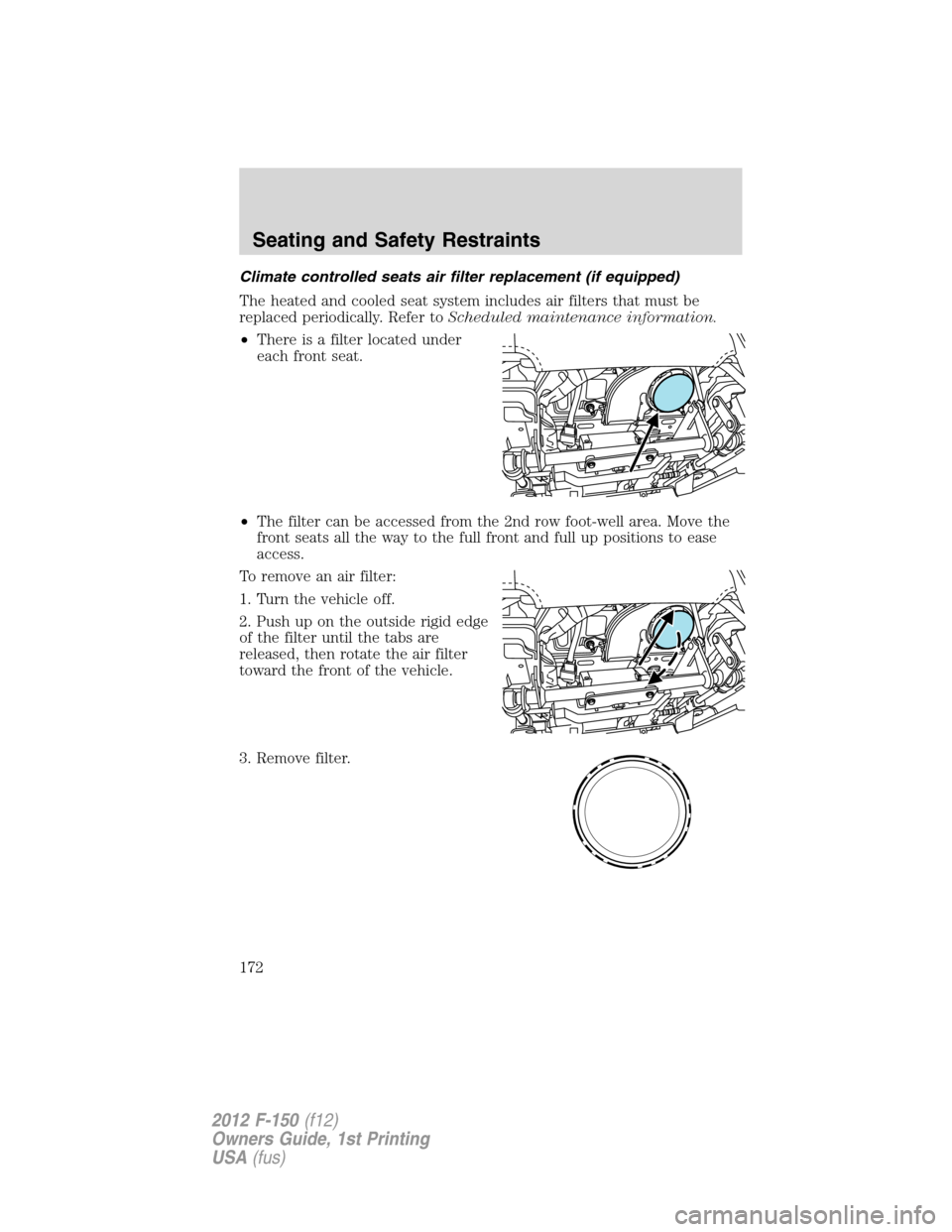
•There is a filter located under
each front seat.
•The filter can be accessed from the 2nd row foot-well area. Move the
front seats all the way to the full front and full up positions to ease
access.
To remove an air filter:
1. Turn the vehicle off.
2. Push up on the outside rigid edge
of the filter until the tabs are
released, then rotate the air filter
toward the front of the vehicle.
3. Remove filter.
Seating and Safety Restraints
172
2012 F-150(f12)
Owners Guide, 1st Printing
USA(fus)
Page 176 of 462
To close the cupholders:
•Push the front edge back into the seat until the cupholders are fully
seated.
•Make sure there is nothing in the cupholders before attempting to
close them.
Make sure that the cupholders are fully seated before stowing the armrest.
Rear heated seats (if equipped)
WARNING:Persons who are unable to feel pain to the skin
because of advanced age, chronic illness, diabetes, spinal cord
injury, medication, alcohol use, exhaustion, or other physical
conditions, must exercise care when using the seat heater. The seat
heater may cause burns even at low temperatures, especially if used
for long periods of time. Do not place anything on the seat that
insulates against heat, such as a blanket or cushion, because this may
cause the seat heater to overheat. Do not puncture the seat with pins,
needles, or other pointed objects because this may damage the heating
element which may cause the seat heater to overheat. An overheated
seat may cause serious personal injury.
Note:Do not do the following:
•Place heavy objects on the seat
•Operate the seat heater if water or any other liquid is spilled on the
seat. Allow the seat to dry thoroughly.
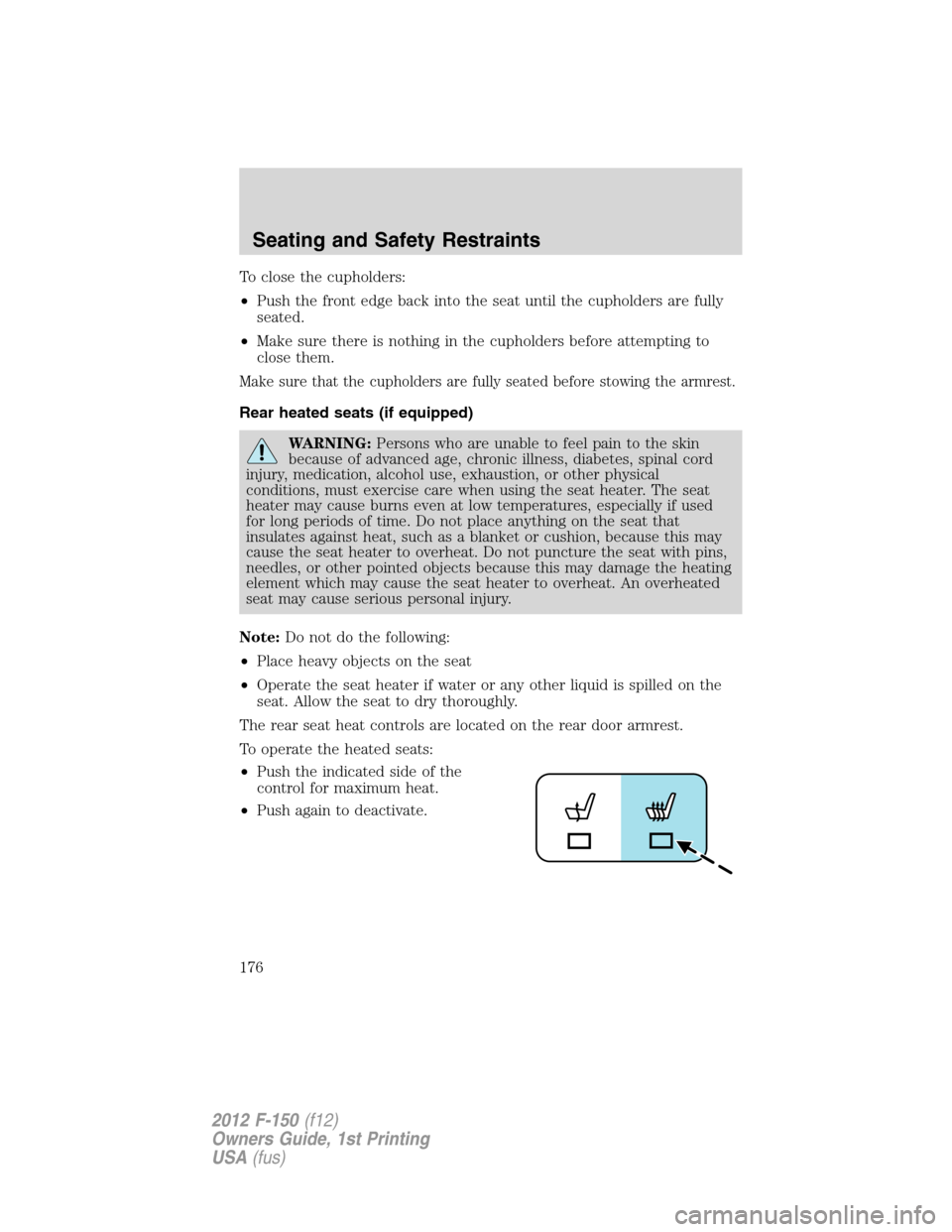
The rear seat heat controls are located on the rear door armrest.
To operate the heated seats:
•Push the indicated side of the
control for maximum heat.
•Push again to deactivate.
Seating and Safety Restraints
176
2012 F-150(f12)
Owners Guide, 1st Printing
USA(fus)
Page 182 of 462
Combination lap and shoulder belts
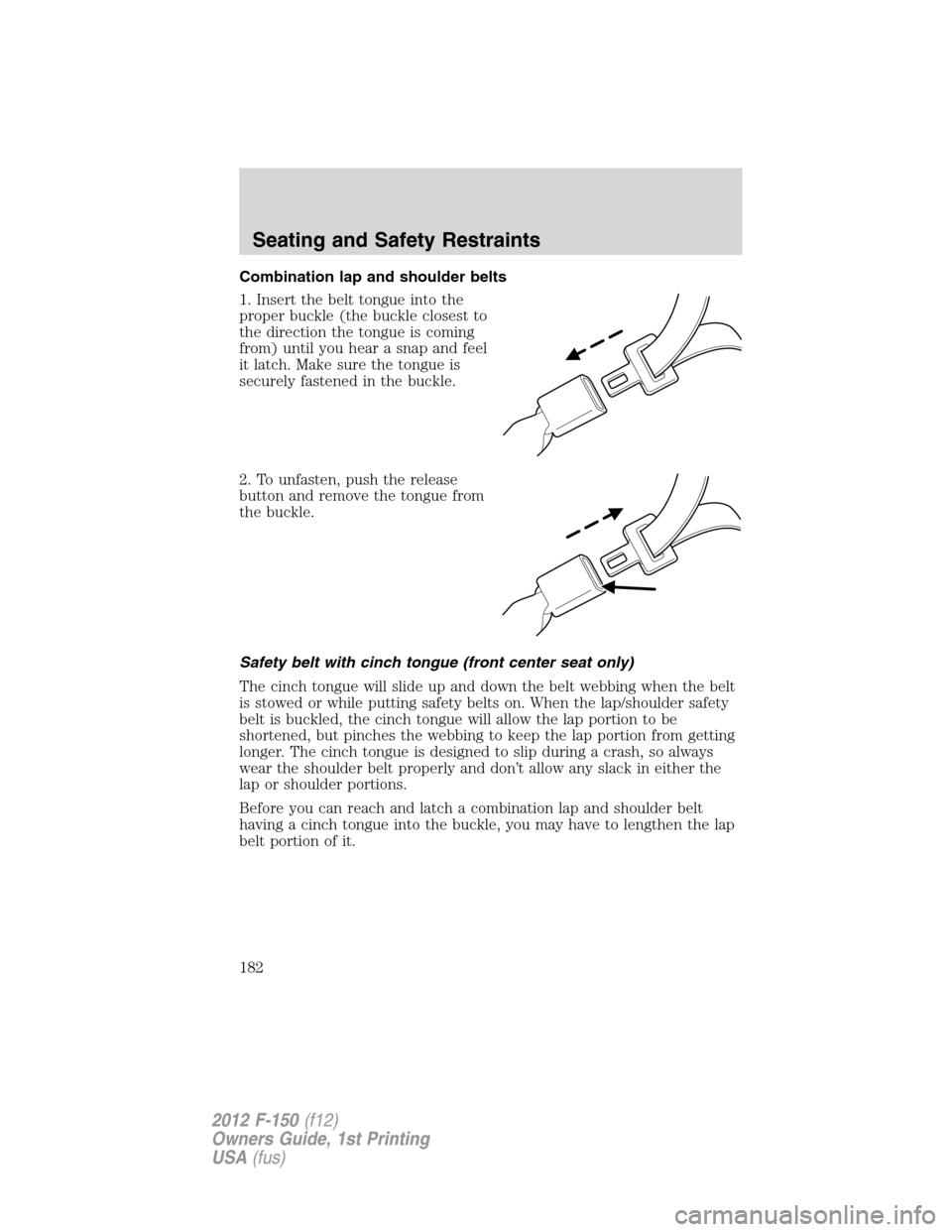
1. Insert the belt tongue into the
proper buckle (the buckle closest to
the direction the tongue is coming
from) until you hear a snap and feel
it latch. Make sure the tongue is
securely fastened in the buckle.
2. To unfasten, push the release
button and remove the tongue from
the buckle.
Safety belt with cinch tongue (front center seat only)
The cinch tongue will slide up and down the belt webbing when the belt
is stowed or while putting safety belts on. When the lap/shoulder safety
belt is buckled, the cinch tongue will allow the lap portion to be
shortened, but pinches the webbing to keep the lap portion from getting
longer. The cinch tongue is designed to slip during a crash, so always
wear the shoulder belt properly and don’t allow any slack in either the
lap or shoulder portions.
Before you can reach and latch a combination lap and shoulder belt
having a cinch tongue into the buckle, you may have to lengthen the lap
belt portion of it.
Seating and Safety Restraints
182
2012 F-150(f12)
Owners Guide, 1st Printing
USA(fus)
Page 190 of 462
If... Then...
The driver’s or front passenger’s
safety belt becomes unbuckled
for approximately 1 minute while
the vehicle is traveling at least
6 mph and 1-2 minutes have
elapsed since the ignition switch
has been turned to ON...The Belt-Minder�feature is activated -
the safety belt warning light illuminates
and the warning chime sounds for six
seconds every 30 seconds, repeating for
approximately five minutes or until the
safety belts are buckled.
The Belt-Minder�feature is
activated and the vehicle speed
is less than 3 mph...The Belt-Minder�feature is suspended -
the safety belt warning light remains
illuminated, but the warning chime does
not sound. This time does not count
towards the five-minute expiration time.
The following are reasons most often given for not wearing safety belts:
(All statistics based on U.S. data)
Reasons given... Consider...
“Crashes are rare events”36700 crashes occur every day.The
more we drive, the more we are
exposed to “rare” events, even for good
drivers.1 in 4 of us will be seriously
injured in a crash during our
lifetime.
“I’m not going far”3of4fatal crashes occur within25
miles of home.
“Belts are uncomfortable” We design our safety belts to enhance
comfort. If you are uncomfortable - try
different positions for the safety belt
upper anchorage and seatback which
should be as upright as possible; this
can improve comfort.
“I was in a hurry”Prime time for an accident.
Belt-Minder�reminds us to take a few
seconds to buckle up.
“Safety belts don’t work”Safety belts,when used properly,
reduce risk of deathto front seat
occupants by45% in cars,and by60%
in light trucks.
Seating and Safety Restraints
190
2012 F-150(f12)
Owners Guide, 1st Printing
USA(fus)