Page 392 of 462

3. Turn the engine off and wait for it to cool before checking the coolant
level.
WARNING:Never remove the coolant reservoir cap while the
engine is running or hot.
4. If the coolant level is normal, you may restart your engine and
continue on.
5. If the coolant is low, add coolant, restart the engine and take your
vehicle to an authorized dealer. SeeAdding engine coolantin this
chapter for more information.
Refer to fail-safe cooling for additional information.
FUEL FILTER
Your vehicle is equipped with a lifetime fuel filter that is integrated with
the fuel tank. Regular maintenance or replacement is not needed.
WHAT YOU SHOULD KNOW ABOUT AUTOMOTIVE FUELS
Important safety precautions
WARNING:Do not overfill the fuel tank. The pressure in an
overfilled tank may cause leakage and lead to fuel spray and fire.
WARNING:The fuel system may be under pressure. If you hear
a hissing sound near the fuel filler door (Easy Fuel�“no cap”
fuel system), do not refuel until the sound stops. Otherwise, fuel may
spray out, which could cause serious personal injury.
WARNING:Automotive fuels can cause serious injury or death
if misused or mishandled.
WARNING:Fuel ethanol and gasoline may contain benzene,
which is a cancer-causing agent.
Maintenance and Specifications
392
2012 F-150(f12)
Owners Guide, 1st Printing
USA(fus)
Page 406 of 462
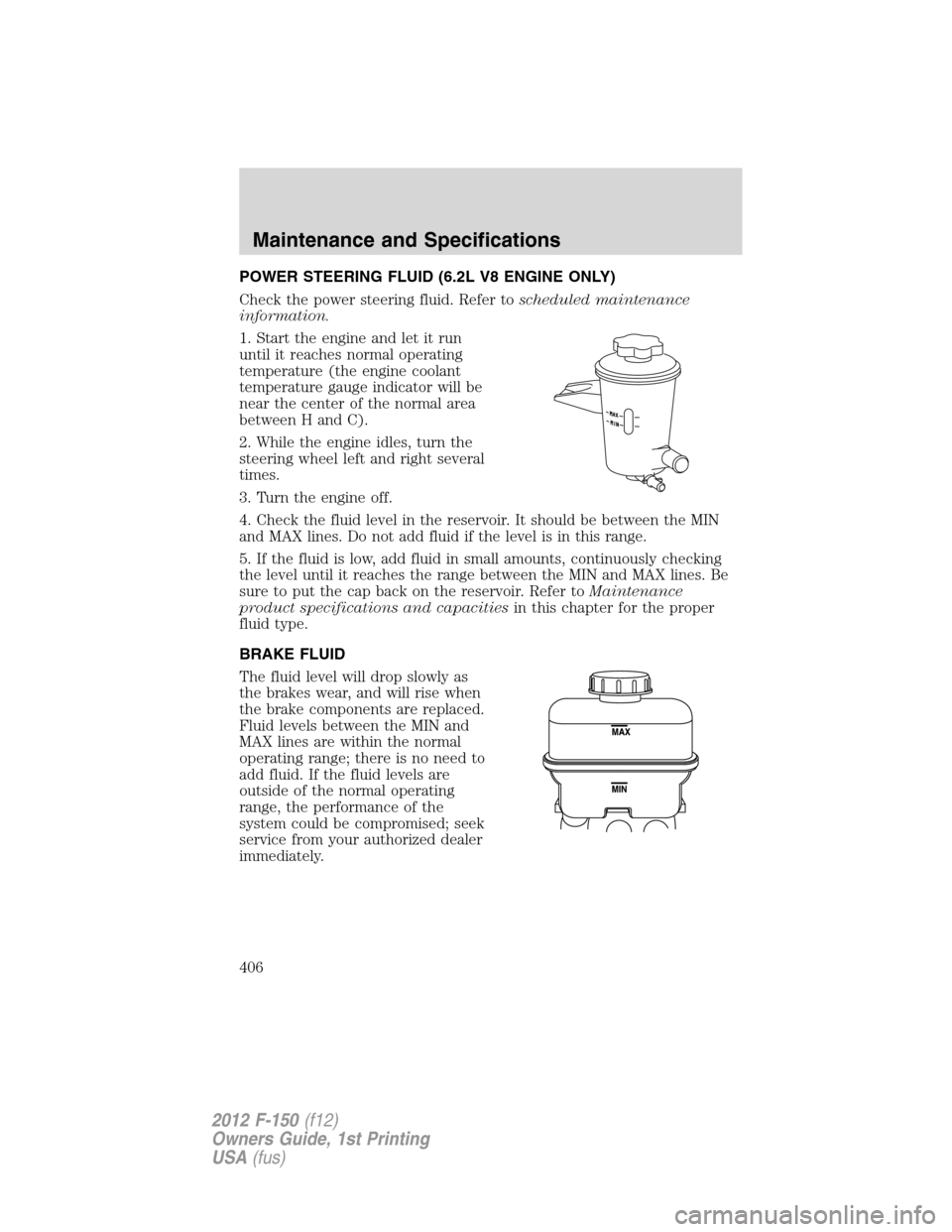
POWER STEERING FLUID (6.2L V8 ENGINE ONLY)
Check the power steering fluid. Refer toscheduled maintenance
information.
1. Start the engine and let it run
until it reaches normal operating
temperature (the engine coolant
temperature gauge indicator will be
near the center of the normal area
between H and C).
2. While the engine idles, turn the
steering wheel left and right several
times.
3. Turn the engine off.
4. Check the fluid level in the reservoir. It should be between the MIN
and MAX lines. Do not add fluid if the level is in this range.
5. If the fluid is low, add fluid in small amounts, continuously checking
the level until it reaches the range between the MIN and MAX lines. Be
sure to put the cap back on the reservoir. Refer toMaintenance
product specifications and capacitiesin this chapter for the proper
fluid type.
BRAKE FLUID
The fluid level will drop slowly as
the brakes wear, and will rise when
the brake components are replaced.
Fluid levels between the MIN and
MAX lines are within the normal
operating range; there is no need to
add fluid. If the fluid levels are
outside of the normal operating
range, the performance of the
system could be compromised; seek
service from your authorized dealer
immediately.
Maintenance and Specifications
406
2012 F-150(f12)
Owners Guide, 1st Printing
USA(fus)
Page 413 of 462

Fuel system
•Fill the fuel tank with high-quality fuel until the first automatic shutoff
of the fuel pump nozzle.
Note:During extended periods of vehicle storage (30 days or more),
fuel may deteriorate due to oxidation. Add a quality gas stabilizer
product to the vehicle fuel system whenever actual or expected storage
periods exceed 30 days. Follow the instructions on the additive label.
The vehicle should then be operated at idle speed to circulate the
additive throughout the fuel system.
Cooling system
•Protect against freezing temperatures.
•When removing vehicle from storage, check coolant fluid level.
Confirm there are no cooling system leaks, and fluid is at the
recommended level.
Battery
•Check and recharge as necessary. Keep connections clean.
•If storing your vehicle for more than 30 days without recharging the
battery, it may be advisable to disconnect the battery cables to ensure
battery charge is maintained for quick starting.
Note:If battery cables are disconnected, it will be necessary to reset
memory features.
Brakes
•Make sure brakes and parking brake are fully released.
Tires
•Maintain recommended air pressure.
Miscellaneous
•Make sure all linkages, cables, levers and pins under vehicle are
covered with grease to prevent rust.
•Move vehicles at least 25 feet (8 m) every 15 days to lubricate
working parts and prevent corrosion.
Maintenance and Specifications
413
2012 F-150(f12)
Owners Guide, 1st Printing
USA(fus)
Page 418 of 462

Item CapacityFord part name or
equivalentFord part number / Ford
specification
Fuel tank
Reg. Cab 8’ box /
SuperCab 6.5’ box /
SuperCab 8’ box26.0 gallons (98.4L)
Standard
36.0 gallons (136.2L)
Optional——
1Use of synthetic or synthetic blend motor oil is not mandatory. Engine oil need only meet the
requirements of Ford specification WSS-M2C945-A and the API Certification mark.2Use of synthetic or synthetic blend motor oil is not mandatory. Engine oil need only meet the
requirements of Ford specification WSS-M2C946-A and the API Certification mark.3Add the coolant type originally equipped in your vehicle.4Service refill capacity is determined by filling the axle to 1/4-9/16 inch (6-14 mm) below the
bottom of the filler hole with the vehicle on a level surface.
Add 4 oz. (118 ml) of Additive Friction Modifier XL-3 or equivalent meeting Ford specification
EST-M2C118-A, for complete fill of 8.8 inch Traction-Lok axles.5Your vehicle’s rear axle is filled with a synthetic rear axle lubricant and is considered lubricated
for life. These lubricants do not need to be checked or changed unless a leak is suspected, service
is required or the axle assembly has been submerged in water. The axle lubricant should be
changed any time the rear axle has been submerged in water.6Service refill capacity is determined by filling the transfer case to the bottom of the filler hole
with the vehicle on a level surface.7Approximate dry fill capacity including transmission fluid cooling system, actual refill capacities
will vary based on vehicle application and transmission fluid cooling system (i.e. coolers size,
cooling lines, auxiliary cooler capacities). The amount of transmission fluid and fluid level should
be set by the indication on the dipstick’s normal operating range.8Automatic transmissions that require MERCON�LV should only use MERCON�LV fluid. Refer to
scheduled maintenance informationto determine the correct service interval. Use of any fluid
other than the recommended fluid may cause transmission damage.
Maintenance and Specifications
418
2012 F-150(f12)
Owners Guide, 1st Printing
USA(fus)
Page 434 of 462

Engine oil/coolant change intervals – 3.5L, 3.7L and 5.0L engines
Engine oilAs indicated by the message center: do not
exceed one year or 10,000 miles (16,000 km)
Engine coolant,
initial change6 years or 100,000 miles (160,000 km)
(whichever comes first)
Engine coolant, after
initial changeEvery 3 years or 50,000 miles (80,000 km)
Engine oil/coolant change intervals – 6.2L engine
Engine oil6 months or 7,500 miles (12,000 km)
(whichever comes first)
Engine coolant,
initial change6 years or 105,000 miles (168,000 km)
(whichever comes first)
Engine coolant, after
initial changeEvery 3 years or 45,000 miles (72,000 km)
Check every month
Engine oil level
Function of all interior and exterior lights
Tires for wear and proper pressure, including spare
Windshield washer fluid level
Check every six months
Battery connections; clean if necessary
Body and door drain holes for obstructions; clean if necessary
Cooling system fluid level and coolant strength
Door weatherstrips for wear; lubricate if necessary
Hinges/latches/outside locks for proper operation; lubricate if necessary
Parking brake for proper operation
Safety belts and seat latches for wear and function
Safety warning lamps (brake, ABS, airbag, safety belt) for operation
Washer spray/wiper operation; clean or replace blades as necessary
Scheduled Maintenance
434
2012 F-150(f12)
Owners Guide, 1st Printing
USA(fus)
Page 435 of 462

Multi-point inspection
In order to keep your vehicle running right, it is important to have the
systems on your vehicle checked regularly. This can help identify
potential issues and prevent major problems. Ford Motor Company
recommends the following multi-point inspection be performed at every
scheduled maintenance interval to help ensure your vehicle keeps
running great.
Multi-point inspection – Recommended each visit
Accessory drive belt(s) Half-shaft dust boots (if equipped)
Battery performance Horn operation
Clutch operation (if equipped) Radiator, cooler, heater and A/C hoses
Engine air filter Suspension component for leaks or
damage
Exhaust system Steering and linkage
Exterior lamps and hazard
warning system operationTires for wear and proper pressure,
including spare
Fluid levels*; fill if necessary Windshield for cracks, chips or pits
For oil and fluid leaks Washer spray and wiper operation
*Brake, coolant recovery reservoir, manual and automatic transmission
(with an underhood dipstick), power steering (if equipped) and
window washer
Be sure to ask your dealership service advisor or technician about the
multi-point vehicle inspection. It’s a comprehensive way to perform a
thorough inspection of your vehicle. It’s your checklist that gives you
immediate feedback on the overall condition of your vehicle. You’ll know
what’s been checked, what’s okay, as well as those things that may
require future or immediate attention. The multi-point vehicle inspection
is one more way to keep your vehicle running great!
Scheduled Maintenance
435
2012 F-150(f12)
Owners Guide, 1st Printing
USA(fus)