Page 261 of 358
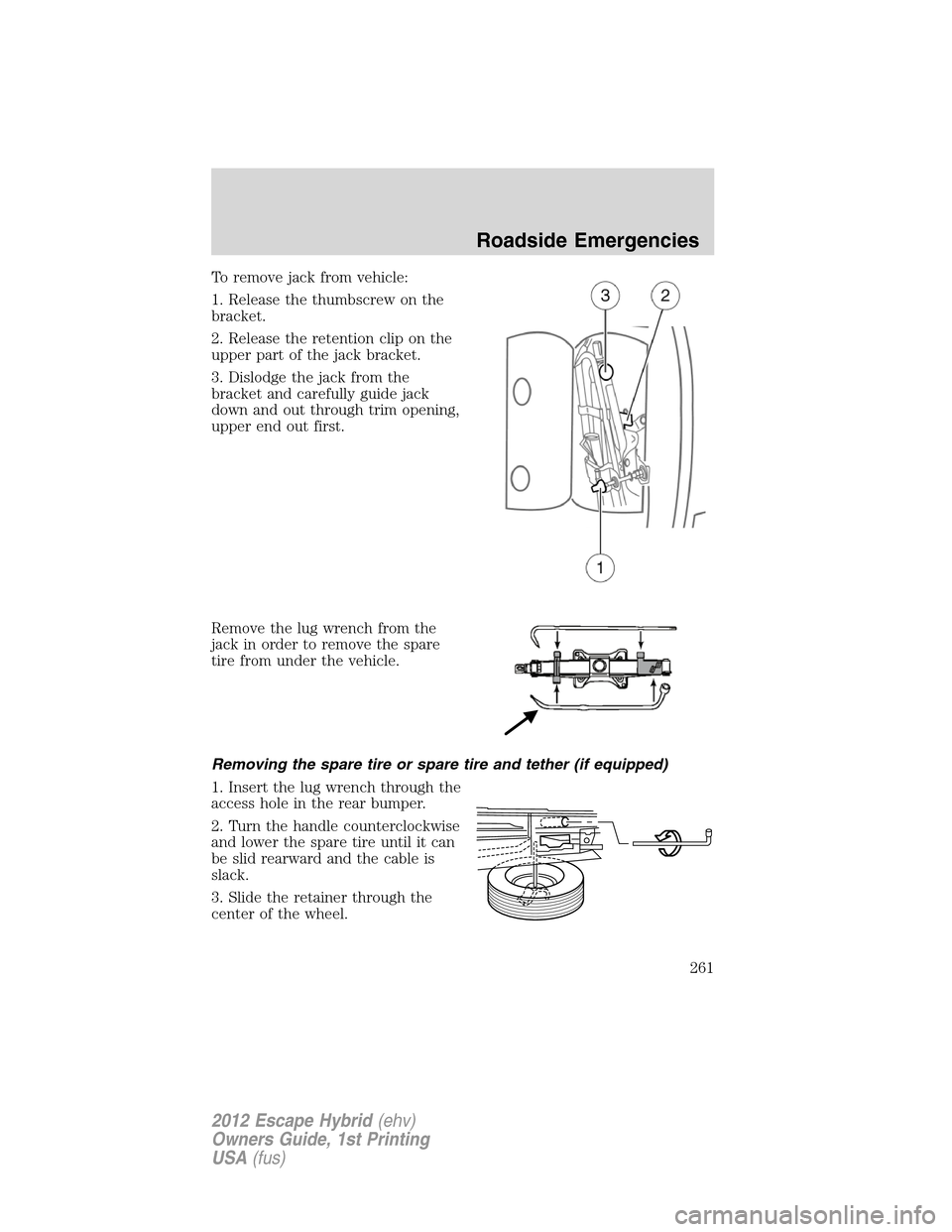
To remove jack from vehicle:
1. Release the thumbscrew on the
bracket.
2. Release the retention clip on the
upper part of the jack bracket.
3. Dislodge the jack from the
bracket and carefully guide jack
down and out through trim opening,
upper end out first.
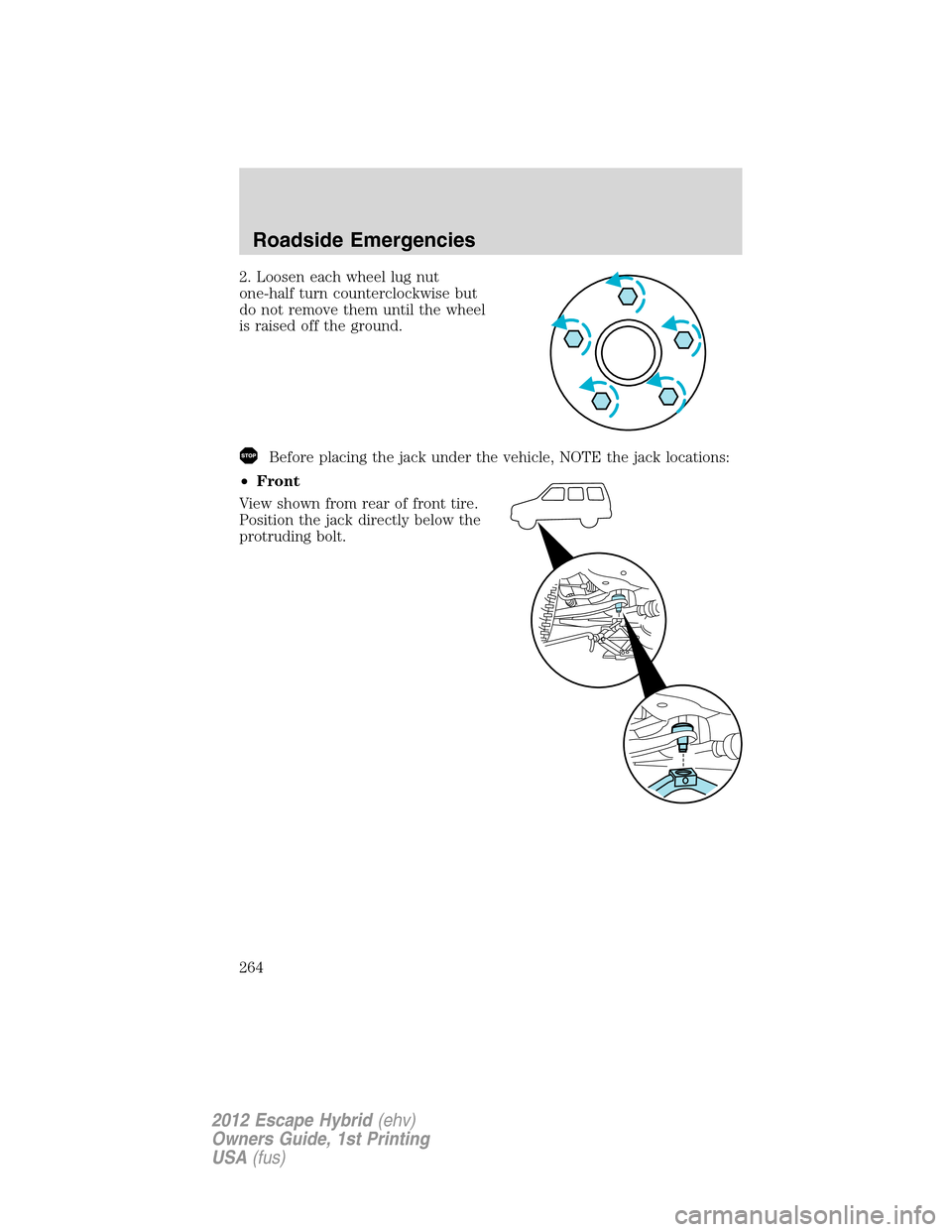
Remove the lug wrench from the
jack in order to remove the spare
tire from under the vehicle.
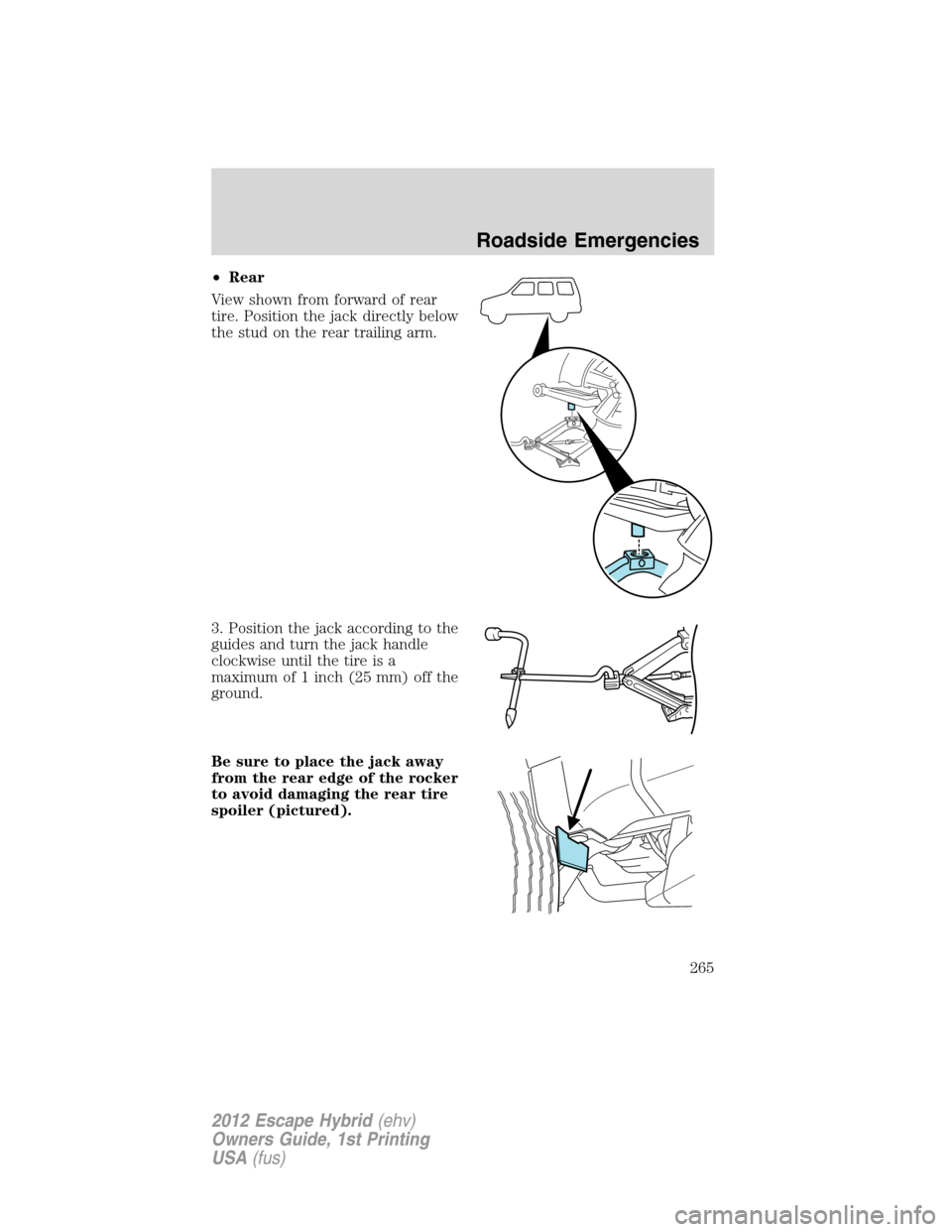
Removing the spare tire or spare tire and tether (if equipped)
1. Insert the lug wrench through the
access hole in the rear bumper.
2. Turn the handle counterclockwise
and lower the spare tire until it can
be slid rearward and the cable is
slack.
3. Slide the retainer through the
center of the wheel.
Roadside Emergencies
261
2012 Escape Hybrid(ehv)
Owners Guide, 1st Printing
USA(fus)
Page 264 of 358
2. Loosen each wheel lug nut
one-half turn counterclockwise but
do not remove them until the wheel
is raised off the ground.
Before placing the jack under the vehicle, NOTE the jack locations:
•Front
View shown from rear of front tire.
Position the jack directly below the
protruding bolt.
Roadside Emergencies
264
2012 Escape Hybrid(ehv)
Owners Guide, 1st Printing
USA(fus)
Page 265 of 358
•Rear
View shown from forward of rear
tire. Position the jack directly below
the stud on the rear trailing arm.
3. Position the jack according to the
guides and turn the jack handle
clockwise until the tire is a
maximum of 1 inch (25 mm) off the
ground.
Be sure to place the jack away
from the rear edge of the rocker
to avoid damaging the rear tire
spoiler (pictured).
Roadside Emergencies
265
2012 Escape Hybrid(ehv)
Owners Guide, 1st Printing
USA(fus)
Page 266 of 358
Never use the differentials as a
jacking point.
WARNING:To lessen the
risk of personal injury, do
not put any part of your body
under the vehicle while changing a
tire. Do not start the engine when
your vehicle is on the jack. The
jack is only meant for changing
the tire.
4. Remove the lug nuts with the lug nut wrench.
5. Replace the flat tire with the spare tire, making sure the valve stem is
facing outward. Reinstall lug nuts until the wheel is snug against the hub.
Do not fully tighten the lug nuts until the wheel has been lowered.
6. Lower the wheel by turning the jack handle counterclockwise.
7. Remove the jack and fully tighten
the lug nuts in the order shown.
Refer toWheel lug nut torque
specificationslater in this chapter
for the proper lug nut torque
specification.
Stowing the jack and tools
Make sure the jack is fully lowered
and reclip the tools onto the jack.
1
4 3
2 5
Roadside Emergencies
266
2012 Escape Hybrid(ehv)
Owners Guide, 1st Printing
USA(fus)
Page 268 of 358

3. Lay the tire on the ground with the valve stem facing down. If your
vehicle is equipped with aluminum wheels, remove the wheel ornament.
4. Slide the wheel partially under the vehicle and install the retainer
through the center of the wheel.
5. Turn the jack handle clockwise until the tire is raised to its original
position underneath the vehicle. The effort to turn the jack handle
increases significantly as the tire contacts the frame. The spare tire
carrier will ratchet when the tire is in the fully stowed position. The
spare tire carrier has a built-in ratchet feature that will not allow you to
overtighten. If the spare tire carrier ratchets with very little effort, take
the vehicle to your authorized dealer for assistance at your earliest
convenience.If your vehicle is equipped with a trailer hitch, guide
the tire with one hand; keep the rear of the tire tilted down until
the tire clears the bumper.
6. Check that the tire lies flat against the frame assembly. Push against
the tire to make sure it is tightly seated under the vehicle. Loosen and
retighten, if necessary. Failure to properly stow the spare tire may result
in failure of the winch cable and loss of the spare tire.(Make sure that
the tire does not contact the bumper.)
7. Repeat this tightness check procedure (every six months, per
scheduled maintenance information),when servicing the spare tire
pressure or at any time that the spare tire is disturbed through service of
other components.
WHEEL LUG NUT TORQUE SPECIFICATIONS
Retighten the lug nuts to the specified torque within 100 miles (160 km)
after any wheel disturbance (tire rotation, changing a flat tire, wheel
removal, etc.).
Bolt size Wheel lug nut torque*
ft-lb N•m
M12 x 1.5 100 135
* Torque specifications are for nut and bolt threads free of dirt and
rust. Use only Ford recommended replacement fasteners.
Roadside Emergencies
268
2012 Escape Hybrid(ehv)
Owners Guide, 1st Printing
USA(fus)
Page 298 of 358
4. Install the dipstick and ensure it is fully seated.
5. Fully install the engine oil filler cap by turning the filler cap clockwise
1/4 of a turn until it is seated.
To avoid possible oil loss, DO NOT operate the vehicle with the
engine oil level dipstick and/or the engine oil filler cap removed.
Engine oil and filter recommendations
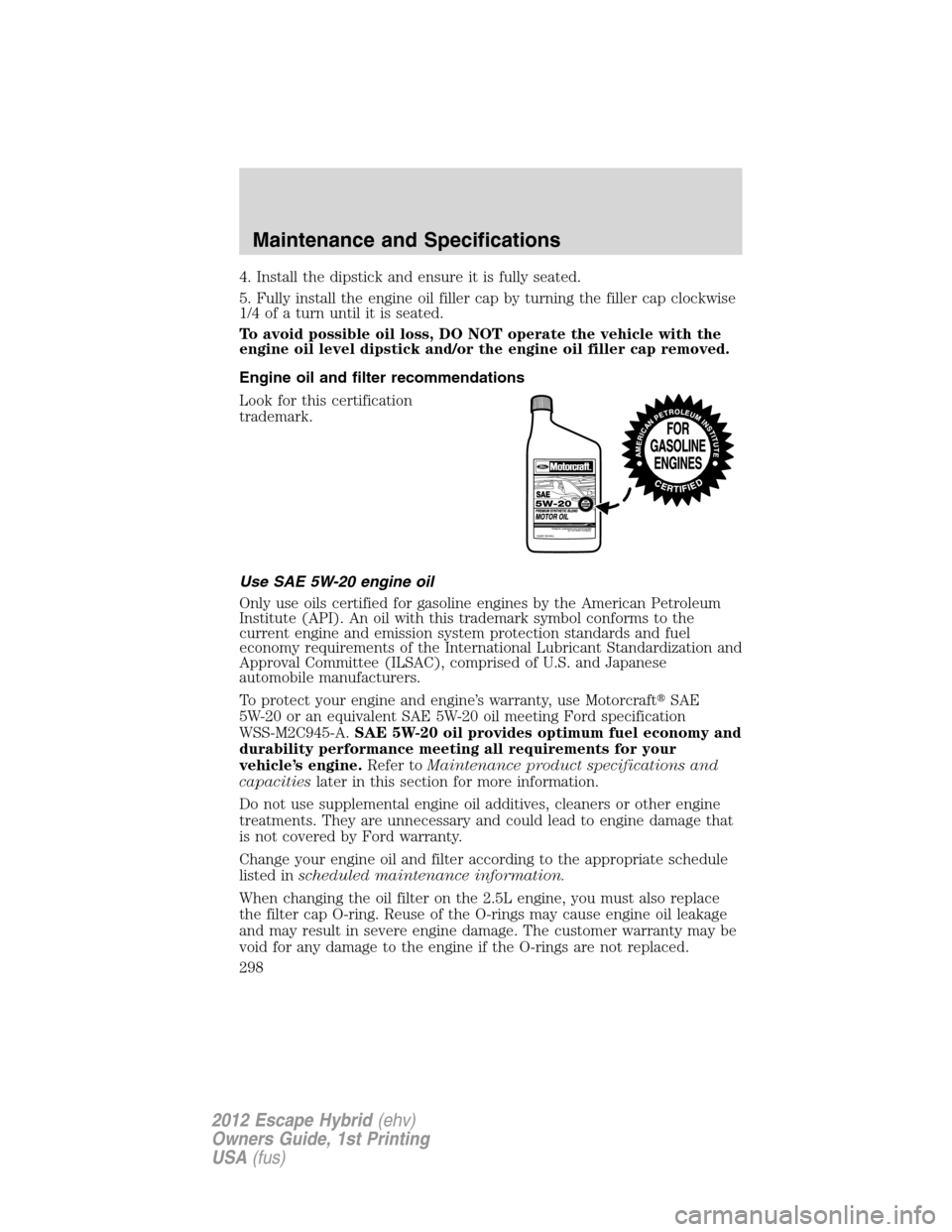
Look for this certification
trademark.
Use SAE 5W-20 engine oil
Only use oils certified for gasoline engines by the American Petroleum
Institute (API). An oil with this trademark symbol conforms to the
current engine and emission system protection standards and fuel
economy requirements of the International Lubricant Standardization and
Approval Committee (ILSAC), comprised of U.S. and Japanese
automobile manufacturers.
To protect your engine and engine’s warranty, use Motorcraft�SAE
5W-20 or an equivalent SAE 5W-20 oil meeting Ford specification
WSS-M2C945-A.SAE 5W-20 oil provides optimum fuel economy and
durability performance meeting all requirements for your
vehicle’s engine.Refer toMaintenance product specifications and
capacitieslater in this section for more information.
Do not use supplemental engine oil additives, cleaners or other engine
treatments. They are unnecessary and could lead to engine damage that
is not covered by Ford warranty.
Change your engine oil and filter according to the appropriate schedule
listed inscheduled maintenance information.
When changing the oil filter on the 2.5L engine, you must also replace
the filter cap O-ring. Reuse of the O-rings may cause engine oil leakage
and may result in severe engine damage. The customer warranty may be
void for any damage to the engine if the O-rings are not replaced.
Maintenance and Specifications
298
2012 Escape Hybrid(ehv)
Owners Guide, 1st Printing
USA(fus)
Page 301 of 358

If the battery has been disconnected or a new battery has been installed,
the clock and the preset radio stations must be reset once the battery is
reconnected.
•Always dispose of automotive
batteries in a responsible manner.
Follow your local authorized
standards for disposal. Call your
local authorized recycling center
to find out more about recycling
automotive batteries.
Low and high voltage battery – storage
Your vehicle must be started and run for a minimum of 10 minutes once
a month in order to maintain the high voltage battery charge. This will
maintain the high voltage battery but it is not enough to maintain the
low voltage (underhood) battery and additional low voltage (underhood)
battery charging may be required after 60 days.
If your vehicle is to be stored for 30 days or longer, the low voltage
(underhood) battery negative terminal must be disconnected. Failure to
do this could damage your vehicle’s batteries.
ENGINE COOLANT AND MOTOR/ELECTRONICS COOLANT
Your vehicle is equipped with two separate coolant systems. One is for
engine cooling and the other is for various electric motors and other
components that are specific to the hybrid operating systems.
L
E
A
D
RETURN
RECYCLE
Maintenance and Specifications
301
2012 Escape Hybrid(ehv)
Owners Guide, 1st Printing
USA(fus)
Page 305 of 358

•Do not use alcohol, methanol, brine or any engine coolants
mixed with alcohol or methanol antifreeze (coolant).Alcohol
and other liquids can cause engine damage from overheating or
freezing.
•Do not add extra inhibitors or additives to the coolant.These
can be harmful and compromise the corrosion protection of the engine
coolant.
For vehicles with overflow coolant systems with a non-pressurized cap
on the coolant recovery system, add coolant to the coolant recovery
reservoir when the engine is cool. Add the proper mixture of coolant and
distilled water to the FULL COLD level. For all other vehicles which have
a coolant degas system with a pressurized cap, or if it is necessary to
remove the coolant pressure relief cap on the radiator of a vehicle with
an overflow system, follow these steps to add engine coolant.
WARNING:To reduce the risk of personal injury, make sure the
engine is cool before unscrewing the coolant pressure relief cap.
The cooling system is under pressure; steam and hot liquid can come
out forcefully when the cap is loosened slightly.
Add the proper mixture of coolant and water to the cooling system by
following these steps:
1. Before you begin, turn the engine off and let it cool.
2. When the engine is cool, wrap a thick cloth around the coolant
pressure relief cap on the coolant reservoir (a translucent plastic bottle).
Slowly turn cap counterclockwise (left) until pressure begins to release.
3. Step back while the pressure releases.
4. When you are sure that all the pressure has been released, use the
cloth to turn it counterclockwise and remove the cap.
5. Fill the coolant reservoir slowly with the proper coolant mixture, to
within the COLD FILL RANGE or the FULL COLD level on the reservoir.
If you removed the radiator cap in an overflow system, fill the radiator
until the coolant is visible and radiator is almost full.
6. Replace the cap. Turn until tightly installed. Cap must be tightly
installed to prevent coolant loss.
After any coolant has been added, check the coolant concentration (refer
toChecking engine coolant). If the concentration is not 50/50, drain
some coolant and adjust the concentration. It may take several drains
and additions to obtain a 50/50 coolant concentration.
Maintenance and Specifications
305
2012 Escape Hybrid(ehv)
Owners Guide, 1st Printing
USA(fus)