Page 288 of 396
Fuse/Relay
LocationFuse Amp
RatingPower Distribution Box
Description
5 40A** Anti-lock brake system (ABS)
pump
6 — Not used
7 30A** Power liftgate
8 20A** Moon roof
9 20A** Power point #2 (console rear)
10 — Not used
11 — Rear window defroster/heated
mirror relay
12 — Not used
13 — Starter relay
14 — Not used
15 — Fuel pump relay
16 — Not used
17 — Not used
18 40A** Blower motor
19 30A** Starter motor
20 20A** Power point #1 (console bin)
21 20A** Cargo area power point
22 — Not used
23 30A** Driver seat module
24 — Not used
25 — Not used
26 40A** Rear window defroster
27 20A** Front power point/lighter
28 30A** Climate controlled seats
29 — Not used
30 — Not used
31 — Not used
32 — Not used
33 — Not used
Roadside Emergencies
288
2012 Edge(edg)
Owners Guide, 1st Printing
USA(fus)
Page 289 of 396
Fuse/Relay
LocationFuse Amp
RatingPower Distribution Box
Description
34 — Blower motor relay
35 — Not used
36 — Rear seat relay
37 — Right trailer tow (TT) stop/turn
lamps relay
38 — Not used
39 40A** Cooling fan (vehicles with TT)
60A** Cooling fan (vehicles without TT)
40 40A** Cooling fan (TT only)
41 — Not used
42 30A** Passenger seat
43 25A** ABS valves
44 — Rear washer relay
45 5A* Rain sensor
46 — Not used
47 — Not used
48 — Not used
49 — Not used
50 15A* Heated mirror
51 — Not used
52 — Stop lamp relay
53 — Left TT stop/turn lamps relay
54 — Not used
55 — Wiper relay
56 15A* Transmission control module
(TCM) (2.0L engine)
57 20A* Left high-intensity discharge
(HID) headlamps
58 10A* Alternator sensor
59 10A* Brake on/off switch
60 15A* Stop lamps
Roadside Emergencies
289
2012 Edge(edg)
Owners Guide, 1st Printing
USA(fus)
Page 291 of 396
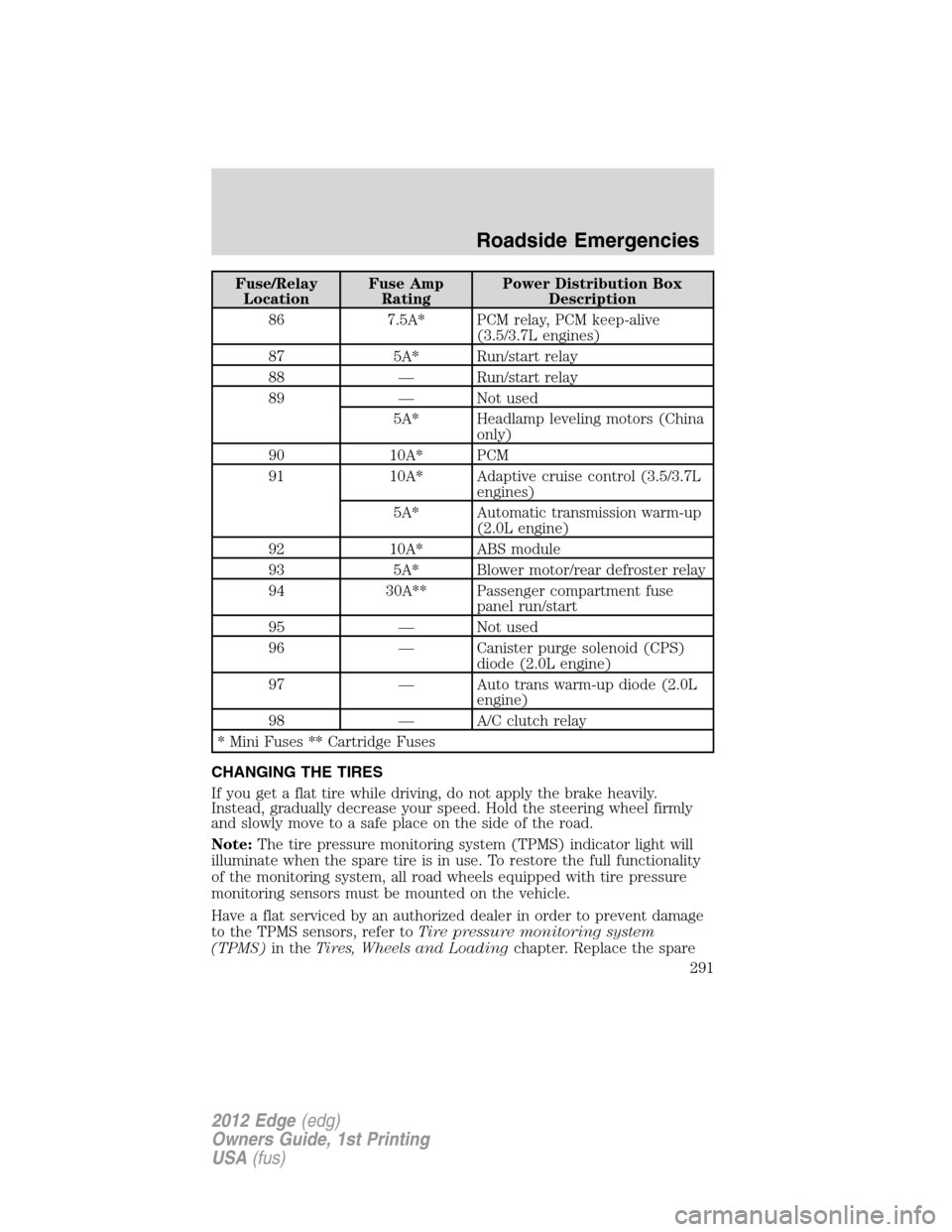
Fuse/Relay
LocationFuse Amp
RatingPower Distribution Box
Description
86 7.5A* PCM relay, PCM keep-alive
(3.5/3.7L engines)
87 5A* Run/start relay
88 — Run/start relay
89 — Not used
5A* Headlamp leveling motors (China
only)
90 10A* PCM
91 10A* Adaptive cruise control (3.5/3.7L
engines)
5A* Automatic transmission warm-up
(2.0L engine)
92 10A* ABS module
93 5A* Blower motor/rear defroster relay
94 30A** Passenger compartment fuse
panel run/start
95 — Not used
96 — Canister purge solenoid (CPS)
diode (2.0L engine)
97 — Auto trans warm-up diode (2.0L
engine)
98 — A/C clutch relay
* Mini Fuses ** Cartridge Fuses
CHANGING THE TIRES
If you get a flat tire while driving, do not apply the brake heavily.
Instead, gradually decrease your speed. Hold the steering wheel firmly
and slowly move to a safe place on the side of the road.
Note:The tire pressure monitoring system (TPMS) indicator light will
illuminate when the spare tire is in use. To restore the full functionality
of the monitoring system, all road wheels equipped with tire pressure
monitoring sensors must be mounted on the vehicle.
Have a flat serviced by an authorized dealer in order to prevent damage
to the TPMS sensors, refer toTire pressure monitoring system
(TPMS)in theTires, Wheels and Loadingchapter. Replace the spare
Roadside Emergencies
291
2012 Edge(edg)
Owners Guide, 1st Printing
USA(fus)
Page 294 of 396

•Driving vehicles with a load on the cargo rack
Drive cautiously when using a full-size dissimilar spare tire/wheel and
seek service as soon as possible.
Stopping and securing the vehicle
1. Park on a level surface, activate
hazard flashers and set the parking
brake.
2. Place the gearshift lever in P
(Park) and turn the engine off.
Removing the spare tire and jack
1. Lift the carpeted load floor panel
located in the rear of the vehicle.
2. Remove the spare tire cover and
foam spacer (if equipped).
3. Remove the wing nut securing
the spare tire by turning it
counterclockwise.
4. Remove the washer.
5. Lift and remove the temporary
spare tire from the cargo area.
6. Remove the jack assembly from
the vehicle. Loosen the bag tabs and
remove the jack and lug wrench
from the bag.
7. Fold down the wrench socket
used to loosen the lug nuts and
operate the jack.
Tire change procedure
WARNING:When one of the front wheels is off the ground, the
transmission alone will not prevent the vehicle from moving or
slipping off the jack, even if the vehicle is in P (Park).
Roadside Emergencies
294
2012 Edge(edg)
Owners Guide, 1st Printing
USA(fus)
Page 296 of 396

3. Align the slot on top of the jack
with the sheet metal flange
indicated by the jack locator triangle
next to the tire you are changing.
Turn the jack handle clockwise until
the wheel is completely off the
ground.
4. Remove the lug nuts with the lug
wrench.
5. Replace the flat tire with the
spare tire, making sure the valve
stem is facing outward. Reinstall the
lug nuts until the wheel is snug
against the hub. Do not fully tighten
the lug nuts until the wheel has
been lowered.
6. Lower the wheel by turning the
jack handle counterclockwise.
7. Remove the jack and fully tighten
the lug nuts in the order shown.
Refer toWheel lug nut torque
specificationslater in this chapter
for the proper lug nut torque
specification.
Stowing the flat/spare tire and jack
1. Fully collapse the jack, fold the wrench socket into the handle and
place them both into the bag making sure to secure the tabs.
2. Place the jack assembly kit in the jack kit recess in the spare tire well
in its original location and orientation.
3. Place the tire in the spare tire well over the jack assembly.
1
4 3
2 5
Roadside Emergencies
296
2012 Edge(edg)
Owners Guide, 1st Printing
USA(fus)
Page 337 of 396

WHAT YOU SHOULD KNOW ABOUT AUTOMOTIVE FUELS
Important safety precautions
WARNING:Do not overfill the fuel tank. The pressure in an
overfilled tank may cause leakage and lead to fuel spray and fire.
WARNING:The fuel system may be under pressure. If you hear
a hissing sound near the fuel filler door, do not refuel until the
sound stops. Otherwise, fuel may spray out, which could cause serious
personal injury.
WARNING:Automotive fuels can cause serious injury or death
if misused or mishandled.
WARNING:Gasoline may contain benzene, which is a
cancer-causing agent.
Observe the following guidelines when handling automotive fuel:
•Extinguish all smoking materials
and any open flames before
refueling your vehicle.
•Always turn off the vehicle before
refueling.
•Automotive fuels can be harmful
or fatal if swallowed. Fuel such as gasoline is highly toxic and if
swallowed can cause death or permanent injury. If fuel is swallowed,
call a physician immediately, even if no symptoms are immediately
apparent. The toxic effects of fuel may not be visible for hours.
•Avoid inhaling fuel vapors. Inhaling too much fuel vapor of any kind
can lead to eye and respiratory tract irritation. In severe cases,
excessive or prolonged breathing of fuel vapor can cause serious
illness and permanent injury.
•Avoid getting fuel liquid in your eyes. If fuel is splashed in the eyes,
remove contact lenses (if worn), flush with water for 15 minutes and
seek medical attention. Failure to seek proper medical attention could
lead to permanent injury.
•Fuels can also be harmful if absorbed through the skin. If fuel is
splashed on the skin and/or clothing, promptly remove contaminated
Maintenance and Specifications
337
2012 Edge(edg)
Owners Guide, 1st Printing
USA(fus)
Page 353 of 396

5. Install a new air filter element. Be careful not to crimp the filter element
edges between the air filter housing and cover. This could cause filter
damage and allow unfiltered air to enter the engine if not properly seated.
6. Replace the air filter housing
cover and secure the clamps. Be
sure that the air cleaner cover tabs
are engaged into the slots of the air
cleaner housing.
Note:Failure to use the correct air filter element may result in severe
engine damage. The customer warranty may be void for any damage to
the engine if the correct air filter element is not used.
VEHICLE STORAGE
If you plan on storing your vehicle for an extended period of time
(30 days or more), refer to the following maintenance recommendations
to ensure your vehicle stays in good operating condition.
All motor vehicles and their components were engineered and tested for
reliable, regular driving. Long term storage under various conditions may
lead to component degradation or failure unless specific precautions are
taken to preserve the components.
General
•Store all vehicles in a dry, ventilated place.
•Protect from sunlight, if possible.
•If vehicles are stored outside, they require regular maintenance to
protect against rust and damage.
Body
•Wash vehicle thoroughly to remove dirt, grease, oil, tar or mud from
exterior surfaces, rear-wheel housing and underside of front fenders.
See theCleaningchapter for more information.
•Periodically wash vehicles stored in exposed locations.
•Touch-up raw or primed metal to prevent rust.
•Cover chrome and stainless steel parts with a thick coat of auto wax
to prevent discoloration. Re-wax as necessary when the vehicle is
washed. See theCleaningchapter for more information.
Maintenance and Specifications
353
2012 Edge(edg)
Owners Guide, 1st Printing
USA(fus)
Page 368 of 396

Ford ESP Can Quickly Pay for Itself
One service bill – the cost of parts and labor – can easily exceed the
price of your Ford ESP Service Contract. With Ford ESP, you minimize
your risk for unexpected repair bills and rising repair costs.
Avoid the rising cost of properly maintaining your vehicle!
Ford ESP also offers a Premium Maintenance Plan that covers items that
routinely wear out.
The coverage is prepaid, so you never have to worry about affording
your vehicle maintenance. It covers regular checkups, routine
inspections, preventive care and replacement of items that require
periodic attention fornormal “wear”:
•Wiper blades•Brake pads and linings
•Spark plugs (except California)•Shock absorbers
•Clutch disc•Belts and hoses
Contact your selling Ford or Lincoln dealership today so they can
customize a Ford Extended Service Plan that fits your driving lifestyle
and budget.
Interest free finance options available
Take advantage of our installment payment plan, just a 10% down
payment will provide you with an affordable no interest, no-fee payment
opportunity.
Ford Extended Service Plan
368
2012 Edge(edg)
Owners Guide, 1st Printing
USA(fus)

