Page 81 of 256

Downloaded from www.Manualslib.com manuals search engine Recline Adjustment
Folding the Passenger's SeatForward
WARNINGS
Do not drive with the passenger'sseat folded forwards if the rear orcentre seat behind is occupied.
Do not drive with items on the foldedseatback.
When folding the passenger's seatforward, make sure that you keepclear of the seatback and seat frame.
1.Push the locking lever
2.Fold the seat forward. Make sure thatthe seatback is in the folded positionand securely latched.
3.Push the locking lever to return theseatback to the vertical position. Makesure that the seatback is securelylatched in position.
REAR SEATS
Folding the Seatback
WARNINGS
When folding the seatbacks down,take care not to get your fingerscaught between the seatback andseat frame.
Do not attempt to fold the rear seatcushion forward.
Lower the head restraints. See HeadRestraints (page 76).
1.Press the unlock buttons down andhold them there.
2.Push the seatback forward. As the rearseatback lowers the seat cushion willalso lower.
79Seats
Page 116 of 256
Downloaded from www.Manualslib.com manuals search engine CARGO NETS
Installing and Removing the Net
Installing the Net
1.Raise the rear outer head restraints.See Head Restraints (page 76).
2.Attach the top securing clips to thehead restraint guides.
3.Attach the bottom securing clips to thebottom anchor points.
Removing the Net
1.Raise the rear outer head restraints.See Head Restraints (page 76).
2.Remove the top and bottom securingclips.
LUGGAGE COVERS
WARNING
Do not place objects on the luggagecover.
DOG GUARD
WARNING
Keep a small distance between thedog guard and the rear seats.
1.Attach the dog guard to the upper andlower anchor points. Tighten thehandwheels.
114Load Carrying
Page 118 of 256

Downloaded from www.Manualslib.com manuals search engine TOWING A TRAILER
WARNINGS
Do not exceed 62 mph (100 km/h).
The rear tyre pressures must beincreased by 3 psi (0.2 bar) abovespecification. See TechnicalSpecifications (page 164).
Do not exceed the maximum grosstrain weight stated on your vehicleidentification plate. See VehicleIdentification Plate (page 167).
Do not exceed the maximumpermissible nose weight, i.e. verticalweight on the tow ball, of 110 pounds(50 kilogrammes).
The electrical system is not suitablefor towing trailers with more thanone rear fog lamp.
Note:Not all vehicles are suitable orapproved to have tow bars fitted. Checkwith your dealer first.
Place loads as low and central to theaxle(s) of the trailer as possible. If you aretowing with an unladen vehicle, the loadin the trailer should be placed toward thenose, within the maximum nose load, asthis gives the best stability.
The stability of your vehicle to trailercombination is very much dependant onthe quality of the trailer.
In high altitude regions above 3 281 feet (1000 metres), the stipulated maximumpermitted gross train weight must bereduced by 10% for every additional 3 281feet (1 000 metres).
Steep Gradients
WARNING
The anti-lock braking system doesnot control the overrun brake on thetrailer.
Change down a gear before you reach asteep downhill gradient.
TOW BALL
WARNINGS
When not in use, always transportthe tow ball arm securely fastenedin the luggage compartment.
Take special care when fitting thetow ball arm as the safety of yourvehicle and the trailer depends onthis.
Do not use any tools for mounting ordismounting the tow ball arm.
Do not modify the trailer coupling.
Do not disassemble or repair the towball arm.
A 13-pin trailer socket and the tow ball armseat are provided under the rear bumper.Turn the trailer socket down through 90degrees until it engages in the end position.
116Towing
Page 121 of 256

Downloaded from www.Manualslib.com manuals search engine Maintenance
WARNING
Remove the tow ball arm andprotect the seat with the plug beforesteam cleaning your vehicle.
Keep the system clean. Periodicallylubricate bearings, sliding surfaces, andlocking balls with resin-free grease or oiland the lock with graphite.
In case of loss, replacement keys areavailable from the manufacturer by statingthe number on the lock cylinder.
TOWING POINTS
WARNING
The towing eye has a left-handthread. Turn it anticlockwise toinstall it. Make sure that the towingeye is fully tightened.
Front Towing Eye
Space is provided in the spare wheel well.
You must carry the towing eye in yourvehicle at all times.
Remove the cover and install the towingeye.
Rear Towing Hook
Note:If your vehicle has a tow bar, use thisto tow other vehicles.
TOWING THE VEHICLE ON
FOUR WHEELS
All Vehicles
WARNINGS
You must switch the ignition on whenyour vehicle is being towed.
The brake and steering assistancewill not operate unless the engine isrunning. Press the brake pedal harderand allow for increased stopping distancesand heavier steering.
Too much tension in the tow ropecould cause damage to your vehicleor the vehicle that is towing.
Do not use a rigid tow bar on thefront towing eye.
When towing your vehicle you mustselect neutral.
Drive off slowly and smoothly withoutjerking the vehicle that is being towed.
119Towing
Page 130 of 256
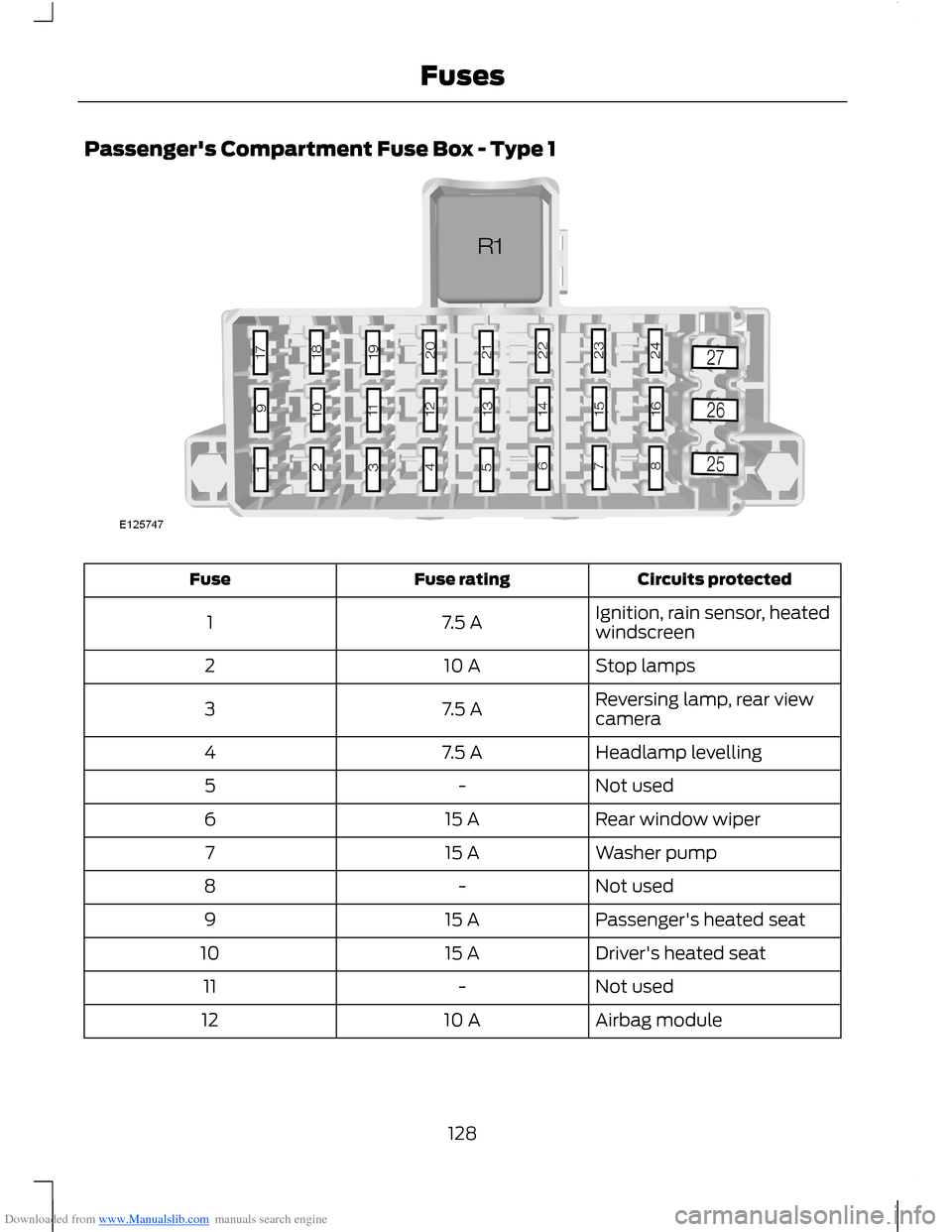
Downloaded from www.Manualslib.com manuals search engine Passenger's Compartment Fuse Box - Type 1
Circuits protectedFuse ratingFuse
Ignition, rain sensor, heatedwindscreen7.5 A1
Stop lamps10 A2
Reversing lamp, rear viewcamera7.5 A3
Headlamp levelling7.5 A4
Not used-5
Rear window wiper15 A6
Washer pump15 A7
Not used-8
Passenger's heated seat15 A9
Driver's heated seat15 A10
Not used-11
Airbag module10 A12
128Fuses
Page 133 of 256
Downloaded from www.Manualslib.com manuals search engine Circuits protectedFuse ratingFuse
Rear window wiper15 A6
Washer pump15 A7
Not used-8
Passenger's heated seat15 A9
Driver's heated seat15 A10
Not used-11
Airbag module10 A12
Ignition, electric powerassisted steering, instrumentcluster, passive anti-theftsystem, anti-lock brakingsystem
10 A13
Powertrain control module,gear selector lever, fuelpump7.5 A14
Audio system, instrumentcluster7.5 A15
Heated windscreen right-hand side7.5 A16
Not used-17
Not used-18
Data link connector10 A19
Trailer module20 A20
Audio system, navigation15 A21
Instrument cluster7.5 A22
Multi functional display,clock, internal scanner,heating vents, air condi-tioning panel
7.5 A23
Sync module10 A24
Not used-25
131Fuses
Page 155 of 256

Downloaded from www.Manualslib.com manuals search engine CLEANING THE EXTERIOR
WARNINGS
If you use a car wash with a waxingcycle, make sure that you remove thewax from the windscreen.
Prior to using a car wash facilitycheck the suitability of it for yourvehicle.
Some car wash installations usewater at high pressure. This coulddamage certain parts of your vehicle.
Remove the aerial before using anautomatic car wash.
Switch the heater blower off toprevent contamination of the freshair filter.
We recommend that you wash your vehiclewith a sponge and lukewarm watercontaining a car shampoo.
Cleaning the Headlamps
WARNINGS
Do not scrape the headlamp lensesor use abrasives, alcoholic solventsor chemical solvents to clean them.
Do not wipe the headlamps whenthey are dry.
Cleaning the Rear Window
WARNING
Do not scrape the inside of the rearwindow or use abrasives or chemicalsolvents to clean it.
Use a clean, lint free cloth or a dampchamois leather to clean the inside of therear window.
Cleaning the Chrome Trim
WARNINGS
Do not use abrasives or chemicalsolvents. Use soapy water.
Do not apply cleaning product to hotsurfaces and do not leave cleaningproduct on chrome surfaces for aperiod of time exceeding that which isrecommended.
Industrial-strength (heavy-duty)cleaners, or cleaning chemicals, maycause damage over a period of time.
Body Paintwork Preservation
WARNINGS
Do not polish your vehicle in strongsunshine.
Do not allow polish to touch plasticsurfaces. It could be difficult toremove.
Do not apply polish to thewindscreen or rear window. Thiscould cause the wipers to becomenoisy and they may not clear the windowproperly.
We recommend that you wax thepaintwork once or twice a year.
CLEANING THE INTERIOR
Seat Belts
WARNINGS
Do not use abrasives, or chemicalsolvents to clean them.
Do not allow moisture to penetratethe seat belt retractor mechanism.
153Vehicle Care
Page 156 of 256

Downloaded from www.Manualslib.com manuals search engine Clean the seat belts with interior cleaneror water applied with a soft sponge. Letthe seat belts dry naturally, away fromartificial heat.
Instrument Cluster Screens, LCDScreens and Radio Screens
WARNING
Do not use abrasives, alcoholicsolvents or chemical solvents toclean them.
Rear Windows
WARNING
Do not use any abrasive materials toclean the interior of the rearwindows.
Note:Do not install stickers or labels to theinterior of the rear windows.
REPAIRING MINOR PAINT
DAMAGE
You should repair paintwork damagecaused by stones from the road or minorscratches as soon as possible. A choice ofproducts are available from an authoriseddealer.
Remove particles such as bird droppings,tree sap, insect deposits, tar spots, roadsalt and industrial fallout before repairingpaint chips.
Always read and follow the manufacturer’sinstructions before using the products.
CLEANING THE ALLOY
WHEELS
Note:Do not apply a cleaning chemical towarm or hot wheel rims and covers.
Note:Industrial-strength (heavy-duty)cleaners, or cleaning chemicals, incombination with brush agitation to removebrake dust and dirt, could wear away theclear coat finish over a period time.
Note:Do not use hydrofluoric acid-basedor high caustic-based wheel cleaners, steelwool, fuels or strong household detergent.
Note:If you intend parking your vehicle foran extended period after cleaning thewheels with a wheel cleaner, drive yourvehicle for a few minutes before doing so.This will reduce the risk of increasedcorrosion of the brake discs, brake pads andlinings.
Note:Some automatic car washes maycause damage to the finish on your wheelrims and covers.
Alloy wheels and wheel covers are coatedwith a clear coat paint finish. To maintaintheir condition we recommend that you:
•Clean them weekly with therecommended wheel and tyre cleaner.
•Use a sponge to remove heavydeposits of dirt and brake dustaccumulation.
•Rinse them thoroughly with apressurised stream of water when youhave completed the cleaning process.
We recommend that you use Ford servicewheel cleaner. Make sure that you readand follow the manufacturer’s instructions.
Using other non-recommended cleaningproducts can result in severe andpermanent cosmetic damage.
154Vehicle Care