Page 418 of 643
STARTING AND OPERATING
CONTENTS
�Starting Procedures .................... 419
▫ Automatic Transmission ............... 419
▫ Normal Starting ..................... 419
▫ Extreme Cold Weather
(Below –20°F Or –29°C) ................ 420
▫ If The Engine Fails To Start ............. 420
▫ After Starting ....................... 422
� Engine Block Heater — If Equipped ........ 422�
Automatic Transmission ................. 422
▫ Key Ignition Park Interlock ............. 424
▫ Brake/Transmission Shift Interlock System . . 424
▫ Fuel Economy (Econ) Mode ............. 425
▫ Six-Speed Automatic Transmission ........ 426
▫ Gear Ranges ........................ 427
� Driving On Slippery Surfaces ............. 434
▫ Acceleration ........................ 434
▫ Traction ........................... 435
5
Page 514 of 643
WHAT TO DO IN EMERGENCIES
CONTENTS
�Hazard Warning Flashers ................ 513
� If Your Engine Overheats ................ 513
� Jacking And Tire Changing ............... 514
▫ Jack Location ....................... 515
▫ Spare Tire Removal ................... 516
▫ To Access Spare Tire Winch Drive Nut ..... 516
▫ Spare Tire Tools ..................... 518
▫ Spare Tire Removal Instructions .......... 520▫
Preparations For Jacking ............... 522
▫ Jacking Instructions ................... 523
▫ Securing The Spare Tire ................ 528
▫ Road Tire Installation ................. 530
� Jump-Starting Procedure ................ 532
▫ Preparations For Jump-Start ............. 533
▫ Jump-Starting Procedure ............... 534
6
Page 546 of 643
MAINTAINING YOUR VEHICLE
CONTENTS
�Engine Compartment — 3.6L ............. 545
� Onboard Diagnostic System — OBD II ...... 546
▫ Loose Fuel Filler Cap Message ........... 546
� Emissions Inspection And Maintenance
Programs ............................ 547
� Replacement Parts ..................... 549
� Dealer Service ........................ 549
� Maintenance Procedures ................. 549
▫ Engine Oil ......................... 550 ▫
Engine Oil Filter ..................... 552
▫ Engine Air Cleaner Filter ............... 553
▫ Exhaust System ..................... 554
▫ Maintenance-Free Battery .............. 556
▫ Air Conditioner Maintenance ............ 557
▫ Body Lubrication .................... 560
▫ Windshield Wiper Blades ............... 560
▫ Cooling System ..................... 562
▫ Brakes ............................ 567
7
Page 562 of 643
WARNING!
Do not remove the A/C air filter while the blower is
operating or personal injury may result.
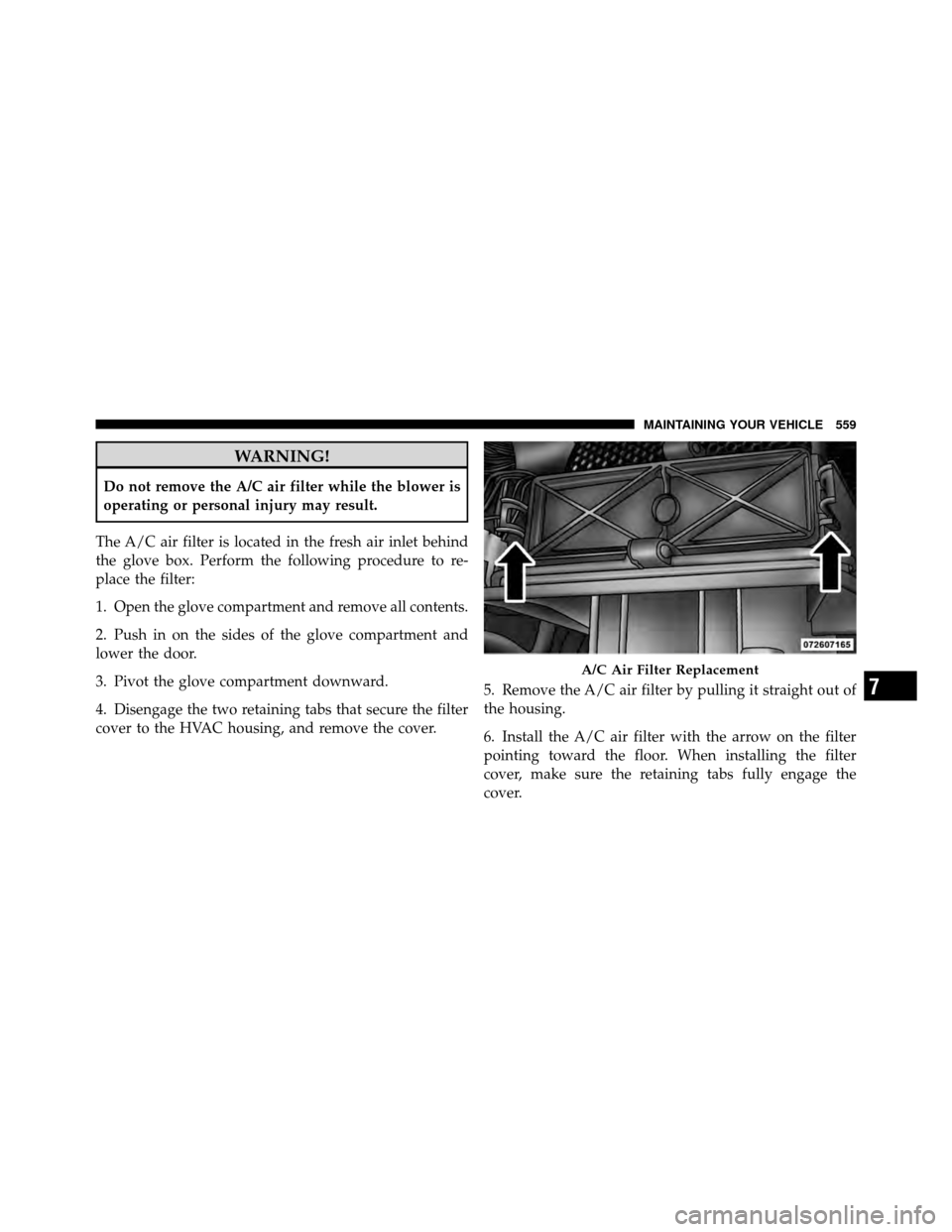
The A/C air filter is located in the fresh air inlet behind
the glove box. Perform the following procedure to re-
place the filter:
1. Open the glove compartment and remove all contents.
2. Push in on the sides of the glove compartment and
lower the door.
3. Pivot the glove compartment downward.
4. Disengage the two retaining tabs that secure the filter
cover to the HVAC housing, and remove the cover. 5. Remove the A/C air filter by pulling it straight out of
the housing.
6. Install the A/C air filter with the arrow on the filter
pointing toward the floor. When installing the filter
cover, make sure the retaining tabs fully engage the
cover.
A/C Air Filter Replacement
7
MAINTAINING YOUR VEHICLE 559
Page 569 of 643

engine cold, the level of the engine coolant (antifreeze) in
the coolant recovery bottle should be between the ranges
indicated on the bottle.
The radiator normally remains completely full, so there is
no need to remove the radiator cap unless checking for
engine coolant (antifreeze) freeze point or replacing the
engine coolant (antifreeze). Advise your service atten-
dant of this. As long as the engine operating temperature
is satisfactory, the coolant bottle only needs to be checked
once a month.
When additional engine coolant (antifreeze) is needed to
maintain the proper level, it should be added to the
coolant bottle. Do not overfill.
Points To Remember
NOTE:When the vehicle is stopped after a few miles (a
few kilometers) of operation, you may observe vapor
coming from the front of the engine compartment. This is normally a result of moisture from rain, snow, or high
humidity accumulating on the radiator and being vapor-
ized when the thermostat opens, allowing hot engine
coolant (antifreeze) to enter the radiator.
If an examination of your engine compartment shows no
evidence of radiator or hose leaks, the vehicle may be
safely driven. The vapor will soon dissipate.
•Do not overfill the coolant recovery bottle.
•Check the engine coolant (antifreeze) freeze point in
the radiator and in the coolant recovery bottle. If
engine coolant (antifreeze) needs to be added, contents
of the coolant recovery bottle must also be protected
against freezing.
•If frequent engine coolant (antifreeze) additions are
required, or if the level in the coolant recovery bottle
does not drop when the engine cools, the cooling
system should be pressure tested for leaks.
566 MAINTAINING YOUR VEHICLE
Page 596 of 643
MAINTENANCE SCHEDULES
CONTENTS
�Maintenance Schedule .................. 594
▫ Required Maintenance Intervals .......... 596
8
M
A I
N T
E
N A
N CE
S
C
H E
D
U L
E
S
Page 612 of 643
IF YOU NEED CONSUMER ASSISTANCE
CONTENTS
�Suggestions For Obtaining Service For Your
Vehicle .............................. 611
▫ Prepare For The Appointment ........... 611
▫ Prepare A List ...................... 611
▫ Be Reasonable With Requests ............ 611
� If You Need Assistance ................. 611
▫ Chrysler Group LLC Customer Center ..... 612
▫ Chrysler Canada Inc. Customer Center ..... 612
▫ In Mexico Contact .................... 612 ▫
Customer Assistance For The Hearing Or
Speech Impaired (TDD/TTY) ............ 613
▫ Service Contract ..................... 613
� Warranty Information .................. 614
� MOPAR� Parts....................... 614
� Reporting Safety Defects ................ 614
▫ In The 50 United States And Washington,
D.C. .............................. 614
▫ In Canada ......................... 615
� Publication Order Forms ................ 615
9