2012 DODGE CHALLENGER manual transmission
[x] Cancel search: manual transmissionPage 85 of 124

WARNING!
• Do not attempt to change a tire on the side of the vehicle close to movingtraffic. Pull far enough off the road to avoid the danger of being hit when
operating the jack or changing the wheel.
• Being under a jacked-up vehicle is dangerous. The vehicle could slip off the jack and fall on you. You could be crushed. Never put any part of your body
under a vehicle that is on a jack.
• Never start or run the engine while the vehicle is on a jack. If you need to get under a raised vehicle, take it to a service center where it can be raised on a
lift.
• The jack is designed to be used as a tool for changing tires only. The jack should not be used to lift the vehicle for service purposes. The vehicle should
be jacked on a firm level surface only. Avoid ice or slippery areas.
• A loose tire or jack thrown forward in a collision or hard stop could endanger the occupants of the vehicle. Always stow the jack parts and the spare tire in
the places provided.
• Carefully follow these tire changing warnings to help prevent personal injury or damage to your vehicle:
• Always park on a firm, level surface as far from the edge of the roadway as possible before raising the vehicle.
• Turn on the Hazard Warning flasher.
• Block the wheel diagonally opposite the wheel to be raised.
• Set the parking brake firmly and set an automatic transmission in PARK; a manual transmission in REVERSE.
• Do not let anyone sit in the vehicle when it is on a jack.
• Do not get under the vehicle when it is on a jack.
• Only use the jack in the positions indicated and for lifting this vehicle during a tire change.
• If working on or near a roadway, be extremely careful of motor traffic.
• Raising the vehicle higher than necessary can make the vehicle less stable. It could slip off the jack and hurt someone near it. Raise the vehicle only
enough to remove the tire.
• To avoid the risk of forcing the vehicle off the jack, do not fully tighten the wheel nuts until the vehicle has been lowered. Failure to follow this warning
may result in personal injury.
• The limited-use spare tires are for emergency use only. Installation of this limited-use spare tire affects vehicle handling. With this tire, do not drive
more than 60 mph (100 km/h). Keep inflated to the cold tire inflation
pressure listed on either your tire placard or limited-use spare tire and wheel
assembly. Replace (or repair) the original tire at the first opportunity and
reinstall it on your vehicle. Failure to do so could result in loss of vehicle
control.
WHAT TO DO IN EMERGENCIES
83
Page 87 of 124

Using The Deflation Button
• Press the Deflation Button (2) to reduce the air pressure in the tire if it becomes over-inflated.
TIREFIT Usage Precautions
• Replace the TIREFIT Sealant Bottle (1) and Sealant Hose (6) prior to theexpiration date (printed on the bottle label) to assure optimum operation of the
system. Refer to “Sealing a Tire with TIREFIT” section (F) “Sealant Bottle and
Hose Replacement”.
• The Sealant Bottle (1) and Sealant Hose (6) are a one tire application use. After each use, always replace these components immediately at an authorized dealer.
• When the TIREFIT sealant is in a liquid form, clean water, and a damp cloth will remove the material from the vehicle or tire and wheel components. Once the
sealant dries, it can easily be peeled off and properly discarded.
• For optimum performance, make sure the valve stem on the wheel is free of debris before connecting the TIREFIT kit.
• You can use the TIREFIT air pump to inflate bicycle tires. The kit also comes with two needles, located in the Accessory Storage Compartment (on the bottom of the
air pump) for inflating sport balls, rafts, or similar inflatable items. However, use
only the Air Pump Hose (7) and make sure the Mode Select Knob (5) is in the Air
Mode when inflating such items to avoid injecting sealant into them. The TIREFIT
Sealant is only intended to seal punctures less than
1∕4in (6 mm) diameter in the
tread of your vehicle.
• Do not lift or carry the TIREFIT kit by the hoses.
Sealing A Tire With TIREFIT
(A) Whenever You Stop To Use TIREFIT:
• Pull over to a safe location and turn on the vehicle’s Hazard Warning flashers.
• Verify that the valve stem (on the wheel with the deflated tire) is in a position thatis near to the ground. This will allow the TIREFIT Hoses (6) and (7) to reach the
valve stem and keep the TIREFIT kit flat on the ground. This will provide the best
positioning of the kit when injecting the sealant into the deflated tire and running
the air pump. Move the vehicle as necessary to place the valve stem in this
position before proceeding.
• Place the transmission in PARK (auto transmission) or in Gear (manual transmission) and turn Off the ignition.
• Set the parking brake.
(B) Setting Up To Use TIREFIT:
• Turn the Mode Select Knob (5) to the Sealant Mode position.
• Uncoil the Sealant Hose (6) and then remove the cap from the fitting at the end ofthe hose.
• Place the TIREFIT kit flat on the ground next to the deflated tire.
WHAT TO DO IN EMERGENCIES
85
Page 88 of 124

• Remove the cap from the valve stem and then screw the fitting at the end of theSealant Hose (6) onto the valve stem.
•
Uncoil the Power Plug (8) and insert the plug into the vehicle’s 12 Volt power outlet.
NOTE: Do not remove foreign objects (e.g., screws or nails) from the tire.
(C) Injecting TIREFIT Sealant Into The Deflated Tire: • Always start the engine before turning ON the TIREFIT kit.
NOTE: Manual transmission vehicles must have the parking brake engaged and the
shift lever in NEUTRAL.
• After pressing the Power Button (4), the sealant (white fluid) will flow from theSealant Bottle (1) through the Sealant Hose (6) and into the tire.
NOTE: Sealant may leak out through the puncture in the tire.
If the sealant (white fluid) does not flow within0–10seconds through the Sealant Hose
(6):
• Press the Power Button (4) to turn Off the TIREFIT kit. Disconnect the SealantHose (6) from the valve stem. Make sure the valve stem is free of debris.
Reconnect the Sealant Hose (6) to the valve stem. Check that the Mode Select
Knob (5) is in the Sealant Mode position and not Air Mode. Press the Power
Button (4) to turn On the TIREFIT kit.
• Connect the Power Plug (8) to a different 12 Volt power outlet in your vehicle or another vehicle, if available. Make sure the engine is running before turning ON
the TIREFIT kit.
• The Sealant Bottle (1) may be empty due to previous use. Call for assistance.
NOTE: If the Mode Select Knob (5) is on Air Mode and the pump is operating, air will
dispense from the Air Pump Hose (7) only, not the Sealant Hose (6).
•If the sealant (white fluid) does flow through the Sealant Hose (6):
• Continue to operate the pump until sealant is no longer flowing through hose (typically takes 30 - 70 seconds). As the sealant flows through the Sealant Hose
(6), the Pressure Gauge (3) can read as high as 70 psi (5 Bar). The Pressure
Gauge (3) will decrease quickly from approximately 70 psi (5 Bar) to the actual
tire pressure when the Sealant Bottle (1) is empty.
• The pump will start to inject air into the tire immediately after the Sealant Bottle (1) is empty. Continue to operate the pump and inflate the tire to the pressure
indicated on the tire pressure label on the driver-side latch pillar (recommended
pressure). Check the tire pressure by looking at the Pressure Gauge (3).
• If the tire does not inflate to at least 26 psi (1.8 Bar) pressure within 15 minutes:
• The tire is too badly damaged. Do not attempt to drive the vehicle further. Call for assistance.
NOTE: If the tire becomes over-inflated, press the Deflation Button to reduce the tire
pressure to the recommended inflation pressure before continuing.
WHAT TO DO IN EMERGENCIES
86
Page 94 of 124

TOWING A DISABLED VEHICLEModelFlat Towing (all four
wheels on the ground)Flatbed Towing (all four
wheels suspended OFF the
ground)Front Wheels Raised, Rear
Wheels on the Ground
Rear Wheels Raised, Front
Wheels on the Ground
RWD Without a Key NOT Permitted Recommended Method NOT Permitted
NOT Permitted
RWD With a Key –
Automatic Transmission Shift lever must be in
NEUTRAL. The distance
to be traveled must not
exceed 15 mi (24 km),
and the towing speed
must not exceed 30 mph
(48 km/h).Recommended Method NOT Permitted
NOT Permitted
RWD With a Key – Manual
Transmission Shift lever must be in
NEUTRAL. There is no
limitation on the distance
to be traveled. The
towing speed must not
exceed 65 mph
(104 km/h)Recommended Method NOT Permitted
NOT Permitted
WHAT TO DO IN EMERGENCIES
92
Page 101 of 124

FLUIDS AND CAPACITIES
Non SRT8
ComponentFluid, Lubricant, or Genuine
PartCapacities
Engine Coolant 3.6L MOPAR
®Antifreeze/
Coolant Five
Year/100,000 Mile
Formula HOAT (Hybrid
Organic Additive
Technology) or equivalent. 11.1 Quarts (10.5 Liters)
Includes heater and
coolant recovery bottle
filled to MAX level.
Engine Coolant 5.7L MOPAR
®Antifreeze/
Coolant Five
Year/100,000 Mile
Formula HOAT (Hybrid
Organic Additive
Technology) or equivalent. 14.7 Quarts (13.9 Liters)
Includes heater and
coolant recovery bottle
filled to MAX level.
Engine Oil with Filter 3.6L API Certified SAE 5W-30 engine oil, API Certified.
Refer to your engine oil
filler cap for correct SAE
grade.6 Quarts (5.6 Liters)
Engine Oil with Filter 5.7L API Certified SAE 5W-20 engine oil, API Certified.
Refer to the engine oil
filler cap for correct SAE
grade.7 Quarts (6.6 Liters)
Engine Oil Filter 3.6L.
5.7L. MOPAR
®Engine Oil Filter
or equivalent. —
Spark Plug 3.6L RER8ZWYCB4 (Gap
0.043 in [1.1 mm]) —
Spark Plug 5.7L LZFR5C–11 (Gap 0.043 in
[1.1 mm]) —
Automatic Transmission MOPAR
®ATF+4®
Automatic Transmission
Fluid or equivalent
licensed ATF+4
®product. —
Manual Transmission MOPAR®ATF+4®
Automatic Transmission
Fluid or equivalent
licensed ATF+4
®product. —
Axle Rear 5.7L. API GL-5 SAE 75W90
Synthetic Gear Lubricant
or equivalent (with
MOPAR
®Friction
Modifier-Hypoid Gear
Additive). —
MAINTAINING YOUR VEHICLE
99
Page 104 of 124

MAINTENANCE CHART
Miles:
8,000 16,000 24,000 32,000 40,000 48,000 56,000 64,000 72,000 80,000 88,000 96,000 104,000
Or Months: 6 12 18 24 30 36 42 48 54 60 66 72 78
Or Kilometers:
13,000 26,000 39,000 52,000 65,000 78,000 91,000 104,000 117,000 130,000 143,000 156,000 169,000
Change the engine oil and engine oil filter. XXXXXXXXXXXXX
Rotate the tires, rotate at the first sign of irregular
wear, even if it occurs before scheduled mainte-
nance. XXXXXXXXXXXXX
If using your vehicle for any of the following: dusty or
off-road conditions. Inspect the engine air cleaner
filter; replace if necessary. XXX
Inspect the brake linings; replace if necessary. X X XXXX
Inspect the CV joints. XXXX
Inspect the exhaust system. X XXXX
Adjust the parking brake on vehicles equipped with
four wheel disc brakes. XXX
Change the automatic transmission fluid and filter if
using your vehicle for any of the following: police,
taxi, fleet or frequent trailer towing. X
Inspect the manual transmission fluid. X X X X
Change the manual transmission fluid if using your
vehicle for any of the following: police, taxi, fleet, or
frequent trailer towing. X
Change the manual transmission fluid if using your
vehicle for any of the following: Most of your driving
is at sustained high speeds during hot weather, above
90°F (32°C), driving in dusty conditions, or stop and
go driving. X
Inspect the rear axle fluid, change if necessary. X X XXXX
MAINTAINING YOUR VEHICLE
102
Page 107 of 124
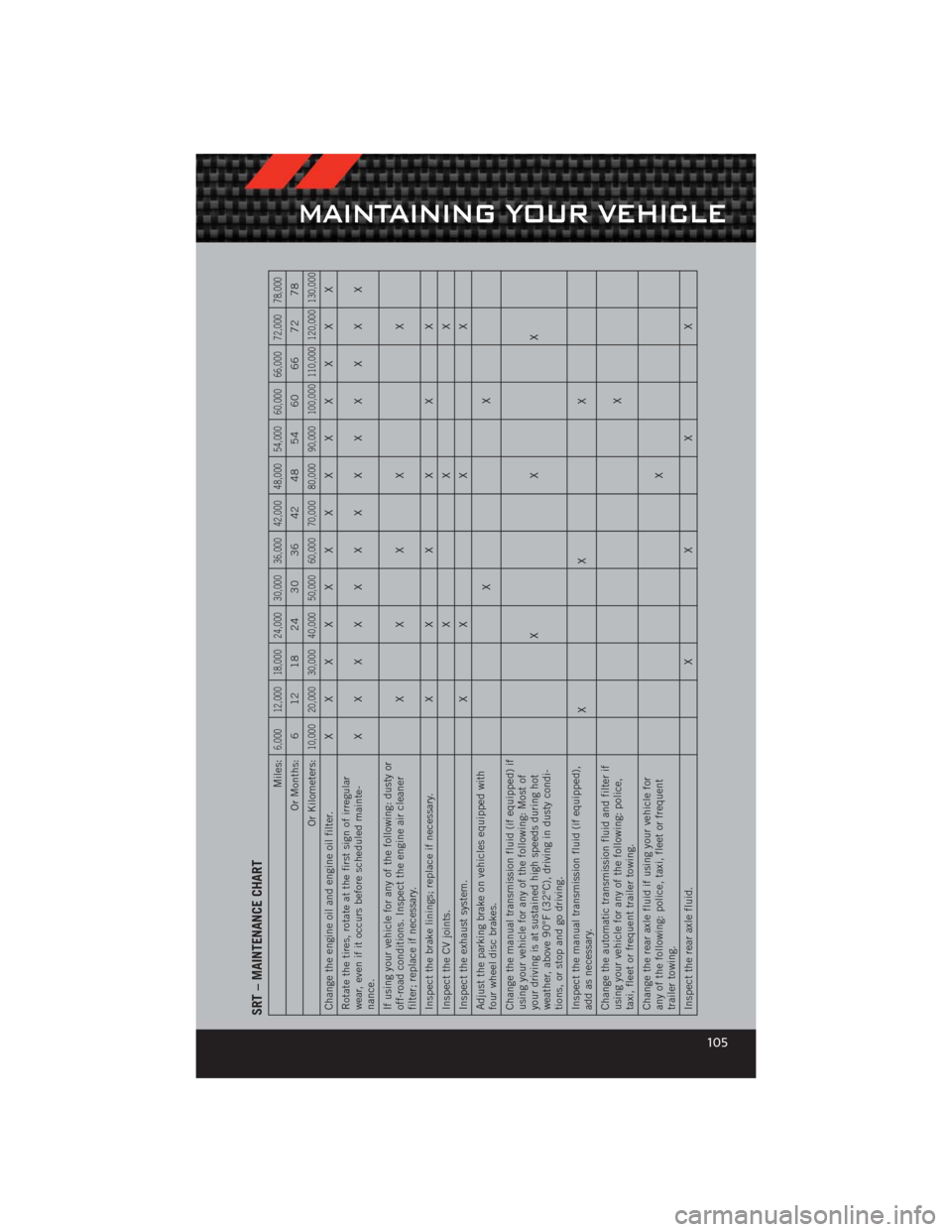
SRT – MAINTENANCE CHART
Miles:
6,000 12,000 18,000 24,000 30,000 36,000 42,000 48,000 54,000 60,000 66,000 72,000 78,000
Or Months: 6 12 18 24 30 36 42 48 54 60 66 72 78
Or Kilometers:
10,000 20,000 30,000 40,000 50,000 60,000 70,000 80,000 90,000 100,000 110,000 120,000 130,000
Change the engine oil and engine oil filter. XXXXXXXXXXXXX
Rotate the tires, rotate at the first sign of irregular
wear, even if it occurs before scheduled mainte-
nance. XXXXXXXXXXXXX
If using your vehicle for any of the following: dusty or
off-road conditions. Inspect the engine air cleaner
filter; replace if necessary. XXXX X
Inspect the brake linings; replace if necessary. X X XXXX
Inspect the CV joints. X X X
Inspect the exhaust system. X X X X
Adjust the parking brake on vehicles equipped with
four wheel disc brakes. XX
Change the manual transmission fluid (if equipped) if
using your vehicle for any of the following: Most of
your driving is at sustained high speeds during hot
weather, above 90°F (32°C), driving in dusty condi-
tions, or stop and go driving. XXX
Inspect the manual transmission fluid (if equipped),
add as necessary. XX X
Change the automatic transmission fluid and filter if
using your vehicle for any of the following: police,
taxi, fleet or frequent trailer towing. X
Change the rear axle fluid if using your vehicle for
any of the following: police, taxi, fleet or frequent
trailer towing. X
Inspect the rear axle fluid. XXXX
MAINTAINING YOUR VEHICLE
105