Page 15 of 576
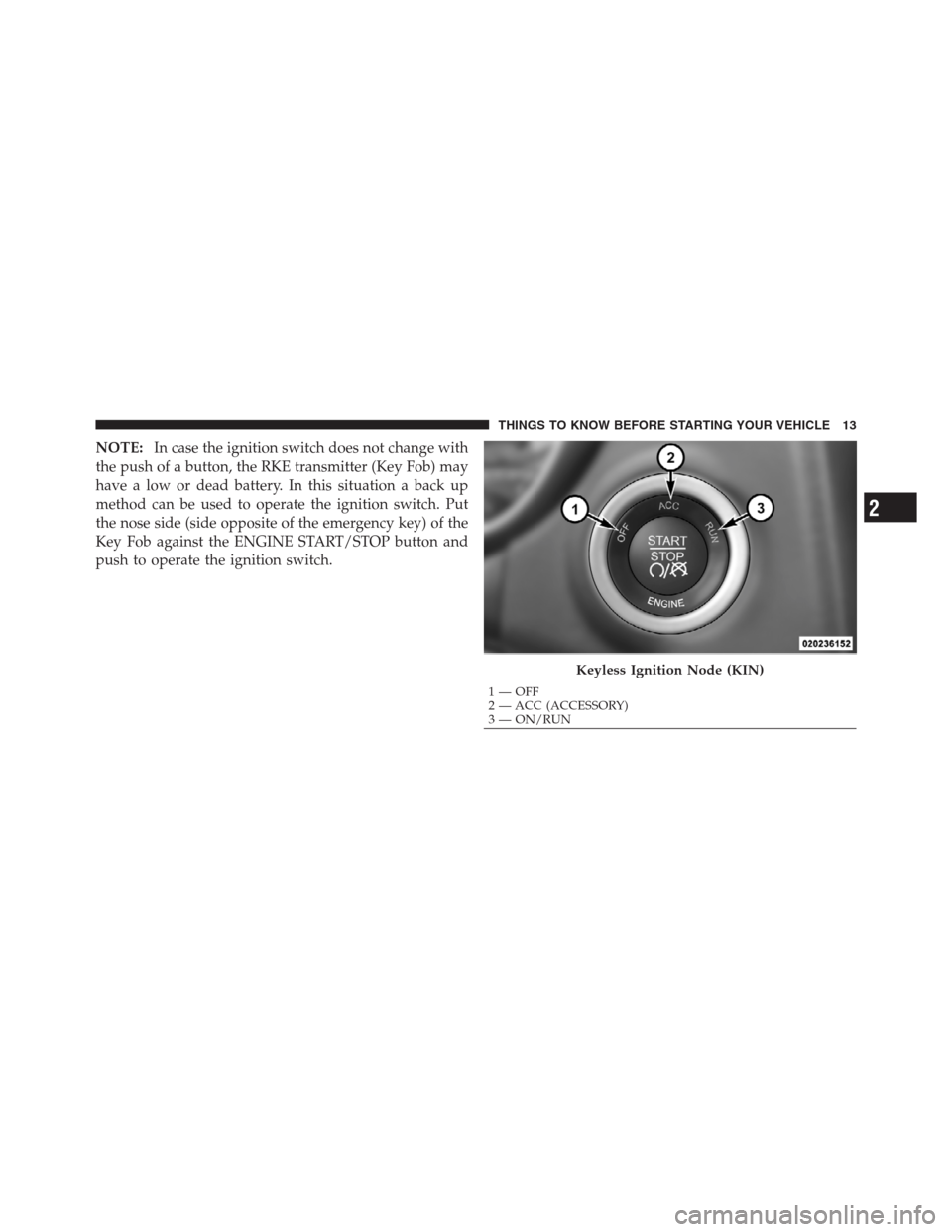
NOTE:In case the ignition switch does not change with
the push of a button, the RKE transmitter (Key Fob) may
have a low or dead battery. In this situation a back up
method can be used to operate the ignition switch. Put
the nose side (side opposite of the emergency key) of the
Key Fob against the ENGINE START/STOP button and
push to operate the ignition switch.
Keyless Ignition Node (KIN)
1 — OFF
2 — ACC (ACCESSORY)
3 — ON/RUN
2
THINGS TO KNOW BEFORE STARTING YOUR VEHICLE 13
Page 28 of 576

4. To assemble the RKE transmitter case, snap the two
halves together.
General Information
This device complies with Part 15 of the FCC rules and
RSS 210 of Industry Canada. Operation is subject to the
following conditions:
•This device may not cause harmful interference.
•This device must accept any interference received,
including interference that may cause undesired
operation.
NOTE:Changes or modifications not expressly ap-
proved by the party responsible for compliance could
void the user’s authority to operate the equipment.
If your RKE transmitter fails to operate from a normal
distance, check for these two conditions:1. A weak battery in the RKE transmitter. The expected
life of the battery is a minimum of three years.
2. Closeness to a radio transmitter such as a radio station
tower, airport transmitter, and some mobile or CB radios.
REMOTE STARTING SYSTEM — IF EQUIPPED
This system uses the Key Fob with Remote
Keyless Entry (RKE) transmitter to start the
engine conveniently from outside the vehicle
while still maintaining security. The system has
a range of approximately 300 ft (91 m).
NOTE:
•The vehicle must be equipped with an automatic
transmission to be equipped with Remote Start.
•Obstructions between the vehicle and the Key Fob
may reduce this range.
26 THINGS TO KNOW BEFORE STARTING YOUR VEHICLE
Page 69 of 576
•Turn on the interior lights, which remain on as long as
the battery has power, until the ignition key is re-
moved or the ignition switch is changed to OFF using
the Keyless Go Start/Stop button.
•Unlock the doors automatically.
In order to reset the Enhanced Accident Response System
functions after an event, the ignition switch must be
changed from IGN ON to IGN OFF.
If A Deployment Occurs
The Advanced Front Air Bags are designed to deflate
immediately after deployment.
NOTE:Front and/or side air bags will not deploy in all
collisions. This does not mean something is wrong with
the air bag system.
If you do have a collision which deploys the air bags, any
or all of the following may occur:
•The nylon air bag material may sometimes cause abra-
sions and/or skin reddening to the driver and front
passenger as the air bags deploy and unfold. The
abrasions are similar to friction rope burns or those you
might get sliding along a carpet or gymnasium floor.
They are not caused by contact with chemicals. They are
not permanent and normally heal quickly. However, if
you haven’t healed significantly within a few days, or if
you have any blistering, see your doctor immediately.
•As the air bags deflate, you may see some smoke-like
particles. The particles are a normal by-product of the
process that generates the non-toxic gas used for air bag
inflation. These airborne particles may irritate the skin,
eyes, nose, or throat. If you have skin or eye irritation,
rinse the area with cool water. For nose or throat irrita-
tion, move to fresh air. If the irritation continues, see your
doctor. If these particles settle on your clothing, follow
the garment manufacturer’s instructions for cleaning.
2
THINGS TO KNOW BEFORE STARTING YOUR VEHICLE 67
Page 555 of 576
Automatic Door Locks..................... 32
Automatic Headlights.................... 176
Automatic Oil Change Indicator............. 293
Automatic Temperature Control (ATC)......... 340
Automatic Transaxle
Special Additives..................... 500
Automatic Transmission...........355,358,499,501
Adding Fluid....................501,523
Autostick.......................... 365
Fluid and Filter Changes............... 501
Fluid Change....................... 501
Fluid Level Check.................... 500
Fluid Type......................... 523
Special Additives..................... 500
Automatic Transmission Limp Home Mode..... 357
Autostick............................. 365
Axle Fluid............................. 523
Axle Lubrication (Axle Fluid)............... 523B-Pillar Location........................ 393
Battery............................... 483
Keyless Transmitter Replacement (RKE)..... 25
Location........................... 483
Belts, Seat............................47,84
Body Mechanism Lubrication............... 488
Brake Assist System...................... 380
Brake Control System, Electronic............. 379
Brake Fluid............................ 523
Brake System........................... 497
Anti-Lock (ABS)..................... 377
Fluid Check.....................498,523
Master Cylinder..................... 498
Parking........................... 375
Warning Light....................... 281
Brake, Parking.......................... 375
Brake/Transmission Interlock............... 354
Brakes............................... 497
Break-In Recommendations, New Vehicle........ 81
10
INDEX 553