Page 441 of 576
NOTE:Remember that everything put into or on the
trailer adds to the load on your vehicle. Also, additional
factory-installed options or dealer-installed options must
be considered as part of the total load on your vehicle.
Refer to the “Tire and Loading Information” placard for
the maximum combined weight of occupants and cargo
for your vehicle.
Towing Requirements
To promote proper break-in of your new vehicle drive-
train components the following guidelines are recom-
mended:
CAUTION!
•Do not tow a trailer at all during the first 500 miles
(805 km) the new vehicle is driven. The engine,
axle or other parts could be damaged.
(Continued)
CAUTION! (Continued)
•Then, during the first 500 miles (805 km) that a
trailer is towed, do not drive over 50 mph
(80 km/h) and do not make starts at full throttle.
This helps the engine and other parts of the
vehicle wear in at the heavier loads.
WARNING!
Improper towing can lead to an injury collision.
Follow these guidelines to make your trailer towing
as safe as possible:
•Make certain that the load is secured in the trailer
and it will not shift during travel. When trailering
cargo that is not fully secured, dynamic load shifts
can occur that may be difficult for the driver to
control. You could lose control of your vehicle and
have a collision.
(Continued)
5
STARTING AND OPERATING 439
Page 453 of 576
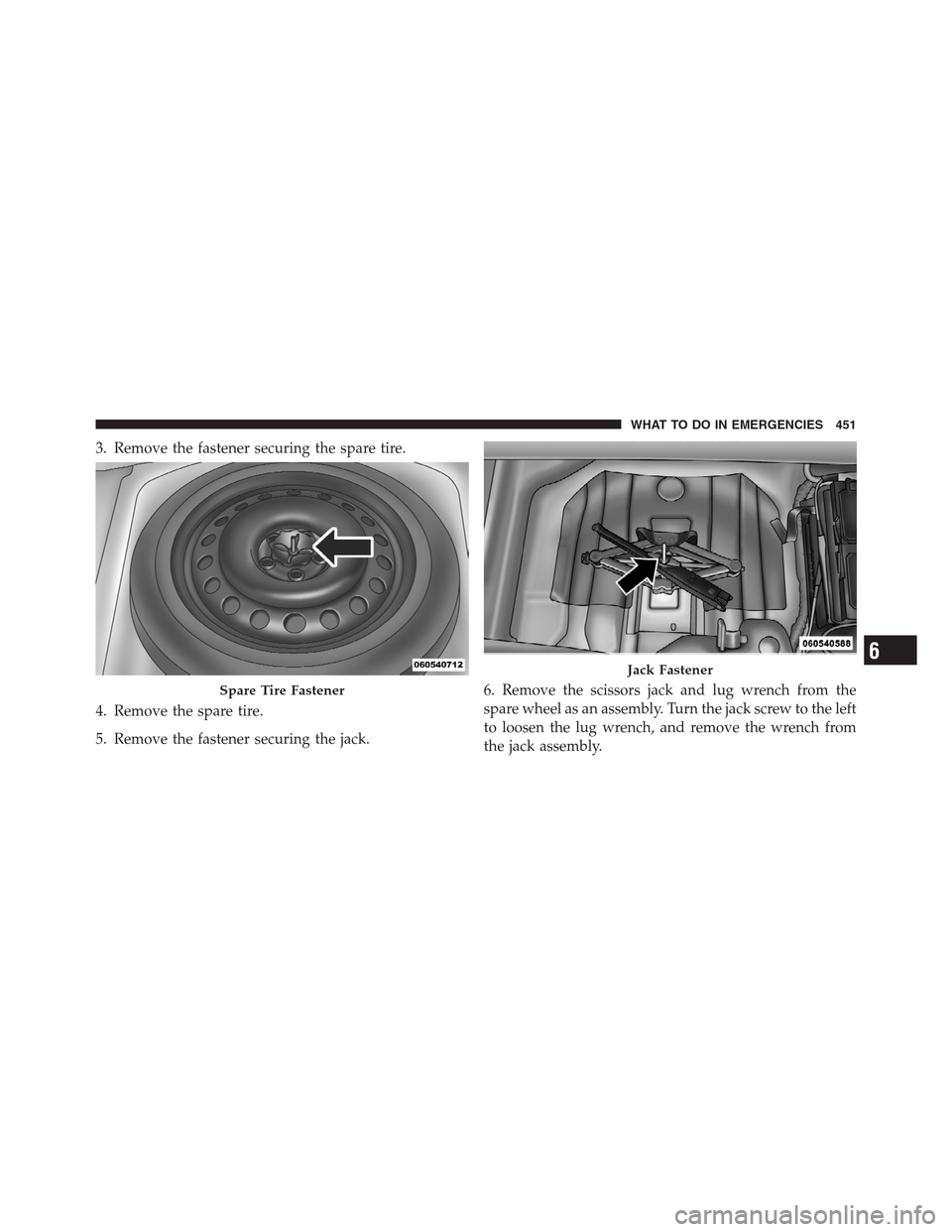
3. Remove the fastener securing the spare tire.
4. Remove the spare tire.
5. Remove the fastener securing the jack.6. Remove the scissors jack and lug wrench from the
spare wheel as an assembly. Turn the jack screw to the left
to loosen the lug wrench, and remove the wrench from
the jack assembly.
Spare Tire Fastener
Jack Fastener6
WHAT TO DO IN EMERGENCIES 451
Page 467 of 576
MANUAL PARK RELEASE — 8 SPEED
TRANSMISSION (3.6L Engine)
WARNING!
Always secure your vehicle by fully applying the
parking brake, before activating the Manual Park
Release. Activating the Manual Park Release will
allow your vehicle to roll away if it is not secured by
the parking brake or by proper connection to a tow
vehicle. Activating the Manual Park Release on an
unsecured vehicle could lead to serious injury or
death for those in or around the vehicle.
In order to push or tow the vehicle in cases where the
transmission will not shift out of PARK (such as a dead
battery), a Manual Park Release is available.
Follow these steps to use the Manual Park Release:NOTE:To prevent the vehicle from rolling unintention-
ally, firmly apply the parking brake.
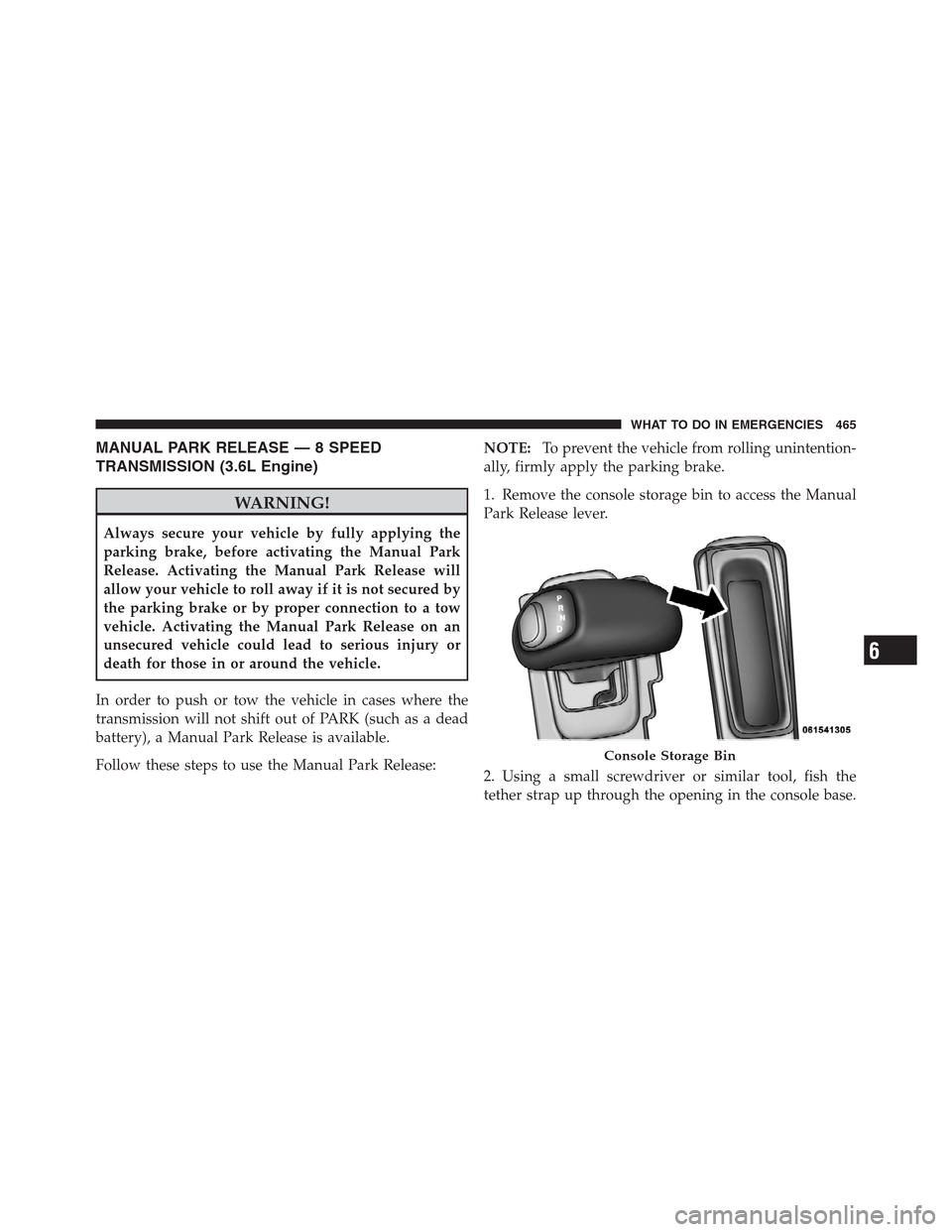
1. Remove the console storage bin to access the Manual
Park Release lever.
2. Using a small screwdriver or similar tool, fish the
tether strap up through the opening in the console base.
Console Storage Bin
6
WHAT TO DO IN EMERGENCIES 465
Page 468 of 576
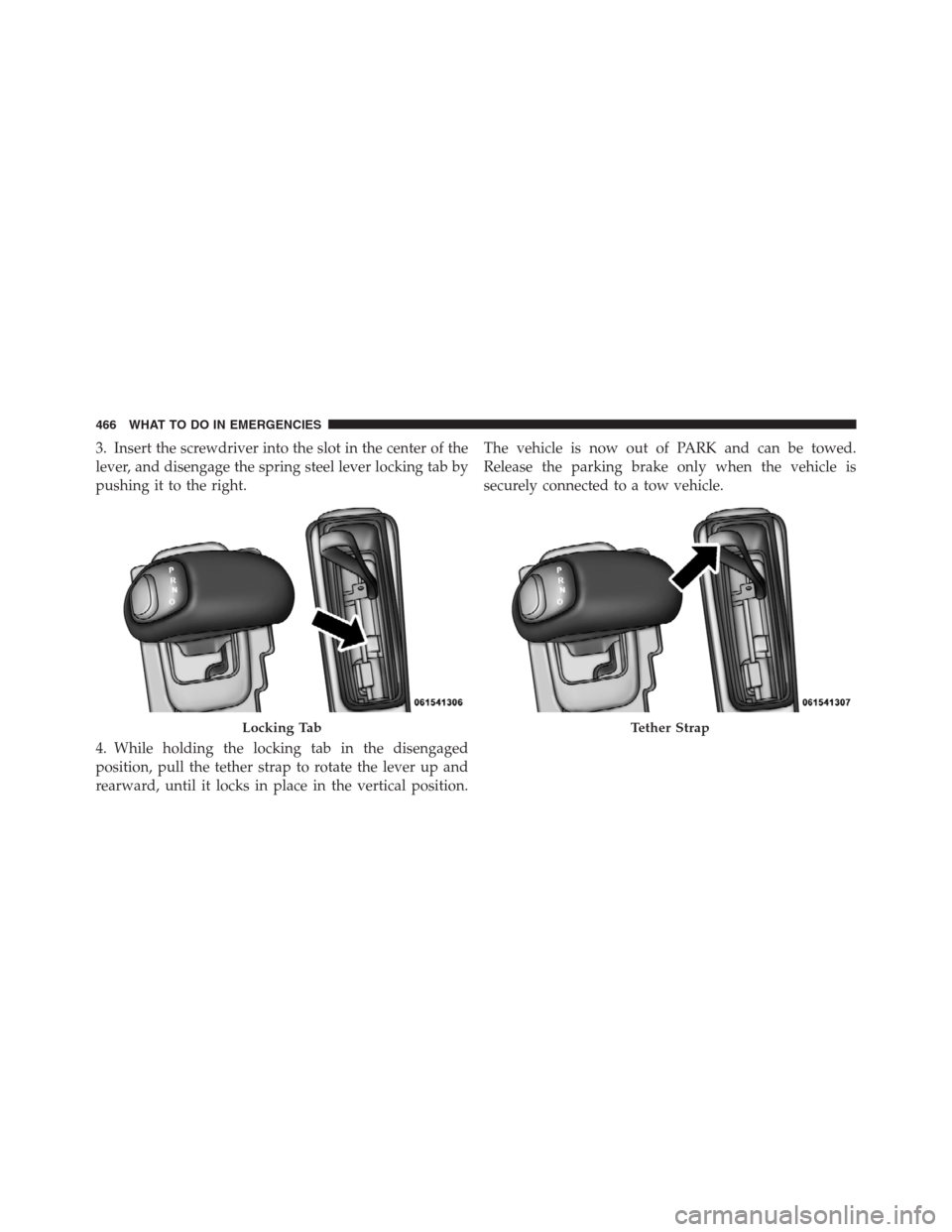
3. Insert the screwdriver into the slot in the center of the
lever, and disengage the spring steel lever locking tab by
pushing it to the right.
4. While holding the locking tab in the disengaged
position, pull the tether strap to rotate the lever up and
rearward, until it locks in place in the vertical position.The vehicle is now out of PARK and can be towed.
Release the parking brake only when the vehicle is
securely connected to a tow vehicle.
Locking TabTether Strap
466 WHAT TO DO IN EMERGENCIES
Page 469 of 576
To Reset The Manual Park Release:
1. Push the latch (at the base of the lever, on the rear side)
rearward (away from the lever) to unlatch the lever.
2. Rotate the Manual Park Release lever forward and
down, to its original position, until the locking tab snaps
into place to secure the lever.3. Pull up gently on the tether strap to confirm that the
lever is locked in its stowed position.
4. Tuck the tether strap into the base of the console.
Reinstall the console storage bin.
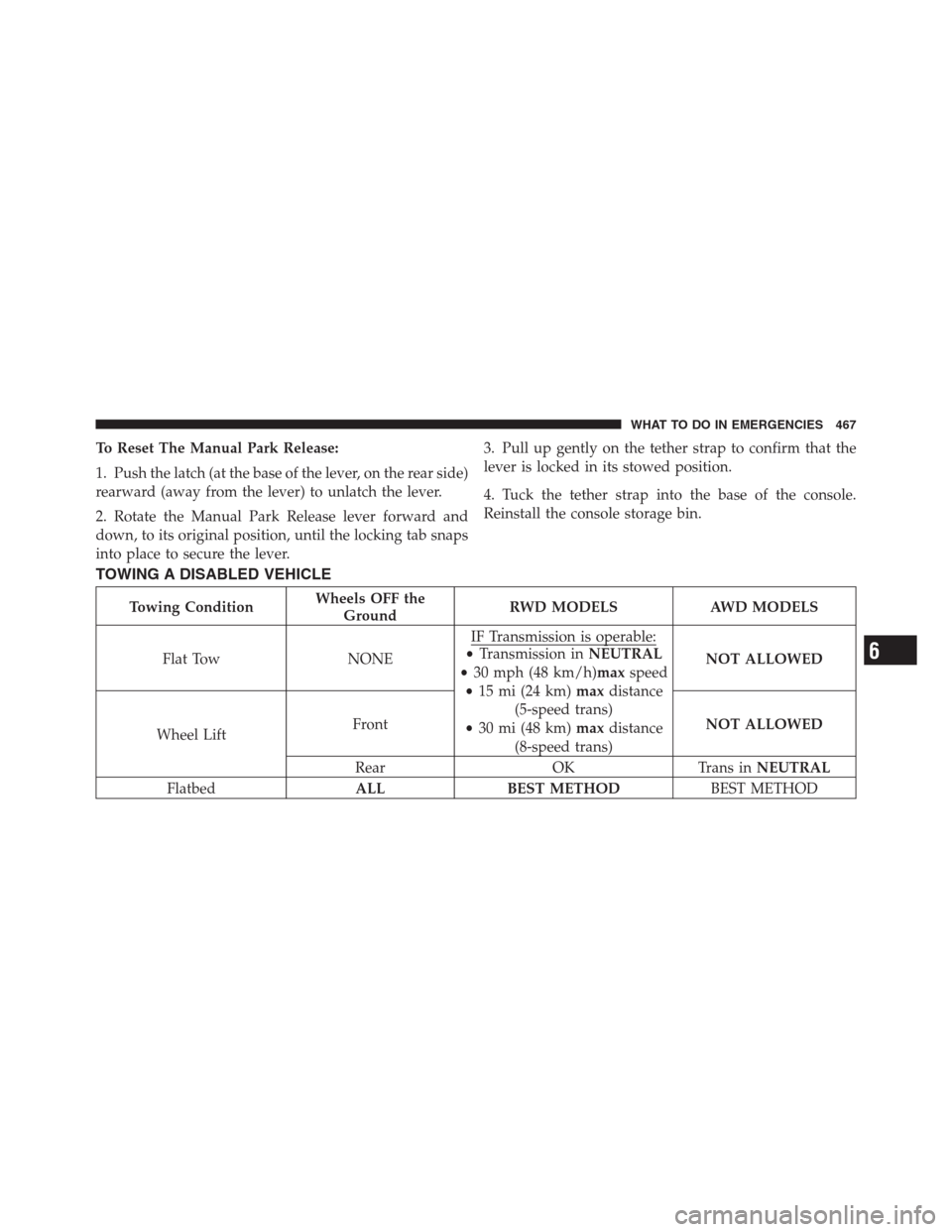
TOWING A DISABLED VEHICLE
Towing ConditionWheels OFF the
GroundRWD MODELS AWD MODELS
Flat Tow NONEIF Transmission is operable:
•Transmission inNEUTRAL
•30 mph (48 km/h)maxspeed
•15 mi (24 km)maxdistance
(5-speed trans)
•30 mi (48 km)maxdistance
(8-speed trans)NOT ALLOWED
Wheel LiftFrontNOT ALLOWED
Rear OK Trans inNEUTRAL
FlatbedALL BEST METHODBEST METHOD6
WHAT TO DO IN EMERGENCIES 467
Page 470 of 576
Proper towing or lifting equipment is required to prevent
damage to your vehicle. Use only tow bars and other
equipment designed for the purpose, following equip-
ment manufacturer ’s instructions. Use of safety chains is
mandatory. Attach a tow bar or other towing device to
main structural members of the vehicle, not to bumpers
or associated brackets. State and local laws applying to
vehicles under tow must be observed.
If you must use the accessories (wipers, defrosters, etc.)
while being towed, the ignition must be in the ON/RUN
position, not the ACC position.
If the vehicle’s battery is discharged, see “Manual Park
Release” or “Shift Lever Override” in “What To Do In
Emergencies” for instructions on shifting the automatic
transmission out of the PARK position for towing.CAUTION!
•Do not use sling type equipment when towing.
Damage to the fascia will occur.
•When securing the vehicle to a flatbed truck, do
not attach to the front or rear suspension compo-
nents. Damage to your vehicle may result from
improper towing.
•Do not push or tow this vehicle with another
vehicle as damage to the bumper fascia and trans-
mission may result.
•The manufacturer does not recommend that you
tow this vehicle on a tow dolly. Vehicle damage
may occur.
Flatbed towing is recommended.DO NOTtow an AWD
vehicle with the rear wheels on the ground.
468 WHAT TO DO IN EMERGENCIES
Page 501 of 576
WARNING! (Continued)
•To avoid contamination from foreign matter or
moisture, use only new brake fluid or fluid that
has been in a tightly closed container. Keep the
master cylinder reservoir cap secured at all times.
Brake fluid in a open container absorbs moisture
from the air resulting in a lower boiling point.
This may cause it to boil unexpectedly during hard
or prolonged braking, resulting in sudden brake
failure. This could result in a collision.
•Overfilling the brake fluid reservoir can result in
spilling brake fluid on hot engine parts, causing
the brake fluid to catch fire. Brake fluid can also
damage painted and vinyl surfaces, care should be
taken to avoid its contact with these surfaces.
(Continued)
WARNING! (Continued)
•Do not allow petroleum based fluid to contami-
nate the brake fluid. Brake seal components could
be damaged, causing partial or complete brake
failure. This could result in a collision.
Use only brake fluid that has been in a tightly closed
container to avoid contamination from foreign matter or
moisture.
Automatic Transmission
Selection Of Lubricant
It is important that the proper lubricant is used in the
transmission to assure optimum transmission perfor-
mance. Use only manufacturer ’s recommended transmis-
sion fluid. Refer to “Fluids, Lubricants, and Genuine
Parts” in “Maintaining Your Vehicle” for further informa-
tion. It is important that the transmission fluid be main-
tained at the prescribed level using the recommended7
MAINTAINING YOUR VEHICLE 499
Page 511 of 576
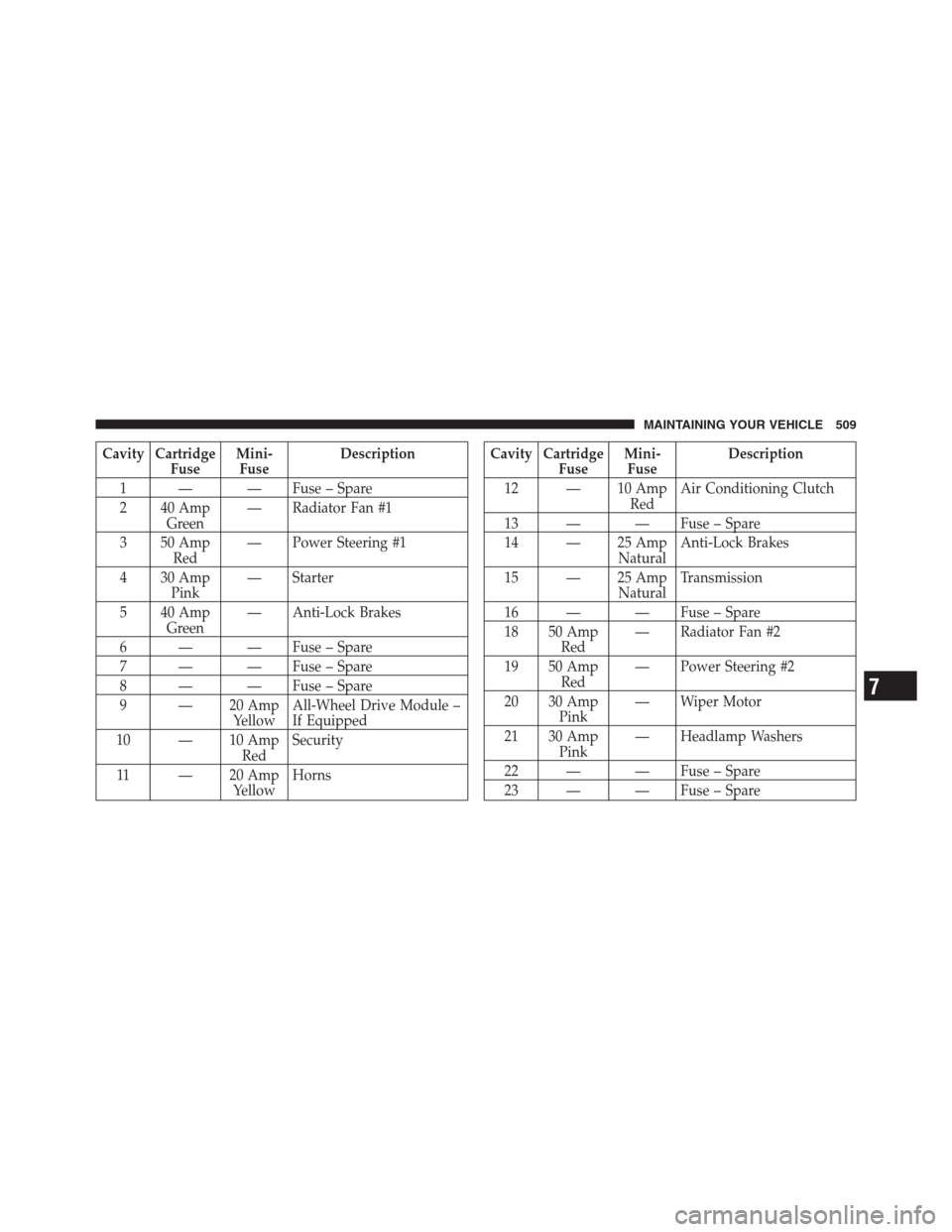
Cavity Cartridge
FuseMini-
FuseDescription
1 — — Fuse – Spare
2 40 Amp
Green— Radiator Fan #1
3 50 Amp
Red— Power Steering #1
4 30 Amp
Pink— Starter
5 40 Amp
Green— Anti-Lock Brakes
6 — — Fuse – Spare
7 — — Fuse – Spare
8 — — Fuse – Spare
9 — 20 Amp
YellowAll-Wheel Drive Module –
If Equipped
10 — 10 Amp
RedSecurity
11 — 20 Amp
YellowHornsCavity Cartridge
FuseMini-
FuseDescription
12 — 10 Amp
RedAir Conditioning Clutch
13 — — Fuse – Spare
14 — 25 Amp
NaturalAnti-Lock Brakes
15 — 25 Amp
NaturalTransmission
16 — — Fuse – Spare
18 50 Amp
Red— Radiator Fan #2
19 50 Amp
Red— Power Steering #2
20 30 Amp
Pink— Wiper Motor
21 30 Amp
Pink— Headlamp Washers
22 — — Fuse – Spare
23 — — Fuse – Spare
7
MAINTAINING YOUR VEHICLE 509